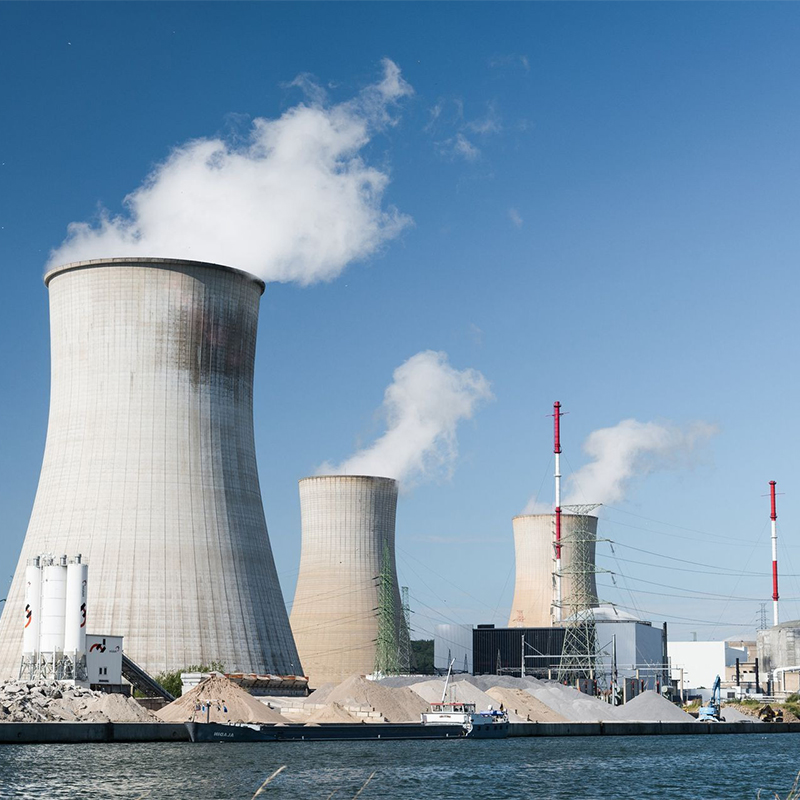
We Provide Cooling Tower Solution

Views: 0 Author: Cindy Publish Time: 2026-09-20 Origin: Site


When an industrial facility needs reliable heat rejection, a cooling tower is much more than another piece of equipment. It is a critical part of the plant's thermal management system.
From power generation and chemical processing to steel, petroleum, plastics, pharmaceuticals, and large-scale HVAC systems, industrial processes generate huge amounts of waste heat. That heat needs to be removed continuously and efficiently. This is where water cooling towers come in.
Choosing among water cooling towers manufacturers therefore requires more than comparing prices. Buyers need to consider cooling capacity, water flow, wet-bulb temperature, approach temperature, construction materials, fan efficiency, fill design, maintenance requirements, spare parts, customization, and long-term operating costs.
In this guide, we compare eight manufacturers that are relevant to industrial cooling applications:
SPX Cooling Tech
Baltimore Aircoil Company (BAC)
EVAPCO
Delta Cooling Towers
Tower Tech
Paharpur Cooling Towers
Thermax
Mach Industry (Zhejiang) Co., Ltd.
The list is an editorial industry comparison rather than an official market-share ranking. Each manufacturer has different products, engineering capabilities, materials, and application strengths. The goal is to help industrial buyers understand the market and identify the factors that matter when selecting a cooling tower manufacturer.
Industrial equipment produces heat almost everywhere.
Think about a steel mill, chemical plant, refinery, power station, plastic injection molding facility, or large manufacturing plant. Many of these operations run continuously, sometimes around the clock.
Where does the heat go?
In many systems, process heat is transferred into circulating water. The heated water then travels to a cooling tower, where heat is rejected to the atmosphere through evaporation and sensible heat transfer.
The basic principle sounds simple, but industrial cooling can become highly complex.
A cooling tower must operate under specific water flow rates, temperatures, ambient conditions, and load variations. A tower that looks suitable on paper may perform poorly if the design conditions are incorrect.
That is why choosing experienced water cooling towers manufacturers is important.
The manufacturer should understand not only how to build a tower but also how the tower interacts with pumps, heat exchangers, chillers, process equipment, piping, water treatment systems, and the surrounding environment.
Not every cooling tower manufacturer is suitable for every industrial project.
A supplier specializing in commercial HVAC systems may not be the right choice for an aggressive chemical-processing environment. Similarly, a company experienced in massive field-erected towers may not be the most economical option for a compact factory installation.
Several factors should be evaluated before making a purchasing decision.
The first question is simple:
Can the cooling tower remove the required amount of heat under the actual design conditions?
Industrial buyers should look beyond a basic cooling tower tonnage number.
Important design parameters include:
Heat load
Circulating-water flow rate
Entering-water temperature
Leaving-water temperature
Design wet-bulb temperature
Approach temperature
Fan power
Number of cells
Seasonal operating conditions
A professional manufacturer should be able to provide technical data based on the customer's actual operating conditions.
A broad product range can give buyers greater flexibility.
Depending on the application, manufacturers may offer:
Crossflow cooling towers
Counterflow cooling towers
Open-circuit cooling towers
Closed-circuit cooling towers
Factory-assembled towers
Field-erected towers
Hybrid cooling systems
Adiabatic cooling systems
Natural-draft cooling towers
There is no universal "best" cooling tower configuration. The right design depends on the project.
Construction materials can have a major effect on service life.
Cooling towers may use galvanized steel, stainless steel, FRP, HDPE, or combinations of different materials.
The correct choice depends on water chemistry, ambient conditions, temperature, corrosion risk, structural requirements, and maintenance expectations.
For example, engineered plastics can provide an attractive solution in environments where corrosion is a significant concern.
Industrial projects rarely fit perfectly into a standard catalog.
Maybe the installation area is narrow. Perhaps the plant has a high design wet-bulb temperature. Maybe the water contains suspended solids or aggressive chemicals.
There could also be requirements for:
Low noise
High altitude
Seismic conditions
Special materials
Unusual piping arrangements
High-temperature operation
Multiple cooling cells
Future expansion
A manufacturer with strong engineering capabilities can adapt the cooling tower to these conditions rather than forcing the project into a standard configuration.
A cooling tower is a long-term investment.
The purchase order is only the beginning.
Before buying, ask about the availability of:
Fill
Drift eliminators
Nozzles
Fan blades
Motors
Gearboxes
Bearings
Pumps
Valves
Replacement components
Technical support
A cooling tower may operate for many years, so spare-parts availability can be just as important as the initial quotation.
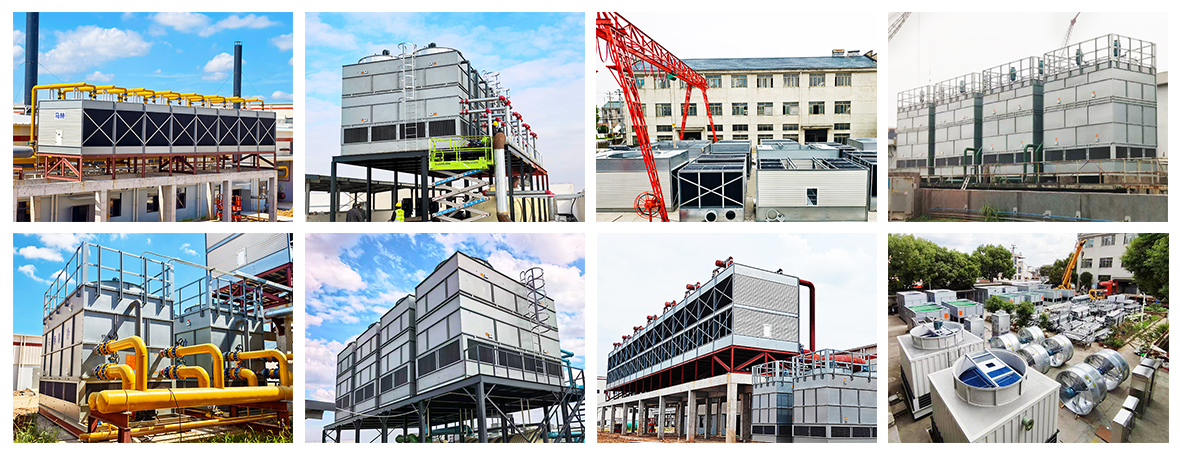
SPX Cooling Tech is one of the established names in the global cooling industry.
Its portfolio includes the Marley, Recold, and SGS brands, covering cooling towers, fluid coolers, evaporative condensers, air-cooled heat exchangers, and related aftermarket solutions.
SPX Cooling Tech serves HVAC, refrigeration, and industrial process cooling applications.
SPX offers different cooling tower configurations, including crossflow and counterflow designs as well as factory-assembled and field-erected systems.
The Marley portfolio is particularly well known in industrial and commercial cooling applications.
Depending on the project, buyers can consider factory-assembled cooling towers for relatively standardized applications or larger field-erected systems for demanding industrial installations.
Industrial applications can include:
Power generation
Refining
Manufacturing
Compressor cooling
Process cooling
Chemical processing
Large HVAC systems
For large industrial facilities, the broad portfolio can be useful when different cooling requirements need to be addressed within the same project.
Baltimore Aircoil Company, commonly known as BAC, is another major manufacturer in the evaporative cooling industry.
BAC produces a broad range of cooling towers and heat-transfer equipment for industrial and commercial applications.
Its portfolio includes crossflow and counterflow cooling towers, modular systems, and closed-circuit equipment.
BAC's product range provides different configurations for different cooling requirements.
Its Series 3000 cooling tower, for example, uses crossflow, axial-fan, induced-draft technology and is available across a broad capacity range.
Other BAC products address counterflow applications, industrial cooling, closed-circuit cooling, and replacement projects.
For industrial buyers, this range provides flexibility when selecting a configuration based on:
Required capacity
Footprint
Water quality
Maintenance access
Installation conditions
Process-fluid requirements
Closed-circuit systems can also be useful when the process fluid needs to remain separated from the evaporative water loop.
EVAPCO is a global manufacturer specializing in evaporative cooling, industrial refrigeration, and heat-transfer equipment.
Its markets include commercial HVAC, industrial process cooling, data centers, industrial refrigeration, and power generation.
EVAPCO offers several cooling tower configurations.
The AT series uses induced-draft counterflow technology and covers a broad range of capacities.
The AXS series uses induced-draft crossflow technology, providing another option for industrial and commercial cooling applications.
EVAPCO also offers lower-profile cooling tower designs for projects where height or sound considerations create installation challenges.
EVAPCO is particularly relevant for projects that require more than a basic open cooling tower.
Its wider portfolio includes:
Open cooling towers
Closed-circuit coolers
Evaporative condensers
Heat-transfer equipment
Industrial refrigeration equipment
This can be useful when engineers want to compare several evaporative heat-rejection approaches within one product ecosystem.
Delta Cooling Towers takes a different approach from manufacturers that primarily rely on conventional metallic tower structures.
The company specializes in engineered-plastic cooling towers, particularly HDPE construction.
Corrosion can be a serious issue in industrial cooling systems.
Imagine installing conventional metal equipment in an environment where water chemistry constantly attacks the material. Over time, corrosion can increase maintenance requirements and shorten component life.
HDPE offers another approach.
Engineered-plastic construction can provide strong corrosion resistance and can be particularly interesting for industrial environments with demanding water conditions.
Delta's cooling tower portfolio includes large-capacity industrial models and systems designed around engineered-plastic construction.
HDPE cooling towers may be worth considering for:
Industrial process cooling
Chemical facilities
Manufacturing plants
Corrosive environments
Facilities seeking reduced corrosion-related maintenance
However, buyers should still evaluate the complete system, including thermal performance, structural requirements, fan efficiency, fill design, and operating conditions.
Tower Tech is a U.S. cooling tower manufacturer serving HVAC, industrial, and utility applications.
Its systems are associated with a factory-assembled modular approach.
Modular equipment can provide practical benefits in projects where installation time matters.
Instead of constructing a large system entirely on site, factory-assembled modules can reduce field installation work.
This approach may be attractive when:
Plant shutdown time is limited
Site labor is expensive
Access is restricted
Replacement equipment must be installed quickly
A project needs modular capacity
The key consideration is whether the standard modular configuration meets the project's actual thermal requirements.
Paharpur Cooling Towers is an India-based cooling technology company with a long history in industrial cooling.
Its portfolio covers wet and dry cooling technologies and serves industries such as power generation, oil and gas, metals, chemicals, cement, and pharmaceuticals.
Paharpur provides factory-assembled cooling towers as well as larger industrial cooling systems.
Its broader portfolio also includes natural-draft cooling towers and dry cooling technologies.
This makes the company relevant to projects where the cooling system needs to be considered as part of a larger power or process plant rather than as an isolated piece of equipment.
For large industrial projects, engineering integration can be especially important.
Thermax is an international engineering company with a broad thermal-management portfolio.
Its cooling solutions include closed-loop cooling towers, hybrid cooling towers, adiabatic cooling towers, evaporative condensers, and air-cooled heat exchangers.
Closed-loop cooling towers can be useful when process fluids need to remain separated from the evaporative cooling-water circuit.
This approach can help protect sensitive process fluids from contamination while transferring heat through a heat-exchange coil.
Thermax also provides adiabatic and hybrid cooling solutions for applications where water consumption, ambient conditions, and energy efficiency need to be balanced.
Its potential applications include:
Manufacturing
Pharmaceuticals
Data centers
Power generation
Industrial process cooling
HVAC
For projects with complex thermal requirements, this broader portfolio gives engineers additional design options.
Mach Industry (Zhejiang) Co., Ltd. is a China-based cooling tower manufacturer serving industrial and commercial customers.
Mach provides cooling tower solutions for applications including central air conditioning, sugar production, power generation, petroleum, smelting, printing and dyeing, and other industrial processes.
Its product portfolio covers several major cooling tower configurations.
Mach offers:
Counterflow industrial cooling towers
Crossflow industrial cooling towers
Counterflow open cooling towers
Crossflow open cooling towers
Closed-circuit cooling towers
Counterflow closed cooling towers
Crossflow closed cooling towers
Mixed-flow closed cooling towers
According to Mach's product information, cooling tower capacities range from approximately 3 tons to 5,000 tons per cell, with multi-cell configurations available for larger projects.
This range allows Mach to serve both relatively compact industrial requirements and larger cooling systems.
For international buyers, working directly with a manufacturer in China can provide another sourcing option.
But smart procurement is not simply about finding the lowest price.
A serious comparison should examine:
Thermal performance
Cooling capacity
Construction materials
Fan efficiency
Fill design
Water distribution
Motor quality
Gearbox quality
Manufacturing quality
Factory inspection
Packaging
Shipping
Installation support
Spare parts
Warranty
In other words, the cheapest cooling tower is not necessarily the cheapest cooling solution.
A cooling tower operates for years. Its purchase price is only one chapter in the story.
| Manufacturer | Main Strength | Typical Industrial Applications | Product Approach |
|---|---|---|---|
| SPX Cooling Tech | Broad industrial cooling portfolio | Power, refining, manufacturing, process cooling | Crossflow, counterflow, factory-assembled and field-erected |
| BAC | Broad evaporative cooling portfolio | Industrial, HVAC, large facilities | Crossflow, counterflow and closed circuit |
| EVAPCO | Wide heat-transfer portfolio | Industrial process, power, data centers | Counterflow, crossflow, modular and closed circuit |
| Delta Cooling Towers | Engineered-plastic construction | Industrial and corrosion-sensitive applications | HDPE cooling towers |
| Tower Tech | Factory-assembled modular approach | HVAC, industrial and utility | Modular packaged systems |
| Paharpur | Broad global cooling portfolio | Power, chemical, cement, metals, oil & gas | Wet, dry and natural-draft systems |
| Thermax | Integrated thermal solutions | Manufacturing, pharmaceuticals, power, process cooling | Closed-loop, hybrid and adiabatic |
| Mach Industry | Flexible industrial cooling solutions | Power, petroleum, smelting, manufacturing, HVAC | Open, closed, crossflow and counterflow |
So, how should an industrial buyer actually make the decision?
Start with the application rather than the brand.
Before requesting quotations, determine the actual heat rejection requirement.
Important information includes:
Heat load
Water circulation rate
Hot-water temperature
Cold-water temperature
Design wet-bulb temperature
Required approach
Site elevation
Operating hours
Seasonal conditions
A manufacturer cannot properly size a cooling tower without reliable design information.
A cooling tower's price tag does not tell the entire story.
Consider this simple formula:
Total Cost of Ownership = Initial Cost + Energy + Water + Chemicals + Maintenance + Downtime
A tower that costs less initially may consume more electricity or require more frequent maintenance.
Over ten or fifteen years, those operating costs can become much larger than the original price difference.
Water quality is one of the most frequently underestimated factors.
Industrial cooling water may contain:
Suspended solids
Minerals
Oil
Biological contaminants
Chemicals
High concentrations of dissolved solids
These conditions affect fill selection, nozzle design, water distribution, blowdown, material selection, and cleaning frequency.
For example, a high-efficiency film fill may provide excellent heat-transfer performance under clean-water conditions, but a heavily contaminated water system may require a more clog-resistant approach.
The best solution is always application-specific.
Before signing a purchase order, ask:
What happens five years from now?
Can the manufacturer supply replacement fill?
What about motors, fans, nozzles, bearings, gearboxes, or drift eliminators?
How quickly can parts be delivered?
Is technical support available?
These questions may seem boring during procurement, but they become very important when equipment needs maintenance during a production schedule.
Price is important, but it should not be the only deciding factor.
A low-cost tower with poor efficiency can increase operating expenses year after year.
Cooling tower performance depends heavily on ambient wet-bulb temperature.
A tower designed for one climate cannot automatically be expected to provide identical performance in another.
Always provide the actual site design conditions.
A cooling tower is constantly exposed to water.
If the water chemistry is aggressive, unsuitable materials can create corrosion and maintenance problems.
Material selection should therefore be part of the initial design process.
Industrial plants often expand.
If production capacity may increase in the future, consider whether the cooling system can support additional cells or modular expansion.
Planning ahead can be much cheaper than replacing an undersized cooling system later.
Two towers with the same nominal cooling capacity can have very different:
Footprints
Fan power
Noise levels
Maintenance requirements
Water consumption
Material configurations
Installation costs
The capacity number is important, but it is only the starting point.
The global market for water cooling towers manufacturers is diverse.
SPX Cooling Tech provides a broad portfolio covering industrial process cooling and large-scale systems. BAC and EVAPCO offer extensive evaporative cooling portfolios. Delta Cooling Towers focuses on engineered-plastic and HDPE construction. Tower Tech emphasizes modular factory-assembled systems. Paharpur offers a broad wet and dry cooling portfolio, while Thermax combines cooling technologies with wider thermal-management solutions.
Mach Industry (Zhejiang) Co., Ltd. provides another option for international buyers looking for a China-based cooling tower manufacturer. Its portfolio includes industrial, open, closed, crossflow, and counterflow cooling tower solutions.
The right manufacturer ultimately depends on your specific project.
What is the heat load?
What is the design wet-bulb temperature?
What is the water quality?
How much space is available?
Is corrosion a concern?
Does the project require open or closed cooling?
How important are energy efficiency and water conservation?
How quickly must replacement parts be available?
Answer these questions first, and the manufacturer comparison becomes much easier.
The right cooling tower is not simply the one with the largest capacity or lowest quotation. It is the one that fits the entire cooling system and continues to deliver reliable performance throughout its operating life.
Water cooling towers manufacturers are companies that design and produce cooling equipment used to reject heat from circulating water or process fluids. Their products can include open-circuit, closed-circuit, crossflow, counterflow, factory-assembled, and field-erected cooling towers.
Industrial water cooling towers are widely used in power generation, chemical processing, petroleum, petrochemical, steel, metals, plastics, food processing, pharmaceuticals, manufacturing, data centers, and large HVAC systems.
In a crossflow cooling tower, air generally moves horizontally across the falling water.
In a counterflow cooling tower, air moves upward while water flows downward.
The appropriate configuration depends on the project's thermal requirements, available space, water conditions, maintenance preferences, and overall system design.
Yes. Mach Industry (Zhejiang) Co., Ltd. is a China-based cooling tower manufacturer. Its product portfolio includes industrial, open, and closed cooling towers in crossflow and counterflow configurations.
Buyers should compare more than the purchase price. Key factors include thermal performance, construction materials, fan efficiency, fill design, water distribution, manufacturing quality, delivery time, spare parts, warranty, technical documentation, and after-sales support.
Both options can be suitable.
A local manufacturer may offer logistical or service advantages, while an overseas manufacturer may provide different combinations of customization, manufacturing capacity, engineering experience, and pricing.
The best approach is to compare the complete project cost and technical requirements rather than focusing on location alone.
A manufacturer normally needs information such as heat load, water flow rate, entering-water temperature, leaving-water temperature, design wet-bulb temperature, site location, water quality, cooling tower type, available installation space, and any special operating requirements.
Mach Industry (Zhejiang) Co., Ltd. provides industrial and commercial cooling tower solutions through its official website, https://www.machcooling.com.
For international buyers comparing water cooling towers manufacturers, Mach can be considered alongside other global suppliers according to the project's technical requirements, budget, customization needs, and long-term operating strategy.