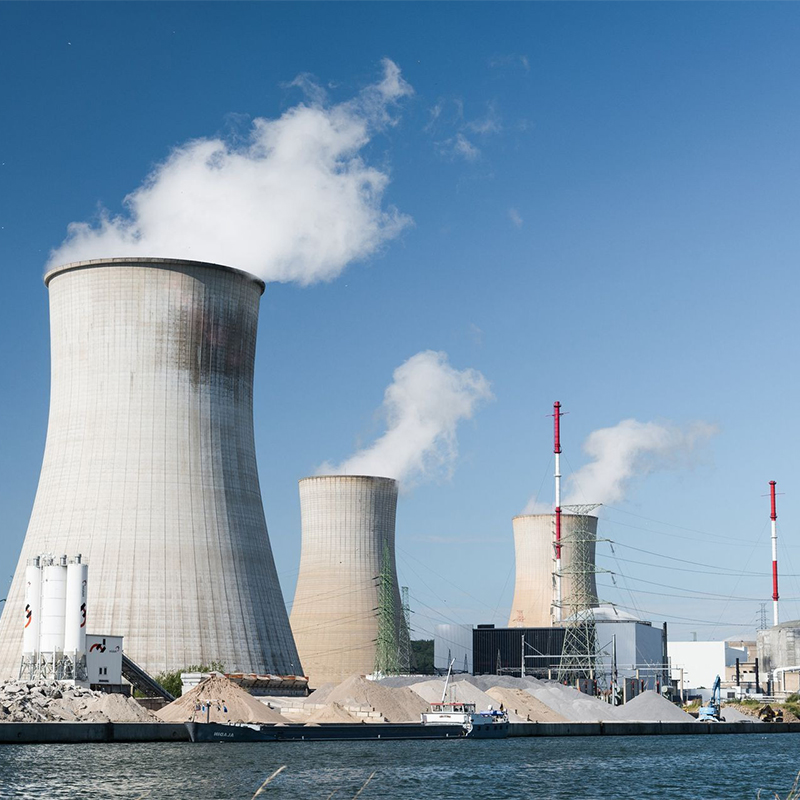
We Provide Cooling Tower Solution

Views: 0 Author: Cindy Publish Time: 2026-10-29 Origin: Site


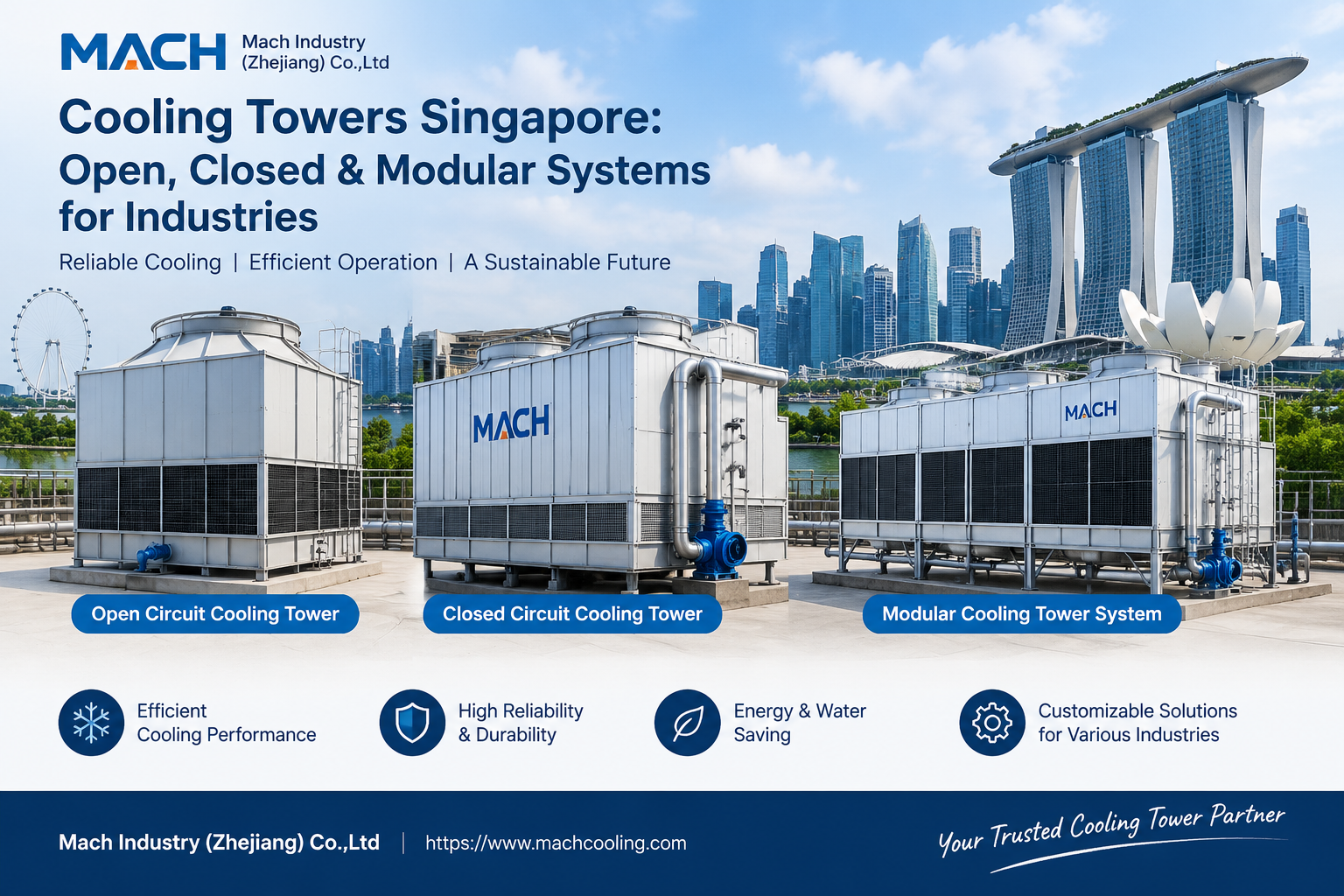
Singapore’s industrial and commercial facilities depend on reliable cooling to keep equipment operating safely and efficiently. From manufacturing plants and data centers to commercial buildings and process industries, effective heat rejection is essential for stable operations. But which cooling system should you choose? An open circuit cooling tower, a closed circuit cooling tower, or a modular cooling tower system?
Each option offers different benefits in terms of cooling performance, water management, maintenance, and installation flexibility. In Singapore’s hot and humid climate, selecting the right equipment requires careful attention to design conditions, water quality, available space, and operating costs.
In this guide, we explain how these cooling tower systems work, compare their advantages, and outline what industrial buyers should consider when choosing a cooling tower. We also introduce Mach Industry (Zhejiang) Co.,Ltd, a cooling tower manufacturer that can help buyers explore suitable industrial cooling solutions.
Singapore is an important regional hub for manufacturing, commercial property, logistics, technology, and industrial services. Many of these operations generate heat that must be removed continuously. Cooling towers help transfer this heat from circulating water into the atmosphere, supporting equipment such as chillers, heat exchangers, compressors, and industrial process systems.
Choosing a cooling tower is not simply a matter of selecting a model with the right capacity. Buyers also need to consider local operating conditions, building restrictions, maintenance access, water consumption, energy costs, and the consequences of unplanned downtime.
A system that performs well in one facility may not be the best fit for another. Understanding your actual cooling requirements is the first step toward selecting a reliable solution.
Industrial equipment generates heat during operation. If that heat cannot be removed effectively, temperatures may rise, equipment efficiency may decline, and components may experience unnecessary stress.
A properly selected cooling tower helps maintain stable process temperatures and supports the performance of connected cooling equipment. For manufacturers, this can mean more predictable production. For commercial buildings, it can help maintain dependable air-conditioning performance.
For facilities operating continuously, reliability is especially important. An unexpected cooling interruption can affect production schedules, equipment availability, and operating costs. That is why cooling tower selection should consider both performance and long-term maintenance requirements.
Singapore has a warm, humid tropical climate throughout the year. Cooling tower performance depends partly on the entering air’s wet-bulb temperature, not just its dry-bulb temperature.
When humidity is high, the difference between dry-bulb and wet-bulb temperatures may be relatively small, limiting the potential for evaporative cooling. As a result, accurate local design data is essential when selecting a cooling tower.
Engineers should consider the design wet-bulb temperature, required cold-water temperature, heat load, water flow, and available installation space. A tower selected only by nominal tonnage may not deliver the expected performance under actual site conditions.
An industrial cooling tower is a heat-rejection device that cools warm circulating water by bringing it into contact with air. In a typical evaporative tower, a small portion of the water evaporates, removing heat from the remaining water.
The cooled water then returns to connected equipment to absorb more heat. Cooling towers are commonly used with water-cooled chillers, industrial heat exchangers, production equipment, and other systems that need to reject heat continuously.
Actual performance depends on several factors, including tower design, water flow, entering-air conditions, fill configuration, airflow, and operating temperatures.
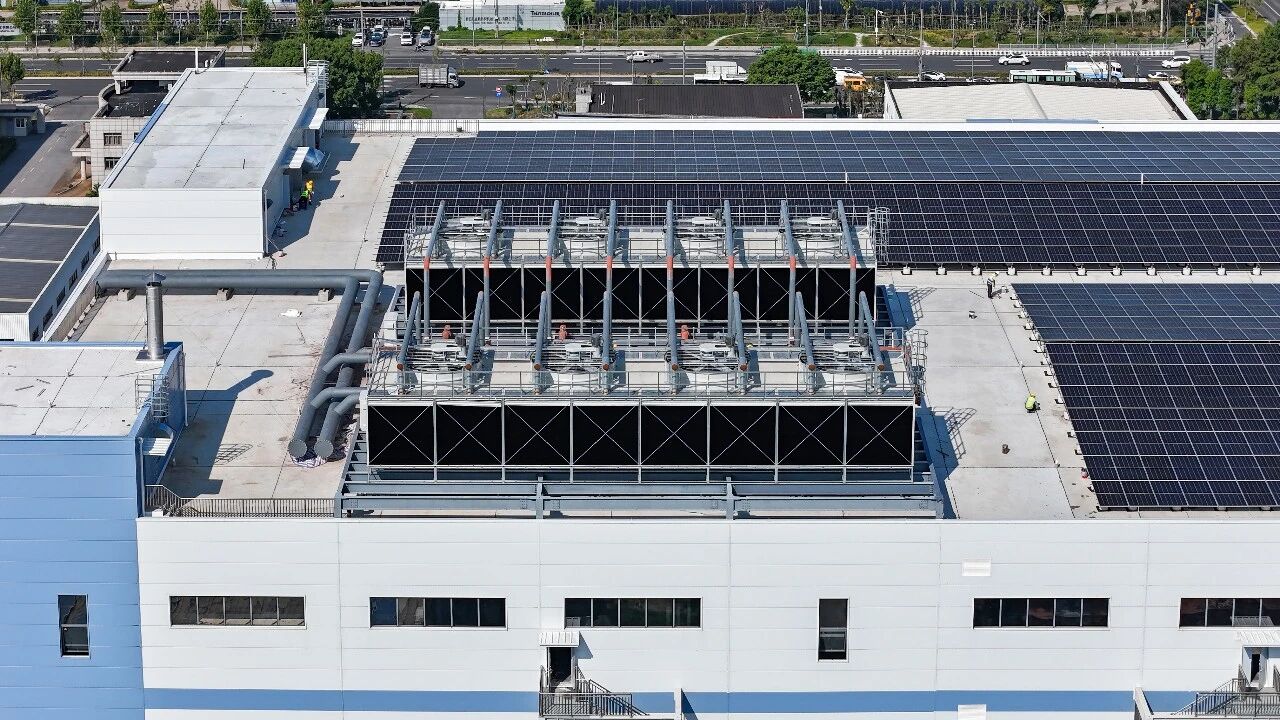
Imagine warm water spreading over a large surface while air moves through the tower. The increased contact between air and water encourages heat and mass transfer.
Fill media improves this process by distributing water into thin films or droplets, increasing the effective contact area. Fans may provide or assist airflow, while drift eliminators reduce the amount of water droplets carried out with the exhaust air.
The cooled water collects in a basin or suitable collection system and returns to the process. Because evaporation concentrates dissolved minerals in the remaining water, water treatment and blowdown management are important parts of routine operation.
An open circuit cooling tower allows the process water itself to contact the air directly. Warm water enters the tower, flows across the fill or distribution surfaces, and is cooled through evaporative heat transfer. The cooled water is collected and returned to the system.
Open circuit cooling towers are widely used because their design is relatively straightforward and they can provide effective cooling for many industrial and commercial applications.
They are often a practical option when the circulating water can be treated appropriately and direct exposure to air does not create unacceptable contamination risks.
Water enters the tower through a distribution system that spreads it over the fill media. Air passes through the tower in a crossflow or counterflow arrangement, depending on the design.
Heat transfers from the water to the air, while evaporation removes additional heat. The fan and air-distribution design must provide sufficient airflow without excessive energy consumption.
The cooled water then returns to the connected equipment. Since the circulating water is exposed to the atmosphere, it may collect airborne dust and other contaminants. Regular inspection, filtration where appropriate, and effective water treatment help keep the system operating reliably.
Open circuit towers can offer an attractive balance of cooling performance, equipment simplicity, and initial cost. They are suitable for many conventional cooling-water applications and are available in different capacities and configurations.
Their main benefits include:
A relatively straightforward system design.
Effective heat rejection for many industrial applications.
Compatibility with a wide range of conventional cooling-water systems.
A broad choice of tower sizes and configurations.
Established maintenance and water-treatment practices.
However, open circuit towers also have limitations. Direct air-water contact means the circulating water is more exposed to environmental contamination. Scale, corrosion, sediment, and biological growth can develop if water chemistry and maintenance are poorly controlled.
Evaporation and blowdown also create ongoing water-management requirements. Buyers should evaluate the complete operating cost rather than focusing only on the purchase price.
Open circuit cooling towers are commonly used with water-cooled chillers, HVAC systems, industrial compressors, manufacturing processes, and heat exchangers where direct-contact cooling water is acceptable.
They can be a practical choice for facilities with established water-treatment programs and sufficient room for routine cleaning and maintenance.
Before selecting this type, confirm that the process can tolerate the water quality associated with an open system. If the circulating fluid must remain isolated from the atmosphere, a closed circuit design may be more suitable.
A closed circuit cooling tower keeps the process fluid inside a coil or heat exchanger rather than allowing it to contact the air directly.
Heat passes from the process fluid through the coil wall to a secondary water-and-air system. In many evaporative closed circuit designs, spray water flows over the coil while air passes through the unit, removing heat through evaporation and sensible heat transfer.
This arrangement helps protect the process fluid from direct environmental exposure and can reduce contamination-related problems in applications where fluid cleanliness is important.

Warm process fluid enters the internal coil and transfers heat through the coil surface. Meanwhile, spray water is distributed over the coil and air flows through the tower.
Heat is released to the atmosphere, allowing the process fluid to leave at a lower temperature. The process fluid remains within the closed loop, although the external spray-water circuit still requires suitable treatment and maintenance.
Actual performance depends on the coil design, spray-water distribution, airflow, fluid properties, and design ambient conditions.
The main advantage of a closed circuit cooling tower is separation between the process fluid and the external environment. This can help reduce contamination, protect sensitive equipment, and maintain the quality of the circulating fluid.
Depending on the application, a closed circuit system may also reduce the need to clean or replace process fluid because of external contamination.
These benefits can be particularly valuable for specialized manufacturing processes or systems with strict fluid-quality requirements.
However, closed circuit towers generally involve more complex construction and may have a higher initial cost than comparable open circuit units. The external spray-water system also requires regular inspection and appropriate water treatment.
Consider a closed circuit tower when process-fluid cleanliness is important, when contamination could damage connected equipment, or when the process requires a dedicated closed loop.
It may also be appropriate when fluid replacement or cleaning would be expensive or disruptive.
Before deciding, compare the cost of the coil-based unit with the expected benefits over its service life. The right choice depends on the fluid, required cooling temperature, site conditions, maintenance strategy, and total cost of ownership—not simply on whether a closed system appears more advanced.
A modular cooling tower system uses multiple cooling cells or units that work together to meet a facility’s heat-rejection requirements.
Instead of relying on one large unit, a project can use several coordinated modules. This approach can simplify capacity planning, provide operational flexibility, and support future expansion.
It is important to understand that modular describes the system arrangement rather than a separate heat-transfer method. Modular systems may use open circuit or closed circuit cooling tower designs.
Modular towers can be useful when a facility has limited installation space or needs to coordinate cooling equipment with existing infrastructure.
Individual modules can be arranged to suit the available footprint, subject to airflow clearances, structural requirements, piping access, and maintenance space. Factory-built components may also help simplify transportation and site installation.
However, the actual footprint depends on the number and dimensions of the modules, the required capacity, and the site layout. Proper engineering is necessary to avoid airflow recirculation, restricted access, and maintenance difficulties.
Multiple modules can operate together to provide the required cooling capacity. Depending on the controls and system design, individual cells may be staged to match changing heat loads. This can help avoid running every unit at full capacity during periods of lower demand.
Modular systems can also make future expansion easier if the original design allows additional units to be connected.
Buyers should confirm how pumps, headers, controls, isolation valves, and standby capacity will be arranged before installation. Adding modules later is easiest when future expansion has been considered from the beginning.
The best option depends on the application rather than the name of the cooling technology.
Open circuit towers are often attractive for conventional cooling-water systems where direct contact with air is acceptable. Closed circuit towers are useful when process-fluid isolation is a priority. Modular arrangements are valuable when flexibility, phased installation, or capacity expansion matters.
The following comparison provides a starting point for industrial buyers.
| Factor | Open Circuit Cooling Tower | Closed Circuit Cooling Tower | Modular Cooling Tower System |
|---|---|---|---|
| Main design | Process water contacts air directly | Process fluid remains inside a coil | Multiple units or cells operate together |
| Process-fluid isolation | No | Yes, through the heat-exchange coil | Depends on whether the modules are open or closed circuit |
| Initial investment | Often lower | Often higher because of coil construction | Depends on capacity and system arrangement |
| Water management | Requires treatment of circulating water | Requires treatment of the external spray-water circuit | Depends on the selected tower design |
| Expansion flexibility | Depends on original system design | Depends on original system design | Often well suited to phased expansion |
| Typical applications | Conventional cooling-water systems | Applications needing process-fluid isolation | Facilities requiring flexible or staged capacity |
For a Singapore project, compare cooling duty, design wet-bulb temperature, water-treatment needs, space, noise limits, energy consumption, maintenance access, and the cost of downtime.
Selecting a cooling tower begins with the real operating requirements. Avoid choosing equipment based only on the size of the building or a general capacity label.
A reliable selection should be based on the heat that must be rejected, water flow, entering and leaving water temperatures, local design conditions, and any process limitations.
The supplier should also understand the site’s water quality, available electrical supply, installation restrictions, and expected operating schedule.
The cooling tower must reject the heat entering the cooling-water system. The required capacity is influenced by the circulating-water flow rate and the temperature difference between hot water entering the tower and cold water leaving it.
These values are commonly used to establish the cooling duty. Be clear about whether a quoted capacity refers to a defined design condition or a nominal rating.
If the system includes chillers, compressors, or process heat exchangers, use the equipment manufacturer’s heat-rejection requirements rather than assuming the cooling load equals the useful cooling output alone.
In evaporative cooling, the entering-air wet-bulb temperature is a key design factor. The difference between the required cold-water temperature and the design wet-bulb temperature is called the approach.
A smaller approach generally requires more heat-transfer capability and may increase equipment size or cost.
Ask the manufacturer to state the design wet-bulb temperature, hot-water temperature, cold-water temperature, water flow, and heat-rejection duty in the proposal. These details make it easier to compare quotations on an equivalent basis.
Water quality affects reliability, maintenance, and long-term operating cost. Dissolved minerals can form scale, suspended solids can obstruct fill passages, and corrosion can damage metal components.
Warm water systems can also support biological growth if they are not properly managed. Establish a water-treatment program appropriate for the materials, makeup water, concentration cycles, and operating conditions.
Include suitable monitoring, filtration where needed, blowdown control, and cleaning procedures. For open circuit towers, pay particular attention to contamination entering the circulating water. Closed circuit towers still require management of their external spray-water circuit.
Singapore projects may face tight plant-room layouts, rooftop restrictions, nearby occupied spaces, and limited access for lifting equipment.
Confirm the overall dimensions, operating weight, service clearances, airflow path, structural loads, and access for replacing components. Check fan motor power, control options, expected sound levels, and water consumption.
Do not position the unit where hot discharge air can easily return to the air inlet. A tower that fits physically but has poor airflow or no maintenance access can become an expensive problem after commissioning.
A cooling tower is a coordinated system, and its performance depends on more than the casing or fan.
Important components include fill media, the water distribution system, drift eliminators, fan and motor, basin, structural supports, and access provisions. Closed circuit designs also include the heat-exchange coil.
The selection of each component affects heat transfer, pressure drop, water distribution, corrosion resistance, and serviceability. Buyers should check construction materials and component specifications against the actual operating environment.
Fill media increases the contact area between air and water, helping the tower transfer heat efficiently. The distribution system should spread water evenly over the intended cooling surface.
Fans move air through the tower, while drift eliminators limit the escape of water droplets in the exhaust. Poor distribution, damaged fill, blocked passages, or ineffective drift control can reduce performance and increase maintenance needs.
Ask the supplier about fill material, compatibility with water conditions, fan and motor specifications, drift eliminator design, and access for inspection and replacement.
Correct installation and a consistent maintenance program are essential for dependable cooling.
Before commissioning, verify the foundation or supporting structure, pipework, electrical connections, controls, water distribution, fan rotation, and safety protections.
After startup, establish baseline operating readings so future performance changes can be identified. Maintenance intervals should reflect the manufacturer’s recommendations, water quality, operating hours, and site conditions.
A documented maintenance plan is more effective than waiting for visible problems to appear.
Inspect the basin, fill, nozzles, strainers, drift eliminators, and accessible pipework for deposits, blockages, corrosion, and damage.
Monitor water chemistry and treatment-system performance, and investigate unexpected changes in conductivity, pH, or corrosion indicators.
Cooling towers can create conditions that support Legionella growth, so owners should implement a suitable water-management program based on applicable Singapore requirements and recognized public-health guidance.
Cleaning and disinfection should be carried out by trained personnel using appropriate procedures and protective equipment. Never rely on visual inspection alone to establish microbiological safety.
Keep fan blades, motors, bearings, and drives in good condition, and check for unusual vibration or noise.
Where appropriate, variable-speed controls can help match airflow to changing loads, but the control strategy must remain within the tower and motor manufacturer’s operating limits.
Review pump performance, water distribution, and approach temperature to identify potential inefficiencies. Track water consumption and operating data over time.
Small problems—such as uneven distribution or a deteriorating fan drive—can gradually reduce performance and increase operating costs if left unresolved.
A suitable supplier should do more than provide a price. Look for a manufacturer or engineering partner that can evaluate the duty, explain the proposed design conditions, and provide clear technical documentation.
Ask for drawings, dimensional information, material specifications, motor data, installation requirements, maintenance guidance, and recommended spare parts.
Confirm warranty terms, delivery arrangements, commissioning responsibilities, and after-sales support. For an overseas supplier serving a Singapore project, also clarify shipping, customs documentation, local installation arrangements, and how technical questions will be handled after delivery.
Cooling tower projects often involve site-specific constraints. Depending on the product range, customization may include capacity, configuration, materials, dimensions, electrical requirements, or component selection.
Ask how the manufacturer checks materials, assembly quality, and performance-related specifications. Request relevant test documentation where available and make sure the quotation clearly identifies the design conditions.
Avoid comparing offers solely by nominal capacity or price. Two units with similar labels may be designed for different water temperatures and ambient conditions, resulting in different performance at your site.
Mach Industry (Zhejiang) Co.,Ltd provides cooling tower solutions for industrial and commercial cooling applications. Buyers in Singapore who are evaluating open circuit, closed circuit, or modular configurations can contact Mach to discuss their project requirements and identify a suitable equipment arrangement.
The right proposal should be based on the actual cooling duty, design conditions, site limitations, and maintenance expectations.
When comparing potential cooling tower solutions, consider:
The required heat-rejection capacity and water flow.
Hot-water and cold-water design temperatures.
The local design wet-bulb temperature.
The type and quality of the circulating fluid.
Available installation space and access requirements.
Energy use, water management, and maintenance needs.
Whether the facility expects future capacity expansion.
Providing accurate information at the quotation stage helps the manufacturer assess the application and reduces the risk of choosing equipment that does not meet the site's operating conditions.
To explore available cooling tower solutions or discuss your requirements, visit the official website of Mach Industry (Zhejiang) Co.,Ltd:
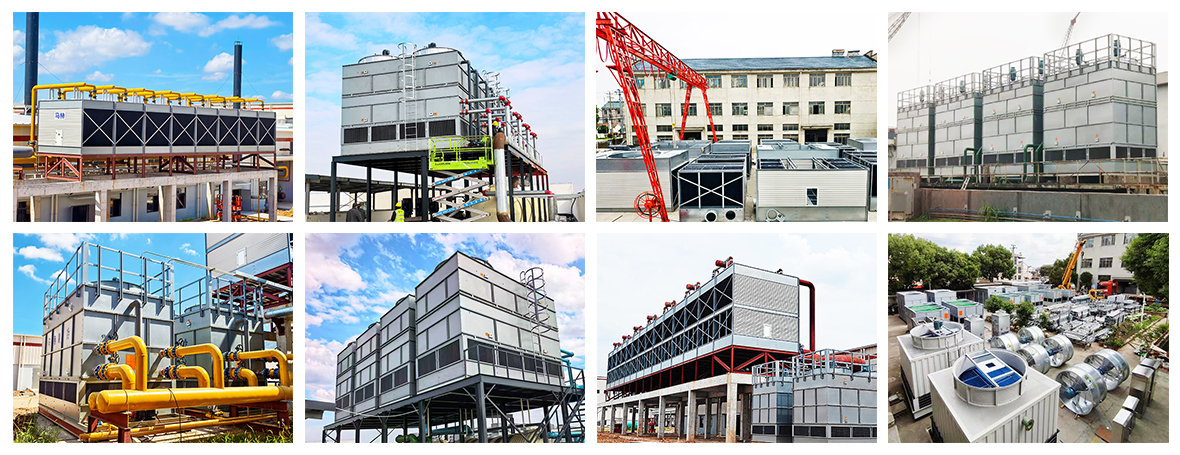
To help the manufacturer assess your project, prepare the required heat-rejection capacity, circulating-water flow rate, hot-water and cold-water temperatures, design wet-bulb temperature, water quality, installation location, available footprint, electrical supply, and expected operating schedule.
Also explain whether the system serves HVAC equipment or an industrial process, whether the process fluid must remain isolated, and whether future expansion is planned.
If replacing an existing tower, provide its nameplate data, dimensions, photographs, piping information, and known performance issues. These details help the supplier evaluate compatibility and prepare a more relevant proposal.
There is no single best type for every facility. Open circuit towers can be suitable for conventional cooling-water applications where direct air-water contact is acceptable. Closed circuit towers are useful when process-fluid isolation is important. Modular systems can help with phased capacity, flexible layouts, and future expansion.
In all cases, the unit should be selected using local design wet-bulb conditions, required water temperatures, heat load, and water-management requirements.
Closed circuit towers often have a higher initial purchase cost because they include a heat-exchange coil and additional construction.
However, the total cost depends on the required duty, materials, site conditions, maintenance needs, and the cost of protecting the process fluid. Where fluid contamination would cause major production losses or expensive cleaning, the additional investment may be justified.
Compare lifecycle costs rather than relying on purchase price alone.
Yes. Modular arrangements can suit facilities that need flexible capacity, staged installation, or easier expansion. They may also provide operational flexibility when loads change, depending on the controls and piping design.
However, the project must account for headers, pumps, controls, electrical connections, structural support, airflow clearance, and maintenance access. A modular system should be engineered as one coordinated installation.
Provide the heat-rejection duty, water flow, hot- and cold-water temperatures, design wet-bulb temperature, process-fluid details, water quality, installation space, electrical supply, preferred configuration, and project location.
If you have an existing tower, include its model, nameplate information, dimensions, and photographs. The more complete the technical information, the easier it is to compare proposals accurately.
Start by selecting a tower that meets the actual design conditions rather than relying on nominal capacity alone. Maintain proper water chemistry, clean blocked components, inspect fans and motors, and monitor operating temperatures and water consumption.
Where appropriate, consider controls that match fan operation to cooling demand. Regular maintenance and performance monitoring can help identify problems before they result in unnecessary energy use or downtime.
Choosing the right cooling tower in Singapore means balancing heat-rejection performance, water quality, energy use, maintenance, site constraints, and long-term reliability.
Open circuit towers offer a practical solution for many conventional cooling-water systems. Closed circuit towers help protect process fluids from direct environmental exposure. Modular systems provide flexibility for facilities that need coordinated capacity or future expansion.
The best choice depends on your operating conditions—not simply on the tower’s size or purchase price. By defining your heat load, confirming design temperatures, reviewing water-management requirements, and comparing quotations using consistent technical criteria, you can make a more informed investment.
Mach Industry (Zhejiang) Co.,Ltd can be contacted through https://www.machcooling.com to discuss cooling tower requirements for your project. Prepare your design data, compare proposals carefully, and select a system that supports dependable operation throughout its service life.