We Provide Cooling Tower Solution

Views: 0 Author: Cindy Publish Time: 2026-11-04 Origin: Site


When you look at an industrial cooling tower, one of the first things you notice is its shape. Some cooling towers are round, others are square or rectangular, and some large natural draft towers have a distinctive hyperbolic profile. These designs are not simply architectural choices. Each shape reflects engineering decisions about airflow, heat transfer, cooling capacity, installation space, structural strength, and operating conditions.
So, does cooling tower shape really affect performance? Absolutely. The external structure influences how the equipment fits into a plant, while its internal arrangement determines how air and water interact. A well-designed cooling tower must balance these factors rather than focus on appearance alone.
In this guide, we will explore the most common cooling tower shapes, explain their engineering principles, compare their applications, and discuss how to select a suitable design for your project.
Cooling tower shape is influenced by several technical and practical factors. Engineers consider the required heat rejection, airflow arrangement, water distribution, available space, construction materials, and maintenance requirements before choosing a design.
Cooling capacity is one of the most important design considerations. A small commercial HVAC system does not need the same tower structure as a large power station or petrochemical facility.
A cooling tower must remove the heat transferred from the process water. As the heat load increases, the equipment may require a larger heat exchange area, greater airflow, more fill volume, or multiple cooling cells.
For this reason, industrial cooling towers are available in different sizes and configurations. A compact square tower may suit a commercial building, while a large power plant may use a massive natural draft tower.
Airflow is central to cooling tower operation. Warm water flows through the tower and comes into contact with moving air. A portion of the water evaporates, carrying heat away and reducing the temperature of the remaining water.
The tower's geometry and internal layout must support an appropriate air path. Poor airflow distribution can create uneven cooling, dead zones, or unnecessary pressure losses.
The external shape alone does not determine airflow performance. Fan selection, fill arrangement, air inlets, drift eliminators, and water distribution equipment also play important roles.
Available installation space often influences the shape of a cooling tower.
A rectangular or square tower can be easier to arrange in a plant with limited ground space or alongside other equipment. Multiple modular cells can also be installed in a row or grouped together.
Round and hyperbolic towers have different structural and site requirements. Large natural draft towers, for example, need substantial foundations and carefully planned surrounding areas.
Engineers should also consider access roads, lifting equipment, maintenance platforms, wind conditions, noise restrictions, and local construction requirements.
Cooling towers come in several external shapes. The most familiar designs include round, square, rectangular, and hyperbolic structures. Each has different construction characteristics and typical applications.
Round cooling towers have a circular footprint and are commonly used in industrial and commercial cooling systems.
Their circular arrangement can support a relatively symmetrical internal layout. Depending on the design, the fan, water distribution system, and fill can be arranged around a central axis.
Round towers may be selected when a compact footprint and a particular airflow configuration are required. However, their suitability depends on the capacity, construction method, and internal components.
A round tower is not automatically more efficient than a square or rectangular one. The actual thermal design and operating conditions matter much more than the outline alone.
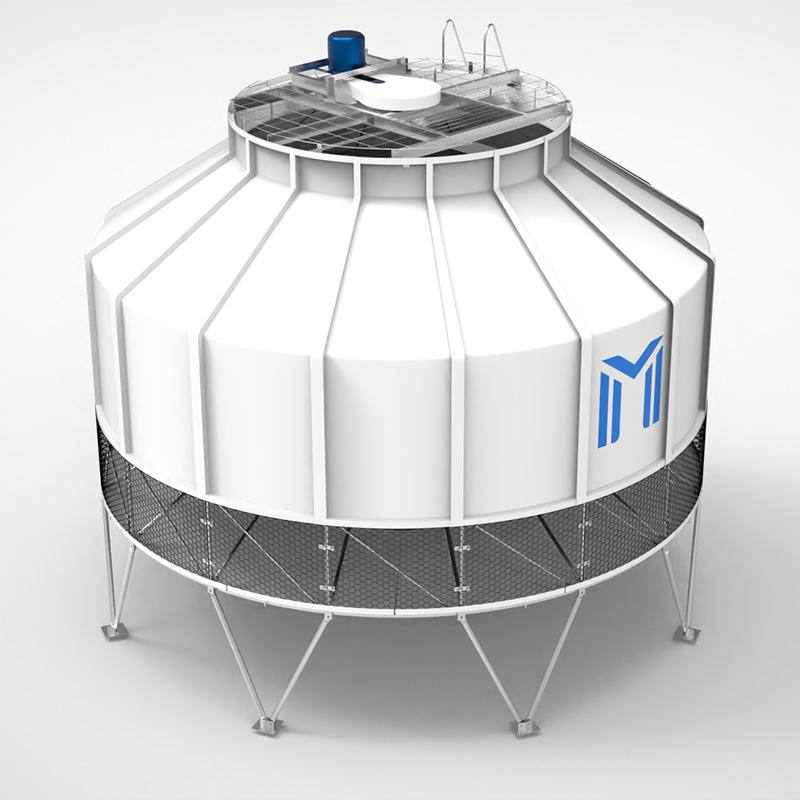
Square cooling towers are widely used in HVAC systems, commercial buildings, and industrial facilities.
Their main advantage is practical space utilization. A square footprint can make it easier to position equipment close to buildings, arrange multiple units, and connect water and electrical services.
Many packaged cooling towers use square or nearly square structures. They may include axial fans, PVC film fill, drift eliminators, water distribution pipes, and a collection basin.
For projects that require modular installation, square cooling towers can be a convenient option. Several cells can be installed together to increase total cooling capacity.
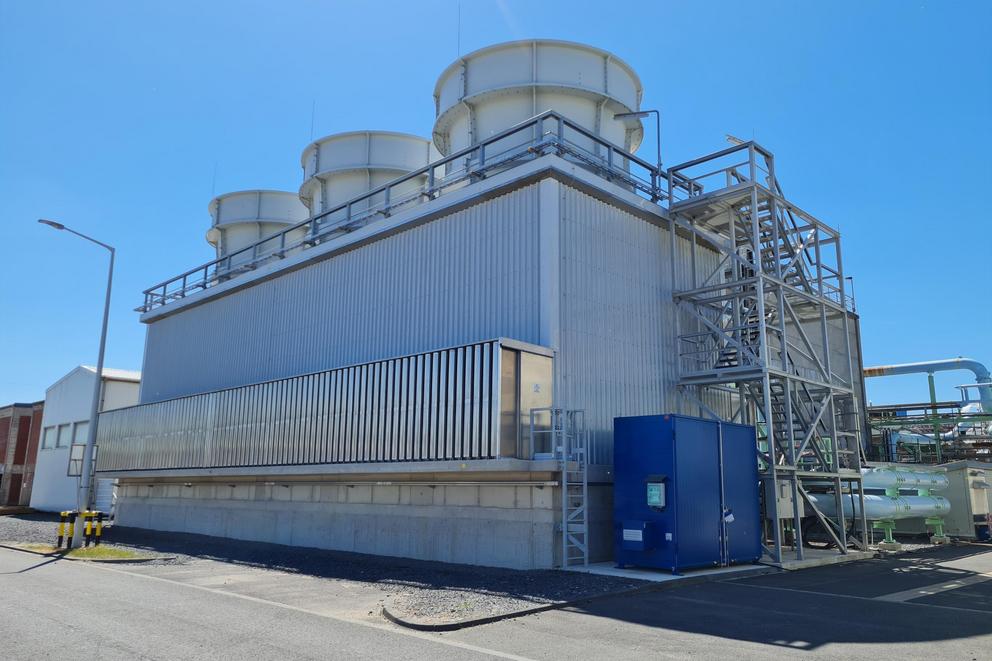
Rectangular cooling towers are often used when the site layout or required capacity calls for a longer equipment arrangement.
Their shape can accommodate multiple cooling cells, extended fill sections, and specific air and water distribution layouts. In large industrial installations, a rectangular structure may be divided into separate cells to support staged operation and maintenance.
One practical benefit is layout flexibility. A long tower can be positioned along a plant boundary or integrated into an existing industrial area.
However, engineers must ensure that air enters and leaves each section properly. If airflow is uneven across the tower, some areas may perform differently from others.

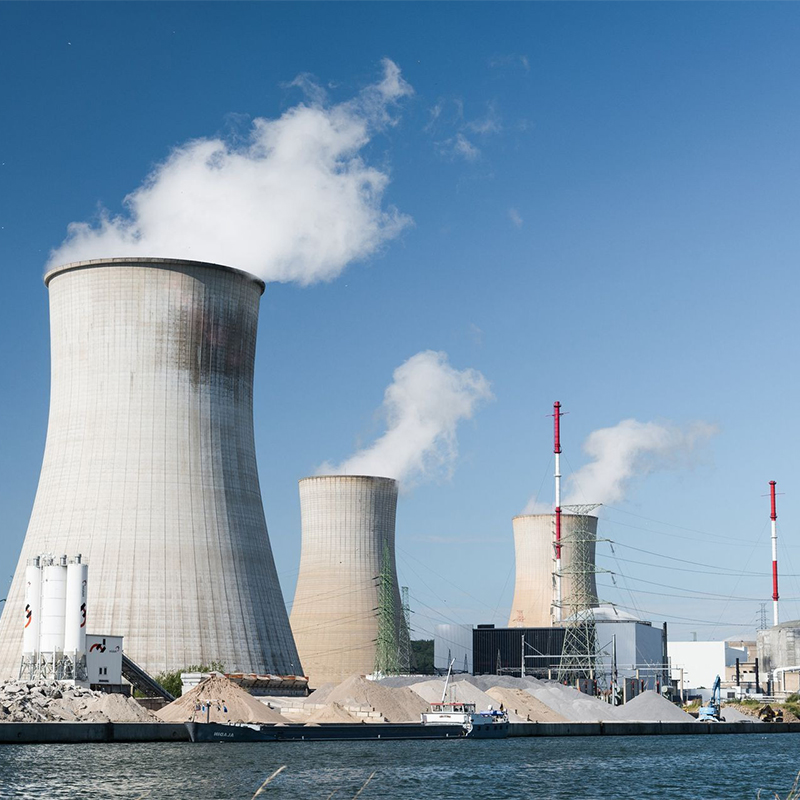
Hyperbolic cooling towers are among the most recognizable structures in the power generation industry. Their tall, curved shells are commonly associated with large natural draft wet cooling towers.
The shape is often described as hyperbolic or hyperboloid because the shell narrows around the middle and widens toward the top and bottom.
Unlike many smaller fan-driven cooling towers, large natural draft towers rely primarily on the density difference between warm, moist air inside the tower and cooler ambient air outside it.
The tall structure supports this natural airflow process. Its curved shell also provides an efficient structural form for handling substantial loads.
Hyperbolic towers are commonly found at thermal power stations and other large facilities where very high heat rejection capacity is required.
Some cooling towers use cylindrical or customized external structures. These designs may be developed for particular industrial requirements, site limitations, or equipment arrangements.
For example, a manufacturer may adapt the housing dimensions, air inlet arrangement, water basin, or internal support structure to match a replacement project.
Special designs should be evaluated according to engineering drawings and operating data. A customized appearance does not automatically indicate better cooling performance.
The hyperbolic profile is not just an architectural feature. It serves structural and airflow-related purposes in large natural draft cooling towers.

Natural draft cooling towers use buoyancy to move air through the structure.
Warm, humid air inside the tower is generally less dense than cooler outside air. As the warm air rises, cooler ambient air enters through the lower openings. This creates a continuous airflow path through the tower.
The tall shell provides the height needed for this chimney-like effect. Water is distributed over the fill, where it contacts the rising air and transfers heat through evaporation and sensible heat exchange.
The process can be compared to a chimney: warm air rises, and fresh air enters from below to replace it.
Actual natural draft performance depends on several factors, including ambient wet-bulb temperature, humidity, wind, tower height, internal resistance, and water loading.
A hyperbolic shell can provide favorable structural behavior. Its curved geometry helps distribute loads through the structure, making it suitable for very large reinforced concrete towers.
The shell must withstand its own weight, wind loads, temperature effects, and other site-specific forces. Engineers use structural analysis to determine wall thickness, reinforcement, foundation design, and construction details.
The geometry can help achieve a large internal volume without requiring a solid cylindrical wall of uniform thickness. However, structural efficiency depends on the complete engineering design, not shape alone.
It is important to understand that external shape and airflow configuration are two different ways to classify cooling towers.
A tower may be square or rectangular externally while using either crossflow or counterflow heat exchange internally. Similarly, draft type describes how air moves through the equipment, not simply what the tower looks like.
In a crossflow cooling tower, air moves horizontally across the falling water.
Warm water is distributed over the fill, usually through a system of basins or distribution channels. Air enters through the tower sides and passes across the fill before leaving through the upper section.
Crossflow designs can offer convenient access to certain water distribution components. Their arrangement may also suit larger rectangular or modular structures.
However, performance depends on proper water distribution, fill selection, airflow balance, and operating conditions.
In a counterflow cooling tower, air generally moves upward while water flows downward.
Warm water enters near the top and passes through the fill. Air enters from the lower section and travels upward, creating an opposing flow direction.
This arrangement provides direct contact between air and water over the fill surface. Counterflow towers often use spray nozzles or pressurized distribution systems.
They are available in several external shapes, including square, rectangular, and round configurations.
Draft type describes the method used to move air through the tower.
In a forced draft cooling tower, a fan pushes air into the equipment. The fan is commonly positioned near the air inlet.
In an induced draft cooling tower, a fan draws air through the tower and discharges it from the upper section. Axial fans are widely used in many industrial induced draft designs.
Large natural draft cooling towers use buoyancy rather than large fans to produce their main airflow.
These configurations should not be confused with crossflow and counterflow. Draft type and water-air flow arrangement are separate design characteristics.
The shape of a cooling tower can influence equipment layout and the way internal components are arranged. However, cooling performance is the result of the complete system.
Air must pass through the tower with an appropriate flow rate and distribution.
The air inlet size, fill resistance, drift eliminators, fan arrangement, and outlet geometry all contribute to the total system resistance.
If the air path is restricted, the fan may need to work harder to achieve the required airflow. Uneven airflow can also create areas where heat transfer is less effective.
A good design provides an appropriate balance between airflow distribution, pressure loss, and cooling capacity.
The water distribution system spreads warm water over the fill. The fill then increases the contact area between air and water.
Film fill uses closely spaced surfaces to create thin water films. It can provide a large contact area in a compact volume, but its suitability depends on water quality and the risk of fouling.
Splash fill breaks water into droplets as it passes over specially designed surfaces. It may be appropriate for certain applications where water contains more suspended solids.
The tower's shape and dimensions must provide enough room for the fill, supports, distribution equipment, and maintenance access.
Cooling tower efficiency is not determined by external shape alone.
Important operating and design factors include:
Entering hot water temperature
Leaving cold water temperature
Ambient wet-bulb temperature
Water flow rate
Airflow rate
Fill type and condition
Water distribution uniformity
Fan and motor performance
Tower cleanliness and maintenance
A well-designed square tower may outperform a poorly designed round tower. Likewise, a hyperbolic structure does not guarantee a specific cooling range or approach temperature.
The right question is not simply, "Which shape looks better?" It is, "Which complete design meets the required thermal performance under actual operating conditions?"
Each common shape has practical advantages. The best option depends on the project rather than a universal ranking.
| Cooling Tower Shape | Typical Characteristics | Common Applications |
|---|---|---|
| Round | Circular footprint and potentially symmetrical internal arrangement | Selected industrial and commercial systems |
| Square | Compact footprint and modular layout flexibility | HVAC, commercial buildings, industrial plants |
| Rectangular | Extended layout that can accommodate multiple cells | Large industrial installations |
| Hyperbolic | Tall curved shell, commonly associated with natural draft operation | Power generation and very large cooling systems |
| Cylindrical or customized | Geometry adapted to specific engineering requirements | Special industrial projects |
Square and rectangular towers are often practical where space planning and modular installation are important. Round designs may suit particular equipment arrangements. Hyperbolic natural draft towers are intended for a different scale of application.
When comparing options, evaluate the thermal duty, installation cost, operating energy, water consumption, maintenance access, and expected service life.
Different industries have different cooling requirements. This is why no single cooling tower shape is suitable for every project.

Power stations reject large quantities of heat from steam cycles and other process systems.
Large natural draft hyperbolic cooling towers are widely used in this sector because they can support substantial cooling duties without relying on large mechanical fans for the main airflow.
Some power plants also use mechanical draft cooling towers. The choice depends on plant capacity, climate, available land, water resources, and project economics.
Manufacturing facilities use cooling towers for equipment cooling, production processes, compressors, heat exchangers, and other industrial systems.
Square and rectangular mechanical draft towers are common choices because they can be arranged in modular configurations.
A plant can sometimes increase cooling capacity by adding cells, provided the water system, electrical supply, site layout, and overall design support the expansion.
Commercial buildings, shopping centers, hotels, hospitals, and office complexes often use packaged cooling towers as part of their central air-conditioning systems.
Square and rectangular structures are popular because they can fit into rooftop spaces, service areas, and mechanical plant rooms.
Noise, vibration, drift control, access, and local building restrictions are important considerations in these installations.
Petrochemical plants, refineries, steel mills, and chemical facilities often require reliable cooling water systems.
Their cooling towers may use multiple cells and customized layouts to handle different process loads.
Material selection is particularly important. Water chemistry, temperature, suspended solids, and chemical treatment can affect the service life of fill, pipes, basins, and structural components.
Choosing a cooling tower shape should be part of a complete engineering evaluation. Here are the main factors to consider.
Start with the required heat rejection duty. Identify the hot water temperature, target cold water temperature, water flow rate, and design wet-bulb temperature.
These values help determine the tower's thermal requirements. A supplier should evaluate the operating conditions rather than recommend a shape based only on the nominal tonnage.
Water quality affects the selection of fill and other internal components.
High suspended solids, biological growth, scale-forming minerals, or corrosive chemicals may require particular materials and maintenance arrangements.
Airflow conditions also matter. Consider the fan type, air inlet and discharge positions, nearby buildings, prevailing winds, and the possibility of hot-air recirculation.
Before choosing a design, check the available installation area and height restrictions.
Allow sufficient space for:
Water and electrical connections
Fan and motor maintenance
Fill and drift eliminator replacement
Inspection of the basin and distribution system
Lifting and removal of major components
Safe access for maintenance personnel
A tower that fits the site but cannot be maintained safely may become an expensive problem later.
The purchase price is only one part of the total cost.
A complete comparison should include installation, foundation work, pumps, fans, motors, electricity, water treatment, replacement components, and maintenance.
A lower initial price may not produce the lowest lifetime cost. Consider the expected operating hours and maintenance requirements before making a decision.
The external structure provides the space and support for the internal cooling system. These components have a direct influence on thermal performance.
Cooling tower fill increases the contact area between water and air. It helps improve heat and mass transfer within the tower.
Common materials include PVC and PP, selected according to operating temperature, water quality, chemical exposure, and mechanical requirements.
Film fill and splash fill have different structures and operating characteristics. The correct option depends on the tower design and water conditions.
Drift eliminators reduce the amount of water droplets carried out of the tower with the exhaust air.
They are important for controlling water loss and limiting the release of entrained droplets into the surrounding environment.
Their design must provide suitable droplet removal while maintaining acceptable airflow resistance.
Mechanical draft cooling towers use fans to move air through the equipment. Fan blades, hubs, motors, gearboxes, and drive systems must match the required operating conditions.
The water distribution system must also deliver water evenly over the fill. Poor distribution can reduce effective heat transfer, even when the tower has sufficient nominal capacity.
These components should be selected as part of one integrated cooling system.
Several common assumptions can lead to poor purchasing decisions.
Misunderstanding 1: A larger tower always provides better cooling.
Not necessarily. Capacity depends on the complete thermal design, including airflow, fill volume, water distribution, and operating conditions.
Misunderstanding 2: Round towers are always more efficient than square towers.
There is no universal rule. A properly designed square tower can perform very well, just as a round tower can be unsuitable for a particular application.
Misunderstanding 3: Hyperbolic shape means higher cooling efficiency.
The hyperbolic profile is primarily associated with the structural and natural draft design of very large towers. It does not automatically guarantee better thermal performance.
Misunderstanding 4: Crossflow means rectangular, and counterflow means round.
Crossflow and counterflow describe the relative directions of air and water movement. They do not define the external shape.
Misunderstanding 5: External appearance is enough to identify cooling tower performance.
Two towers that look similar may have different fill, fan systems, water distribution arrangements, and thermal ratings.
Regardless of the external shape, every cooling tower requires regular inspection and maintenance.
For mechanical draft towers, inspect fan blades, hubs, motors, gearboxes, vibration levels, and fasteners. Check the fill for scaling, biological growth, deformation, and blockage.
For all wet cooling towers, inspect the water basin, distribution pipes, spray nozzles, drift eliminators, and structural supports.
Large natural draft towers also require attention to the concrete shell, structural condition, water distribution system, fill, and drift eliminators.
Maintenance schedules should reflect operating conditions, water treatment practices, manufacturer recommendations, and applicable safety requirements.
Before working on fans or other rotating equipment, isolate electrical power, apply lockout/tagout procedures, and verify that all moving parts have stopped. Follow site-specific access and fall-protection requirements.
Selecting a cooling tower is not simply a matter of choosing between a round, square, rectangular, or hyperbolic structure. You need a solution that matches your cooling requirements, installation conditions, water quality, and long-term operating plans.
Mach Industry (Zhejiang) Co.,Ltd. focuses on cooling tower products and industrial cooling solutions. The company website, https://www.machcooling.com, provides a starting point for customers who want to learn more about its products and discuss project requirements.
When evaluating a cooling tower supplier, consider more than the appearance of the equipment. Ask for relevant technical specifications, cooling capacity information, operating conditions, component details, and installation requirements.

A professional technical discussion should cover:
Required cooling capacity and water flow rate
Entering and leaving water temperatures
Design wet-bulb temperature
Cooling tower configuration and airflow arrangement
Installation dimensions and site limitations
Fill, fan, motor, and water distribution specifications
Maintenance access and replacement requirements
By reviewing these details before purchasing, buyers can make a more informed decision and reduce the risk of selecting an unsuitable cooling tower.
Square and rectangular shapes are common in many packaged mechanical draft cooling towers, particularly in HVAC and industrial applications. Large power stations may use hyperbolic natural draft towers.
The most common design depends on the industry and cooling capacity.
Large natural draft cooling towers often use a hyperbolic shell because this geometry provides favorable structural characteristics and supports a tall natural draft structure.
The shape helps the shell resist structural loads while allowing a large internal cooling space.
Not automatically. Round and square towers have different layout and construction characteristics. Their actual performance depends on thermal design, airflow, fill, water distribution, and operating conditions.
Choose the design that best fits your project requirements.
It can influence airflow paths, internal layout, pressure losses, and installation conditions. However, external shape is only one part of the design.
Fill performance, fan efficiency, water distribution, wet-bulb temperature, and maintenance condition are also critical.
Many mechanical draft cooling towers can be configured to suit specific site and capacity requirements. Dimensions, cell arrangements, access points, and component layouts may be adapted where the design permits.
Customization should be supported by engineering calculations and confirmed technical specifications.
Cooling tower shape is an important part of equipment design, but it should never be considered in isolation. Round, square, rectangular, cylindrical, and hyperbolic structures each serve different engineering and application needs.
Square and rectangular towers often provide practical layout flexibility for commercial and industrial installations. Round designs suit selected equipment arrangements, while hyperbolic natural draft towers are widely associated with large-scale power generation.
The best cooling tower is not necessarily the largest or most impressive-looking one. It is the design that delivers the required cooling performance, fits the site, operates reliably, and remains practical to maintain.
If you are planning a new cooling tower project or replacing an existing unit, work with a supplier who can evaluate your operating conditions and provide relevant technical information. Visit Mach Industry (Zhejiang) Co.,Ltd. at https://www.machcooling.com to learn more about cooling tower products and industrial cooling solutions.