We Provide Cooling Tower Solution

Views: 0 Author: Cindy Publish Time: 2026-11-03 Origin: Site


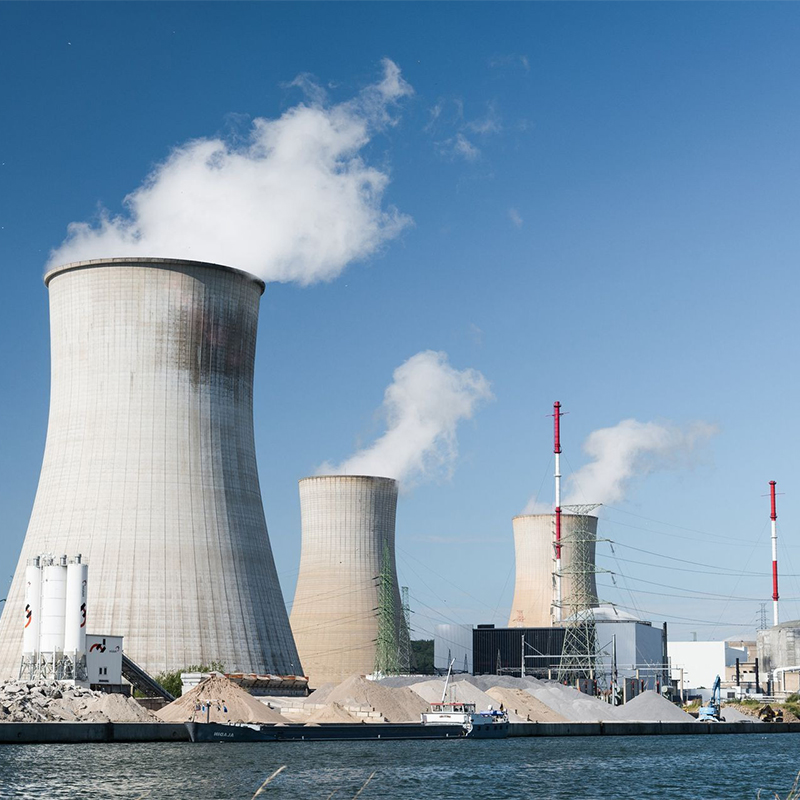
When people think about large industrial cooling towers, the first image that often comes to mind is a massive concrete structure with a narrow middle and a wide top and bottom. This distinctive shape is not just an architectural choice. It is an important part of the engineering behind a hyperboloid cooling tower.
Hyperboloid cooling towers are widely associated with large power plants and industrial facilities. Many use natural draft to move air through the tower without relying on large mechanical fans. Their impressive height, reinforced concrete shells, and carefully designed internal systems allow them to handle substantial heat loads.
But how does this unusual structure actually work? Why is the middle narrower than the top and bottom? And what role do components such as cooling tower fill and drift eliminators play?
In this guide, we will explore hyperboloid cooling tower design, working principles, major components, applications, advantages, limitations, and maintenance requirements. We will also explain how selecting suitable cooling tower components can help maintain reliable performance.
A hyperboloid cooling tower is a large cooling structure whose outer shell has a hyperbolic profile, typically formed as a hyperboloid of revolution. Its familiar silhouette features a broad base, a narrower central section, and a wider upper section.
Many large hyperboloid cooling towers are natural draft wet cooling towers. They remove heat from circulating water by bringing it into contact with moving air. Unlike conventional mechanical draft towers, they use buoyancy-driven airflow rather than relying primarily on large fans.
These towers are particularly suitable for facilities that need to reject very large quantities of heat continuously.
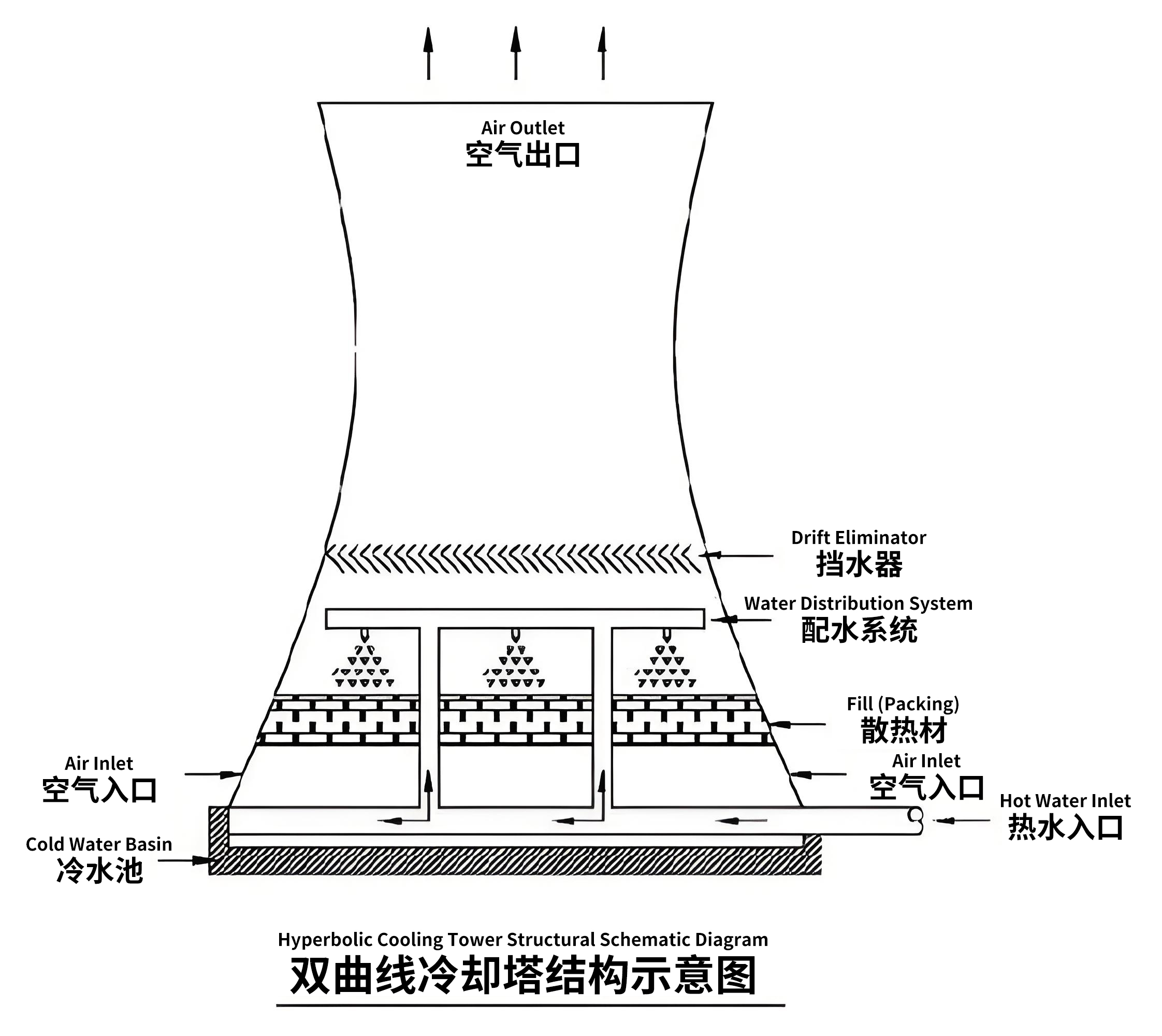
Why does the tower have a narrow waist instead of straight vertical walls?
The answer involves structural engineering and airflow.
The curved shell provides an efficient structural form for carrying loads, including its own weight and environmental forces such as wind. Its geometry helps distribute structural stresses through the shell toward the supporting base.
The shape also works with the tower's natural-draft airflow system. Warm, moist air rises through the structure and leaves through the upper opening, while cooler ambient air enters through the lower perimeter.
The narrow central region is commonly called the throat. The lower and upper portions have different structural and aerodynamic functions, so the entire profile must be designed as one integrated system.
Most large hyperboloid cooling towers are designed around the natural draft principle.
The tower shell acts like a very large chimney. Air inside the tower becomes warmer and more humid as it receives heat from the circulating water. Its density changes, creating a pressure difference between the air inside and outside the tower.
This difference helps draw fresh air through the lower openings and move it upward.
Because the airflow is driven mainly by buoyancy, these towers generally do not need the large fan assemblies used in mechanical draft cooling towers.
However, natural draft does not mean zero energy consumption for the entire cooling system. Pumps and other auxiliary equipment may still require considerable electrical power.
The working principle is based on evaporative cooling, heat transfer, and natural air circulation.
Warm water enters the tower from the industrial process or condenser system. It is distributed over the internal cooling area, where it comes into contact with upward-moving air. A small portion of the water evaporates, carrying heat away from the remaining water.
The cooled water collects at the bottom and returns to the plant.
Let's look at each stage.
The cooling process begins when warm circulating water enters the tower through a network of pipes.
A water distribution system directs the water toward nozzles or other distribution devices. These components spread the water across the cooling area to achieve relatively uniform coverage.
Good water distribution is essential. If some areas receive too much water while others receive too little, the tower may not use its available cooling surface effectively.
Uneven distribution can also contribute to localized scaling, fouling, and reduced thermal performance.
At the same time, ambient air enters through openings near the bottom of the tower.
The air moves upward through the internal cooling section while water flows downward. This counterflow arrangement creates a large contact area between the two streams.
As the air passes through the falling water and fill surfaces, heat transfers from the water to the air.
The efficiency of this process depends on several factors, including airflow, water distribution, fill design, ambient wet-bulb temperature, and the condition of the internal components.
Evaporation is the main mechanism responsible for cooling in a conventional wet cooling tower.
When a small amount of water changes from liquid into vapor, it absorbs latent heat. This energy is carried away with the moist air leaving the tower.
The remaining circulating water becomes cooler and can return to the condenser or industrial process.
This is why cooling tower performance depends strongly on atmospheric conditions, especially the entering-air wet-bulb temperature.
The chimney effect is what makes natural draft possible.
As air rises through the tower, it becomes warmer and more humid. Its density is generally lower than that of the cooler ambient air outside.
This density difference creates a buoyancy force that helps maintain upward airflow.
The height and geometry of the tower influence the available natural draft. Weather conditions, wind, ambient temperature, humidity, and tower operating conditions also affect airflow.
In simple terms, the tower uses the natural tendency of warm air to rise to support the cooling process.
The outer concrete shell attracts attention, but the internal components do much of the actual cooling work.
A typical large natural draft wet cooling tower may include the following systems.
The reinforced concrete shell is the most recognizable part of a hyperboloid cooling tower.
It supports itself and transfers structural loads to the foundation and supporting structure. Its design must account for wind pressure, temperature changes, concrete behavior, reinforcement requirements, and long-term exposure to moisture.
The shell is usually designed by specialist structural engineers. Construction quality, material selection, reinforcement detailing, and inspection all influence long-term durability.
The water distribution system spreads warm water over the fill or cooling area.
Depending on the tower design, it may include:
Main water inlet pipes
Distribution headers
Branch pipes
Spray nozzles
Supporting pipework and fittings
The goal is to deliver the required water flow evenly across the available cooling area.
Blocked nozzles, damaged pipes, and uneven water pressure can create distribution problems. Regular inspection helps identify these issues before they significantly affect cooling performance.
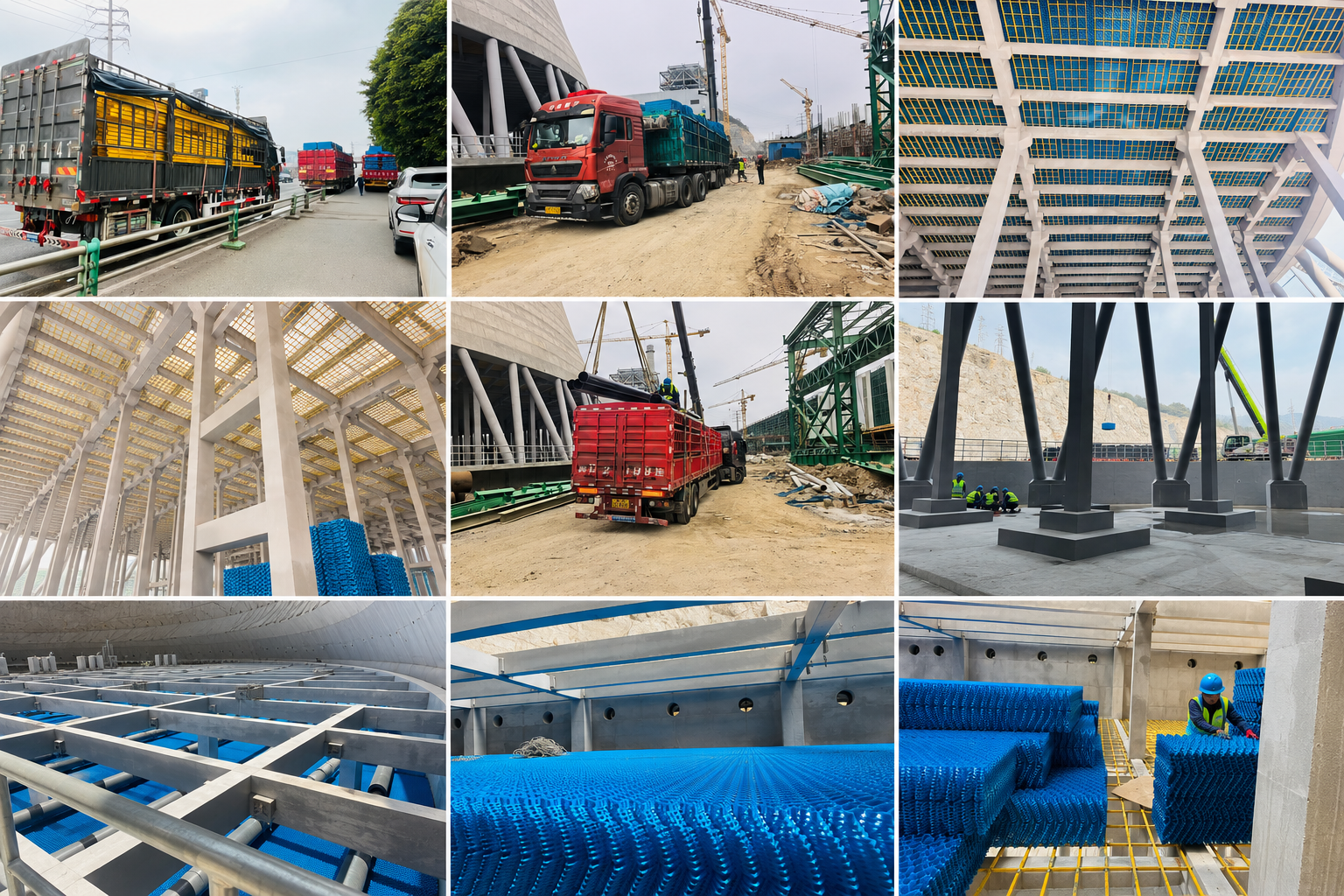
Cooling tower fill increases the contact area between water and air. It slows the water's movement and helps create thin water films or droplets, depending on the fill design.
In suitable wet cooling tower systems, fill can improve heat and mass transfer without requiring a larger tower footprint.
Common fill categories include:
Film fill: Spreads water into thin films over closely spaced surfaces.
Splash fill: Breaks falling water into smaller droplets through repeated splashing.
Specialty fill designs: Developed for particular water quality, operating conditions, and tower configurations.
The correct fill depends on water quality, suspended solids, temperature, biological growth risks, and the tower's original design.
A critical point is that not every hyperboloid cooling tower uses the same fill arrangement. The fill must match the actual internal structure and hydraulic conditions.
Drift eliminators reduce the amount of liquid water droplets carried out of the tower with the exhaust air.
They change the direction of the airflow so that entrained droplets collide with internal surfaces and drain back into the tower.
Effective drift elimination helps reduce water loss and limit the release of droplets containing dissolved solids or treatment chemicals.
Material selection, blade geometry, installation quality, and maintenance all affect performance.
Air enters through the lower perimeter of the tower, commonly through an open air inlet section.
After passing through the cooling area, the cooled water falls into a collection basin or cold-water pool at the bottom.
The basin stores water before it is pumped back into the industrial process.
It also needs proper drainage, water level control, and access for inspection and cleaning.
The hyperboloid form combines structural and functional considerations. It is not simply a design chosen to make a power plant look impressive.
Large cooling towers must withstand their own weight and environmental loads throughout decades of operation.
A curved reinforced concrete shell can provide structural efficiency while using a relatively thin shell compared with the overall dimensions of the structure.
The shape helps transfer loads through the shell toward the supporting base.
However, actual structural performance depends on detailed engineering, concrete quality, reinforcement, foundation conditions, and local environmental loads.
The tower's height supports the development of natural draft.
Its open lower section allows ambient air to enter, while the upper outlet allows warm, moist air to escape.
The shell's geometry is designed together with the tower's airflow requirements. It should not be assumed that the hyperboloid shape alone creates efficient cooling. Internal layout, fill resistance, water distribution, and environmental conditions also matter.
Large hyperboloid cooling towers commonly use reinforced concrete shells because of their structural requirements and long-term exposure conditions.
Other parts of the cooling system may use concrete, steel, stainless steel, PVC, polypropylene, FRP, or other materials depending on their function.
For example, fill and drift eliminators may use suitable plastic materials, while pipes and supports may use different materials according to temperature, chemical exposure, and mechanical loading.
Material compatibility is essential for long-term reliability.
Hyperboloid describes the shape of the tower shell. It does not, by itself, describe every aspect of the cooling process.
Most familiar large hyperboloid towers are natural draft wet cooling towers, but cooling systems can differ in their heat-transfer arrangements.
Common cooling tower system categories include:
Wet cooling towers: Use direct contact between water and air, with evaporation providing the main cooling effect.
Dry cooling systems: Transfer heat through heat exchangers without direct evaporation of the circulating process water into the cooling air.
Hybrid cooling systems: Combine wet and dry heat-rejection methods to meet specific performance or water-use requirements.
These categories should not be confused with the structural classification of a tower. A hyperboloid shell is a structural form, while wet, dry, and hybrid describe heat-rejection methods.
Hyperboloid cooling towers are most commonly associated with large facilities that reject substantial quantities of heat.
Their natural draft arrangement can be attractive when a site requires continuous cooling at a very large scale.
Thermal power stations use cooling systems to remove heat from steam condensation and other plant processes.
Large natural draft cooling towers can provide the heat-rejection capacity needed for these installations.
The cooling tower helps maintain condenser operating conditions, supporting the overall performance of the power generation system.
Nuclear power facilities also require carefully engineered heat-rejection systems.
Cooling towers may be used as part of the plant's cooling water arrangement, depending on the site design and cooling system configuration.
The cooling tower's role is to reject heat safely and reliably. Its design, operation, inspection, and maintenance must follow strict engineering and regulatory requirements.
Some large industrial facilities generate substantial process heat and need continuous cooling.
Examples include major manufacturing complexes, steel production facilities, and other energy-intensive operations.
Whether a hyperboloid tower is appropriate depends on the required cooling capacity, site conditions, water availability, environmental requirements, and project economics.
Petrochemical and chemical plants often operate multiple heat exchangers and process cooling circuits.
A large cooling system can help maintain stable process temperatures and support continuous production.
Water chemistry deserves particular attention in these environments because process contamination, dissolved minerals, and chemical exposure may affect the cooling system's components.
Why do engineers continue to use this design for large cooling applications?
Several characteristics make hyperboloid natural draft cooling towers attractive for suitable projects.
1. Natural airflow: The tower uses buoyancy to move air, reducing the need for large mechanical fan systems.
2. Large heat-rejection capacity: These structures can be designed for the high cooling loads associated with major power and industrial facilities.
3. Structural efficiency: The curved shell provides an efficient form for carrying structural loads when properly engineered.
4. Reduced dependence on large fans: Natural draft systems avoid some of the mechanical complexity associated with large fan-driven cooling towers.
5. Long-term infrastructure potential: A well-designed and maintained reinforced concrete structure can provide a long operating life.
6. Suitable for continuous operation: Their design can support large-scale cooling requirements where stable, continuous heat rejection is essential.
These benefits do not mean that hyperboloid towers are automatically the best choice for every industrial project. Their suitability depends on the specific application.
Every cooling tower design involves trade-offs.
Hyperboloid cooling towers have several limitations that project planners should consider.
High initial construction cost: A massive reinforced concrete structure requires significant engineering, materials, labor, and construction time.
Large land and site requirements: The tower and its surrounding infrastructure need substantial space.
Long construction schedule: Foundation work, reinforcement, concrete placement, and shell construction can take considerable time.
Weather dependence: Natural draft performance is influenced by ambient temperature, humidity, wind, and other atmospheric conditions.
Water consumption: Wet cooling towers lose water through evaporation, blowdown, and drift. Water treatment and makeup water systems are therefore important.
Specialist maintenance: Structural inspections and internal component maintenance may require specialized access arrangements and experienced personnel.
For smaller industrial facilities, mechanical draft cooling towers may offer a more practical and flexible solution.
Both designs reject heat, but they use different methods to move air.
| Comparison | Hyperboloid Natural Draft Tower | Mechanical Draft Cooling Tower |
|---|---|---|
| Air movement | Primarily buoyancy-driven | Driven by mechanical fans |
| Typical structure | Large reinforced concrete shell | Often modular or packaged construction |
| Fan requirement | Usually no large main fan system | Uses axial or centrifugal fans |
| Typical scale | Common in very large installations | Available in small, medium, and large capacities |
| Initial construction | Often substantial | Depends on tower size and design |
| Airflow control | Influenced by natural draft and weather | Can be adjusted through fan operation |
| Typical applications | Major power and industrial facilities | Commercial and industrial cooling systems |
Which design is better?
There is no universal answer. A natural draft tower may suit a large power station with suitable land and environmental conditions. A mechanical draft tower may be more appropriate for a factory that needs modular capacity, easier installation, or more direct airflow control.
The right choice depends on cooling load, site conditions, water availability, energy costs, and project investment.
Although the outer shell defines the appearance of a hyperboloid cooling tower, the internal components have a direct influence on heat-transfer performance.
For maintenance teams and component buyers, these parts deserve special attention.
Cooling tower fill should be selected according to the tower's original design and operating conditions.
Important considerations include:
Water temperature
Water quality
Suspended solids
Chemical composition
Expected fouling and scaling
Available installation space
Required thermal performance
Hydraulic resistance and airflow requirements
Film fill can provide a large contact area and effective heat transfer under suitable water conditions. However, it may be more sensitive to clogging when water contains high levels of suspended solids or biological material.
Splash fill may be more suitable for certain applications where fouling resistance is a priority.
Replacing fill with a different type or geometry without engineering review may change pressure drop, water distribution, and cooling performance.
Drift eliminators and water distribution systems work together to support efficient tower operation.
Blocked nozzles can cause uneven water coverage. Damaged eliminators may allow excessive droplet carryover. Deposits on internal surfaces can also restrict airflow.
During maintenance, inspect these components for physical damage, fouling, loose supports, and incorrect installation.
Replacement components should match the original design requirements as closely as possible.
A hyperboloid cooling tower is a major industrial asset. Regular maintenance helps protect its structural integrity and cooling performance.
A practical maintenance program should cover both the concrete structure and the internal cooling equipment.

Inspect the concrete shell and supporting areas for visible signs of deterioration.
Look for:
Cracking
Concrete spalling
Exposed reinforcement
Water leakage
Corrosion-related damage
Signs of unusual movement or deformation
Structural findings should be assessed by qualified engineers. Do not treat significant shell damage as a routine cosmetic issue.
Fill and drift eliminators operate in a wet environment and may gradually accumulate deposits or biological growth.
Inspection should identify:
Clogged fill passages
Deformed or broken fill sheets
Loose supports
Damaged drift eliminator blades
Excessive scale or biological deposits
Uneven water distribution
If cleaning cannot restore the components to an acceptable condition, replacement may be necessary.
Water quality has a major influence on cooling tower maintenance.
Poor water treatment can lead to scaling, corrosion, sediment accumulation, and biological growth.
A suitable water treatment program should consider hardness, alkalinity, conductivity, pH, suspended solids, and microbiological control.
Blowdown and makeup water management also help control the concentration of dissolved solids in the circulating water.
Water treatment should follow the facility's engineering requirements and applicable health and environmental regulations.
Improving cooling tower performance does not always require major structural changes. In many cases, attention to internal components and operating conditions can produce meaningful improvements.
Consider the following measures:
Maintain uniform water distribution. Check nozzles, distribution pipes, and spray patterns to ensure that the cooling area receives the required water flow.
Keep fill in good condition. Remove deposits using approved cleaning methods and replace severely damaged or unsuitable fill.
Inspect drift eliminators. Maintain their correct position and condition to control water droplet carryover.
Improve water treatment. Manage scaling, corrosion, sediment, and biological growth to protect internal components.
Monitor operating performance. Record inlet and outlet water temperatures, water flow, ambient wet-bulb temperature, and other relevant operating data.
Review airflow restrictions. Check for obstructions, damaged internal components, or conditions that may increase air resistance.
Plan maintenance carefully. Schedule inspections and repairs to reduce unexpected shutdowns.
Performance improvements should be evaluated using actual operating data. A change that appears beneficial in one tower may not produce the same result in another.
For large cooling tower maintenance projects, selecting the right components is just as important as choosing a reliable contractor.
A suitable supplier should understand cooling tower structures, internal components, material requirements, and replacement compatibility.
Before placing an order, consider the following:
Provide the supplier with the original component dimensions, drawings, material specifications, and installation details whenever available.
For fill replacement, include the existing fill type, sheet dimensions, spacing, configuration, and operating water quality.
For drift eliminators, confirm the dimensions, blade profile, module arrangement, and support requirements.
Ask about the material specifications and quality control procedures.
For plastic cooling tower components, relevant considerations may include material grade, temperature resistance, chemical compatibility, dimensional consistency, and manufacturing quality.
A reliable supplier should communicate clearly about technical information, product specifications, packaging, lead times, and delivery arrangements.
For international projects, confirm shipping requirements and the documentation needed before placing an order.
Mach Industry (Zhejiang) Co.,Ltd. provides cooling tower products and related solutions for industrial customers.
Website: https://www.machcooling.com
For cooling tower projects involving maintenance, upgrades, or replacement requirements, selecting suitable components is an important part of maintaining reliable operation.
When discussing a cooling tower project with Mach Industry, customers should prepare relevant equipment information, such as:
Cooling tower type and model
Required cooling capacity
Existing component dimensions
Water inlet and outlet temperatures
Water flow rate
Operating environment
Required replacement components
Available technical drawings and photographs
This information helps clarify project requirements and supports more accurate product selection.
For customers maintaining large natural draft cooling towers, it is particularly important to identify the original internal component configuration before selecting replacement fill, drift eliminators, or water distribution equipment.
Visit https://www.machcooling.com to learn more about Mach Industry and its cooling tower solutions.
No. Hyperboloid describes the geometric shape of the tower shell, not the complete airflow system.
However, the large hyperboloid towers commonly seen at power plants are generally natural draft cooling towers.
The narrow central section, or throat, forms part of the tower's structural and aerodynamic design.
The curved shell helps distribute structural loads, while the overall height and shape support the natural draft airflow system.
Most large hyperboloid natural draft cooling towers do not rely on large mechanical fans for their main airflow.
Instead, they use the density difference between warm internal air and cooler outside air to create natural circulation.
Other equipment, such as water pumps, may still consume electrical energy.
Fill increases the contact area between water and air, improving heat and mass transfer.
The appropriate fill type depends on the tower's design, water quality, operating temperature, and fouling conditions.
The reinforced concrete structure of a properly designed and maintained tower can have a very long service life.
However, its internal components may require more frequent maintenance or replacement. Fill, drift eliminators, nozzles, and other parts have different service lives depending on material quality and operating conditions.
Regular structural inspection and internal component maintenance are essential.

A hyperboloid cooling tower is an impressive example of large-scale industrial engineering. Its distinctive curved shell provides structural efficiency, while its height supports the natural draft process that moves air through the cooling system.
The tower's cooling performance, however, depends on much more than its outer shape. Water distribution, fill, drift eliminators, water quality, and operating conditions all contribute to effective heat rejection.
For power plants and large industrial facilities, regular inspection and suitable replacement components are essential to maintaining reliable operation.
Whether you are studying hyperboloid cooling tower design or planning a cooling tower maintenance project, understanding how the structure and internal systems work together will help you make better engineering and purchasing decisions.
For more information about cooling tower products and industrial cooling solutions, visit Mach Industry (Zhejiang) Co.,Ltd. at https://www.machcooling.com.