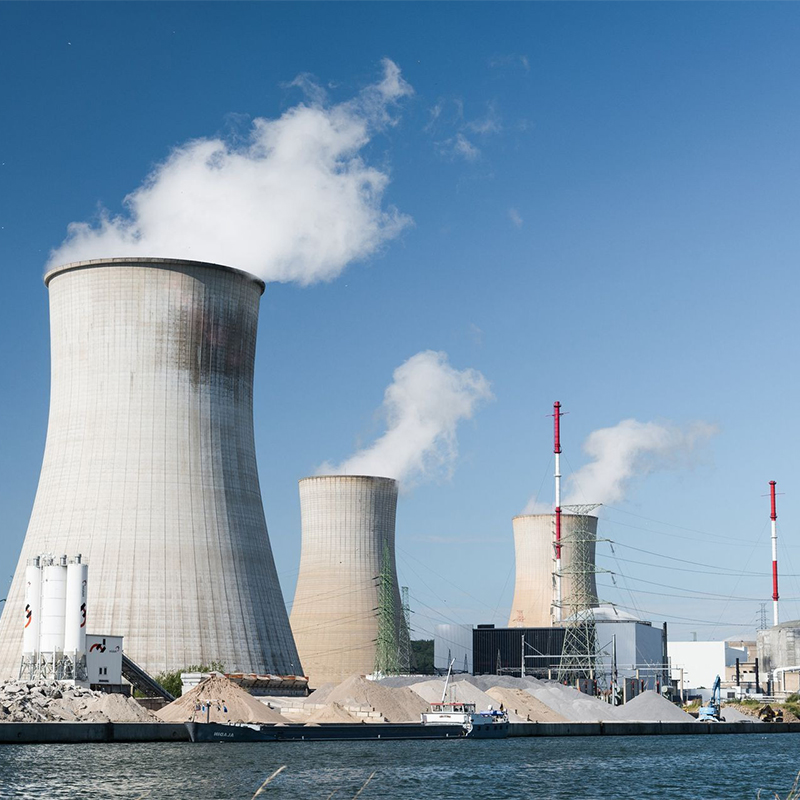
We Provide Cooling Tower Solution

Views: 0 Author: Cindy Publish Time: 2026-11-02 Origin: Site


In modern manufacturing, temperature control plays an important role in production efficiency, product quality, and equipment reliability. Whether you operate a plastic injection molding factory, an industrial chiller system, or a small manufacturing workshop, choosing the right cooling equipment is essential.
A mini cooling tower for chiller and injection molding machine applications provides an efficient solution for removing excess heat from industrial processes. Compared with large industrial cooling towers, mini cooling towers feature a more compact structure, making them suitable for factories with limited installation space and relatively small cooling requirements.
But how does a mini cooling tower work? Can it support continuous injection molding production? How do you choose the right cooling capacity for an industrial chiller?
In this article, we will explore the working principles, applications, advantages, selection methods, and maintenance requirements of mini cooling towers. We will also explain how Mach Industry (Zhejiang) Co.,Ltd can help industrial customers find suitable cooling tower solutions.
A mini cooling tower is a compact evaporative cooling device designed to remove heat from circulating water. It operates using the same basic principle as a conventional industrial cooling tower but has a smaller structure and is generally designed for lower cooling loads.
Unlike air-cooled equipment that relies entirely on heat exchange with ambient air, an evaporative cooling tower uses water evaporation to transfer heat into the atmosphere.
During operation, hot water enters the cooling tower and is distributed over the cooling fill. A fan moves air through the tower, allowing water and air to come into contact. A small portion of the water evaporates, removing heat from the remaining water. The cooled water is then collected and returned to the industrial equipment.

Mini cooling towers are commonly used in:
Industrial water-cooled chillers
Plastic injection molding machines
Small manufacturing workshops
Hydraulic oil cooling systems
Industrial processing equipment
Commercial refrigeration applications
Small-scale production lines
Their compact design makes them a practical choice when a large centralized cooling tower is unnecessary.
The operating principle is relatively simple.
First, hot circulating water from the industrial equipment enters the cooling tower through an inlet pipe. The water distribution system spreads it evenly across the cooling fill.
Next, the fan draws or pushes air through the tower. As water flows down the fill surface, it comes into contact with the moving air. Part of the water evaporates, taking heat away from the circulating water.
Finally, the cooled water collects in the basin and flows back to the equipment through the circulation pump.
This process continues throughout operation, providing continuous heat rejection.
Think of a cooling tower as a natural heat exchanger. Instead of depending entirely on mechanical refrigeration, it uses airflow and evaporation to help remove industrial heat.
Although different manufacturers may use different designs, a typical mini cooling tower includes several essential components.
Tower Casing
The casing forms the external structure of the cooling tower. It protects internal components and provides mechanical support.
Cooling Fill
Cooling fill increases the contact area between water and air. This improves heat and mass transfer and plays an important role in overall cooling performance.
Fan and Motor
The fan moves air through the cooling tower, supporting the evaporation process. The motor provides the required driving power.
Water Distribution System
Spray nozzles or distribution pipes spread hot water evenly over the fill surface.
Water Collection Basin
The basin collects cooled water before it returns to the industrial equipment.
Drift Eliminator
The drift eliminator reduces water droplets carried away by exhaust air, helping control water loss.
Piping and Pump Connections
These components connect the cooling tower with the industrial water circulation system.
Each component contributes to cooling efficiency. For example, blocked fill passages can restrict airflow, while damaged spray nozzles can create uneven water distribution.
Industrial equipment generates heat during normal operation. Without an effective cooling system, temperatures may rise beyond the recommended operating range.
Excessive temperatures can reduce equipment efficiency, affect product quality, increase energy consumption, and cause unexpected production interruptions.
A cooling tower provides a practical way to remove heat from suitable industrial water circuits.
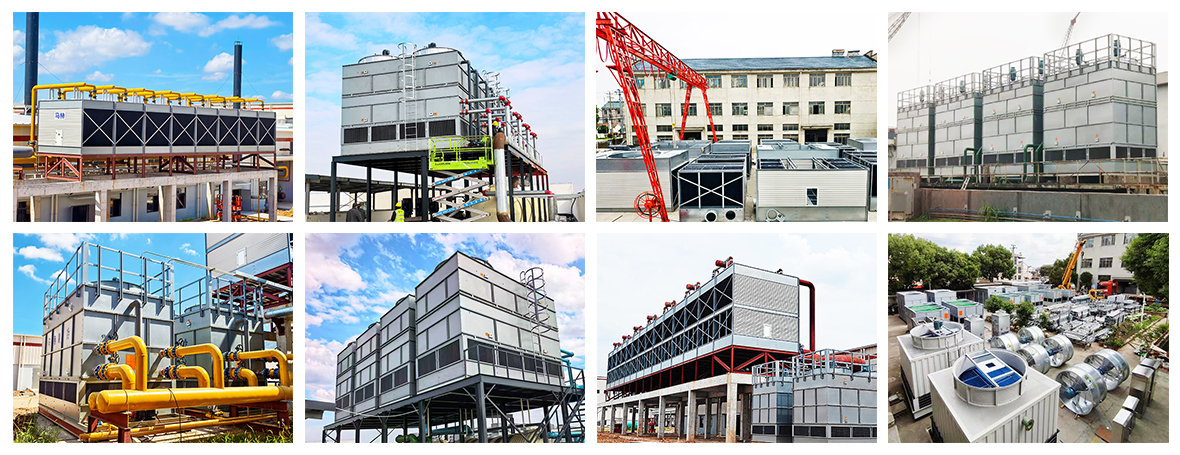
Water-cooled chillers are widely used in manufacturing because they provide controlled chilled water for industrial processes.
During operation, the chiller absorbs heat from the process water through its evaporator. The refrigeration system transfers this heat to the condenser side, where condenser water carries it away.
The cooling tower then removes the heat from the condenser water and releases it into the atmosphere.
In this system, the chiller and cooling tower perform different but complementary functions:
The chiller produces chilled water for industrial equipment.
The condenser water transfers heat away from the chiller.
The cooling tower rejects that heat into the surrounding air.
A mini cooling tower can be used with a small water-cooled chiller when its heat rejection capacity, water flow, and operating temperatures meet the chiller manufacturer's requirements.
One important point: cooling tower capacity should not be selected simply by looking at the chiller's refrigeration tonnage. The heat rejection load is generally greater than the chiller's cooling output because compressor energy also becomes heat.
Injection molding machines are widely used in plastic manufacturing. They produce components for automotive parts, electrical products, household appliances, packaging, and many other industries.
During injection molding, plastic materials are heated, melted, injected into molds, and cooled until they solidify.
Cooling is essential because it directly affects production cycle time and finished product quality.
The mold needs to release heat efficiently so that the plastic component can reach the required solidification condition. Hydraulic systems may also require cooling because pumps and motors generate heat during operation.
If cooling water temperature becomes too high, the mold may take longer to cool. This can increase cycle time and affect product consistency.
A suitable mini cooling tower can provide cooling water for applications where the required water temperature is compatible with evaporative cooling.
For processes requiring more precise or lower temperatures, a dedicated industrial chiller may be necessary.
A mini cooling tower can be integrated into a complete water-cooled chiller system.
In this arrangement, the chiller transfers heat from the process water to the condenser water, while the cooling tower removes heat from the condenser water.
The two systems work together to maintain continuous cooling.
A typical cooling process follows these steps:
Industrial equipment transfers heat to the process water.
The chiller evaporator absorbs heat from the process water.
The refrigerant cycle transfers heat to the condenser side.
A condenser water pump sends warmer water to the cooling tower.
The cooling tower distributes water over the fill while the fan moves air through the unit.
Evaporation removes heat from the circulating water.
The cooled condenser water returns to the chiller.
The cycle repeats while the system operates.
The cooling tower must be selected according to the chiller manufacturer's specified condenser water conditions.
Before purchasing a mini cooling tower, it is important to understand the difference between open-circuit and closed-circuit designs.
An open-circuit cooling tower allows circulating water to come into direct contact with air. It is widely used in industrial cooling systems where appropriate water treatment and maintenance are provided.
A closed-circuit cooling tower uses a heat exchange coil to keep the process fluid separated from the external spray water and air.
This arrangement can help reduce direct contamination of the process fluid and may be suitable for applications requiring a more isolated cooling circuit.
Which type should you choose?
It depends on your water quality, application requirements, maintenance expectations, and investment budget.
Injection molding factories are important users of industrial cooling equipment.
A mini cooling tower can serve an individual production line or form part of a centralized cooling water system, depending on the factory's layout and total cooling demand.
Mold cooling is one of the most important stages in injection molding production.
After molten plastic enters the mold, it must cool and solidify before the finished component can be removed.
Cooling channels inside the mold circulate water to absorb heat. Maintaining suitable water temperature and flow helps achieve consistent mold cooling.
For applications with moderate temperature requirements, cooling tower water may be suitable.
However, precision molding processes or materials requiring tighter temperature control may need a dedicated chiller.
Many injection molding machines use hydraulic systems to generate and control clamping and injection forces.
Hydraulic pumps and motors generate heat during operation. If hydraulic oil temperature becomes excessive, its viscosity may change, potentially affecting system performance and component life.
An oil cooler transfers heat from hydraulic oil into a circulating cooling water circuit.
A mini cooling tower can help remove this heat when the water temperature meets the oil cooler manufacturer's requirements.
Production interruptions can be expensive.
A machine that stops because of high temperatures may delay orders, increase labor costs, and disrupt the entire production schedule.
A properly selected cooling tower helps maintain stable heat rejection during normal operating conditions.
For factories operating several injection molding machines, engineers should consider the combined heat load, simultaneous operating rates, and possible future production expansion before selecting equipment.
Why do manufacturers choose a mini cooling tower instead of a larger cooling system?
The main reasons include compact design, installation flexibility, operating costs, and suitability for smaller cooling loads.
Factory space is valuable.
Every additional square meter may be needed for production equipment, material storage, or worker access.
A mini cooling tower occupies less space than many large industrial cooling tower systems. Its compact structure makes it suitable for smaller workshops, equipment rooms, and individual production areas.
However, remember that the installation footprint is not the only consideration. The cooling tower also needs sufficient air intake and exhaust clearance, maintenance access, and room for water piping.
Evaporative cooling uses water evaporation to reject heat.
Under suitable operating conditions, this can be an economical alternative to relying entirely on mechanical refrigeration for heat rejection.
A mini cooling tower generally consumes electricity through its fan motor and associated pumps. Actual operating costs depend on:
Fan motor power
Water pump selection
Operating hours
Water consumption
Water treatment requirements
Maintenance frequency
Another advantage is that cooling tower water may be used directly in suitable industrial applications instead of producing chilled water with a refrigeration system.
However, the required process temperature must always be considered before choosing this arrangement.
Consistent cooling water supply helps industrial equipment operate within its specified temperature range.
For injection molding factories, suitable cooling water conditions can support repeatable mold cooling and more predictable production cycles.
However, a cooling tower does not guarantee a fixed outlet water temperature.
Its performance changes with outdoor wet-bulb temperature, heat load, airflow, water flow, and equipment design.
If the process requires precise temperature control, additional equipment such as a chiller, temperature controller, or bypass system may be necessary.
Many mini cooling towers are relatively straightforward to integrate into small industrial water systems.
Their compact structure can simplify transportation and positioning.
Maintenance is also manageable when the equipment is designed with accessible components.
Operators should regularly inspect the cooling fill, spray nozzles, fan, motor, basin, and water quality.
A smaller cooling tower still requires proper water treatment and maintenance. Compact size does not mean maintenance-free operation.
Both systems can remove heat, but they use different methods.
An evaporative cooling tower relies on water evaporation and airflow, while an air-cooled system transfers heat directly to ambient air through a heat exchanger.
The following comparison explains their main differences.
| Comparison Factor | Mini Cooling Tower | Air-Cooled System |
|---|---|---|
| Cooling method | Evaporative heat rejection | Heat transfer to ambient air |
| Main resources | Water and electricity | Electricity |
| Water consumption | Requires makeup water | Generally no cooling tower makeup water |
| Ambient influence | Strongly affected by wet-bulb temperature | Strongly affected by dry-bulb temperature |
| Maintenance | Requires water treatment and cleaning | Requires heat exchanger and airflow cleaning |
| Installation | Needs water supply and drainage arrangements | Needs sufficient airflow and installation space |
| Main advantage | Can achieve relatively low water temperatures under suitable conditions | Avoids cooling tower evaporation and water treatment |
Neither system is automatically better in every situation.
A factory with limited water availability may prefer an air-cooled solution. A suitable evaporative cooling system may offer advantages where water is available and the required cooling conditions support it.
The right choice depends on local climate, energy prices, water availability, installation conditions, and cooling requirements.
Selecting a cooling tower based only on its appearance or advertised capacity is risky.
The equipment must match the actual heat rejection requirements of your machinery.
Here are the most important factors to consider.
Heat load is the starting point for cooling tower selection.
You need to know how much heat the system must remove during normal and peak production.
For a water circuit, a useful approximate heat transfer equation is:
Q = m × Cp × ΔT
Where:
Q = heat transfer rate
m = water mass flow rate
Cp = specific heat capacity of water
ΔT = water temperature difference between inlet and outlet
For water, an approximate engineering relationship is:
Q (kW) ≈ 1.163 × Flow (m³/h) × ΔT (°C)
For example, if the circulating water flow rate is 10 m³/h and the temperature difference is 5°C:
Q = 1.163 × 10 × 5 = 58.15 kW
This is an approximate heat transfer calculation, not a direct cooling tower model selection.
The cooling tower must also account for the design wet-bulb temperature, cooling range, approach temperature, airflow, and operating conditions.
Water flow rate is just as important as cooling capacity.
A tower with sufficient nominal capacity may still perform poorly if the pump, water distribution system, or connecting pipes cannot deliver the required flow.
Before selecting a model, confirm:
Hot water inlet temperature
Required cold water outlet temperature
Circulating water flow rate
Allowable temperature difference
Required operating pressure
Seasonal ambient wet-bulb temperature
The difference between hot water temperature and cold water temperature is called the cooling range.
The difference between cold water temperature and entering-air wet-bulb temperature is called the approach.
Both values are essential for cooling tower selection.
Installation conditions can significantly influence equipment performance.
Consider whether the tower will be installed indoors or outdoors, the available floor area, ventilation, ambient temperature, humidity, and surrounding obstructions.
If the cooling tower is installed close to a wall or another building, exhaust air may recirculate into the air inlet.
This can reduce cooling performance.
Proper installation clearance is therefore essential.
Water quality affects cooling tower reliability.
Hard water can cause scale formation, while suspended solids may block spray nozzles and fill passages.
Corrosive water can also shorten component life.
For industrial applications, ask the manufacturer about suitable casing, basin, fill, piping, and hardware materials.
PVC and PP are commonly used for cooling tower fill. However, material selection should consider water temperature, chemical compatibility, and actual operating conditions.
Water treatment should also be planned to control scaling, corrosion, and biological growth.
Matching a mini cooling tower with a chiller requires more than comparing their rated capacities.
Both pieces of equipment must operate within compatible conditions.
First, obtain the chiller manufacturer's condenser heat rejection data.
This is particularly important because a chiller's heat rejection load is greater than its refrigeration cooling output. The difference is largely associated with compressor energy input.
Second, confirm the required condenser water flow rate and entering water temperature.
Check the allowable temperature range and pressure drop specified by the chiller manufacturer.
Third, select a cooling tower based on the required heat rejection capacity at the actual site design wet-bulb temperature.
A tower's nominal capacity under one set of conditions may not represent its capacity under different operating conditions.
Fourth, check the condenser water pump, pipe diameter, valves, and control strategy.
The pump must provide the required flow through the complete circuit, including the cooling tower and chiller condenser.
Finally, confirm how the system will operate during startup, low load, high ambient temperature, and seasonal changes.
A properly engineered system should protect the chiller from operating outside its permitted condenser water conditions.
Different injection molding machines have different cooling requirements.
A small machine producing simple plastic components may have a very different heat load from a large machine operating several molds continuously.
Start by identifying which parts need cooling:
Injection molds
Hydraulic oil coolers
Auxiliary equipment
Other process cooling components
Then determine whether these components can share one cooling water circuit or require separate temperature-controlled circuits.
For example, a factory may use cooling tower water for hydraulic oil cooling while a separate chiller supplies lower-temperature water to precision molds.
This arrangement allows each circuit to operate according to its own temperature requirements.
When requesting a quotation, provide the following information:
Injection molding machine model and quantity.
Machine rated power and operating conditions.
Estimated heat load.
Required water supply temperature.
Return water temperature.
Required water flow rate.
Local summer design wet-bulb temperature.
Installation dimensions and available space.
Whether the cooling system serves one machine or multiple machines.
This information allows the manufacturer to evaluate the application instead of recommending a cooling tower based only on general machine tonnage.
A good cooling tower can only deliver its expected performance when installed correctly.
Even high-quality equipment may experience problems if airflow is restricted or water circulation is poorly designed.
Install the cooling tower in an area with sufficient fresh air circulation.
Avoid locations where hot exhaust air can easily return to the tower air inlet.
Keep the unit away from walls, exhaust outlets, and other obstacles that could restrict airflow.
Outdoor installation is common, but indoor installation may also be possible when appropriate ventilation and exhaust arrangements are provided.
Use appropriately sized water pipes to reduce unnecessary pressure losses.
Install suitable isolation valves, strainers, drain connections, and water flow measurement points where required.
Make sure the pump is correctly selected for the required flow rate and total system resistance.
An undersized pump may cause insufficient water circulation, while an incorrectly selected oversized pump can waste energy.
Ensure that the fan motor, pump, electrical controls, and protective devices meet local electrical standards.
Provide suitable protection against overload, short circuits, and water exposure.
Before starting production, check the direction of fan rotation, water distribution, leakage, vibration, and operating current.
Regular maintenance helps a mini cooling tower maintain stable performance and avoid unexpected downtime.
A simple maintenance schedule can prevent small problems from becoming expensive repairs.
Cooling fill provides the contact surface needed for heat and mass transfer.
Over time, dirt, algae, scale, and suspended particles may accumulate on its surface.
Blocked fill passages reduce airflow and interfere with water distribution.
Inspect the fill regularly and clean it using methods compatible with the material and manufacturer's recommendations.
Check the fan blades, motor bearings, mounting bolts, and electrical connections.
Unusual vibration or noise may indicate an imbalance, loose components, or bearing problems.
Regularly monitor water conductivity, pH, hardness, and other parameters relevant to the water treatment program.
Proper blowdown and makeup water management help control dissolved solids and reduce scaling risks.
Inspect spray nozzles and distribution pipes to make sure water is evenly spread over the fill.
Check drift eliminators for damage, dirt, or incorrect installation.
These components help maintain efficient operation and reduce water droplets leaving the tower.
Even a well-designed cooling system can develop problems during long-term operation.
Understanding common warning signs makes troubleshooting easier.
| Problem | Possible Cause | Recommended Action |
|---|---|---|
| High outlet water temperature | High heat load, poor airflow, high wet-bulb temperature | Check actual load, airflow, and tower selection |
| Low water flow | Pump problems, blocked pipes, clogged strainers | Inspect pump, valves, and piping |
| Uneven water distribution | Blocked or damaged spray nozzles | Clean or replace nozzles |
| Excessive water drift | Damaged or incorrectly installed eliminators | Inspect and replace damaged components |
| Excessive vibration | Fan imbalance or loose mounting | Inspect fan and motor assembly |
| Scale accumulation | Poor water treatment | Review water chemistry and treatment program |
| Algae growth | Inadequate biological control | Clean the tower and improve water treatment |
One important point: if outlet water temperature rises suddenly, do not immediately assume that the cooling tower is undersized.
First check water flow, fan operation, fill condition, spray distribution, and current ambient wet-bulb temperature.
The actual problem may be much simpler to solve.
When purchasing a mini cooling tower for an industrial chiller or injection molding machine, choosing the right manufacturer is just as important as choosing the right capacity.
You need equipment that matches your application, reliable manufacturing quality, and technical support throughout the purchasing process.
Mach Industry (Zhejiang) Co.,Ltd specializes in cooling tower manufacturing and industrial cooling solutions.
Through its official website, Mach Cooling, the company provides information about its cooling tower products and industrial cooling applications.
Mach Industry focuses on cooling tower products and related cooling equipment for industrial and commercial applications.
Its cooling tower solutions are designed for different heat rejection requirements and installation environments.
For customers looking for a mini cooling tower, the important consideration is not simply finding the smallest unit.
It is finding a model that delivers the required cooling performance under actual operating conditions.
Different factories have different cooling challenges.
A plastic injection molding workshop may require cooling for molds and hydraulic oil systems, while a refrigeration facility may need condenser water cooling for a water-cooled chiller.
Mach Industry can help customers evaluate their application requirements and identify an appropriate cooling tower configuration.
The final selection should be based on heat load, water flow, design temperatures, installation environment, and operating conditions.
Every industrial cooling project deserves proper technical evaluation.
A standard product may be suitable for one factory but not necessarily for another.
When contacting Mach Industry, customers can provide their equipment model, cooling load, required water temperature, flow rate, and installation dimensions.
This information helps the manufacturer evaluate the application and recommend a suitable solution.
Whether you need a compact cooling tower for one injection molding machine or a larger system for several production lines, proper equipment selection is the foundation of reliable operation.
For more information about cooling tower products and industrial cooling solutions, visit:
Official Website: https://www.machcooling.com
The required size depends on the machine's actual heat rejection load, water flow rate, inlet and outlet water temperatures, and local wet-bulb temperature.
Machine clamping force or injection tonnage alone cannot determine the correct cooling tower capacity.
For an accurate recommendation, provide the machine model, cooling requirements, and operating conditions to the manufacturer.
Yes.
A mini cooling tower can work with a small water-cooled chiller if its heat rejection capacity, condenser water flow, and operating temperatures meet the chiller manufacturer's requirements.
Always check the chiller's condenser specifications before selecting the cooling tower.
A cooling tower rejects heat into the atmosphere, primarily through evaporation.
A chiller uses a refrigeration cycle to remove heat from process water and produce chilled water at a controlled temperature.
They can work together in one system, but they are not interchangeable.
A cooling tower cannot always achieve the low water temperatures required by precision manufacturing processes.
Cleaning frequency depends on water quality, operating hours, environmental conditions, and the manufacturer's recommendations.
Regular inspections are important, particularly during periods of continuous operation.
Check the basin, fill, nozzles, drift eliminators, and water circulation system.
Clean components whenever dirt, scale, or biological growth begins to affect performance.
Yes, provided the equipment is correctly selected for the continuous heat load and is installed and maintained according to the manufacturer's instructions.
Consider peak summer conditions rather than sizing the tower only for average operating temperatures.
Yes, it may be possible to use one cooling tower for multiple machines.
However, the combined heat load, simultaneous operating conditions, required water flow, and distribution piping must all be evaluated.
For machines requiring different water temperatures, separate cooling circuits or additional chillers may be necessary.
A mini cooling tower for chiller and injection molding machine applications can be a practical solution for factories that need reliable heat rejection without installing an oversized cooling system.
Its compact design, evaporative cooling principle, and flexible applications make it suitable for many small and medium-sized industrial cooling projects.
However, choosing the right equipment requires more than looking at product dimensions or nominal tonnage.
Heat rejection capacity, water flow, cooling range, approach temperature, local wet-bulb conditions, and water quality all influence actual performance.
If you are planning to purchase a mini cooling tower for an industrial chiller or injection molding machine, working with an experienced manufacturer can help you avoid incorrect equipment selection and unnecessary operating costs.
Mach Industry (Zhejiang) Co.,Ltd is ready to support industrial customers looking for suitable cooling tower solutions.
Visit www.machcooling.com to explore its products and contact the team for technical consultation and a quotation.
Choose the right cooling tower, maintain stable water temperatures, and keep your production running efficiently.