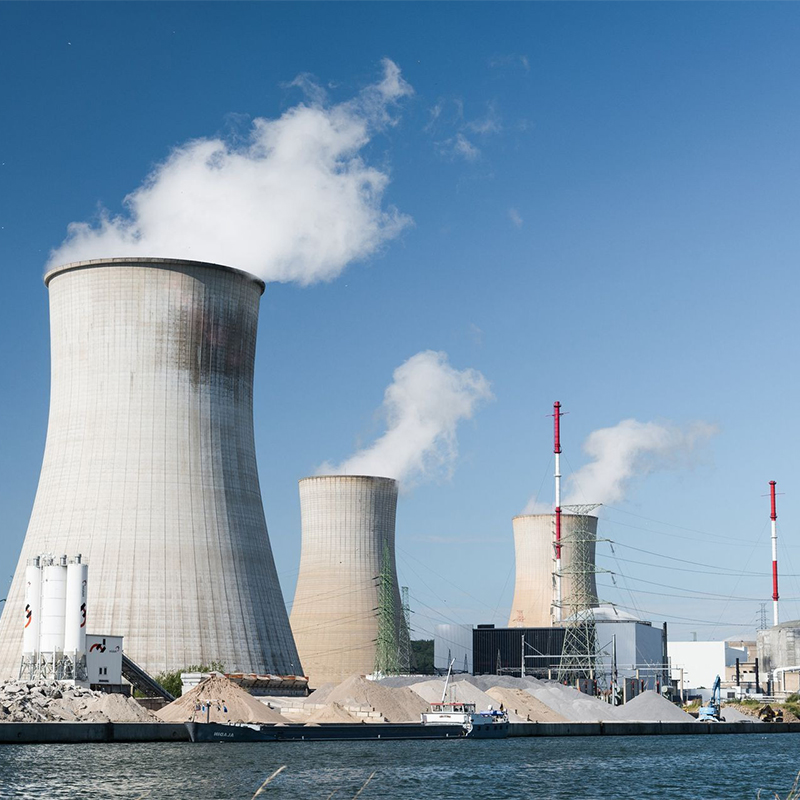
We Provide Cooling Tower Solution

Views: 0 Author: Cindy Publish Time: 2026-10-31 Origin: Site


Industrial facilities depend on reliable cooling systems to maintain production efficiency, protect equipment, and control operating temperatures. Whether you operate a power plant, chemical factory, plastic manufacturing facility, or commercial HVAC system, an industrial cooling tower plays an essential role in removing unwanted heat from circulating water.
However, choosing the right cooling tower is not simply about purchasing equipment with a suitable cooling capacity. Energy consumption, cooling performance, maintenance requirements, product quality, and supplier reliability all matter. That's why working with a trusted cooling tower supplier is so important.
An energy saving industrial cooling tower can help businesses reduce electricity consumption, improve heat rejection efficiency, and control long-term operating expenses. For manufacturers and industrial operators, investing in the right cooling equipment is a practical way to improve production stability while managing operating costs.
Power Tower Cooling Technology (Shaoxing) Co.,Ltd is committed to providing cooling tower products and related components for industrial and commercial cooling applications. Through suitable equipment selection, quality materials, and practical technical support, we aim to help customers find reliable cooling solutions for different operating environments.
In this article, we'll explore what makes an industrial cooling tower energy-efficient, how to choose a reliable supplier, and which factors matter most when purchasing cooling tower equipment.
An industrial cooling tower is a long-term investment. Once installed, it may operate continuously for thousands of hours every year. Even a relatively small difference in energy efficiency can create a noticeable impact on annual operating costs.
Imagine purchasing two cooling towers with similar rated capacities. One uses an optimized fan system, properly designed fill media, and an effective water distribution arrangement. The other has poor airflow distribution and inefficient heat exchange.
Although their initial specifications may look similar, their actual operating performance could be very different.
This is where an experienced cooling tower supplier makes a difference.
A professional cooling tower manufacturer should understand your operating conditions, evaluate your cooling requirements, recommend appropriate configurations, and provide reliable product support.
Instead of simply selling equipment, the right supplier helps you select a cooling solution that works throughout its service life.
When evaluating suppliers, consider several important factors:
Manufacturing experience and technical capabilities.
Cooling tower design and product quality.
Energy efficiency and cooling performance.
Material selection and product durability.
Customization and replacement capabilities.
Technical support and spare parts availability.
Choosing the right supplier from the beginning can help reduce purchasing risks and avoid unnecessary maintenance expenses later.
Industrial cooling towers are heat rejection devices that remove heat from circulating water and release it into the atmosphere.
They are widely used in industrial production, power generation, refrigeration, and building air-conditioning systems.
In many applications, hot process water enters the cooling tower after absorbing heat from industrial equipment. Inside the tower, the water is distributed over cooling fill, where it comes into contact with moving air.
A portion of the water evaporates, carrying heat away and reducing the temperature of the remaining water. The cooled water then returns to the production or cooling system.
This process allows factories to reuse cooling water rather than continuously consuming fresh water.
A properly selected cooling tower can therefore support both operational efficiency and responsible resource management.
Most mechanical-draft cooling towers use fans to move air through the equipment.
Water flows downward through the fill while air moves upward or horizontally, depending on the tower design. The contact between air and water creates the conditions necessary for heat and mass transfer.
Cooling tower performance depends on several operating parameters:
Entering water temperature.
Leaving water temperature.
Wet-bulb temperature.
Water circulation rate.
Airflow volume.
Heat rejection capacity.
The difference between entering and leaving water temperatures is known as the cooling range.
The difference between the leaving water temperature and the ambient wet-bulb temperature is called the approach.
Understanding these values is essential when selecting an industrial cooling tower because they directly influence the required heat rejection capacity.
An industrial cooling tower consists of several components that work together.
Cooling tower structure: Supports the entire system and protects internal components.
Cooling tower fill: Provides an extensive surface area for heat and mass transfer between air and water.
Water distribution system: Uses pipes and spray nozzles to distribute hot water across the fill.
Fans and motors: Generate the airflow required for cooling.
Drift eliminators: Reduce the amount of water droplets carried out with exhaust air.
Cold-water basin: Collects cooled water before it returns to the industrial process.
Other components may include gearboxes, shafts, bearings, louvers, and control systems.
Each component affects overall performance. For example, inefficient fill can increase the energy required to achieve the same cooling result, while poorly selected fans may consume unnecessary electricity.
Energy efficiency is no longer just an optional feature. For many industrial businesses, it is an important factor in controlling production costs and improving competitiveness.
Cooling towers often operate for extended periods, so electricity consumption from fans and associated pumps can accumulate quickly.
An energy-efficient design helps reduce unnecessary power consumption while maintaining the required cooling capacity. It can also improve equipment reliability and reduce maintenance expenses.
Fans and circulating water pumps are among the main electricity consumers in a cooling system.
Selecting appropriately sized motors, optimizing fan blades, and using variable-frequency drives where suitable can improve energy performance.
A variable-frequency drive adjusts motor speed according to actual cooling demand.
For example, when the cooling load decreases, the fan can operate at a lower speed rather than running continuously at full capacity.
This approach can provide meaningful energy savings, especially in systems with changing seasonal or production loads.
However, fan speed control must be coordinated with minimum airflow requirements, water temperatures, and equipment operating limits.
A cooling tower must remove heat effectively under specified operating conditions.
Better heat transfer between water and air helps the system achieve its target outlet temperature.
High-performance fill, uniform water distribution, and optimized airflow all contribute to this process.
When heat transfer is improved, operators may be able to achieve the required cooling performance without unnecessarily increasing fan speed or water circulation.
The goal is not simply to maximize airflow or install the largest possible motor. It is to balance heat exchange performance, airflow resistance, water distribution, and energy consumption.
The initial purchase price represents only one part of the total cost of ownership.
Electricity, water treatment, replacement parts, cleaning, and maintenance all contribute to long-term expenses.
An inexpensive cooling tower may become costly if it requires frequent repairs or consumes excessive energy.
A better purchasing strategy considers the equipment's expected operating conditions and lifetime costs.
Investing in an efficient cooling system can help businesses achieve a better balance between initial investment and long-term financial performance.
Energy efficiency comes from the coordinated performance of multiple components.
There is no single part that automatically makes a cooling tower energy-efficient. Instead, the structure, fill, fans, water distribution system, and operating controls must work together.
Cooling tower fill is one of the most important components influencing thermal performance.
Its main purpose is to increase the contact area between water and air, allowing more effective heat and mass transfer.
There are two common types of cooling tower fill.
Film fill
Film fill spreads water into thin films over closely arranged surfaces, creating a large contact area.
It is commonly used in applications where water quality and operating conditions are suitable.
PVC film fill is widely used because it offers a practical combination of lightweight construction, formability, and cost-effectiveness.
Splash fill
Splash fill breaks water into smaller droplets, increasing contact between water and air.
It is often considered for applications involving more challenging water conditions, depending on the specific fill design.
Common cooling tower fill materials include:
Material | Main Characteristics | Typical Applications |
|---|---|---|
PVC | Lightweight, economical, widely available | General industrial cooling |
PP | Good chemical resistance and higher temperature capability than many standard PVC grades | Industrial applications with more demanding conditions |
CPVC | Better temperature resistance than standard PVC | Higher-temperature cooling applications |
Choosing the right fill geometry and material can improve heat exchange performance and help maintain stable operation.
However, fill selection should always consider water quality, temperature, airflow resistance, and the original cooling tower design.
Fans provide the airflow needed for evaporative cooling.
Their blade geometry, diameter, rotational speed, and installation conditions influence airflow and power consumption.
Efficient fan systems should deliver the required air volume without creating excessive resistance or vibration.
Motor selection is equally important.
A motor should match the required load and operating environment rather than being oversized without a clear technical reason.
Regular inspection of blades, bearings, belts, and gearboxes can also prevent energy losses caused by mechanical problems.
Water distribution affects how evenly hot water reaches the cooling tower fill.
If some areas receive too much water while others remain dry, the fill cannot operate efficiently.
Uneven distribution may create localized hot spots and reduce the effective heat transfer area.
Properly designed distribution pipes, spray nozzles, and pressure conditions help maintain consistent water coverage.
This allows the cooling tower to use its fill area more effectively and reduces the risk of unnecessary energy consumption.
Modern cooling tower systems can use temperature sensors, pressure monitoring, and automated controls to adjust operation according to real-time demand.
For example, a control system can regulate fan speed based on cold-water temperature.
Multiple-cell systems may also benefit from staged fan operation, allowing individual cells to operate according to actual cooling requirements.
These technologies can reduce unnecessary operation and improve system flexibility.
Different industrial projects require different cooling tower configurations.
Understanding the main types helps buyers select equipment that matches their available space, water quality, cooling requirements, and maintenance preferences.
In a crossflow cooling tower, air moves horizontally across the falling water.
Hot water is distributed through a system positioned above the fill, and gravity allows water to flow downward.
One advantage is convenient access to many distribution components, which can simplify inspection and maintenance.
Crossflow cooling towers are widely used in commercial HVAC systems and industrial applications where their configuration is appropriate.
In a counterflow cooling tower, air moves upward while water flows downward.
Because air and water travel in opposite directions, the design can provide effective heat and mass transfer in a relatively compact arrangement.
Counterflow systems are suitable for many industrial applications, although their actual performance depends on fill design, airflow resistance, and operating conditions.
Open-circuit cooling towers allow process water to come into direct contact with air.
Heat is removed mainly through evaporation and sensible heat transfer.
These systems are commonly used in industrial cooling and HVAC applications.
Because water is exposed to the atmosphere, water treatment and routine cleaning are important for controlling scale, corrosion, and biological growth.
Closed-circuit cooling towers use a heat exchanger coil to separate the process fluid from the external spray water and air.
This arrangement helps keep the process fluid isolated from direct atmospheric exposure.
Closed-circuit systems can be suitable for applications where fluid cleanliness and process protection are important.
Their investment cost and maintenance requirements should be evaluated according to the specific project.
Industrial cooling towers are used across a wide range of industries.
Each application has its own requirements for cooling capacity, water quality, operating temperature, and equipment reliability.
Power plants and energy facilities use cooling systems to remove heat generated during electricity production and other industrial processes.
Cooling towers support stable operating temperatures and help maintain overall plant performance.
Large-scale projects may require multiple cooling tower cells, high water circulation rates, and carefully coordinated control systems.
Chemical manufacturing often involves continuous processes that generate considerable heat.
Reliable cooling is essential for maintaining process conditions and protecting equipment.
Cooling tower materials must be selected according to water chemistry, temperature, and potential exposure to industrial contaminants.
Plastic injection molding, extrusion, metal processing, and other manufacturing operations require dependable temperature control.
Cooling towers help remove heat from molds, machinery, compressors, and process water systems.
Stable cooling performance can help manufacturers maintain production consistency and reduce unexpected interruptions.
Large commercial buildings, shopping centers, hotels, and industrial facilities often use cooling towers as part of central chiller systems.
Efficient cooling tower operation can improve the overall performance of the cooling plant and help reduce building energy consumption.
Food processing and pharmaceutical production may require reliable cooling for equipment and supporting utilities.
In these industries, water quality, hygiene requirements, and system separation must be considered carefully.
The cooling tower configuration should comply with the relevant process and regulatory requirements.
Finding a reliable supplier involves more than comparing quotations.
Buyers should evaluate manufacturing capabilities, technical knowledge, product quality, customization options, and after-sales support.
A professional supplier should understand different cooling tower structures, operating conditions, and industrial applications.
Ask about previous projects, manufacturing processes, product specifications, and the types of cooling systems the supplier can support.
A supplier that understands both complete equipment and key components may provide more practical recommendations.
Material selection has a direct impact on product durability and performance.
Cooling tower structures, fill media, drift eliminators, fans, and other components must be suitable for their intended environments.
Ask for technical datasheets, material specifications, inspection procedures, and relevant test documentation.
Where necessary, request samples or third-party testing records.
Industrial projects are rarely identical.
Cooling capacity, installation dimensions, water temperature, ambient wet-bulb temperature, and water quality can vary considerably.
A good supplier should be able to discuss these requirements and recommend a suitable configuration.
Customized dimensions and component arrangements may be necessary for replacement projects or equipment upgrades.
Maintenance becomes difficult when replacement components are unavailable.
Before placing an order, ask about spare parts, replacement fill, fan components, drift eliminators, and technical assistance.
Reliable support can help reduce downtime and make long-term maintenance more manageable.
Before requesting a quotation, prepare the basic technical information about your project.
These details help the manufacturer evaluate the required cooling capacity and recommend an appropriate model.
Parameter | Description |
|---|---|
Cooling capacity | Total heat that the cooling tower must reject, usually expressed in kW, MW, or refrigeration tons. |
Water flow rate | Amount of circulating water passing through the cooling tower per unit of time. |
Hot water temperature | Temperature of the water entering the cooling tower. |
Cold water temperature | Required temperature of the cooled water leaving the tower. |
Wet-bulb temperature | Local design wet-bulb temperature, which influences achievable cooling performance. |
Cooling range | Difference between hot-water and cold-water temperatures. |
Cooling tower approach | Difference between cold-water temperature and ambient wet-bulb temperature. |
Installation space | Available length, width, and height, including maintenance clearance. |
Water quality | Water characteristics that may affect fill selection, scaling, corrosion, and maintenance. |
Power supply | Voltage, frequency, and electrical requirements for motors and controls. |
Providing accurate information allows a cooling tower supplier to make a more reliable recommendation instead of simply selecting a model based on nominal capacity.
Even a well-designed cooling tower needs proper operation and maintenance.
Over time, dirt, scale, biological growth, mechanical wear, and changes in process demand can reduce performance.
Fortunately, several practical measures can help improve energy efficiency.
Aging or clogged fill can restrict airflow and reduce effective heat transfer.
If the existing fill is damaged, deformed, or heavily blocked, replacing it with suitable high-performance fill may improve cooling performance.
However, replacement fill must match the original tower dimensions, support arrangement, airflow characteristics, water distribution, and operating conditions.
Simply installing denser fill does not guarantee better efficiency.
Check fan blade condition, alignment, rotation direction, vibration, and motor loading.
If the cooling load changes throughout the day or across seasons, consider whether variable-speed control is appropriate.
Maintaining the correct airflow can prevent unnecessary electricity consumption while protecting cooling performance.
Water quality influences cooling tower reliability.
Excessive suspended solids, mineral deposits, corrosion products, and biological growth can block fill passages and reduce heat transfer.
A suitable water treatment program, regular blowdown, and monitoring of key water parameters help keep the system operating properly.
Inspect the cooling tower structure, water distribution pipes, spray nozzles, fill, drift eliminators, fans, motors, and basin.
Look for leakage, unusual vibration, uneven water distribution, and damaged components.
Early maintenance is usually more manageable than repairing a major failure after performance has deteriorated.
When selecting an industrial cooling tower supplier, customers need a partner that understands product performance, component quality, and practical application requirements.
Power Tower Cooling Technology (Shaoxing) Co.,Ltd provides cooling tower products and related components for industrial and commercial cooling applications.
Through its website, www.coolingtowerpart.com, the company offers customers access to cooling tower solutions and replacement components.
Our focus is to help customers identify suitable products for their equipment requirements and support more reliable cooling system operation.
Different industries have different cooling demands.
A plastic processing factory may prioritize stable process water temperatures, while a power generation facility may require large-scale heat rejection capacity.
We understand the importance of evaluating actual operating conditions before recommending products.
Our approach focuses on matching product specifications with customer requirements rather than relying on a one-size-fits-all solution.
Cooling tower performance depends heavily on the quality of its internal components.
Fill media, drift eliminators, water distribution systems, and other parts all influence thermal performance and operating reliability.
Selecting suitable replacement components can help restore the performance of aging equipment.
We emphasize the importance of material selection, dimensional compatibility, and application-specific product recommendations.
Replacement projects can be challenging because existing cooling towers may have different dimensions, structures, and installation conditions.
Customers may need replacement fill that matches an existing tower or components designed for a particular operating environment.
By reviewing drawings, dimensions, photographs, and technical parameters, the appropriate product configuration can be evaluated before production or supply.
We believe that effective communication is an important part of successful industrial equipment purchasing.
Customers should be able to discuss product dimensions, material requirements, operating conditions, and replacement needs before confirming an order.
Providing clear technical information helps reduce selection errors and makes project coordination easier.
For customers looking for cooling tower products and components, Power Tower aims to provide practical product support throughout the purchasing process.
Industrial cooling technology continues to develop as manufacturers look for ways to improve performance and reduce energy consumption.
Several trends are becoming increasingly important.
Variable-frequency drives and intelligent controls: These allow cooling towers to respond more effectively to changing cooling loads.
Improved fan blade designs: Optimized aerodynamic designs can help achieve the required airflow with better energy performance.
Advanced cooling tower fill: Improved fill geometries aim to increase heat transfer while maintaining acceptable airflow resistance.
Remote monitoring: Digital sensors and monitoring systems make it easier to identify operating problems before they become serious.
Improved materials: Material developments are helping manufacturers develop components with better durability and application-specific resistance.
These technologies are not automatically suitable for every installation. The best solution depends on the project's operating conditions, energy prices, maintenance capabilities, and investment budget.
There is no single cooling tower design that is the most efficient for every application.
Crossflow and counterflow systems can both provide good performance when properly designed and selected.
The best choice depends on cooling capacity, wet-bulb temperature, water quality, installation space, fan power, and operating conditions.
Start by checking fan and motor efficiency, optimizing fan speed, maintaining proper water distribution, and cleaning clogged fill.
Variable-frequency drives may reduce electricity consumption when cooling demand changes.
Regular maintenance also helps prevent unnecessary energy losses.
Cooling tower service life depends on structural materials, operating conditions, water treatment, maintenance quality, and environmental exposure.
Different components have different replacement cycles.
For example, cooling tower fill may need replacement before the main structure reaches the end of its service life.
Regular inspections help identify deterioration and determine when repairs or replacement are necessary.
Important information includes:
Required cooling capacity.
Water flow rate.
Entering and leaving water temperatures.
Local design wet-bulb temperature.
Installation dimensions.
Water quality.
Power supply.
For replacement projects, photographs, original model information, drawings, and component dimensions are also useful.
A professional manufacturer can help evaluate technical requirements, select suitable materials, and recommend equipment configurations.
This reduces the risk of incorrect product selection and helps customers achieve more dependable cooling performance.
Reliable technical support and replacement parts are also important advantages.
Choosing a trusted cooling tower supplier is an important step toward building an efficient and reliable industrial cooling system.
The right cooling tower should deliver the required heat rejection performance while balancing electricity consumption, water usage, maintenance requirements, and long-term operating costs.
From cooling tower fill and fans to water distribution and intelligent controls, every component contributes to overall system performance.
Before purchasing, evaluate the manufacturer's experience, product materials, technical capabilities, customization options, and after-sales support.
Power Tower Cooling Technology (Shaoxing) Co.,Ltd is committed to providing cooling tower products and related components for customers seeking dependable industrial cooling solutions.
Whether you are planning a new cooling project, upgrading an existing system, or replacing aging cooling tower components, selecting the right products is essential.
Looking for an energy saving industrial cooling tower solution or reliable cooling tower components?
Visit our website to explore our products and contact our team with your project requirements.
Power Tower Cooling Technology (Shaoxing) Co.,Ltd
Website: https://www.coolingtowerpart.com
Email our team through the website to discuss your cooling tower requirements and find suitable industrial cooling solutions.