We Provide Cooling Tower Solution

Views: 0 Author: Cindy Publish Time: 2026-09-16 Origin: Site


Looking for a small cooling tower manufacturer can be surprisingly difficult.
Why? Because “small” does not mean the same thing to every buyer. A compact cooling tower for a commercial chiller may be completely different from a small industrial unit serving injection molding equipment, compressors, heat exchangers, or process machinery.
And then there is the manufacturer question.
Should you choose a famous global brand? A specialized cooling tower company? Or a direct manufacturer that can customize the tower around your exact operating conditions?
This guide looks at seven representative small cooling tower manufacturers from around the world. It is not an official global ranking, because no single organization publishes a universally accepted ranking of small cooling tower manufacturers. Instead, the list focuses on companies with strong cooling tower capabilities, relevant factory-assembled or compact products, engineering experience, and established applications.
The goal is simple: help you compare manufacturers before you request a quotation.
A small cooling tower is generally a factory-assembled or compact evaporative cooling system designed for relatively modest heat-rejection requirements.
There is no universal tonnage cutoff that officially defines “small.” Depending on the application, a small tower might handle several tons, dozens of tons, or more than 100 tons of cooling capacity.
For example, SPX Cooling Tech's Marley Aquatower is a compact crossflow cooling tower with thermal capacities listed from 7 to 126 tons, making it a clear example of a product line serving smaller cooling requirements.
Small cooling towers are commonly used for:
Commercial HVAC
Chiller systems
Plastic injection molding
Machine cooling
Compressors
Hydraulic equipment
Food and beverage processing
Small industrial processes
Data and equipment facilities
Heat exchanger systems
The important point is this: physical size and cooling capacity are not the same thing.
A compact tower can still provide serious heat rejection when it is properly engineered.
Rather than simply picking the most famous cooling tower names, several practical criteria were considered.
First, a manufacturer needs to offer cooling towers that can realistically serve smaller applications.
A company may be excellent at designing huge natural-draft towers for power plants but have limited relevance to a buyer looking for a compact factory-assembled unit.
A good manufacturer should be able to work with actual operating parameters rather than selling based on a single “tonnage” number.
Heat load, water flow, entering and leaving water temperature, wet-bulb temperature, approach, airflow, and installation conditions all matter.
A cooling tower is not a disposable product.
It may operate for many years, so technical support, spare parts, maintenance knowledge, documentation, and engineering assistance are important parts of the buying decision.
With those points in mind, the following seven manufacturers are worth researching.

SPX Cooling Tech / Marley is one of the best-known names in the global cooling tower industry.
SPX Cooling Tech manufactures cooling towers, evaporative fluid coolers, evaporative condensers, and related equipment under brands including Marley, Recold, and SGS. The company says its brands have supported HVAC, refrigeration, and industrial process cooling applications for decades.
For small cooling tower buyers, the Marley Aquatower is particularly relevant. It is a factory-assembled crossflow tower with listed thermal capacity from 7 to 126 tons and water flow from 20 to 378 gpm.
SPX also offers a broad portfolio of other cooling tower configurations, including Marley MD, NC, AV, Sigma, and other product families.
The major advantage is product breadth.
If your project starts small but may expand later, working with a manufacturer that has multiple tower families can make future upgrades easier.
Marley's long-established brand presence, factory-assembled options, engineering resources, and broad product portfolio also make it a strong reference point when comparing cooling tower manufacturers.

Baltimore Aircoil Company (BAC) is another major name in evaporative cooling and heat rejection.
BAC offers cooling towers for HVAC and industrial applications, with product families covering crossflow, counterflow, induced-draft, and forced-draft configurations.
For smaller applications, BAC's product portfolio includes options that extend into relatively modest capacities. Its Series V cooling tower, for example, is listed with thermal capacity from 12 to 1,335 tons, while its FXT cooling tower is positioned specifically for small-scale projects and is listed from 46 to 257 tons.
BAC also emphasizes compact layouts, maintenance accessibility, and operating efficiency across different product families.
BAC is particularly attractive when the project has demanding space, maintenance, or efficiency requirements.
Its product portfolio is broad enough to support both smaller projects and larger industrial systems, which can be useful for companies operating multiple facilities.
Another advantage is the availability of engineering resources and documentation for system designers.
EVAPCO is a global manufacturer specializing in evaporative cooling and heat transfer equipment.
Its product portfolio covers commercial HVAC, industrial process cooling, data centers, industrial refrigeration, and power generation.
One notable product family is the EVAPCO AT Cooling Tower. The company lists the AT series with capacities from 33 to 5,141 nominal tons, meaning the same product family can cover relatively small projects as well as much larger systems.
EVAPCO also offers the AXS crossflow cooling tower, designed around induced-draft axial-fan technology and simplified maintenance.
EVAPCO is a strong candidate for buyers who want a combination of thermal engineering, factory-assembled equipment, and broad application experience.
Its presence across HVAC, process cooling, and data center applications is also useful if you need a manufacturer that understands different operating environments.
For buyers comparing small cooling towers, the key is to focus on the specific model and its rated performance rather than judging the manufacturer only by brand reputation.
Paharpur Cooling Towers is a major cooling tower manufacturer based in India with extensive experience across industrial, commercial, HVACR, and power applications.
Paharpur offers wet cooling, dry cooling, adiabatic cooling, and cooling tower components. Its factory-assembled and unitary product range includes several compact product families.
The company's published product information includes the AQ3800, CF3, OXF-30K, RXF, CFI, CF-II, 6.1KF, QF-20K, and 9KF ranges.
Its CF-II, for example, is described as a compact counterflow cooling tower for HVACR applications, with a listed water-flow range of 60–640 CMH per cell.
Paharpur stands out for its wide range of packaged and factory-assembled cooling solutions.
That makes it particularly relevant for buyers who need compact equipment but still want access to a large manufacturer's engineering capabilities.
The company also serves industries including pharmaceuticals, food and beverage, chemicals, oil and gas, power, and commercial buildings.
Delta Cooling Towers takes a somewhat different approach from some of the larger multinational cooling tower companies.
The U.S.-based manufacturer is particularly known for engineered plastic cooling towers, including HDPE construction.
For small applications, Delta's Pioneer forced-draft cooling towers are especially relevant. Its published specifications include models from 10 to 100 cooling tons, with compact models such as the 10-, 15-, 20-, and 25-ton units.
Delta also offers Paragon induced-draft towers beginning at 55 cooling tons.
Material selection is one of Delta's biggest differentiators.
Its published product information highlights seamless engineered HDPE construction, corrosion resistance, removable nozzles, PVC fill, and factory assembly.
That can be especially attractive for applications where corrosion, water chemistry, or long-term maintenance is a major concern.
If your project is relatively small and you want a specialized cooling tower rather than a huge industrial system, Delta is certainly worth comparing.
John Cockerill Hamon brings a different type of expertise to this list.
John Cockerill Hamon focuses heavily on engineered cooling systems, including induced-draft, forced-draft, natural-draft, fan-assisted natural-draft, and plume-abated cooling towers.
The company reports more than 6,000 HAMON induced-draft cooling towers worldwide, covering power and industrial applications.
It is worth noting that Hamon's strength is particularly visible in large-scale and engineered projects. Therefore, it may not be the first choice for every small cooling tower buyer.
If your “small” tower is part of a more complex engineered cooling system, Hamon's design capabilities can be valuable.
The company considers factors such as water quality, air environment, noise, plume limitations, available plot area, local conditions, and thermal performance when developing cooling systems.
In other words, Hamon is more about engineering the whole cooling challenge than simply selling a standard box.

Mach Industry (Zhejiang) Co., Ltd. is a manufacturer option worth considering for buyers looking for a direct factory relationship and application-specific cooling tower solutions.
For international buyers, a manufacturer such as Mach can offer an important advantage: closer communication between the customer and the production side.
Instead of starting with a generic product number, buyers can discuss the actual project requirements, including:
Cooling capacity
Water flow
Hot-water temperature
Cold-water temperature
Wet-bulb temperature
Installation location
Available footprint
Fan and motor requirements
Fill material
Water distribution
Electrical requirements
That information gives the manufacturer a much clearer picture of what the tower actually needs to accomplish.
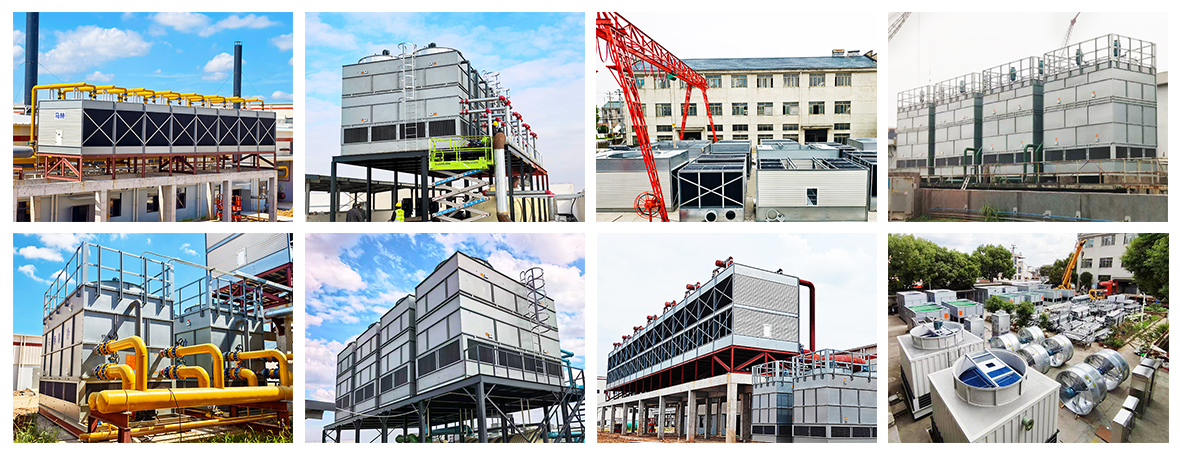
For buyers comparing global brands with direct manufacturers, Mach can be a practical option when customization, communication, project flexibility, and factory-direct sourcing are important.
A smaller tower is not necessarily a simple tower.
A 30-ton, 50-ton, or 100-ton project may still have unusual water chemistry, strict space limitations, high ambient temperatures, special materials, or unique connection requirements.
A manufacturer that can discuss those details directly can potentially provide a better fit than a one-size-fits-all approach.
Mach Cooling is the official website for Mach Industry (Zhejiang) Co., Ltd., where buyers can review cooling tower solutions and discuss project requirements.
So, which manufacturer should you choose?
There is no universal winner.
The right choice depends on your project.
| Manufacturer | Strong Point | Relevant Small-Tower Angle | Typical Buyer |
|---|---|---|---|
| SPX / Marley | Broad product portfolio | Compact factory-assembled options | HVAC, industrial, commercial |
| BAC | Efficiency and serviceability | Small-scale and compact product options | HVAC, industrial |
| EVAPCO | Global engineering and product range | Factory-assembled towers | HVAC, process cooling |
| Paharpur | Packaged and customized solutions | Compact/unitary towers | HVACR, industrial |
| Delta | HDPE construction | 10–100 ton Pioneer models | Industrial, HVAC |
| John Cockerill Hamon | Engineered cooling systems | Specialized applications | Industrial and engineered projects |
| Mach | Factory-direct flexibility | Application-specific solutions | OEM, industrial, international buyers |
First ask what you are cooling.
A tower for an office building chiller may have completely different requirements from a tower used for injection molding.
Do not choose a manufacturer before defining the application.
Next, look at the available capacity range.
If your project needs 40 tons, there is little reason to start with a manufacturer focused exclusively on enormous field-erected towers.
On the other hand, if your 80-ton system may grow to 200 tons, a manufacturer with a broader product portfolio could be more attractive.
Material matters more than many first-time buyers realize.
FRP, galvanized steel, stainless steel, HDPE, PVC, polypropylene, and other materials can each have different advantages depending on water chemistry, temperature, corrosion exposure, and expected service life.
The cheapest material is not necessarily the cheapest solution over 10 or 15 years.
Look beyond the purchase price.
Fan motor efficiency, water distribution, fill design, drift eliminators, access to components, spare parts, and cleaning requirements all influence lifecycle cost.
A tower that saves a little at purchase but consumes significantly more energy every year can become expensive surprisingly quickly.
Start with heat rejection.
How much heat must the tower remove?
This is the foundation of the entire selection process.
Never choose a tower solely because its catalog says “small” or because another facility uses the same model.
Provide the manufacturer with:
Water flow rate
Entering-water temperature
Leaving-water temperature
Expected operating range
These parameters allow the manufacturer to evaluate actual thermal requirements.
Where will the cooling tower operate?
A tower designed for a mild climate may need different performance characteristics when installed in a hot, humid location.
Wet-bulb temperature is therefore a critical part of the quotation process.
Measure the available area before selecting the tower.
Consider not just the tower footprint but also:
Air intake clearance
Air discharge
Maintenance access
Piping
Electrical connections
Crane access
Noise restrictions
A tower that fits on paper but cannot be serviced properly is not a good design.
Many buyers search for small cooling tower price immediately.
That makes sense.
But the price can vary significantly because capacity is only one factor.
Important cost drivers include:
Cooling capacity
Construction materials
Fan and motor
Fill media
Water distribution system
Controls
Corrosion protection
Customization
Transportation
Installation
Water treatment requirements
A standard factory-assembled tower will usually be easier to price than a heavily customized unit.
However, customization can be worthwhile when the project has unusual conditions.
The smart approach is to compare total value, not just the lowest quotation.
A famous manufacturer can be excellent, but the specific product still needs to match your application.
The cheapest tower may not provide the lowest lifecycle cost.
Wet-bulb temperature can make a major difference to tower performance.
If one quotation includes premium materials and another uses standard materials, comparing only the final price is misleading.
Before purchasing, ask how replacement fill, motors, fans, nozzles, drift eliminators, and other components will be supplied.
If your production line will expand, tell the manufacturer now.
It is much easier to plan for future capacity before installation than after the tower is already operating.
Before selecting a small cooling tower manufacturer, ask:
1. What cooling capacity can you guarantee under my design conditions?
2. What water flow rate is required?
3. What entering and leaving water temperatures should I use?
4. What wet-bulb condition is the tower rated for?
5. What materials are used for the casing, fill, basin, and hardware?
6. What fan and motor configuration is included?
7. What maintenance access is available?
8. What spare parts are available?
9. What certifications or performance testing are available?
10. Can the tower be customized for my installation?
These questions quickly separate a serious manufacturer from a company that simply resells equipment.
Finding the best small cooling tower manufacturer is not about finding the biggest company.
It is about finding the manufacturer whose product, engineering capability, materials, service, price, and production flexibility match your application.
SPX Cooling Tech / Marley, BAC, EVAPCO, Paharpur, Delta Cooling Towers, and John Cockerill Hamon all bring different strengths to the market. Mach Industry (Zhejiang) Co., Ltd. can also be considered by buyers who value direct manufacturer communication, customization, and factory-based project support.
The most important lesson?
Do not start with the manufacturer. Start with the cooling requirement.
Once you know the heat load, water flow, temperatures, wet-bulb condition, installation space, and operating environment, it becomes much easier to identify the right manufacturer and product.
And that is how you avoid buying a cooling tower that is either too small, too large, too expensive, or simply wrong for the job.
There is no universal capacity limit for a “small cooling tower.” The term generally refers to compact or factory-assembled towers serving relatively modest heat loads. Depending on the application, this can range from several tons to more than 100 tons.
There is no single best manufacturer for every project. Marley, BAC, EVAPCO, Paharpur, Delta, John Cockerill Hamon, and Mach all have different strengths. The best choice depends on capacity, application, materials, climate, installation space, budget, and technical requirements.
Small cooling tower prices vary according to capacity, materials, fan and motor configuration, fill, water distribution, controls, customization, shipping, and installation. The most accurate way to obtain a price is to provide complete operating conditions to the manufacturer.
Yes. Depending on the manufacturer and product line, customization can include dimensions, materials, fan and motor configuration, fill, water distribution, electrical requirements, controls, and connection arrangements.
At minimum, provide the required cooling capacity, water flow rate, entering-water temperature, leaving-water temperature, design wet-bulb temperature, installation location, available space, water quality, power supply, and operating schedule. The more complete the information, the more accurate the manufacturer's selection and quotation can be.