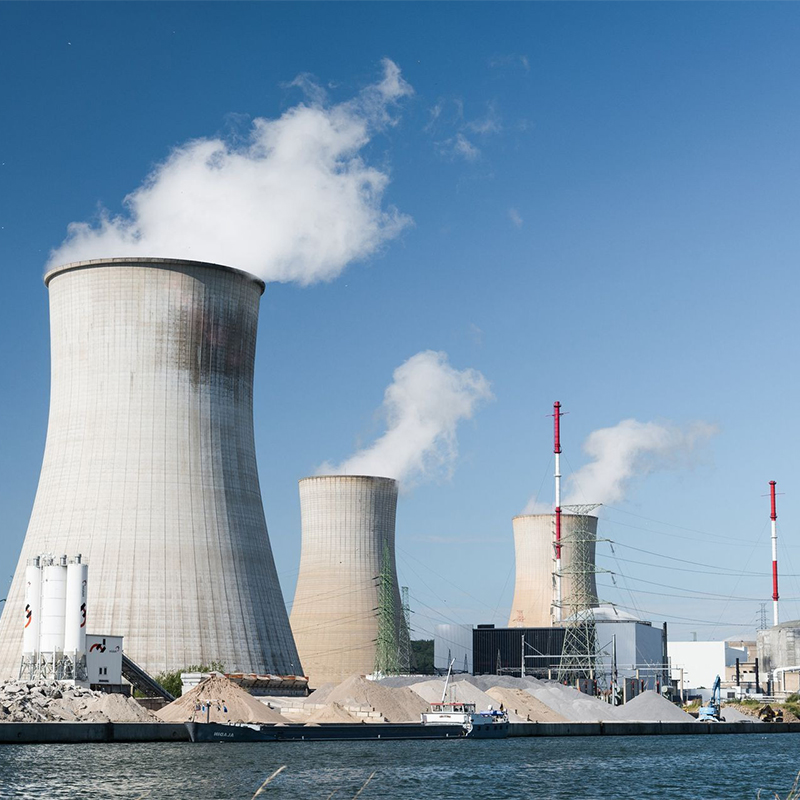
We Provide Cooling Tower Solution

Views: 0 Author: Cindy Publish Time: 2026-09-17 Origin: Site


When an industrial facility needs to reject a huge amount of heat, a small packaged cooling tower may simply not be enough. This is where a field erected cooling tower comes into the picture.
Unlike a factory-assembled cooling tower that arrives largely complete, a field erected cooling tower is transported to the project site in separate components and assembled there. This approach allows engineers to design much larger and more customized cooling systems for demanding industrial applications.
But what exactly makes a field erected cooling tower different? How does it work? What components does it contain? And how can you choose the right system for your plant?
This guide answers those questions in straightforward language. Whether you are an engineer, plant manager, EPC contractor, project consultant, or industrial buyer, understanding these fundamentals can help you make better decisions before purchasing or designing a field erected cooling tower.
A field erected cooling tower is a large cooling tower whose major structural, mechanical, and thermal components are transported to the final project location and assembled on site.
Instead of manufacturing and assembling the entire tower as a single factory package, the manufacturer produces the individual components and prepares them for transportation. Once they arrive at the industrial site, the tower is constructed according to the engineering design.
Why does this approach make sense?
Scale is the simple answer.
Large industrial plants can require enormous cooling capacity and high circulating-water flow rates. Transporting one completely assembled tower can be impractical because of its physical size, weight, and transportation limitations.
With field erection, the tower can be built to suit the site.
This gives engineers much more freedom to determine the tower's dimensions, number of cells, fill arrangement, fan configuration, water distribution system, materials, and other design parameters.
Field erected cooling towers are commonly considered for large industrial applications such as power generation, petrochemical processing, refineries, chemical production, steel manufacturing, and other heavy-duty facilities.
The main difference is how the tower is manufactured, transported, and assembled.
A packaged cooling tower is generally manufactured and assembled at the factory before being transported to the customer's site. Installation is therefore relatively straightforward.
A field erected cooling tower is different. Its major components are shipped separately and assembled at the final location.
Think of it as the difference between buying a finished house and constructing a large custom building on its actual site.
Packaged towers are often practical for standardized applications where capacity and dimensions fall within common ranges.
Field erected towers become more attractive when the project requires:
Very large cooling capacity
High circulating-water flow
Customized dimensions
Multiple cooling cells
Special materials
Complex site integration
Large industrial infrastructure
Transportation is another major factor. A large tower cannot always be shipped efficiently as one completed structure. Shipping individual components can make large-scale construction much more practical.
Although a field erected cooling tower can be enormous, the basic cooling principle is surprisingly simple.
Hot water enters the tower and is distributed across the heat-transfer area. Air moves through the tower, either naturally or with the assistance of mechanical fans.
As water comes into contact with moving air, heat transfers from the water to the air. At the same time, a small portion of the water evaporates, carrying additional heat away from the circulating water.
The cooled water collects in the basin and returns to the industrial process.
Then the cycle starts again.
It is essentially nature doing the heavy lifting, while engineering makes the process faster, larger, and more predictable.
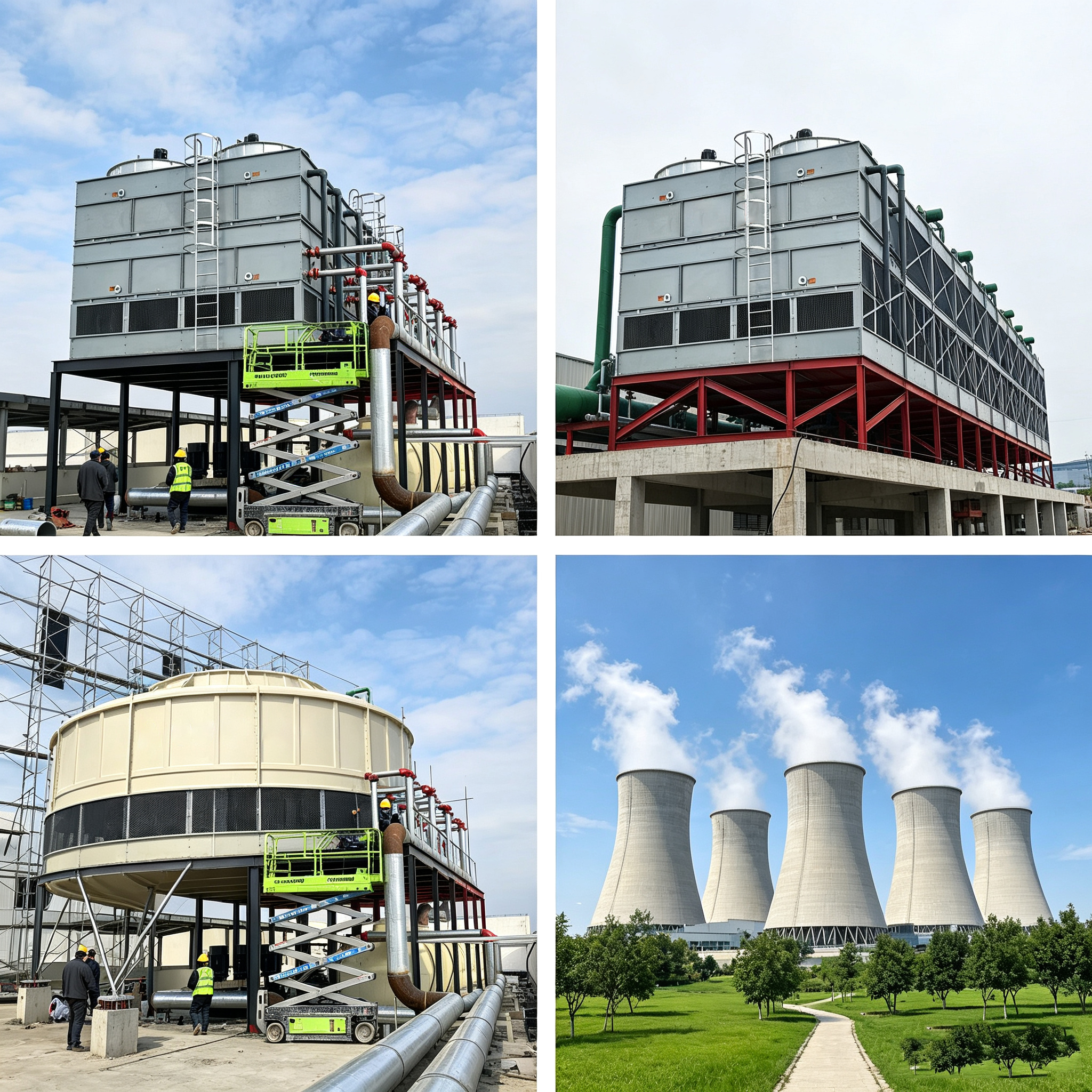
The primary purpose of a cooling tower is heat rejection.
Hot process water enters at a higher temperature than the desired outlet temperature. As the water travels through the tower, it comes into contact with air.
Heat moves from the warmer water into the cooler air, while evaporation provides additional cooling.
The cooled water then leaves the tower and returns to the process.
The effectiveness of this process depends on several variables, including:
Water flow rate
Airflow rate
Cooling range
Approach temperature
Fill design
Wet-bulb temperature
Water distribution
Tower geometry
This is why simply selecting a large tower does not guarantee good performance.
The complete air-water system must be properly engineered.
Air and water are the two main players inside an evaporative cooling tower.
Water must be distributed evenly, while air must move through the heat-transfer area efficiently.
If the water distribution is uneven, some portions of the fill may remain underused.
If airflow is insufficient, the tower may not reject enough heat.
If airflow is excessive, fan energy consumption may increase unnecessarily.
The goal is balance.
A field erected cooling tower is therefore not simply a giant structure filled with water. It is a carefully engineered system in which water flow, airflow, heat-transfer area, and operating conditions must work together.
So, why choose a field erected cooling tower instead of a standard packaged unit?
The answer usually comes down to scale, flexibility, and customization.
Large industrial facilities often have unique cooling requirements that cannot be satisfied by an off-the-shelf tower.
Instead of forcing the project to fit a standard tower, a field erected design allows the cooling system to be designed around the project.
One of the biggest advantages is scalability.
Field erected cooling towers can be designed for very large heat loads and high circulating-water flow rates.
Multiple cells can also be combined into a single cooling system, allowing the total capacity to increase while maintaining operational flexibility.
This makes field erected systems particularly suitable for facilities where cooling demand is measured on a very large industrial scale.
Rather than asking, “Which standard tower can fit our process?” engineers can start with the required cooling duty and develop a tower around that requirement.
Industrial facilities rarely have unlimited space.
Buildings, pipelines, electrical equipment, access roads, property boundaries, and other structures can all affect cooling tower placement.
A field erected cooling tower provides greater freedom in terms of dimensions and layout.
The tower can be engineered around:
Available footprint
Required height
Maintenance access
Piping layout
Air intake requirements
Electrical infrastructure
Crane access
Future expansion
This flexibility can be particularly valuable when installing cooling equipment in an existing industrial facility.
Industrial cooling towers are expected to operate for many years.
That means the tower structure and components need to be selected with long-term performance in mind.
Proper material selection, corrosion protection, mechanical design, water treatment, inspection, and preventive maintenance all contribute to service life.
A well-designed field erected cooling tower should be viewed as a long-term industrial asset rather than simply another piece of equipment.
Field erected cooling towers can be classified in several ways.
Two of the most important distinctions are airflow direction and draft method.
Understanding these categories can help you communicate more effectively with cooling tower manufacturers and engineering contractors.
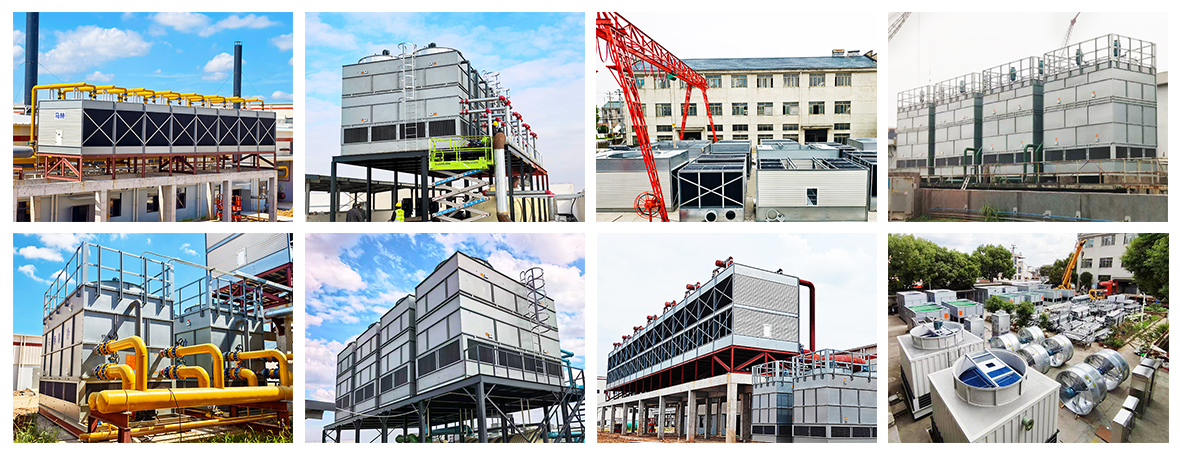
In a crossflow configuration, air generally moves horizontally across the falling water.
Water is distributed from the upper section of the tower and travels downward through the fill, while air enters through the sides.
Crossflow designs can provide convenient access to certain water distribution and maintenance areas.
They can also be suitable where the site layout and maintenance strategy favor this configuration.
However, the final choice should always be based on the actual project requirements.
In a counterflow configuration, air generally moves upward while water flows downward.
The opposing directions create effective contact between air and water.
Counterflow towers can provide strong thermal performance within a relatively compact footprint and are widely used in industrial cooling applications.
The decision between crossflow and counterflow should consider thermal duty, water distribution, maintenance, space, fan configuration, and project economics.
Field erected cooling towers can also be divided into mechanical-draft and natural-draft designs.
Mechanical-draft towers use fans to move air through the tower.
This provides greater control over airflow and allows operators to adjust tower performance by controlling fan operation.
Natural-draft towers rely primarily on the stack effect created by differences in air temperature and density.
Natural-draft towers can reach enormous sizes and are commonly associated with major power-generation facilities.
The appropriate design depends on project scale, energy requirements, climate, site conditions, and performance objectives.
A field erected cooling tower is not a single product.
It is an integrated system consisting of many components.
Each component affects overall performance, reliability, and maintenance.
Cooling tower fill is one of the most important thermal components in an evaporative cooling tower.
Its primary function is to increase the contact area between water and air.
Film fill spreads water into thin layers across a large surface area. Splash fill breaks the water into droplets as it travels through the tower.
The correct fill depends heavily on water quality and operating conditions.
For relatively clean water, high-efficiency film fill can provide excellent heat-transfer performance.
For applications with suspended solids or a higher risk of fouling, splash fill may be more appropriate because its open structure can provide greater resistance to clogging.
The water distribution system delivers hot water throughout the tower.
It may include:
Headers
Pipes
Branches
Nozzles
Spray systems
Distribution basins
Uniform water distribution is critical.
If some parts of the fill receive too much water while others receive too little, the available heat-transfer area is not being used efficiently.
For large field erected towers, the distribution system should also be designed for practical inspection and maintenance.
Mechanical-draft towers depend on fans to move air.
Fan performance is influenced by:
Diameter
Blade geometry
Blade material
Fan speed
Blade pitch
Motor power
Airflow
Efficiency
Large industrial fans must also operate reliably under continuous-duty conditions.
Vibration monitoring, balancing, alignment, lubrication, and inspection are therefore important parts of fan maintenance.
Drift eliminators reduce the amount of water droplets carried out of the tower with the exhaust air.
This helps conserve water and can reduce the release of droplets containing dissolved minerals and treatment chemicals.
Their design needs to balance droplet capture and airflow resistance.
If the pressure drop becomes too high, fan energy consumption may increase.
The structural system supports the tower, fill, water distribution equipment, fans, piping, access platforms, and other components.
Depending on the design and application, structural materials may include concrete, steel, fiberglass-reinforced materials, wood, or engineered combinations.
Material selection depends on:
Tower size
Structural loads
Environmental conditions
Corrosion exposure
Temperature
Expected service life
For large projects, structural engineering is just as important as thermal engineering.
Choosing the right field erected cooling tower should begin with engineering data rather than a product brochure.
Before contacting a manufacturer, collect as much information as possible about the process and site.
Start by determining how much heat the tower needs to reject.
Consider both normal and peak operating loads.
If production capacity may increase in the future, discuss expansion requirements during the initial design stage.
It can be much easier to plan additional capacity from the beginning than to modify an undersized cooling system later.
Determine the circulating-water flow rate and temperature range.
For example, a process might require water to enter the tower at 40°C and leave at 32°C.
The manufacturer needs this information to evaluate the required cooling capacity and tower configuration.
Also consider flow fluctuations.
Real industrial processes rarely operate at exactly one fixed point all year.
Wet-bulb temperature is a critical design parameter for evaporative cooling systems.
It strongly influences the lowest temperature the cooling water can realistically approach under the given atmospheric conditions.
A tower designed without accurate climate information may struggle to meet the required outlet-water temperature during the hottest or most demanding periods.
Water quality can determine which cooling tower products are appropriate.
Suspended solids, hardness, biological activity, oil contamination, and chemical composition can affect:
Fill life
Nozzle performance
Scaling
Fouling
Corrosion
Maintenance frequency
For example, selecting an extremely high-performance film fill without considering suspended solids may create a clogging problem later.
The best component is not necessarily the one with the highest theoretical efficiency.
It is the one that performs reliably in your actual operating environment.

Thermal calculations are only one part of the project.
Successful field erected cooling tower design also requires attention to site engineering, structure, maintenance, safety, and future expansion.
Consider the tower footprint, height, access roads, crane requirements, pipe routing, electrical connections, maintenance areas, and surrounding structures.
Air intake and discharge areas must remain sufficiently clear.
Why?
Because nearby buildings or structures can interfere with airflow and potentially reduce cooling performance.
A technically excellent tower can still perform poorly if the surrounding site restricts its airflow.
Cooling towers operate in wet environments.
Some industrial facilities may also expose equipment to aggressive chemicals.
Materials should therefore be selected according to the actual operating environment.
Corrosion-resistant materials, suitable coatings, and appropriate fasteners can help extend service life and reduce maintenance requirements.
Installation is one of the defining characteristics of a field erected cooling tower.
Because major components are assembled at the project site, construction planning is essential.
The foundation must be prepared according to the engineering drawings and expected loads.
Before major assembly begins, the project team should check:
Foundation dimensions
Anchor locations
Structural supports
Basin configuration
Piping connections
Access structures
Equipment locations
Accurate preparation at this stage can prevent costly modifications later.
Once the structural system is ready, major components can be assembled.
Depending on the project, this may include:
Fill
Water distribution equipment
Fans
Motors
Drift eliminators
Piping
Access platforms
Controls
Before commissioning, the system should be checked for alignment, leakage, vibration, electrical connections, water distribution, and airflow.
A controlled startup allows problems to be identified before the cooling tower enters full industrial operation.
There is no single standard price for a field erected cooling tower.
Project cost depends on numerous factors, including:
Cooling capacity
Tower size
Number of cells
Structural materials
Fill type
Fan system
Motor configuration
Water distribution system
Site conditions
Transportation
Installation
Commissioning
Customization
The cheapest quotation is not necessarily the lowest-cost solution over the tower's lifecycle.
Energy consumption, maintenance, component replacement, downtime, and expected service life can all have a major impact on total cost.
When comparing quotations, look at the complete package rather than the equipment price alone.
Even a well-designed field erected cooling tower requires regular maintenance.
Preventive maintenance is similar to changing the oil in a machine. It may seem routine, but it can prevent much more expensive failures.
Regular inspections should cover:
Tower structure
Basin
Water distribution
Fill
Drift eliminators
Fans
Motors
Gearboxes
Fasteners
Piping
Look for corrosion, cracks, unusual vibration, water leakage, biological growth, scaling, and abnormal operating temperatures.
Fill should be inspected for fouling, deformation, blockage, and physical damage.
Nozzles should be checked for clogging and uneven spray patterns.
If water distribution becomes uneven, cooling performance can deteriorate even when the fan and motor continue operating normally.
This is one reason routine inspection should not be ignored.
Fans require regular inspection for blade damage, imbalance, corrosion, and abnormal vibration.
Motors, bearings, gearboxes, and drive systems should be serviced according to their operating requirements.
Early detection of mechanical problems can prevent unplanned shutdowns and expensive repairs.
Common field erected cooling tower problems include:
Poor cooling performance
Excessive vibration
Fill blockage
Uneven water distribution
Scaling
Corrosion
Excessive water consumption
High energy consumption
Most of these problems can be reduced through proper design, correct component selection, water treatment, regular inspection, and preventive maintenance.
One particularly important lesson is simple:
Do not wait until the tower stops cooling properly before investigating its condition.
Monitor performance continuously.
Changes in approach temperature, water flow, fan vibration, water consumption, or energy use can provide valuable early warning signs.

The manufacturer can influence the success of a project just as much as the equipment design.
Look for a company that understands both the thermal requirements and the practical realities of industrial installation.
A capable manufacturer should be able to evaluate:
Heat load
Water flow
Temperature range
Wet-bulb temperature
Water quality
Site conditions
Installation limitations
Maintenance requirements
Customization is particularly important for field erected cooling tower projects because dimensions and configurations often need to fit specific sites.
Ask about manufacturing capabilities, material selection, inspection procedures, and production consistency.
Quality control should cover critical components rather than focusing only on the final appearance.
Dimensional accuracy, material quality, mechanical balance, and component compatibility can all influence long-term performance.
A field erected cooling tower is a long-term investment.
The supplier should be able to support replacement parts and technical questions throughout the equipment lifecycle.
Access to cooling tower fill, nozzles, drift eliminators, fans, motors, and other components can make future maintenance much easier.
A supplier that remains available after installation can provide significant practical value when the system eventually needs inspection, repair, or upgrades.

Mach Industry (Zhejiang) Co.,Ltd focuses on cooling tower solutions for industrial applications, including cooling tower equipment and related components.
For a field erected cooling tower project, the key is not simply selecting a standard model.
The system needs to be matched to the project's:
Cooling load
Water flow
Temperature conditions
Site limitations
Water quality
Operating requirements
Maintenance expectations
A manufacturer with engineering and customization capabilities can help industrial customers develop a configuration around their actual project requirements.
This manufacturer-focused approach can be particularly useful for large industrial projects where standard packaged equipment may not provide sufficient flexibility.
For more information about cooling tower solutions and industrial cooling equipment, visit Mach Industry (Zhejiang) Co.,Ltd.

A field erected cooling tower is more than a large cooling machine.
It is a customized industrial system designed around a specific heat-rejection requirement.
Its structure, cooling tower fill, fans, water distribution system, drift eliminators, motors, materials, and controls all need to work together.
The best starting point is always the application.
Determine the heat load, water flow, temperature range, wet-bulb temperature, water quality, site conditions, and future requirements.
Then work with a manufacturer that can translate those numbers into a practical cooling tower design.
Whether your project involves a power plant, chemical facility, refinery, steel plant, or another large industrial operation, careful planning can make the difference between a tower that simply exists and a cooling system that performs reliably year after year.
Ultimately, the goal is straightforward:
Choose the right field erected cooling tower, match every major component to the application, and build a cooling system that can deliver dependable performance for the long term.