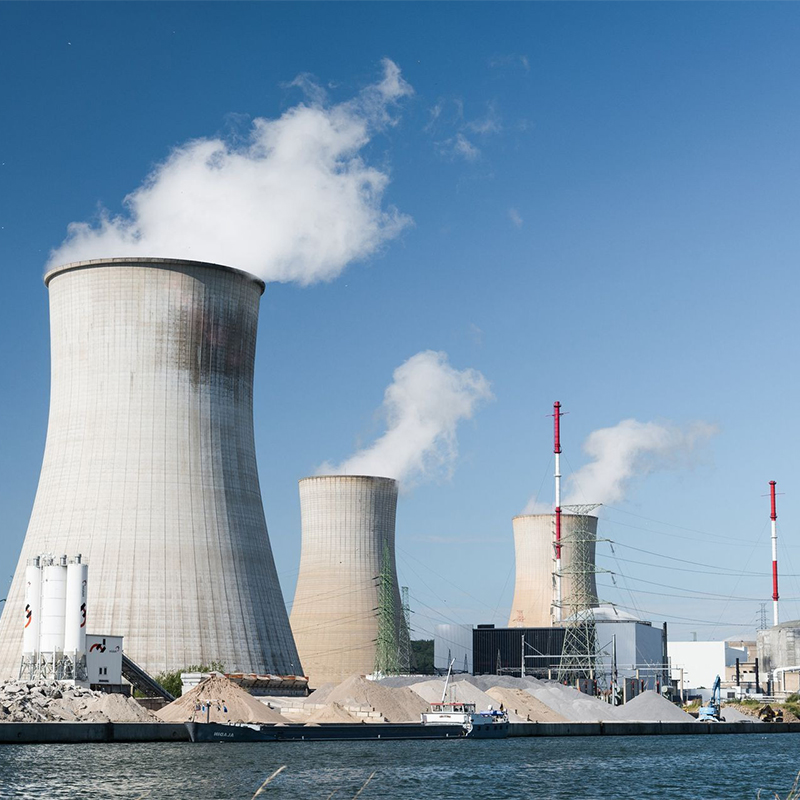
We Provide Cooling Tower Solution

Views: 0 Author: Cindy Publish Time: 2026-10-07 Origin: Site


When you need to remove heat from an industrial process, HVAC system, refrigeration system, or other heat-generating equipment, one important question quickly comes up: Should you choose an evaporative air cooling tower or an air-cooled tower?
At first glance, both systems appear to do the same job. They use air to carry heat away. However, the way they accomplish that job is very different.
An evaporative air cooling tower uses air and water together. A small portion of the water evaporates and carries heat away from the system. An air-cooled tower, often referred to as a dry cooler or air-cooled heat exchanger, rejects heat directly to surrounding air without relying on water evaporation.
That fundamental difference affects almost everything else, including cooling performance, water consumption, energy use, equipment size, maintenance, operating costs, and suitability for different climates.
So, which one is better?
The honest answer is: it depends on your application.
In this guide, we will compare evaporative air cooling towers and air-cooled towers from a practical industrial perspective, helping you understand the differences and choose the right cooling solution for your project.
An evaporative air cooling tower is a heat rejection system that uses air and water together to remove heat.
Hot water enters the cooling tower and is distributed through a spray system or water distribution system. The water then comes into contact with moving air, usually across cooling tower fill media.
As the air and water interact, a small portion of the water evaporates. This evaporation absorbs heat from the circulating water, allowing the remaining water to leave the tower at a lower temperature.
This is the basic principle behind evaporative cooling.
Think about what happens when you sweat on a hot day. Your body becomes cooler because evaporation removes heat from your skin. An evaporative cooling tower uses a similar physical principle, but on a much larger industrial scale.
The cooling process generally follows several steps.
First, hot water enters the cooling tower. The water distribution system spreads the water over the fill or through spray nozzles.
Next, a fan moves air through the tower. Depending on the tower design, air can flow upward, horizontally, or in another engineered direction.
The water comes into contact with the moving air. A small amount of water evaporates and removes heat from the circulating water.
The cooled water collects in the basin and is then returned to the industrial process.
The process can be summarized simply:
Hot water → water distribution → air-water contact → evaporation → heat rejection → cooled water
The key advantage is that evaporation provides an additional mechanism for heat transfer that a conventional dry cooling system does not have.
Although cooling tower designs vary, a typical evaporative tower may include:
Fans and motors
Cooling tower fill
Water distribution pipes
Spray nozzles
Drift eliminators
Cold-water basin
Louvers
Pumps
Make-up water system
Blowdown system
Temperature controls
Water treatment equipment
The fill media is especially important in many evaporative cooling towers. It increases the contact area between air and water, giving the cooling process more time and surface area to work.
The quality, geometry, material, and cleanliness of the fill can therefore have a significant effect on tower performance.
An air-cooled tower works according to a different principle.
Instead of using evaporation, an air-cooled system transfers heat from a process fluid directly to ambient air through a heat exchanger.
The hot fluid flows through tubes while fans move ambient air across the outside surfaces of the tubes. Fins are often added to increase the heat-transfer area.
There is normally no direct contact between cooling water and air.
In simple terms, an air-cooled system works much like a large industrial radiator.
Hot fluid enters the heat exchanger. Air flows across the heat-transfer surface. Heat moves from the fluid into the metal tubes and fins and then into the surrounding air.
The operating principle is relatively simple.
Hot process fluid enters the heat exchanger. Large fans move ambient air over the finned tubes. Heat passes through the tube wall and fins and is carried away by the air.
The process can be summarized as:
Hot fluid → heat exchanger → ambient air → heat rejection
The biggest limitation is also straightforward.
The system depends heavily on ambient air temperature.
If outdoor air is extremely hot, the temperature difference between the process fluid and the surrounding air becomes smaller. As a result, heat rejection becomes more difficult.
This is one of the major differences between air-cooled and evaporative cooling systems.
Typical components include:
Axial fans
Fan motors
Finned tube bundles
Headers
Structural supports
Louvers
Temperature sensors
Control systems
Vibration monitoring equipment
Unlike an evaporative cooling tower, a conventional dry air-cooled system does not require cooling tower fill, spray water, drift eliminators, or an evaporative water basin.
Now let's compare the two systems directly.
Although both systems reject heat to the atmosphere, their differences in operating principles create significant differences in performance and cost.
The fundamental difference is simple.
Evaporative cooling uses air + water + evaporation.
Air cooling uses air + heat exchanger surfaces.
An evaporative tower benefits from the latent heat associated with water evaporation. This allows it to reject a large amount of heat without relying entirely on sensible heat transfer.
An air-cooled tower depends primarily on the temperature difference between the process fluid and ambient air.
This makes ambient dry-bulb temperature particularly important for air-cooled systems.
Water consumption is one of the most obvious differences.
An air-cooled system normally requires little or no cooling water because it does not depend on evaporation.
An evaporative cooling tower, on the other hand, consumes water through evaporation and usually requires additional water for blowdown and system management.
This can be a disadvantage where water is expensive or scarce.
However, water consumption should not be considered in isolation.
Why?
Because the water is providing a powerful cooling effect.
An evaporative tower may use water but achieve a high heat rejection rate in a relatively compact system.
The real question is not simply:
“Which system uses less water?”
It is:
“Which combination of water, electricity, equipment size, and operating cost is best for my site?”
Evaporative systems can offer strong thermal efficiency because evaporation provides an effective heat rejection mechanism.
An air-cooled system may need a large heat-transfer surface and substantial airflow to reject the same amount of heat, especially during hot weather.
However, it would be inaccurate to say that evaporative cooling is always more energy efficient.
Actual energy consumption depends on:
Heat load
Fan efficiency
Pump requirements
Ambient conditions
Water temperature
Equipment design
Control strategy
Operating hours
A proper comparison should therefore use the actual operating conditions of the project.
Cooling performance is another major difference.
Evaporative cooling towers are strongly influenced by ambient wet-bulb temperature. This allows them to achieve effective cooling even when dry-bulb temperatures are high.
Air-cooled equipment is more directly limited by ambient dry-bulb temperature.
Imagine trying to cool hot process fluid with 40°C air. The hotter the surrounding air becomes, the harder it is to reject heat.
Evaporative cooling can gain an advantage because evaporation changes the effective cooling potential of the air.
Footprint can also influence the decision.
Air-cooled equipment often requires substantial heat-transfer surface area because the cooling process depends entirely on sensible heat transfer.
As heat loads increase, the equipment can become quite large.
Evaporative cooling towers can often achieve high heat rejection in a relatively compact footprint.
For industrial sites where land is expensive or limited, this can be an important advantage.
Neither system is maintenance-free.
Evaporative cooling towers require attention to water quality and mechanical components.
Typical maintenance tasks include:
Water treatment
Basin cleaning
Fill inspection
Nozzle inspection
Drift eliminator inspection
Fan maintenance
Pump maintenance
Scale control
Corrosion control
Biological control
Air-cooled systems eliminate most water-related maintenance.
However, they still require regular:
Fan inspection
Motor maintenance
Fin cleaning
Tube inspection
Corrosion inspection
Vibration monitoring
Dust and debris can accumulate on the fin surfaces and reduce airflow, particularly in industrial environments.
Operating cost depends on much more than electricity.
For evaporative systems, you should consider:
Water consumption
Water treatment
Blowdown
Pump electricity
Fan electricity
Cleaning
Maintenance
For air-cooled systems, major operating costs may include:
Fan electricity
Fin and coil cleaning
Fan maintenance
Motor maintenance
Performance losses during hot weather
This is why total cost of ownership, rather than initial purchase price alone, should guide the decision.
Initial investment varies significantly depending on system capacity and project requirements.
An air-cooled system can appear attractive because it eliminates many water-side components.
However, large heat loads can require a substantial amount of heat-transfer surface and fan capacity.
An evaporative system may involve more components, including water distribution, pumps, fill, basin, and water treatment.
At the same time, its compact heat rejection capability can make it highly competitive for large industrial applications.
Why do so many industrial facilities continue to use evaporative cooling towers?
Because they offer an excellent combination of heat rejection performance, compact size, and operating flexibility.
Evaporation is a powerful cooling mechanism.
Instead of relying only on the temperature difference between hot fluid and outdoor air, the system uses water evaporation to remove additional heat.
This makes evaporative cooling particularly useful for high-capacity industrial applications.
Hot weather can create serious challenges for dry cooling systems.
Evaporative cooling can maintain strong performance because the process benefits from wet-bulb conditions rather than relying exclusively on high-temperature dry air.
This makes evaporative cooling attractive for many facilities that operate continuously throughout the summer.
High heat rejection capacity within a relatively compact footprint can be a major advantage.
If you have limited installation space, an evaporative cooling tower may offer a more practical solution than a large dry cooling system.
Air-cooled systems have several important advantages of their own.
This is usually the biggest reason buyers consider air cooling.
There is no need to continuously evaporate cooling water, making air-cooled systems attractive for water-stressed locations.
Because there is no conventional evaporative cooling-water circuit, you avoid many water-related issues.
There is generally no need to manage:
Cooling tower blowdown
Water chemistry
Biological growth in an evaporative basin
Cooling tower water treatment
Fill fouling
This can simplify operation.
If a site has limited water availability, an air-cooled solution can be highly attractive.
Instead of consuming water to improve thermal performance, the system uses more heat-transfer surface and airflow.
For some locations, that is a very reasonable trade-off.
Evaporative cooling also has disadvantages.
The most obvious one is water consumption.
The system requires reliable water supply and appropriate water management.
Poor water chemistry can cause:
Scale
Corrosion
Fouling
Biological growth
Reduced heat-transfer efficiency
Nozzle blockage
Routine maintenance is therefore essential.
Environmental factors also need to be considered, including water discharge, drift, plume formation, and local regulations.
The biggest limitation of air-cooled systems is their dependence on ambient temperature.
As outdoor temperature increases, the system's ability to reject heat decreases.
During extreme summer conditions, an air-cooled system may require:
Larger heat-transfer surfaces
Higher airflow
More fan power
Lower process-fluid temperatures
Additional equipment capacity
This does not mean air cooling is unsuitable for hot climates.
It means the equipment needs to be properly designed for the site's worst-case conditions.
There is no universal answer.
If your priority is high heat rejection, compact equipment, and strong performance under demanding ambient conditions, an evaporative air cooling tower is often the better option.
If your priority is water conservation, simpler operation, and minimal water management, an air-cooled system may be more suitable.
A practical comparison should consider:
| Factor | Evaporative Air Cooling Tower | Air-Cooled Tower |
|---|---|---|
| Cooling principle | Evaporation + air | Air only |
| Water consumption | Required | Very low or none |
| Hot-weather performance | Generally strong | More sensitive to ambient temperature |
| Footprint | Often compact | Can be larger |
| Water treatment | Required | Generally not required |
| Fill media | Common | Not required |
| Maintenance | Mechanical + water management | Mainly mechanical |
| Main advantage | Strong heat rejection | Water conservation |
| Main limitation | Water consumption and treatment | Hot-weather performance |
The answer is straightforward: the air-cooled tower.
A dry cooling system does not rely on evaporation, so it can significantly reduce cooling-water consumption.
However, lower water consumption does not automatically mean lower total operating cost.
A dry system may require more fan energy, larger equipment, or additional heat-transfer surface.
Therefore, buyers should compare water savings against electricity consumption, equipment cost, available space, and required cooling performance.
Different industries have different priorities.
Manufacturing facilities often generate continuous process heat.
Applications such as plastics processing, metalworking, chemical production, food processing, and general manufacturing may benefit from the high heat rejection capability of evaporative cooling.
Where water availability is limited, air-cooled systems may be a better fit.
Power and energy facilities can have extremely high heat loads.
Cooling technology selection depends on the process, climate, water resources, environmental regulations, required operating temperatures, and overall plant design.
For large heat loads, evaporative cooling can offer excellent thermal performance.
Large commercial and industrial HVAC systems commonly use evaporative cooling towers for condenser heat rejection.
For locations where water is limited, air-cooled chillers or dry cooling systems may be considered instead.
The choice depends on system efficiency requirements, climate, space, and operating cost.
Data centers present another interesting application.
They require highly reliable heat rejection while balancing energy consumption and water use.
Evaporative systems can provide efficient cooling, while dry systems can reduce water dependence.
In some projects, hybrid cooling strategies may offer a useful middle ground.
Climate should always be part of the cooling-system selection process.
For evaporative cooling, wet-bulb temperature is especially important.
For air-cooled systems, dry-bulb temperature is a major design consideration.
Do not simply look at the annual average temperature.
Instead, consider the actual design conditions.
Ask:
What is the summer design dry-bulb temperature?
What is the design wet-bulb temperature?
What is the required leaving-water or process-fluid temperature?
How many hours will the system operate at peak load?
Is water readily available?
Are there water discharge restrictions?
These questions can help determine which technology is more appropriate.
If you select an evaporative cooling tower, water management should be taken seriously.
Poor water quality can affect fill media, spray nozzles, pipes, basins, pumps, and other components.
Scale can form a layer over heat-transfer surfaces, much like putting a blanket over equipment that needs to release heat.
Fouling can restrict airflow or water distribution.
Biological growth can also create operational and maintenance problems.
For this reason, proper water treatment, blowdown control, cleaning, and routine inspection are essential to maintaining tower performance.
Don't begin by asking, “Which cooling tower is better?”
Instead, ask:
“Which cooling technology fits my application?”
Start with the actual heat rejection requirement.
Consider:
Process heat
Condenser heat
Chiller load
Seasonal variations
Future expansion
Peak operating conditions
An undersized system may fail to provide sufficient cooling, while excessive oversizing can increase capital and operating costs.
Determine the required entering and leaving fluid temperatures.
Then compare those requirements with the site's design dry-bulb and wet-bulb conditions.
For evaporative systems, wet-bulb conditions are particularly important.
For dry systems, dry-bulb temperature is critical.
Ask whether the site can reliably supply cooling water for the expected operating life.
If water is readily available, evaporative cooling may offer excellent performance.
If water is expensive or restricted, an air-cooled solution may become more attractive.
A cooling tower is a long-term asset.
Don't focus only on what happens on installation day.
Consider who will:
Inspect the fans
Clean the equipment
Manage water treatment
Check the fill
Monitor vibration
Replace components
Perform routine maintenance
The easier a system is to maintain properly, the more reliably it can perform over its operating life.
A useful comparison should include:
Initial investment + electricity + water + treatment + maintenance + replacement + downtime risk
This provides a much better picture than comparing equipment purchase prices alone.
Working directly with a cooling tower manufacturer can provide benefits beyond price.
A qualified manufacturer can help evaluate:
Heat load
Water flow
Required temperatures
Site conditions
Cooling tower configuration
Fill selection
Fan requirements
Material requirements
Maintenance considerations
Installation limitations
Instead of simply selecting a standard product, you can match the cooling system to your actual operating conditions.
That can significantly reduce the risk of buying equipment that looks suitable on paper but performs poorly in the field.
Mach Industry (Zhejiang) Co.,Ltd provides cooling tower solutions for industrial and commercial applications.
For customers comparing evaporative cooling towers with air-cooled alternatives, the key is to match the technology with the project's actual operating requirements.
The right choice depends on heat load, required cooling temperature, climate, water availability, space limitations, energy costs, and maintenance expectations.
Mach Industry can support customers in evaluating cooling tower configurations and application requirements for different industrial projects.
For more information about cooling tower solutions and manufacturer support, visit the official Mach Cooling website.
Not necessarily.
An evaporative cooling tower is often a better choice when high heat rejection, compact size, and strong hot-weather performance are priorities.
An air-cooled tower may be more suitable when water conservation and simple water management are more important.
An evaporative cooling tower consumes water because evaporation is part of its operating principle.
Actual consumption depends on heat load, climate, tower design, operating hours, water chemistry, and blowdown practices.
Therefore, water consumption should be calculated according to the specific application.
Air-cooled systems generally have fewer water-related maintenance requirements.
Evaporative systems require additional attention to water treatment, scale, fouling, biological control, nozzles, fill, basin cleanliness, and blowdown.
However, both systems require regular mechanical inspection and maintenance.
An evaporative air cooling tower can have an advantage in hot climates because it benefits from evaporative cooling and wet-bulb conditions.
Air-cooled systems rely more directly on hot ambient air, which can reduce heat rejection performance during peak summer conditions.
The decision should be based on actual project requirements.
Start with heat load, required outlet temperature, climate, water availability, electricity cost, available footprint, maintenance capabilities, and environmental requirements.
If water is available and high heat rejection is the priority, evaporative cooling is worth considering.
If water conservation is critical, air cooling may be the better option.
If both factors are important, a hybrid cooling solution may deserve consideration.
So, which system wins?
There is no universal winner.
An evaporative air cooling tower is often the better choice when you need strong heat rejection, compact equipment, and reliable cooling performance under demanding ambient conditions.
An air-cooled tower becomes attractive when water conservation, simple operation, and reduced dependence on cooling-water infrastructure are the top priorities.
Think of the decision as a balancing scale.
On one side, you have water consumption, compactness, and cooling performance.
On the other side, you have water availability, simplicity, and dry operation.
The right system is the one that balances those factors for your facility—not necessarily the one that wins a generic comparison.
For industrial buyers, the smartest approach is to compare both technologies based on actual heat load, design temperature, climate, water availability, energy costs, maintenance requirements, available space, and total lifecycle cost.
And when the decision involves a major industrial investment, working with an experienced cooling tower manufacturer can help turn those calculations into a practical, reliable cooling solution.
For cooling tower projects and manufacturer support, Mach Industry (Zhejiang) Co.,Ltd can help you evaluate the appropriate cooling technology for your application.