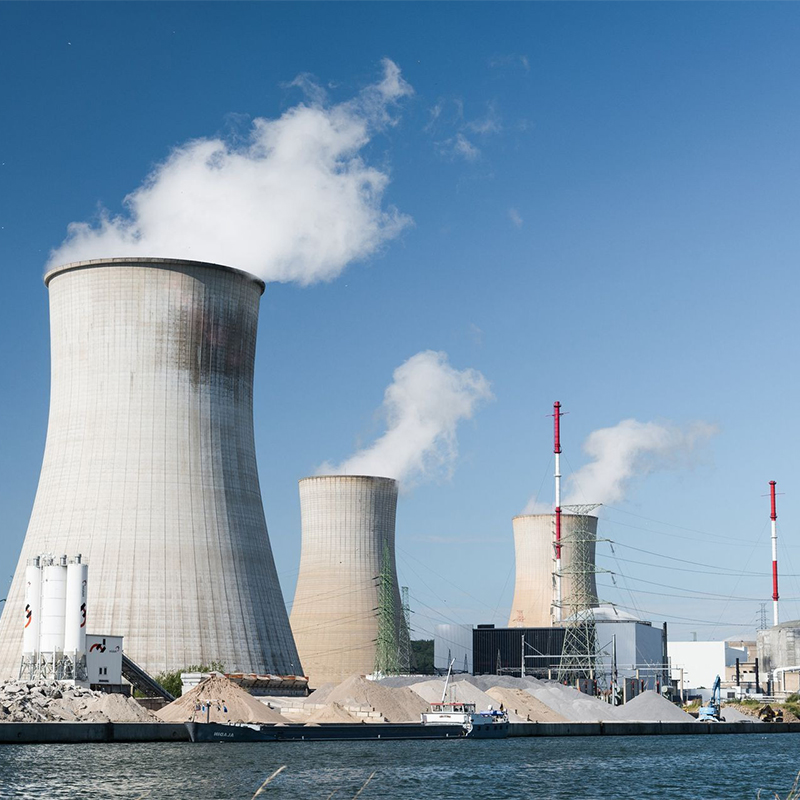
We Provide Cooling Tower Solution

Views: 0 Author: Cindy Publish Time: 2026-11-17 Origin: Site


Industrial manufacturing processes generate considerable amounts of heat. From power plants and chemical factories to steel mills and large manufacturing facilities, almost every industrial operation depends on an effective cooling system to maintain stable production temperatures.
Among different industrial cooling solutions, cooling towers play an important role in removing unwanted heat from circulating water. They use the natural evaporation process to transfer heat from warm water into the surrounding air.
However, have you ever noticed that your cooling tower consumes more water during certain operating periods, even when production conditions seem similar? Or perhaps the cooling performance becomes unstable despite the cooling tower running continuously?
These situations may be related to changes in the cooling tower evaporation rate.
Maintaining a stable evaporation rate in a cooling tower is important for controlling water consumption, supporting efficient heat rejection, and protecting industrial equipment. Nevertheless, stable evaporation does not mean that water loss must remain exactly the same throughout the year. Outdoor temperature, humidity, circulating water temperature, airflow, and industrial heat load all influence evaporation.
In this article, we will explore how cooling tower evaporation works, what affects its stability, how to calculate evaporation rates, and how industrial operators can improve cooling tower performance.
We will also explain how Mach Industry (Zhejiang) Co.,Ltd, a cooling tower manufacturer operating under the Mach Cooling brand, approaches industrial cooling tower solutions.

The cooling tower evaporation rate refers to the quantity of circulating water converted into water vapor during the cooling process over a specific period.
It is commonly measured in:
Gallons per minute (GPM)
Cubic meters per hour (m³/h)
Kilograms per hour (kg/h)
Liters per minute (L/min)
In a conventional evaporative cooling tower, warm circulating water flows through the fill section while air moves in the opposite direction or across the water flow, depending on the tower design.
A small portion of the water evaporates during this contact process. The evaporation absorbs heat from the remaining water, reducing its temperature before it returns to the industrial cooling system.
This process is the foundation of evaporative cooling technology.
Think of evaporation as a natural heat-removal engine.
When warm water enters a cooling tower, the distribution system spreads it across the fill media. The fill increases the contact surface area between water and air.
As air passes through the fill, part of the water changes from liquid into vapor.
This phase change requires energy. The necessary energy comes mainly from the heat contained in the circulating water.
As a result, the remaining water becomes cooler.
The larger the effective contact area between air and water, the greater the opportunity for heat and mass transfer, provided that airflow and water distribution are properly maintained.
Evaporation rate and cooling tower efficiency are closely related, but they are not the same measurement.
A higher evaporation rate does not necessarily indicate better cooling tower efficiency.
For example, a cooling tower operating under a higher industrial heat load will generally require more evaporation to remove the additional heat.
On the other hand, excessive water consumption may result from damaged drift eliminators, leakage, or inappropriate blowdown control rather than evaporation itself.
To evaluate cooling tower performance accurately, operators should consider several parameters:
Cooling range
Approach to wet-bulb temperature
Circulating water flow rate
Heat rejection capacity
Fan power consumption
Makeup water consumption
Blowdown and drift losses
Looking at these parameters together provides a much clearer understanding of cooling tower performance.
A stable and predictable evaporation rate helps industrial facilities maintain reliable cooling performance while controlling water consumption.
Although evaporation naturally changes with operating conditions, unexpected fluctuations may indicate problems within the cooling tower system.
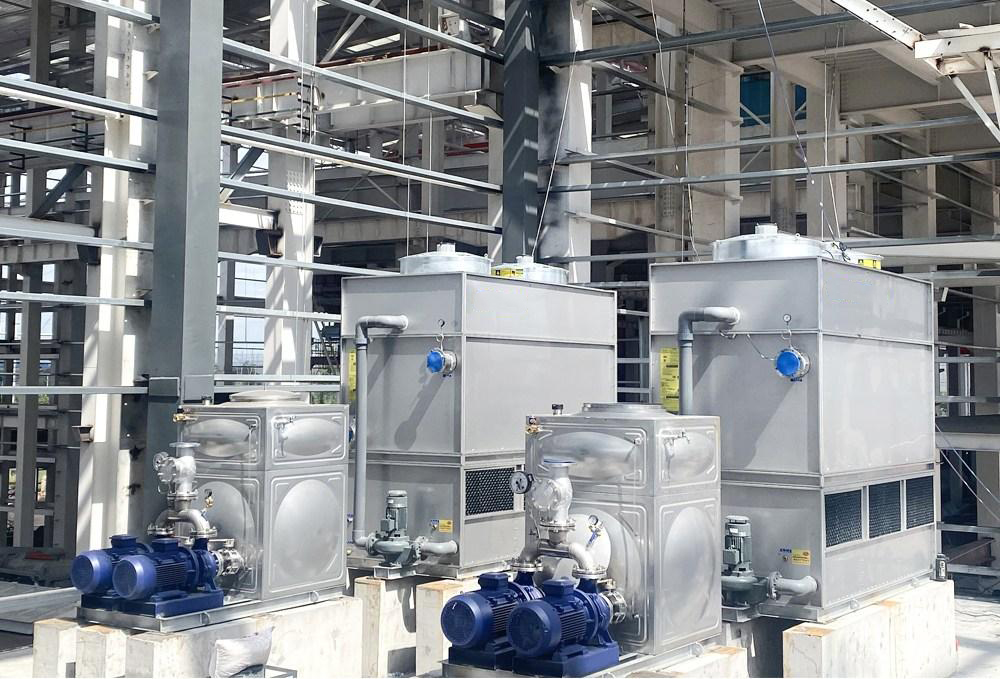
Many industrial processes require circulating water to remain within a specific temperature range.
For example, chemical reactors, compressors, heat exchangers, and manufacturing equipment may depend on continuous cooling.
If the cooling tower cannot remove enough heat, the circulating water temperature rises.
This can reduce production efficiency, increase equipment stress, and potentially cause unexpected shutdowns.
Maintaining predictable heat rejection helps protect industrial production and equipment reliability.
Evaporation is a normal part of cooling tower operation, but every evaporated liter of water must eventually be replaced by makeup water.
When water consumption increases unexpectedly, the facility may face higher water supply and treatment costs.
At the same time, poorly adjusted fans and pumps may consume unnecessary electricity.
An efficient cooling tower should balance water consumption and energy consumption instead of focusing on only one parameter.
Unstable operating conditions may be associated with scaling, corrosion, biological growth, and mechanical problems.
For instance, blocked fill media can restrict airflow and reduce heat transfer. Damaged fan blades may cause vibration and uneven airflow.
Regular monitoring helps operators identify these issues before they develop into serious equipment problems.
Why does the evaporation rate change even when a cooling tower operates continuously?
The answer is that evaporation depends on several environmental and operating conditions.
Understanding these factors is the first step toward improving cooling tower performance.
Wet-bulb temperature is one of the most important environmental factors affecting evaporative cooling.
It represents the cooling potential of air through evaporation.
When wet-bulb temperature increases, the cooling tower generally has less capacity to cool water to a low temperature.
Relative humidity also influences evaporation.
Dry air can generally accept more additional moisture than humid air under otherwise comparable conditions.
This explains why a cooling tower may operate differently during a dry afternoon and a humid summer morning, even when the industrial heat load remains similar.
The temperature of the incoming hot water directly affects the cooling process.
The difference between the hot-water inlet temperature and cold-water outlet temperature is called the cooling range.
For example:
Hot water temperature: 40°C
Cold water temperature: 30°C
Cooling range: 10°C
A larger cooling range generally means that more heat has been removed from the circulating water.
Under comparable conditions, a greater heat rejection requirement also results in a higher evaporation requirement.
Airflow is essential for maintaining an effective evaporation process.
Cooling tower fans move air through the tower, allowing it to contact circulating water.
If airflow becomes insufficient, heat and mass transfer may decrease.
Common airflow-related problems include:
Incorrect fan blade angle
Damaged fan blades
Fan imbalance
Motor performance problems
Blocked air inlets
Excessive resistance through fill media
Proper fan selection, blade adjustment, motor operation, and maintenance all contribute to stable cooling tower performance.
Water should be distributed evenly across the cooling tower fill.
If certain areas receive excessive water while other sections remain relatively dry, the available heat-transfer surface is not being used effectively.
Cooling tower fill media helps spread water into thin films or smaller droplets, increasing contact between air and water.
However, clogged, damaged, or incorrectly installed fill can reduce effective heat transfer and increase airflow resistance.
For industrial cooling towers, choosing suitable fill according to water quality and operating conditions is especially important.
Circulating water flow and industrial heat load directly influence the cooling duty.
When production equipment operates at full capacity, the cooling tower may need to reject considerably more heat than during partial-load operation.
As the heat load increases, the evaporation requirement generally increases as well.
Therefore, operators should never judge evaporation rate without considering actual industrial operating conditions.
Calculating evaporation is useful for estimating makeup water requirements and evaluating cooling tower operation.
For a preliminary engineering estimate, the evaporation rate can be calculated from the heat removed by the cooling tower.
A general heat-balance equation is:
E = Q / hfg
Where:
E = Evaporation mass flow rate
Q = Heat removed per unit time
hfg = Latent heat of vaporization of water
For a simplified cooling tower estimate using US customary units, the following formula is commonly used:
E (GPM) ≈ 0.00095 × C × R
Where:
E = Evaporation rate in GPM
C = Circulating water flow rate in GPM
R = Cooling range in °F
This formula provides an approximate evaporation rate under typical operating assumptions.
Let's consider an industrial cooling tower with the following operating parameters:
Circulating water flow: 1,000 GPM
Hot-water temperature: 100°F
Cold-water temperature: 90°F
Cooling range: 10°F
Using the formula:
E = 0.00095 × 1,000 × 10
E = 9.5 GPM
This means that approximately 9.5 gallons of water evaporate every minute under the simplified assumptions.
Over one hour:
9.5 × 60 = 570 gallons
Over 24 hours:
570 × 24 = 13,680 gallons
This example shows why evaporation management is important for large industrial cooling water systems.
Actual evaporation rates may differ depending on operating conditions, water properties, and the accuracy of the simplified calculation.
Evaporation is not the only source of cooling tower water loss.
The total makeup water requirement must also account for blowdown, drift, and other losses.
A simplified water balance is:
Makeup Water = Evaporation + Blowdown + Drift + Other Losses
These terms represent different processes.
Evaporation: Water converted into vapor during heat rejection.
Blowdown: Water intentionally discharged to control dissolved solids.
Drift: Small liquid droplets carried out with exhaust air.
Other losses: Leakage, overflow, and other system losses.
This distinction is essential when diagnosing excessive makeup water consumption.
For example, if water consumption suddenly increases, the problem may be a damaged drift eliminator or an incorrectly adjusted blowdown valve rather than excessive evaporation.
Unstable evaporation rates may result from changing operating conditions or problems with cooling tower equipment.
The following issues are particularly common in industrial circulating water systems.
Cooling tower fill can gradually become blocked by:
Mineral deposits
Suspended solids
Algae
Biological growth
Dirt and other contaminants
When this happens, water distribution becomes less uniform and airflow resistance may increase.
The cooling tower may then struggle to achieve its required cold-water temperature.
Regular inspection and appropriate cleaning help preserve the designed heat-transfer surface.
The cooling tower fan plays a critical role in maintaining the required airflow.
If fan blades become damaged, blade angles are incorrect, or the fan assembly becomes unbalanced, airflow performance may decline.
Mechanical vibration can also increase stress on bearings, motors, gearboxes, and supporting structures.
Operators should regularly inspect fan vibration, motor current, rotation direction, blade condition, and operating speed.
Blocked spray nozzles, damaged distribution pipes, and incorrect water pressure can create uneven water distribution.
Some areas may receive too much water, while other sections remain relatively dry.
This reduces the effective air-water contact area and can lead to inconsistent cooling performance.
Checking spray nozzles and distribution basins is therefore an important maintenance task.
Industrial circulating water often contains dissolved minerals and suspended substances.
When operating conditions are unsuitable, mineral scale may accumulate on cooling tower surfaces.
Warm circulating water can also encourage biological growth if water treatment is inadequate.
These deposits interfere with heat transfer and may contribute to corrosion and blockages.
An appropriate water-treatment program is essential for maintaining stable long-term operation.
Maintaining a stable evaporation rate requires more than adjusting the fan speed.
Operators need to manage airflow, water distribution, fill condition, water quality, and industrial heat load together.
Here are five practical ways to improve cooling tower operation.
Start by checking whether the cooling tower fan is operating within its intended design range.
Inspect:
Fan blades and hub
Blade angle
Motor condition
Gearbox, where fitted
Drive system
Mechanical vibration
The blade angle should follow the manufacturer's specifications.
For systems using variable-frequency drives, fan speed can be adjusted according to cooling demand.
However, reducing or increasing fan speed without understanding the actual operating conditions may create additional problems.
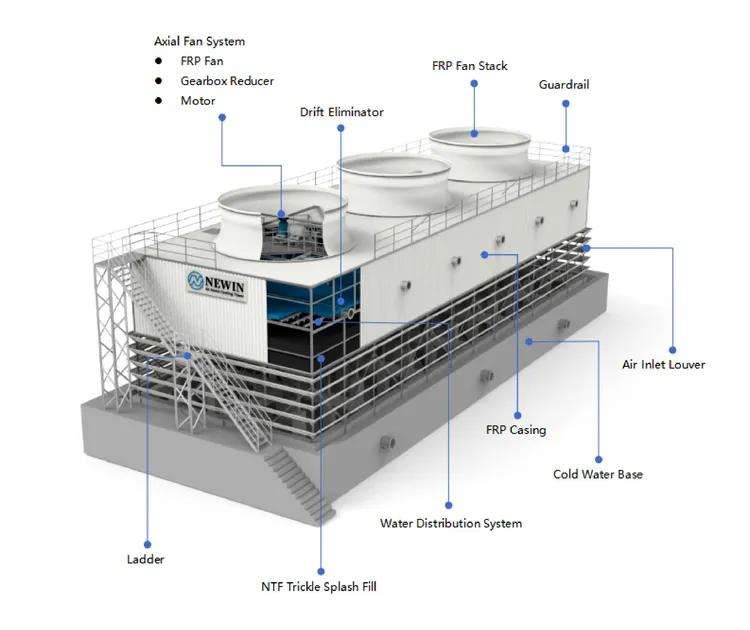
Cooling tower fill is one of the most important components influencing heat-transfer performance.
Its main function is to increase the contact area between circulating water and air.
Different fill designs provide different advantages.
Film fill spreads water across a large surface area, while splash fill breaks water into smaller droplets.
For relatively clean industrial circulating water, appropriately selected film fill can provide effective heat transfer.
For applications with higher suspended-solids or fouling risks, suitable splash fill may be a better option.
When selecting replacement cooling tower fill, consider:
Water temperature
Water quality
Suspended solids
Chemical compatibility
Airflow resistance
Fill material
Installation dimensions
Choosing the right fill is not simply about maximizing surface area. It is about matching heat-transfer performance with actual operating conditions.
A good water distribution system ensures that circulating water reaches the fill evenly.
Operators should inspect spray nozzles, headers, pipes, and distribution basins.
Remove blockages and replace damaged components where necessary.
Uniform water distribution improves the use of the available heat-transfer surface and helps prevent localized cooling problems.
Water quality has a direct influence on cooling tower reliability.
Important monitoring parameters include:
pH
Conductivity
Hardness
Alkalinity
Suspended solids
Relevant microbiological indicators
An appropriate treatment program helps control scaling, corrosion, and biological fouling.
Blowdown should also be adjusted according to water quality and the required cycles of concentration.
Reducing blowdown too aggressively may cause dissolved solids to accumulate and create additional maintenance problems.
Regular data collection is one of the simplest ways to maintain stable operation.
Operators should record:
Hot-water inlet temperature
Cold-water outlet temperature
Wet-bulb temperature
Circulating water flow
Fan operating conditions
Makeup water consumption
Blowdown volume
Comparing these values over time helps identify abnormal changes.
For example, if evaporation increases together with industrial heat load, the change may be normal.
However, if makeup water consumption rises while heat load remains relatively constant, operators should investigate drift, leakage, and blowdown control.
Every cooling tower component contributes to the overall heat rejection process.
When one component performs poorly, the balance between airflow, water distribution, and evaporation can be affected.
Cooling tower fill provides the surface area needed for effective air-water contact.
Its geometry, material, and installation quality all influence heat-transfer performance.
Film fill creates thin water films across closely spaced surfaces, while splash fill breaks water into smaller droplets.
Both designs have advantages depending on water quality and operating conditions.
For industrial cooling towers, selecting suitable PVC or PP fill media can help support long-term operation.
However, material selection should consider water temperature, chemical compatibility, mechanical requirements, and expected service life.
Cooling tower fans provide the airflow required for evaporative heat rejection.
Axial fans are widely used in mechanical-draft cooling towers because they can move large volumes of air efficiently.
The motor provides the driving power, while the transmission system transfers that power to the fan.
Correct fan selection and installation help maintain the required airflow without unnecessary electricity consumption.
Operators should avoid increasing fan speed whenever cooling performance declines.
First, check whether fill blockage, uneven water distribution, or restricted air inlets are responsible.
Drift eliminators capture liquid droplets carried out of the cooling tower with exhaust air.
They reduce water losses caused by airborne droplets, but they do not prevent normal evaporation.
If drift eliminators become damaged, poorly installed, or blocked, liquid water loss may increase.
This is why drift should be monitored separately from evaporation when evaluating total cooling tower water consumption.
Different industries have different cooling requirements.
Heat loads, operating schedules, water quality, and environmental conditions all influence cooling tower evaporation.
Power plants require continuous heat rejection to support reliable electricity generation.
Cooling towers remove heat from circulating water systems associated with condensers and other equipment.
Changes in generating load can influence the cooling duty and evaporation requirement.
Reliable fan operation, clean fill, and effective water treatment are especially important for maintaining consistent performance.
Chemical plants often operate continuously and depend on stable cooling water temperatures for reactors, heat exchangers, and production equipment.
Changes in production conditions can create significant variations in heat load.
Cooling tower operators should coordinate system monitoring with production schedules and pay close attention to water chemistry, corrosion, and fouling.
Steel production and metallurgical processes generate substantial heat.
Cooling systems may serve furnaces, casting equipment, rolling mills, and auxiliary machinery.
High operating temperatures and challenging water conditions can place additional demands on cooling tower components.
Durable fill media, reliable fans, and effective water distribution are essential considerations.
Commercial HVAC systems and general manufacturing facilities often experience seasonal and daily changes in cooling demand.
During periods of high ambient temperature, cooling towers may operate under greater thermal stress.
Automated fan control and routine maintenance help match cooling capacity with actual demand while avoiding unnecessary energy consumption.
When evaporation or makeup water consumption changes unexpectedly, operators should investigate the complete cooling tower system rather than immediately adjusting fan or pump settings.
Some common situations include:
Problem 1: Excessive Makeup Water Consumption
Possible causes include increased heat load, excessive blowdown, damaged drift eliminators, and water leakage.
Recommended action: Check the complete cooling tower water balance and inspect the water distribution system.
Problem 2: Poor Cold-Water Temperature
Possible causes include insufficient airflow, high wet-bulb temperature, clogged fill, and excessive water loading.
Recommended action: Check fan operation, fill condition, water distribution, and environmental conditions.
Problem 3: Uneven Cooling Performance
Possible causes include blocked spray nozzles and uneven water distribution.
Recommended action: Inspect the distribution pipes, spray nozzles, and water basin.
Problem 4: Increasing Fan Vibration
Possible causes include fan imbalance, loose components, damaged blades, and bearing problems.
Recommended action: Stop the equipment when necessary and inspect the fan assembly following appropriate safety procedures.
Problem 5: Increasing Water Treatment Costs
Possible causes include excessive blowdown, poor water quality, and inadequate treatment control.
Recommended action: Review conductivity monitoring, cycles of concentration, and the water-treatment program.
Problem 6: Reduced Heat Rejection Performance
Possible causes include scaling, biological fouling, restricted airflow, and incorrect operating conditions.
Recommended action: Inspect fill media, fan performance, and water quality before selecting corrective measures.
A structured maintenance schedule makes it easier to identify developing problems and maintain reliable operation.
Check:
Hot-water inlet temperature.
Cold-water outlet temperature.
Wet-bulb temperature, where available.
Fan operation and unusual vibration.
Water distribution.
Makeup water consumption.
Abnormal noise or leakage.
Check:
Spray nozzles and distribution pipes.
Drift eliminator condition.
Fan blades and hub.
Motor connections.
Accessible fill surfaces.
Water-treatment records.
Blowdown control.
Compare operating data with previous months to identify unusual changes.
Arrange a more comprehensive inspection of:
Cooling tower structure.
Fill media and supports.
Fan assembly.
Motor and gearbox, where applicable.
Water distribution system.
Drift eliminators.
Electrical and mechanical connections.
Evaluate whether aging fill or damaged components should be replaced.
Always follow appropriate equipment isolation, lockout/tagout, and confined-space safety procedures where applicable.
Maintaining a stable evaporation rate requires more than adjusting operating parameters. The quality and compatibility of cooling tower equipment also influence long-term performance.
Mach Industry (Zhejiang) Co.,Ltd, operating under the Mach Cooling brand, focuses on industrial cooling tower solutions.
We recognize that every industrial cooling tower has different operating requirements. Heat load, circulating water flow, water temperature, local climate, and installation conditions all influence equipment selection.
An effective cooling tower should be selected according to actual operating conditions.
Important design parameters include:
Required heat rejection capacity.
Circulating water flow rate.
Hot-water inlet temperature.
Cold-water outlet temperature.
Local design wet-bulb temperature.
Installation space and environmental conditions.
Proper equipment selection helps avoid undersized systems that struggle to remove heat and oversized systems that may involve unnecessary investment.
Fill media directly affects the contact between circulating water and air.
Its geometry, material, installation quality, and resistance to fouling should all be considered.
Mach Cooling recognizes that the correct fill configuration must match the actual water quality and operating temperature rather than relying on a one-size-fits-all solution.
Fan performance is another important part of cooling tower efficiency.
Blade configuration, airflow requirements, motor capacity, and mechanical compatibility should be evaluated together.
A suitable airflow arrangement supports heat rejection while helping control operating energy consumption.
Different industrial facilities have different cooling challenges.
A power plant may prioritize continuous heat rejection, while a manufacturing facility may need flexible operation under changing production loads.
Mach Industry (Zhejiang) Co.,Ltd encourages customers to evaluate cooling tower equipment and components according to their system requirements, maintenance conditions, and long-term operating objectives.
If your industrial cooling tower experiences unstable cooling performance, excessive makeup water consumption, or declining heat-transfer efficiency, reviewing the equipment configuration is a practical first step.
Whether you are planning a new industrial cooling tower project or evaluating improvements to an existing system, selecting suitable equipment is essential.
Visit the official website of Mach Industry (Zhejiang) Co.,Ltd:
Contact Mach Cooling to explore industrial cooling tower solutions for your application.
There is no single normal evaporation rate for every cooling tower.
A commonly used preliminary estimate is approximately 0.95% of circulating water flow for every 10°F of cooling range.
For example, a tower circulating 1,000 GPM with a 10°F cooling range may evaporate approximately 9.5 GPM.
Actual values depend on heat load, operating conditions, water properties, and the accuracy of the calculation assumptions.
No.
A higher evaporation rate may simply reflect a higher industrial heat load.
To evaluate cooling performance, operators should compare evaporation with heat rejection, cooling range, wet-bulb temperature, and total water consumption.
Start by distinguishing evaporation from drift, blowdown, and leakage.
Maintain drift eliminators, repair leaks, and optimize blowdown according to water quality and cycles of concentration.
Avoid restricting airflow simply to reduce evaporation if doing so compromises the required cooling duty.
Inspection frequency depends on water quality, operating hours, environmental conditions, and fill material.
Monthly visual inspections are a useful starting point for many industrial facilities.
More detailed inspections should be arranged during scheduled maintenance. Systems with high fouling potential may require more frequent attention.
Cooling tower fill increases the contact area between air and water.
Effective fill design and proper water distribution support heat and mass transfer, helping the cooling tower achieve its required heat rejection capacity.
However, fill condition, airflow resistance, and water quality must all be considered.
Yes.
Fan speed influences airflow through the cooling tower.
Increasing airflow may improve heat and mass transfer under suitable conditions, while insufficient airflow can reduce cooling performance.
However, fan speed should be adjusted according to system requirements and equipment limits rather than increased without investigation.
A stable evaporation rate is an important part of reliable industrial circulating water management.
However, stability does not mean keeping evaporation at exactly the same level regardless of weather, production demand, or operating conditions.
It means maintaining predictable heat rejection while controlling unnecessary water and energy losses.
To achieve this, industrial operators need to pay attention to wet-bulb temperature, circulating water flow, heat load, airflow, fill condition, water distribution, and water treatment.
Cooling tower fans and fill media deserve particular attention because they directly influence the contact between air and water.
Regular monitoring and preventive maintenance can help identify problems before they affect production.
For industrial facilities looking to improve cooling tower performance, choosing suitable equipment and components is equally important.
Mach Industry (Zhejiang) Co.,Ltd is committed to providing industrial cooling tower solutions that support reliable operation and effective heat rejection.
Learn more about Mach Cooling and explore our industrial cooling tower solutions at: