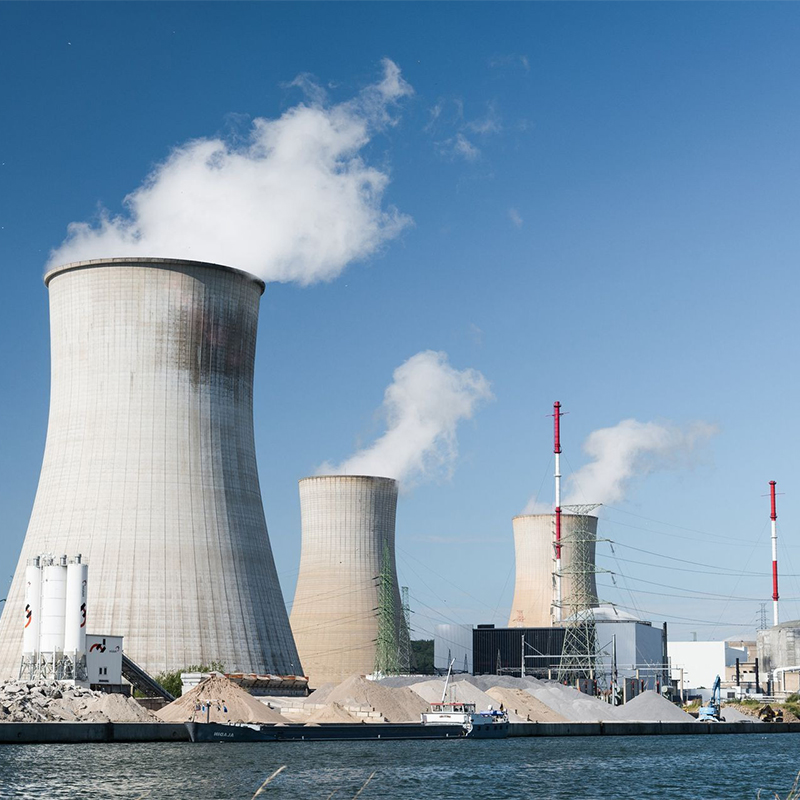
We Provide Cooling Tower Solution

Views: 0 Author: Cindy Publish Time: 2026-11-20 Origin: Site


When an industrial cooling system operates every day, reliable heat removal is only part of the job. Noise, energy consumption, installation space, water usage, and maintenance requirements also affect the performance of the entire facility. That is why more HVAC contractors, plant engineers, and plastic manufacturers are looking for a low noise FRP round cooling tower that combines efficient heat rejection, quiet operation, and durable construction.
A round FRP cooling tower is a practical solution for many applications where circulating water needs to be cooled continuously. Its fiberglass-reinforced plastic structure offers excellent corrosion resistance and relatively low weight, while its fan, motor, water distribution system, and fill media work together to support heat transfer.
For HVAC systems, the cooling tower helps remove heat from water-cooled chillers and central air-conditioning equipment. In plastic factories, it provides cooling water for injection molding, extrusion, blow molding, and auxiliary production machinery.
With a properly selected low-noise configuration, the cooling tower can also help reduce noise disturbance around production areas, offices, and nearby buildings.
As an industrial cooling tower manufacturer, Mach Industry (Zhejiang) Co.,Ltd provides cooling tower solutions for different industrial and commercial applications. In this guide, we will explore how low-noise FRP round cooling towers work, where they are used, what features matter, and how to choose the right model for your project.
A low noise FRP round cooling tower is a mechanical draft cooling tower designed to cool circulating water while limiting the sound generated during operation.
FRP stands for fiberglass-reinforced plastic. It is a composite material commonly used for cooling tower casings and structural components because it offers good corrosion resistance and performs well in many outdoor industrial environments.
The term "round" describes the tower's general cylindrical shape. Many round cooling towers use a compact vertical arrangement, with water distribution components near the top, fill media inside the body, and a fan system that moves air through the tower.
The cooling process is straightforward. Warm water enters the tower and is distributed over the fill media. Air passes through the falling water, allowing a small portion of the water to evaporate and carry heat away. The cooled water collects in the basin and returns to the cooling system.
A low-noise design does not depend on one component alone. Fan selection, motor performance, blade balance, airflow resistance, vibration control, water distribution, and installation conditions all influence the final operating noise.
FRP is widely used in cooling tower construction because it combines relatively low weight with good corrosion resistance.
Unlike conventional steel components, properly selected FRP parts do not rust in the same way when exposed to moisture and common cooling tower operating conditions. This makes FRP a practical material for outdoor cooling equipment.
FRP can also be molded into different shapes, making it suitable for cylindrical casings, fan stacks, panels, and other tower components. Its relatively light weight can simplify transportation and installation, particularly for projects where equipment needs to be installed on rooftops or in areas with limited access.
However, FRP quality depends on the resin system, reinforcement, manufacturing process, material thickness, and workmanship. Buyers should ask manufacturers about material specifications and suitability for the intended environment rather than judging product quality by appearance alone.
The cooling process mainly relies on evaporation and direct contact between air and water.
First, hot water from a chiller condenser or industrial process enters the tower. The water distribution system spreads it over the fill media, which increases the contact area between water and air.
Next, the fan moves air through the tower. As the air contacts the warm water, a small portion of the water evaporates. This evaporation removes heat from the remaining water, lowering its temperature.
Finally, the cooled water falls into the cold-water basin and is pumped back to the equipment that needs cooling.
The actual cooling performance depends on several factors, including water flow, entering water temperature, leaving water temperature, ambient wet-bulb temperature, airflow, and tower design.
This is why a cooling tower should be selected according to actual operating conditions rather than nominal tonnage alone.
Cooling towers often operate for long periods, sometimes throughout the day and night. If a tower produces excessive noise, it can affect workers, nearby offices, neighboring buildings, and the overall working environment.
This issue is especially important in commercial HVAC projects, hospitals, hotels, office buildings, and factories located close to residential or public areas.
In plastic manufacturing plants, cooling equipment may be installed near production lines where operators need to communicate, monitor machines, and concentrate on their work.
A low-noise cooling tower can help reduce disturbance, improve the working environment, and make it easier to meet project-specific acoustic requirements.
However, it is important to understand that "low noise" is a design objective rather than a universal sound level. Actual noise performance should be confirmed against the manufacturer's test data and the project's measurement conditions.
Several components contribute to cooling tower noise. Understanding these sources helps engineers choose the right noise-control measures.
1. Fan noise
The fan is one of the main sources of operating noise. Air moving across the fan blades can create aerodynamic noise, particularly when blade design, rotational speed, or operating conditions are unsuitable.
2. Motor and drive noise
Motors, gearboxes, belts, bearings, and other drive components may produce mechanical sound. Poor alignment or worn components can make the problem worse.
3. Water noise
Warm water falling through the tower and striking internal components or the basin can create noticeable splashing sounds. Water distribution design and fill arrangement influence this noise.
4. Vibration
Unbalanced rotating parts, loose fasteners, damaged bearings, or an unsuitable foundation can transfer vibration to the tower structure.
5. Airflow turbulence
Restricted air passages and uneven airflow may increase turbulence, resulting in additional noise and potentially affecting cooling performance.
A low-noise FRP round cooling tower should be designed as a complete system. Reducing noise from the fan while ignoring vibration or water splashing may not deliver the expected result.
An appropriately selected fan with a suitable blade profile, diameter, and rotational speed can help move the required air volume without unnecessarily increasing aerodynamic noise.
The motor and drive components should match the fan's operating requirements. Accurate installation, correct alignment, secure mounting, and regular balancing help limit mechanical vibration.
Water distribution also matters. Properly designed nozzles and fill arrangements help distribute water evenly and avoid unnecessary splashing.
For projects with stricter acoustic requirements, engineers may consider additional measures such as acoustic barriers, sound-attenuating enclosures, or carefully planned equipment positioning.
The goal is to balance cooling performance, energy consumption, maintenance access, and sound levels rather than reducing noise at the expense of heat rejection.
HVAC systems use cooling towers to reject heat from water-cooled chillers and other heat-generating equipment.
A low-noise FRP round cooling tower can be considered for commercial and industrial buildings where stable cooling and controlled operating noise are important.
The tower is part of a larger cooling-water circuit. It works with chillers, pumps, piping, heat exchangers, and control equipment.
The cooling tower itself does not produce chilled air for the building. Instead, it helps remove heat from the chiller's condenser-water circuit so the chiller can continue operating effectively.
For HVAC contractors and system designers, the key is to match the cooling tower with the chiller's heat rejection requirement and the site's design conditions.
In a water-cooled chiller system, the chiller transfers heat from the building's chilled-water circuit to the condenser-water circuit. The cooling tower then releases that heat into the atmosphere.
A correctly selected cooling tower helps maintain condenser-water temperatures within the chiller manufacturer's recommended operating range.
This supports stable chiller operation and can help avoid unnecessary energy use caused by unsuitable condenser-water conditions.
When choosing a cooling tower for a chiller project, engineers should check:
Chiller heat rejection requirements
Condenser-water flow rate
Entering and leaving water temperatures
Local design wet-bulb temperature
Expected operating hours
Available installation space
One important point: cooling tower capacity should not be assumed to be identical to the chiller's refrigeration capacity. The tower must reject the total heat transferred to the condenser-water circuit, including the heat added by the chiller compressor.
Commercial buildings often have limited plant-room or rooftop space. A compact round cooling tower may be suitable when the available footprint, access routes, structural loading, and maintenance clearances are considered during the design stage.
Noise is another major concern.
Hotels need a comfortable environment for guests. Hospitals require a suitable atmosphere for patients and staff. Office buildings should avoid unnecessary equipment noise near occupied areas.
The cooling tower's location, discharge direction, distance from windows, nearby walls, and potential sound reflection should all be reviewed.
Even a low-noise cooling tower can create disturbance if it is installed in a poorly planned location. Good site planning is therefore just as important as equipment selection.
Plastic production depends heavily on temperature control.
During molding and extrusion, heat must be removed from molds, hydraulic systems, process equipment, and auxiliary machinery. If cooling water is unstable or insufficient, production cycles may become longer and product quality may be affected.
A low-noise FRP round cooling tower can serve as part of the factory's circulating-water system. It rejects heat from process water and returns cooled water to the production equipment.
The required cooling tower capacity depends on the number and type of machines, total heat load, water flow, operating schedule, and local climate.
For plastic factories, reliable cooling is not simply a utility requirement. It is an important part of the production process.
Injection molding machines generate heat during plasticizing, injection, clamping, and hydraulic operation.
Depending on the machine design, cooling water may be used for molds, oil coolers, and other heat-exchange equipment.
Stable mold temperature helps control the cooling stage of the molding cycle. If the cooling system cannot remove enough heat, cycle times may increase, and dimensional consistency or surface quality may become harder to maintain.
A cooling tower supports the plant's cooling-water loop by removing heat from circulating water.
However, the tower must be sized according to the combined heat load and actual water temperature requirements. Some applications may also require a heat exchanger or a separate temperature-control unit between the cooling tower loop and the production equipment.
Extrusion lines need consistent temperature management for barrels, dies, cooling sections, and auxiliary equipment.
Blow molding systems also rely on cooling to help shape and stabilize products after forming.
In a factory with several production lines, cooling demand may change as machines start, stop, or operate at different production rates.
The cooling system should therefore be designed around the plant's actual operating profile instead of assuming that every machine runs at full load all the time.
A properly selected cooling tower helps remove process heat and supports a stable supply of cooling water.
Engineers should also consider water quality, filtration, scaling, and the possibility of process contamination.
Consistent cooling can help manufacturers maintain predictable production conditions.
When molds and process equipment receive water at the required temperature and flow rate, operators have better control over process stability.
Insufficient cooling may lead to longer cycle times, temperature fluctuations, or unplanned production interruptions.
Oversized equipment, on the other hand, can increase initial investment and may operate inefficiently if the system is poorly controlled.
The right solution is not necessarily the largest cooling tower. It is a tower that matches the real heat load, expected operating range, and future production needs.
Although a round cooling tower may look like a single piece of equipment from the outside, its performance depends on several connected components.
Each part has a specific role in moving air, distributing water, transferring heat, and maintaining safe operation.
When evaluating a supplier, buyers should review the complete configuration rather than focusing only on the casing or fan.
The FRP casing forms the tower's outer body and helps protect internal components from the surrounding environment.
Its design should provide sufficient structural strength while allowing suitable access for inspection and maintenance.
For outdoor installations, buyers should consider exposure to sunlight, wind, rain, temperature changes, and the chemical characteristics of the surrounding atmosphere.
UV-resistant materials and appropriate structural design may be important depending on the project.
The support structure and foundation must also be suitable for the operating weight of the tower, including water, rotating equipment, and dynamic loads. Structural requirements should be confirmed by the project engineer.
The fan provides the airflow needed for heat and mass transfer.
Its diameter, blade design, speed, and motor power should match the tower's required airflow and operating conditions. An unsuitable fan can increase energy consumption or noise without delivering the required cooling performance.
The motor supplies the driving power. It should be selected for the installation environment and operating duty, with appropriate electrical protection and maintenance access.
The water distribution system carries warm water to the tower's spray nozzles or distribution points.
Even water distribution helps the fill work effectively. Blocked nozzles, poor pressure, or uneven flow can reduce cooling performance and create localized operating problems.
Fill media increases the contact area between air and water. It slows the water's movement and spreads it into thin films or droplets, giving heat transfer more time and surface area.
The appropriate fill type depends on water quality, temperature, suspended solids, and the risk of scaling or biological fouling.
In applications with poor water quality, an easily maintained fill arrangement may be more practical than a configuration that is difficult to clean.
Drift eliminators reduce the amount of water droplets carried out of the tower by the exhaust air. They help limit water loss and reduce the discharge of droplets into nearby areas.
Their condition should be checked during routine maintenance.
Correct capacity selection is one of the most important steps in a cooling tower project.
A tower that is too small may fail to meet the required leaving-water temperature during hot weather or peak production. A tower that is too large may increase capital cost and may not deliver the expected efficiency if the system is not controlled properly.
Before requesting a quotation, prepare the basic operating data and explain how the equipment will be used.
A manufacturer can then review the conditions and recommend a suitable model or customized configuration.
Start with the total heat that must be rejected.
For HVAC applications, obtain the condenser heat rejection data from the chiller manufacturer.
For plastic factories, calculate or estimate the heat load from the machines and process equipment connected to the cooling-water system.
Do not assume that cooling capacity is identical to the chiller's refrigeration capacity. A cooling tower must reject both the heat removed from the chilled-water circuit and the heat added by the chiller compressor, subject to the system design.
Where multiple machines are connected, consider their simultaneous operating load and any planned production expansion.
The cooling tower supplier needs to know the circulating-water flow rate, hot-water inlet temperature, and cold-water outlet temperature.
These values define the required cooling range and help determine the tower's thermal duty.
The local design wet-bulb temperature is also essential because an evaporative cooling tower cannot normally cool water below the entering air's wet-bulb temperature.
A tower selected using unrealistic climate assumptions may not achieve the expected outlet temperature.
Provide actual design conditions whenever possible. If operating conditions vary, share the normal, minimum, and maximum values so the manufacturer can evaluate the operating range.
Check the available installation footprint, tower height, service access, lifting route, piping layout, and foundation conditions.
Air intake and discharge should not be obstructed by nearby walls or other equipment.
For noise-sensitive projects, explain the required sound limit, measurement distance, measurement position, and whether the requirement applies at the property boundary or another location.
Ask the supplier for available sound data and the conditions under which it was measured.
If the project has strict acoustic limits, an acoustic consultant may need to assess the complete installation, including reflections from nearby buildings and noise from pumps or other equipment.
A round FRP cooling tower is often considered for projects that need a compact, relatively lightweight cooling unit.
Its cylindrical form can be suitable for certain airflow arrangements and installation layouts.
Square or rectangular cooling towers may offer different advantages, particularly in modular systems or installations requiring multiple cells.
Larger industrial projects may also use different mechanical draft or natural draft designs depending on capacity and site conditions.
There is no single tower shape that is best for every project.
When comparing cooling tower types, consider:
Thermal performance under the actual design conditions
Available installation footprint and height
Noise data and acoustic requirements
Material specifications and corrosion resistance
Maintenance access and replacement-part availability
Initial investment and long-term operating costs
Water treatment and operating requirements
The best choice is the one that meets the project's cooling requirements while fitting its installation and operating conditions.
Good installation and routine maintenance help protect cooling performance and equipment life.
Before commissioning, check the foundation, anchor points, electrical connections, motor rotation, fan clearance, water distribution, basin condition, and piping connections.
During operation, monitor:
Water flow and water level
Inlet and outlet water temperatures
Fan vibration and operating sound
Motor current and operating condition
Water distribution and nozzle condition
Basin cleanliness and water quality
A sudden change in noise may indicate loose fasteners, blade damage, imbalance, bearing wear, or another mechanical issue. Operators should investigate unusual sounds rather than allowing the equipment to continue running without inspection.
Clean the basin and water distribution components as required by the site's water treatment program. Inspect fill media and drift eliminators for scale, dirt, biological growth, or physical damage.
Maintain suitable water treatment and follow applicable regulations for cooling-water hygiene.
Always isolate electrical power and follow the manufacturer's safety procedures before carrying out inspection or maintenance.
Choosing a cooling tower manufacturer is about more than comparing prices.
You need a supplier that understands your operating conditions, can review technical requirements, and can recommend a configuration that fits the project.
Mach Industry (Zhejiang) Co.,Ltd provides industrial cooling tower solutions for different application environments. For HVAC and plastic industry projects, the selection process should consider heat load, water flow, design temperatures, local wet-bulb conditions, installation space, noise expectations, and maintenance needs.
Whether your project involves a central air-conditioning system, a chiller plant, injection molding machines, or extrusion production lines, providing accurate operating information helps the manufacturer evaluate the required cooling capacity and configuration.
When contacting Mach, it is helpful to prepare the following information:
Application: HVAC, injection molding, extrusion, or another industrial process.
Required cooling capacity or total heat rejection.
Circulating-water flow rate.
Hot-water inlet and cold-water outlet temperatures.
Local design wet-bulb temperature.
Installation space and site conditions.
Noise requirements and any project-specific restrictions.
Expected operating schedule and future capacity requirements.
With these details, the technical team can better understand your project and discuss a suitable cooling tower solution.
Visit the official website to learn more about Mach's industrial cooling tower products and services:
Manufacturer: Mach Industry (Zhejiang) Co.,Ltd
Website: https://www.machcooling.com
Low-noise performance comes from the combined design of the fan, motor, drive system, water distribution, and tower installation. Suitable fan selection, balanced rotating parts, vibration control, and appropriate acoustic measures can all help reduce noise.
Yes. It can be used in water-cooled HVAC systems when its capacity and operating conditions match the chiller's heat rejection requirements. The design wet-bulb temperature and condenser-water temperatures must be considered during selection.
Yes. A cooling tower can reject heat from circulating water used by injection molding machines and related equipment. The required capacity depends on the total heat load, water flow, and required water temperatures.
Not automatically. Noise level and energy consumption are related to equipment selection and operating conditions, but one does not guarantee the other. A properly selected fan and motor can help balance airflow, power consumption, and sound performance.
Prepare the heat load, water flow rate, hot-water and cold-water temperatures, local wet-bulb temperature, operating schedule, and installation conditions. A manufacturer can use these details to evaluate the required capacity.
Inspection frequency depends on operating hours, water quality, environmental conditions, and the manufacturer's recommendations. Operators should establish a regular inspection and cleaning plan and check the fan, motor, basin, fill, nozzles, and drift eliminators.
The required configuration depends on the application and manufacturer's available design options. Buyers should discuss cooling capacity, dimensions, materials, fan configuration, water flow, and noise requirements with the manufacturer before ordering.
The right low-noise FRP round cooling tower should do more than circulate water. It should match your heat load, maintain the required cooling-water temperature, fit your installation space, and meet the acoustic expectations of your facility.
Whether you are planning a central HVAC system, upgrading a chiller plant, or improving cooling for a plastic manufacturing line, start with accurate operating data. This gives the manufacturer a clear basis for recommending a suitable solution.
Contact Mach Industry (Zhejiang) Co.,Ltd to discuss your project requirements, cooling capacity, configuration, and low-noise options.
Website: https://www.machcooling.com
Make your next cooling system more reliable with a cooling tower solution designed around your actual industrial needs.