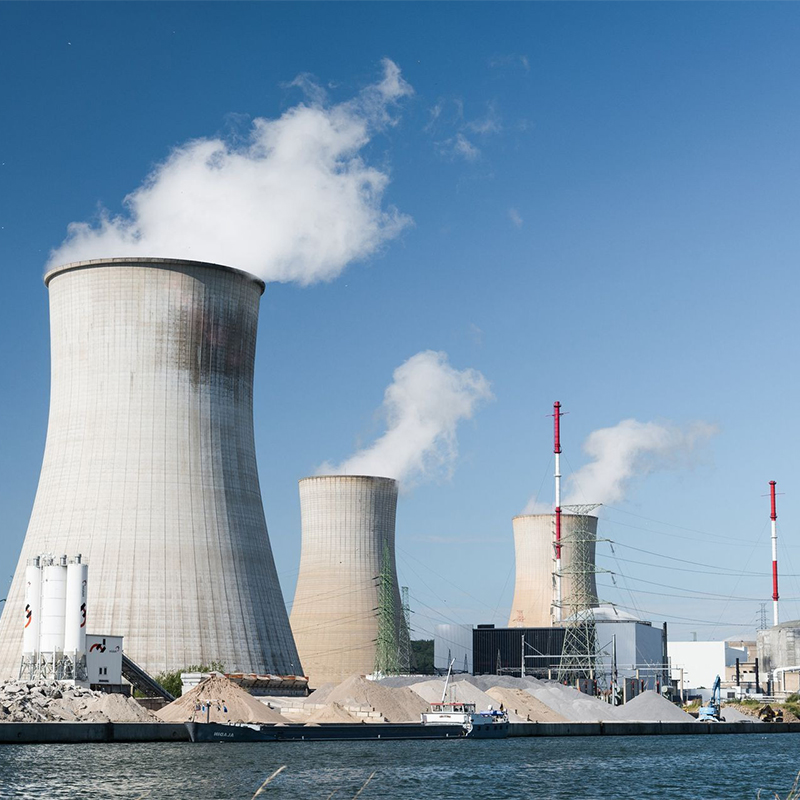
We Provide Cooling Tower Solution

Views: 0 Author: Cindy Publish Time: 2026-10-05 Origin: Site


A cooling tower may look simple from the outside. Hot water enters, air moves through the tower, heat is rejected, and cooler water leaves the system. But behind this seemingly simple process is a constantly changing thermal system.
Outdoor temperature changes. Cooling loads rise and fall. Water flow fluctuates. Fans do not always need to operate at full speed. So, how do you keep everything working efficiently without relying on an operator to constantly adjust the equipment?
That is where a cooling tower control system comes in.
A cooling tower control system acts like the brain of the cooling tower. It collects operating data, compares that information with target values, and automatically adjusts fans, pumps, valves, and other equipment. The result can be more stable cooling, lower energy consumption, better equipment protection, and easier operation.
In this guide, we will explain what a cooling tower control system is, how it works, which components it uses, how fan and temperature control are handled, and what you should consider when selecting a system for an industrial or HVAC application.
A cooling tower control system is a combination of sensors, controllers, electrical equipment, software, and control devices used to automatically manage cooling tower operation.
Its primary purpose is simple: maintain the required cooling-water conditions while using only the amount of cooling capacity that the system actually needs.
Think of it like cruise control in a car.
You set a target speed, and the system automatically adjusts engine output according to road conditions. A cooling tower control system works in a similar way. You establish a temperature or operating target, and the controller adjusts the cooling equipment according to actual demand.
Depending on the application, a system may include:
Temperature sensors
Flow sensors
Water-level sensors
Pressure sensors
PLCs or dedicated controllers
Variable frequency drives (VFDs)
Motor starters
Fan motors
Pump controls
Vibration switches
HMI interfaces
BMS or SCADA communication
Water-quality monitoring devices
The exact configuration depends on the cooling tower design, cooling capacity, number of cells, fan arrangement, process requirements, and desired level of automation.
Why invest in a control system if the cooling tower already works?
Because "working" and "working efficiently" are two very different things.
A cooling tower that operates every fan at full speed all day may provide sufficient cooling, but it can waste a significant amount of electricity when the cooling load is low.
On the other hand, if the fans operate too slowly when the process requires more heat rejection, water temperature can rise and affect downstream equipment.
A good control system creates a balance between these two extremes.
It can automatically increase cooling capacity when demand rises and reduce capacity when demand falls. At the same time, it can monitor equipment status and provide alarms when something goes wrong.
Temperature stability is one of the most important reasons to automate a cooling tower.
The controller receives temperature feedback from the cooling-water circuit and compares the actual temperature with the desired setpoint.
If the leaving-water temperature rises above the target, the controller can increase fan speed or bring additional fans online.
Once the target temperature is reached, the controller can reduce cooling capacity.
This creates a continuous feedback loop instead of relying on manual adjustments.
Cooling tower fans can represent a significant portion of the system's electrical load.
So, why run a fan at 100% speed when the cooling load only requires 50% capacity?
A variable frequency drive can adjust fan speed according to actual demand. When the cooling load is low, the fan slows down. When the water temperature increases, the fan speeds up.
This demand-based operation can reduce unnecessary energy consumption while also improving temperature stability.
A cooling tower control system is not only about efficiency. It is also about protection.
The system can monitor conditions such as:
High water temperature
Low water level
Loss of water flow
Motor overload
Fan vibration
VFD faults
Pump faults
Abnormal operating conditions
When a critical problem occurs, the controller can generate an alarm or stop the affected equipment.
For large industrial cooling towers, this protection can be extremely valuable because a fan, gearbox, or motor failure can result in expensive downtime.

The easiest way to understand a cooling tower control system is to follow the operating cycle:
Measure → Compare → Adjust → Measure Again
First, sensors collect operating information.
Second, the controller compares the information with programmed setpoints.
Third, the controller sends commands to fans, pumps, valves, or other equipment.
Finally, the sensors measure the new operating condition and send the information back to the controller.
This is called a closed-loop control process.
Sensors are the eyes and ears of a cooling tower control system.
Temperature sensors can measure entering and leaving water temperatures. Flow sensors can verify whether water is circulating correctly. Level sensors can monitor the cooling tower basin.
Depending on the application, the system may also monitor:
Pressure
Vibration
Motor current
Conductivity
Humidity
Ambient temperature
Water quality
The important point is that good control starts with good measurements.
Even the most advanced PLC cannot make the right decision if its temperature sensor is installed incorrectly or gives inaccurate information.
Once the sensor information reaches the controller, it is compared with programmed target values.
For example, suppose the desired leaving-water temperature is 30°C.
If the actual temperature rises to 31°C, the controller recognizes that additional cooling is required.
It can then increase fan speed or start another fan.
If the temperature drops below the target, the controller can reduce fan speed.
More advanced systems can use PID control to make these adjustments gradually rather than simply switching equipment on and off.
After analyzing the data, the controller sends output signals to the cooling equipment.
A VFD may receive a speed command.
A motor starter may start or stop a fan.
A pump controller may change pump operation.
A valve actuator may adjust water flow.
The exact configuration depends on the cooling tower and the process requirements.
The basic idea is straightforward: the control system turns information into physical action.

After the equipment changes its operating condition, the sensors measure the result again.
If the water temperature is still too high, the controller can increase cooling capacity further.
If the desired temperature has been reached, the controller can stabilize operation.
This continuous feedback makes an automatic cooling tower control system much more responsive than a fixed operating schedule.
Although cooling tower control systems vary from project to project, most industrial systems use several common components.
The right combination depends on tower size, cooling duty, number of cells, fan type, water circuit, environmental conditions, and automation requirements.
Temperature sensors are fundamental to cooling tower control.
They should be installed at locations where their measurements accurately represent the water condition that needs to be controlled.
For example, leaving-water temperature is often used as the primary feedback signal for fan-speed control.
Some systems also monitor entering-water temperature and ambient conditions.
The goal is not simply to collect more data. The goal is to collect the right data at the right locations.
A PLC, programmable controller, or dedicated cooling tower controller processes sensor signals and executes the control logic.
It can determine:
When a fan should start
When a fan should stop
How fast a VFD should operate
When a pump should run
When an alarm should be activated
When equipment should be shut down
PLC-based control is particularly useful for larger industrial cooling towers because the control logic can be customized and expanded as the plant develops.
A variable frequency drive, or VFD, changes motor speed instead of forcing the fan to operate only at full speed or zero speed.
This provides much finer control.
When cooling demand is low, the fan can slow down. As water temperature rises, the fan can accelerate.
For systems with variable cooling loads, VFD control can provide an effective combination of temperature control and energy efficiency.
Motor starters, contactors, overload protection, and disconnect devices provide the electrical interface between the control system and motors.
In a simple system, a motor starter may provide basic on/off control.
In a more advanced system, the VFD manages motor speed while the control panel provides protection, isolation, bypass functions, and communication.
Cooling tower operation depends on proper water circulation.
A low basin water level can create problems for pumps, while insufficient water flow can reduce cooling performance.
Level and flow sensors therefore provide important protection.
The control system can use their signals to activate makeup water, generate alarms, or prevent equipment from operating under unsafe conditions.
Water-quality monitoring can also be integrated when automatic blowdown or conductivity control is required.
Cooling tower fans, motors, shafts, bearings, and gearboxes are rotating mechanical equipment.
Excessive vibration may indicate a developing mechanical problem.
A vibration switch or monitoring device can provide an additional layer of protection.
If vibration exceeds a predefined limit, the system can generate an alarm or shut down the affected fan.
This can help prevent a relatively small mechanical problem from developing into major equipment damage.
An HMI, or Human-Machine Interface, provides operators with a visual interface for monitoring:
Water temperature
Fan speed
Fan status
Pump status
Alarms
Setpoints
Operating hours
Larger facilities may connect the cooling tower controller to a Building Management System, SCADA platform, or plant automation network.
This allows operators to monitor multiple cooling tower cells from a central location.
There is no single fan-control method that fits every cooling tower.
The right strategy depends on tower size, number of fans, cooling load, required temperature stability, operating profile, and project budget.
On-off control is the simplest approach.
When water temperature reaches a high limit, the fan starts.
When the temperature falls to a lower limit, the fan stops.
This method is relatively simple and can work well for smaller cooling towers.
However, frequent starting and stopping can cause temperature fluctuations and additional mechanical or electrical stress.
A suitable deadband and minimum run or stop time can help reduce excessive cycling.
A multi-cell cooling tower can use staged fan control.
For example, the first fan starts when temperature reaches a defined threshold.
If temperature continues increasing, a second fan starts.
Additional fans are activated as cooling demand increases.
This approach provides more flexibility than single-fan on/off control, but cooling capacity is still available only in discrete stages.
VFD control provides continuous fan-speed modulation.
Instead of choosing only between "off" and "full speed," the controller can operate the fan at many different speeds.
This allows the cooling tower to follow changing thermal loads much more closely.
For many industrial applications, VFD-based fan control is an effective way to improve temperature stability while reducing unnecessary fan energy consumption.
Temperature control is at the heart of most cooling tower automation strategies.
However, there is an important engineering principle to understand.
A cooling tower cannot normally cool water below the surrounding air's wet-bulb temperature through evaporative cooling.
That means the control system must use realistic temperature targets based on environmental conditions and the cooling tower's design.
Wet-bulb temperature is an important reference for evaporative cooling.
When outdoor wet-bulb temperature increases, heat rejection becomes more difficult.
A controller that ignores this condition may command maximum fan speed while still being unable to reach an unrealistic water-temperature target.
Advanced systems can take ambient conditions into account when establishing or resetting cooling-water targets.
This helps prevent the system from wasting energy trying to achieve an impractical setpoint.
PID control can make fan-speed modulation smoother and more precise.
Instead of waiting for a large temperature difference before making a major adjustment, the controller continuously evaluates the difference between the actual temperature and the desired setpoint.
Proper PID tuning is important.
Poorly tuned control loops can cause:
Fan-speed hunting
Unstable temperatures
Excessive cycling
Unnecessary energy consumption
Commissioning should therefore include sensor verification, control-loop testing, minimum fan-speed checks, and operating-condition testing.
Cooling towers naturally lose water through evaporation, drift, and blowdown.
A control system can help maintain the correct basin level and coordinate makeup-water operation.
Water-quality control can also be integrated when required.
This is important because poor water management can contribute to:
Scale
Corrosion
Fouling
Reduced heat-transfer performance
Increased maintenance
Higher water consumption
Makeup-water control keeps the basin supplied as water is lost.
Blowdown removes a portion of concentrated circulating water and helps control dissolved solids.
These two processes need to work together.
If makeup water is excessive, water consumption increases.
If blowdown is insufficient, dissolved solids can become concentrated.
An integrated water-management strategy can therefore help maintain more consistent operating conditions.
A properly designed control system does much more than automate a few switches.
It connects the cooling tower's mechanical, electrical, and thermal behavior into one coordinated operating strategy.
One of the biggest opportunities comes from matching fan operation with actual cooling demand.
Instead of running every fan continuously at maximum speed, the system can stage fans or adjust VFD speed.
When the load is low, cooling capacity can be reduced.
When the load increases, cooling capacity increases automatically.
Actual energy savings depend on motor size, operating hours, climate, tower design, and load profile, but demand-based control can significantly reduce unnecessary operation.
Many industrial processes require stable cooling-water temperatures.
A sudden increase in cooling-water temperature can affect:
Chillers
Heat exchangers
Compressors
Injection molding machines
Furnaces
Process equipment
Data-center cooling systems
Automatic control allows the cooling tower to respond continuously to changing loads instead of waiting for manual intervention.
A modern control system can record alarms and operating information that would otherwise be difficult to capture.
Operators can identify whether:
A fan has failed
Water flow has disappeared
Temperature has increased unexpectedly
A VFD has entered a fault condition
A pump has stopped
A vibration limit has been exceeded
This makes troubleshooting more systematic and can reduce the time required to identify the cause of a problem.
Even an automated cooling tower can perform poorly if the control strategy, sensors, or equipment are incorrectly configured.
Understanding common problems makes commissioning and maintenance easier.
If fans repeatedly start and stop, the control deadband may be too narrow.
Other possible causes include poorly positioned sensors, aggressive control settings, or insufficient minimum run and stop times.
Increasing the deadband or using VFD modulation can often improve operating stability.
A temperature sensor installed in the wrong location can provide misleading information.
Calibration errors, wiring problems, sensor drift, and poor immersion conditions can also cause inaccurate readings.
Before changing complicated control logic, always verify the measurement.
In control engineering, bad data often creates bad decisions.
VFD alarms can result from:
Motor overload
Excessive temperature
Incorrect parameters
Electrical problems
Mechanical resistance
Poor ventilation
Improper installation
Motor, gearbox, or bearing problems can also appear as abnormal current or vibration.
A good control system should distinguish between normal operating alarms and critical shutdown conditions.
Choosing a control system should start with the cooling tower and process—not with a particular controller brand.
First determine what needs to be controlled.
Then determine what information needs to be measured.
Finally, determine what level of automation the application actually requires.
A small single-cell cooling tower may only require temperature feedback and basic fan control.
A large industrial cooling tower may require:
Multiple VFDs
Fan sequencing
Pump interlocks
Basin-level monitoring
Vibration protection
Water-quality monitoring
Alarm management
Centralized communication
The control architecture should match the physical size and complexity of the cooling tower.
Ask how sensitive the process is to temperature changes.
If the process can tolerate several degrees of variation, simple staged fan control may be sufficient.
If tighter temperature stability is required, variable-speed fans and properly tuned PID control may provide a better solution.
Modern industrial facilities increasingly expect equipment to communicate with centralized automation systems.
Before selecting a control panel, consider:
Communication protocols
Remote monitoring
Data logging
Alarm management
BMS or SCADA integration
Future expansion
Number of additional cooling cells
A good control system should be able to grow with the plant rather than becoming obsolete after a small expansion.
Mach Industry (Zhejiang) Co.,Ltd. focuses on cooling tower manufacturing and customized cooling solutions for industrial and commercial applications.
For Mach customers, a cooling tower control system should be considered part of the complete heat-rejection solution rather than simply an electrical cabinet attached to a tower.
The appropriate control configuration can be developed around factors such as:
Cooling capacity
Cooling tower type
Number of fans
Number of cells
Process requirements
Local climate
Water conditions
Automation architecture
Energy-efficiency objectives
Depending on the project, control functions can include temperature monitoring, fan-speed control, fan staging, pump interlocking, water-level monitoring, alarm protection, equipment safety monitoring, and communication with a plant-level control system.
This integrated approach allows the cooling tower to work as part of the customer's overall cooling system.

When purchasing a cooling tower, the control system should not be treated as an afterthought.
The mechanical design, fan selection, motor capacity, water distribution, heat-transfer requirements, and control strategy all influence one another.
Working directly with a cooling tower manufacturer can make it easier to coordinate these elements from the beginning.
For example, the control strategy can be designed around the actual fan configuration instead of being added after the tower has already been selected.
This can simplify commissioning and help ensure that the control system matches the cooling tower's operating characteristics.
For customized industrial projects, Mach Industry (Zhejiang) Co.,Ltd. can provide cooling tower solutions based on the customer's specific operating requirements.
A cooling tower control system is the intelligence that turns a mechanical cooling tower into a responsive, efficient, and manageable heat-rejection system.
At its simplest, the system may measure temperature and switch a fan on or off.
At a more advanced level, it can coordinate temperature sensors, PLC logic, VFDs, pumps, fans, water management, safety devices, alarms, and remote monitoring in one integrated system.
The key is not to add automation simply for the sake of automation.
The goal is to make the cooling tower respond to real operating conditions.
When the cooling load increases, cooling capacity should increase.
When demand falls, unnecessary fan energy should fall with it.
When an abnormal condition occurs, the system should detect it before a small problem becomes a major failure.
For industrial users, that combination of stable cooling, energy efficiency, equipment protection, and operational visibility is why a well-designed cooling tower control system matters.
Whether you need a basic temperature-control solution or a complete PLC/VFD/BMS-integrated system, the right control strategy can make your cooling tower easier to operate, more stable, and more efficient.
Mach Industry (Zhejiang) Co.,Ltd. provides cooling tower solutions for customers looking for reliable heat-rejection equipment and application-specific configurations.

The main purpose is to automatically maintain the required cooling conditions while coordinating fans, pumps, valves, and safety devices according to actual operating demand.
Yes. VFDs are commonly used to vary cooling tower fan speed according to temperature feedback or another control signal. This can provide more precise capacity control than simple on-off operation.
Typical systems use water-temperature, flow, and water-level sensors. More advanced systems may also monitor vibration, pressure, conductivity, ambient conditions, and electrical parameters.
No. A smaller cooling tower may use a dedicated temperature controller or a simpler control panel. PLC-based control becomes more useful as system complexity, fan quantity, and integration requirements increase.
The system can reduce fan operation when cooling demand is low and increase cooling capacity when demand rises. VFD-based fan control is particularly useful for variable-load applications.
Wet-bulb temperature is an important thermodynamic reference for evaporative cooling. Cooling-water targets need to account for ambient wet-bulb conditions and the cooling tower's approach temperature.
The exact maintenance interval depends on the equipment and application. However, sensors, electrical connections, VFDs, alarms, safety devices, and control logic should all be included in a regular preventive-maintenance program.
Yes. For project-specific requirements, Mach Industry (Zhejiang) Co.,Ltd. can configure cooling tower solutions around cooling capacity, tower design, fan arrangement, application conditions, and customer control requirements.
The best cooling tower control system is not necessarily the most complicated one.
It is the one that provides the right measurements, the right control response, and the right level of protection for the application.
Whether you need simple temperature control, staged fan operation, VFD-based modulation, or a complete PLC and BMS-integrated solution, effective control should make the cooling tower more stable, more efficient, safer, and easier to manage.
For industrial cooling projects, choosing the right cooling tower manufacturer and control strategy at the beginning can make a significant difference in long-term performance.