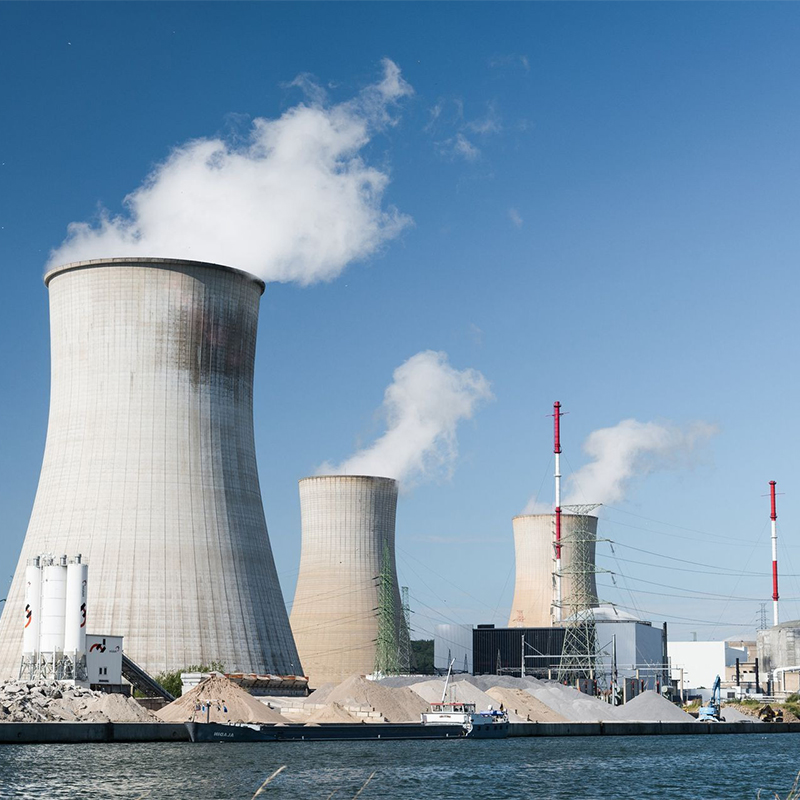
We Provide Cooling Tower Solution

Views: 0 Author: Cindy Publish Time: 2026-10-05 Origin: Site


When you walk into a large office building, hotel, shopping mall, hospital, or industrial facility on a hot summer day, you probably don't think about where all that indoor heat goes.
But someone has to deal with it.
A large central air conditioning system doesn't simply make heat disappear. It moves heat from one place to another. In many large HVAC systems, a cooling tower plays a critical role in getting that unwanted heat out of the building and into the atmosphere.
So, how does cooling tower air conditioning actually work?
The basic process is surprisingly logical. A chiller removes heat from the building's chilled-water system. That heat is transferred to condenser water. The condenser water travels to the cooling tower, where air and evaporation remove the heat. The cooled water then returns to the chiller, and the cycle starts again.
Think of the system as a relay race. Each component receives the heat, moves it one step further, and finally hands it off to the atmosphere.
Let's take a closer look.
Cooling tower air conditioning generally refers to a central HVAC arrangement that uses a water-cooled chiller and cooling tower.
The cooling tower itself does not normally blow cold air into a room. Instead, it performs a different but equally important job: heat rejection.
Inside the building, air-conditioning equipment removes heat from occupied spaces. That heat eventually reaches the chiller. The chiller then transfers the heat to condenser water.
The cooling tower receives that hot condenser water and rejects the heat outdoors.
That's the big picture.
The system can therefore be divided into two important water circuits:
The chilled-water loop, which serves the building.
The condenser-water loop, which serves the chiller and cooling tower.
Understanding these two loops makes the entire system much easier to visualize.
A large building produces an enormous amount of heat.
People generate heat. Computers generate heat. Lighting generates heat. Motors and equipment generate heat. Sunlight adds even more heat through windows and roofs.
The air conditioning system needs to remove all of it.
But removing heat from a building is only half the job.
The heat still needs to go somewhere.
This is where a cooling tower becomes useful.
Instead of relying entirely on outdoor air passing over a condenser coil, a water-cooled HVAC system uses circulating water to transport heat to the tower. The cooling tower then uses air and evaporation to reject that heat.
This approach can be highly effective for large cooling loads.
The complete process can look complicated when you see all the pumps, pipes, chillers, controls, and cooling tower equipment.
But break it into five steps, and it becomes much easier.
The first step happens inside the building.
Warm outdoor air, sunlight, occupants, computers, lighting, appliances, and other equipment add heat to the indoor environment.
The HVAC system needs to remove this heat to maintain the desired indoor temperature.
Cold water circulates through air-handling units, fan-coil units, or other terminal equipment.
As warm indoor air passes over cooling coils, heat transfers from the air into the chilled water.
The chilled water becomes warmer and returns to the chiller.
Inside the chiller, refrigeration equipment removes this heat from the chilled-water loop.
The chiller doesn't simply destroy the heat.
Instead, it transfers the heat into the condenser-water loop.
Now the condenser water becomes warmer.
A condenser-water pump sends this warm water toward the cooling tower.
This is where the cooling tower performs its key function.
Warm condenser water enters the tower and is distributed over the fill.
The fill creates a large wetted surface area. Air moves through the tower and contacts the water.
A small amount of water evaporates.
That evaporation carries heat away from the remaining water.
It's similar to how your skin cools when sweat evaporates. The cooling tower simply turns that basic physical principle into an engineered heat-rejection system.
After passing through the cooling tower, the condenser water is cooler.
It returns to the chiller, absorbs more heat, and travels back to the cooling tower again.
The cycle continues as long as the air conditioning system is operating.
A common misunderstanding is that a cooling tower is simply a giant air conditioner.
It isn't.
The two pieces of equipment perform different jobs.
An air conditioning system is responsible for controlling indoor temperature and comfort.
A cooling tower is primarily responsible for rejecting heat from a water-cooled HVAC system.
The chiller sits between these two functions.
You can think of it this way:
Building → Chilled Water → Chiller → Condenser Water → Cooling Tower → Atmosphere
Each stage has a specific role.
The chiller is the heart of the refrigeration process.
It connects the building-side cooling loop with the heat-rejection loop.
Without understanding the chiller, cooling tower air conditioning can seem confusing.
The chiller receives relatively warm chilled water from the building and removes its heat.
At the same time, condenser water carries the rejected heat away from the chiller.
This creates a continuous exchange of energy.
The chilled-water loop serves the building.
Cold water travels from the chiller to air-handling equipment.
The water absorbs heat from indoor air and returns warmer.
The chiller cools it again.
The condenser-water loop serves the heat-rejection side.
Warm condenser water leaves the chiller and enters the cooling tower.
After heat is rejected, cooler water returns to the chiller.
These two loops work together but should not be confused.
A complete system typically includes several major components.
The tower rejects heat from condenser water to outdoor air.
The chiller removes heat from chilled water through a refrigeration cycle.
Pumps circulate water through the chilled-water and condenser-water loops.
Fans move air through the tower. Depending on the design, cooling towers can use axial or centrifugal fan arrangements.
Fill media increases water-air contact.
This is one of the most important internal components because it effectively gives the water more surface area and more opportunity to release heat.
Distribution nozzles or basins spread water across the fill.
Good distribution is essential.
If half of the fill is heavily flooded while another section stays relatively dry, the tower cannot use its full heat-transfer area.
Why do large HVAC systems use cooling towers instead of simply using air-cooled equipment everywhere?
One major reason is heat rejection efficiency.
Evaporative cooling can transfer significant amounts of heat while using relatively low air temperatures compared with some dry cooling approaches.
The key is evaporation.
When a small amount of water changes from liquid to vapor, it carries a substantial amount of heat with it.
That's why evaporation is such a powerful natural cooling mechanism.
The tower takes advantage of this principle continuously.
A well-designed and properly maintained cooling tower can help keep condenser-water temperatures at favorable levels.
This matters because the chiller compressor does not have to work against unnecessarily high condensing conditions.
In simple terms:
Better heat rejection can mean less work for the chiller.
That can translate into improved HVAC efficiency and lower operating costs.
There isn't just one type of cooling tower.
Different tower designs serve different applications.
Crossflow towers allow air to move horizontally through the falling water.
They are widely used in HVAC and industrial applications.
One potential advantage is convenient access to certain components, depending on the tower configuration.
Counterflow towers move air upward while water travels downward.
The opposing directions create close interaction between the two streams.
Counterflow designs can offer compact configurations and strong heat-transfer performance when properly engineered.
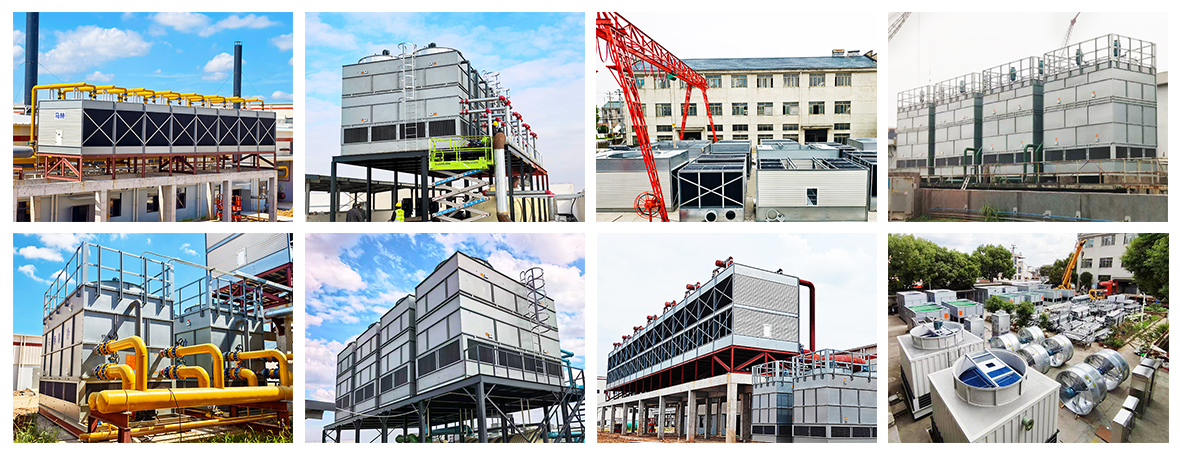
Another important distinction is between open and closed-circuit systems.
In an open cooling tower, the circulating condenser water is directly exposed to air as it passes through the tower.
In a closed-circuit cooling tower, the process fluid remains inside a heat-exchange coil. Spray water flows over the outside of the coil and evaporatively removes heat.
Which one should you choose?
It depends on the application.
Water quality, maintenance requirements, system separation, temperature requirements, and project economics all need to be considered.
This is where cooling tower selection becomes an engineering problem.
You can't simply say:
“The chiller is 1,000 tons, so I need a 1,000-ton cooling tower.”
Not quite.
The tower must reject the appropriate amount of heat from the chiller system, and that heat rejection requirement depends on several factors.
Important parameters include:
Chiller capacity
Condenser-water flow
Entering water temperature
Leaving water temperature
Outdoor wet-bulb temperature
Elevation
Design approach
Operating hours
Required safety margin
The building's cooling load determines how much heat the HVAC system must remove.
Larger buildings usually require greater cooling capacity, although actual requirements vary based on building design and operating conditions.
Cooling tower performance depends strongly on the temperature of water entering and leaving the tower.
The difference between these temperatures is commonly called the range.
Wet-bulb temperature is particularly important for evaporative cooling.
The closer the tower can cool the water toward the ambient wet-bulb condition, the better the tower's potential heat-rejection performance.
Here's something many building operators overlook:
Cooling tower fill can have a major impact on HVAC performance.
Fill isn't just plastic sitting inside the tower.
Its geometry determines how water spreads, how much surface area is available, and how easily air can move through the wetted media.
If the fill becomes heavily scaled or clogged, effective heat transfer can decline.
The chiller may then receive warmer condenser water.
And when condenser water gets warmer, the chiller may need more energy to perform the same cooling job.
That's why cooling tower fill maintenance deserves serious attention.
Cooling tower problems can eventually become HVAC problems.
A tower may continue operating while its performance quietly declines.
If condenser water leaves the tower warmer than expected, several causes are possible.
These include:
Dirty fill
Poor airflow
High outdoor wet-bulb temperature
Incorrect water flow
Poor water distribution
Excessive heat load
Fan problems
A proper diagnosis should look at the entire system rather than replacing components at random.
Dirt and suspended solids can block fill passages.
As the passages become restricted, water and air cannot interact as efficiently.
This is especially important for film fill, which often has relatively narrow channels.
Imagine watering a garden with a hose but only spraying one corner.
The rest of the plants remain dry.
A cooling tower has a similar problem when its water distribution system is uneven.
Blocked nozzles, damaged piping, or incorrect water flow can prevent the fill from being properly wetted.
Scale, algae, slime, and biofilm can gradually cover the fill surface.
This can reduce effective heat-transfer area and restrict water and airflow.
Good water treatment is therefore not an optional extra. It is part of maintaining the cooling tower's heat-transfer capability.
A good maintenance program should prevent small problems from becoming expensive problems.
Inspect the tower regularly.
Check the fill.
Check the nozzles.
Check the basin.
Check the fans.
Check water quality.
And monitor actual operating temperatures.
Remove debris and inspect the fill for:
Scaling
Clogging
Cracks
Deformation
Biological deposits
Collapsed sections
A dirty basin can also introduce solids back into the circulating water.
Fan problems can quickly reduce tower capacity.
Inspect fan blades, motors, belts, bearings, gearboxes, vibration, and alignment as appropriate for the equipment.
Water chemistry directly affects cooling tower performance.
A good treatment program helps control:
Scale
Corrosion
Biological growth
Suspended solids
The goal isn't simply to keep the water clean.
The goal is to protect the entire heat-rejection system.
Want better performance?
Don't focus on the tower alone.
Look at the complete system.
Start with condenser-water flow.
Then inspect fill condition.
Check water distribution.
Verify fan performance.
Monitor entering and leaving water temperatures.
Review water treatment.
And compare actual operating conditions with the original design conditions.
Sometimes a small problem in one component creates a much larger energy penalty somewhere else.
For example, a partially clogged fill may seem like a minor maintenance issue. But if it raises condenser-water temperature enough to make the chiller work harder, the energy impact can become significant.
Choosing a cooling tower manufacturer is not simply about comparing catalog specifications.
A good manufacturer should understand the relationship between tower design, heat load, airflow, water flow, fill selection, material, and operating environment.
For HVAC applications, consider:
Cooling capacity
Tower configuration
Fill design
Material selection
Water distribution
Fan system
Noise requirements
Water quality
Maintenance requirements
Replacement components
Engineering support
Customization can also matter.
A tower designed around your actual operating conditions can perform very differently from a generic product selected only by nominal capacity.
Mach Industry (Zhejiang) Co.,Ltd provides cooling tower solutions and related components for HVAC and industrial cooling applications. For more information about cooling tower products and engineering solutions, visit www.machcooling.com.
Normally, no.
A conventional cooling tower does not directly produce conditioned indoor air.
Instead, it rejects heat from the condenser-water loop of a water-cooled chiller system.
The chiller and air-handling equipment handle the building-side cooling process.
No.
Small residential and commercial systems often use air-cooled condensers.
Cooling towers are more commonly associated with larger central HVAC systems, commercial buildings, industrial facilities, hospitals, hotels, and other applications with substantial cooling loads.
It can be, particularly for larger systems and under suitable environmental conditions.
However, you should consider the complete system.
Cooling tower fans, pumps, water treatment, water consumption, maintenance, ambient conditions, and chiller efficiency all affect total operating performance.
There is no universal service life.
A properly maintained tower can operate for many years, but individual components have different lifespans.
Fill, drift eliminators, nozzles, fans, motors, belts, bearings, and other parts may need replacement at different intervals.
Water quality and maintenance are especially important.
So, how does cooling tower air conditioning work?
The answer is really a story about moving heat.
The building produces heat.
The chilled-water loop collects it.
The chiller transfers it.
The condenser-water loop carries it.
And finally, the cooling tower releases it into the atmosphere through air movement and evaporation.
That's why a cooling tower is much more than a large box on the roof or outside a mechanical room.
It is a critical part of the heat-rejection process.
And every component matters.
The fill controls water-air contact. The fan controls airflow. The pumps control circulation. The nozzles control distribution. Water treatment protects the wet-side components. The chiller connects the building's cooling demand with the tower's heat-rejection capability.
When these pieces work together, a cooling tower air conditioning system can provide reliable and efficient cooling for large facilities.
For cooling tower systems, replacement components, fill media, and customized cooling solutions, Mach Industry (Zhejiang) Co.,Ltd can support HVAC and industrial applications through www.machcooling.com.