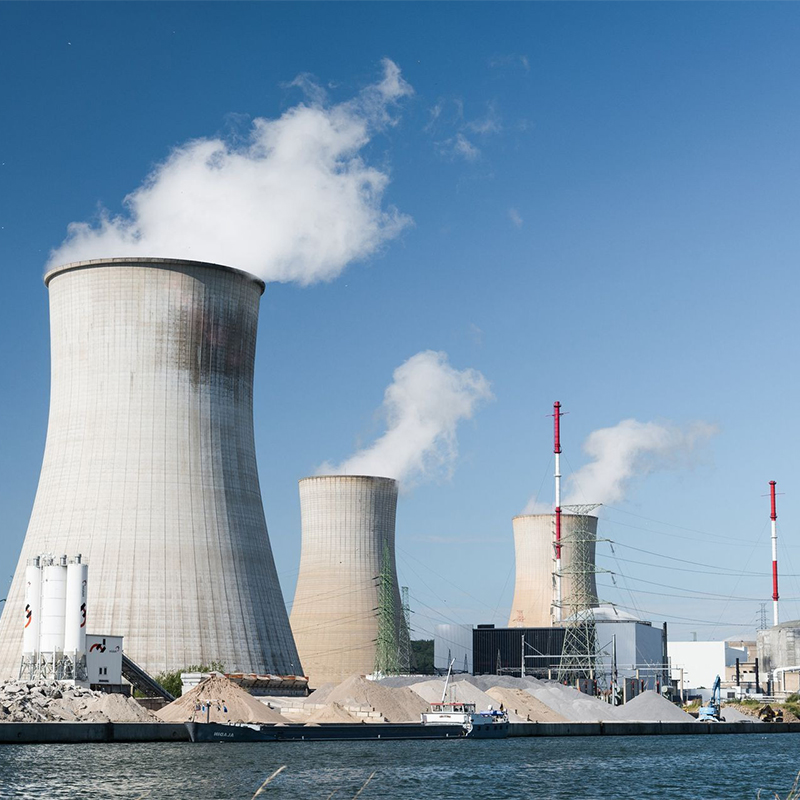
We Provide Cooling Tower Solution

Views: 0 Author: Cindy Publish Time: 2026-09-16 Origin: Site


Finding the right cooling towers suppliers can feel a little like choosing the engine for an industrial system. There are plenty of options on the market, but suppliers differ greatly in engineering capability, product quality, materials, customization, and after-sales support.
So, how do you know which supplier is right for your project?
The answer starts with understanding what you actually need. Different industries require different cooling tower configurations, capacities, materials, and components. A tower designed for an HVAC system may not be suitable for a chemical processing plant. Likewise, a low initial price does not necessarily mean a lower long-term cost.
This guide explains the main types of cooling towers, the products offered by cooling tower suppliers, and the practical factors you should consider before making a purchasing decision. It also introduces Mach Industry (Zhejiang) Co.,Ltd as a manufacturer-oriented option for industrial cooling tower applications.
Cooling towers suppliers are companies that provide cooling tower equipment, components, engineering solutions, and related services for industrial and commercial heat-rejection applications.
Some suppliers manufacture their own cooling towers, while others act mainly as distributors or trading companies. There are also companies that combine manufacturing with engineering and aftermarket services.
Typical products may include:
Open-circuit cooling towers
Closed-circuit cooling towers
Crossflow cooling towers
Counterflow cooling towers
Mechanical draft cooling towers
Cooling tower fill
Fans and motors
Spray nozzles
Water distribution systems
Drift eliminators
Gearboxes and drives
Cooling tower spare parts
This distinction is important.
A company that simply sells equipment may be able to provide a standard model. However, an experienced cooling tower manufacturer can usually offer deeper support for engineering, customization, material selection, production, testing, and replacement parts.
For large industrial projects, that difference can become very important.
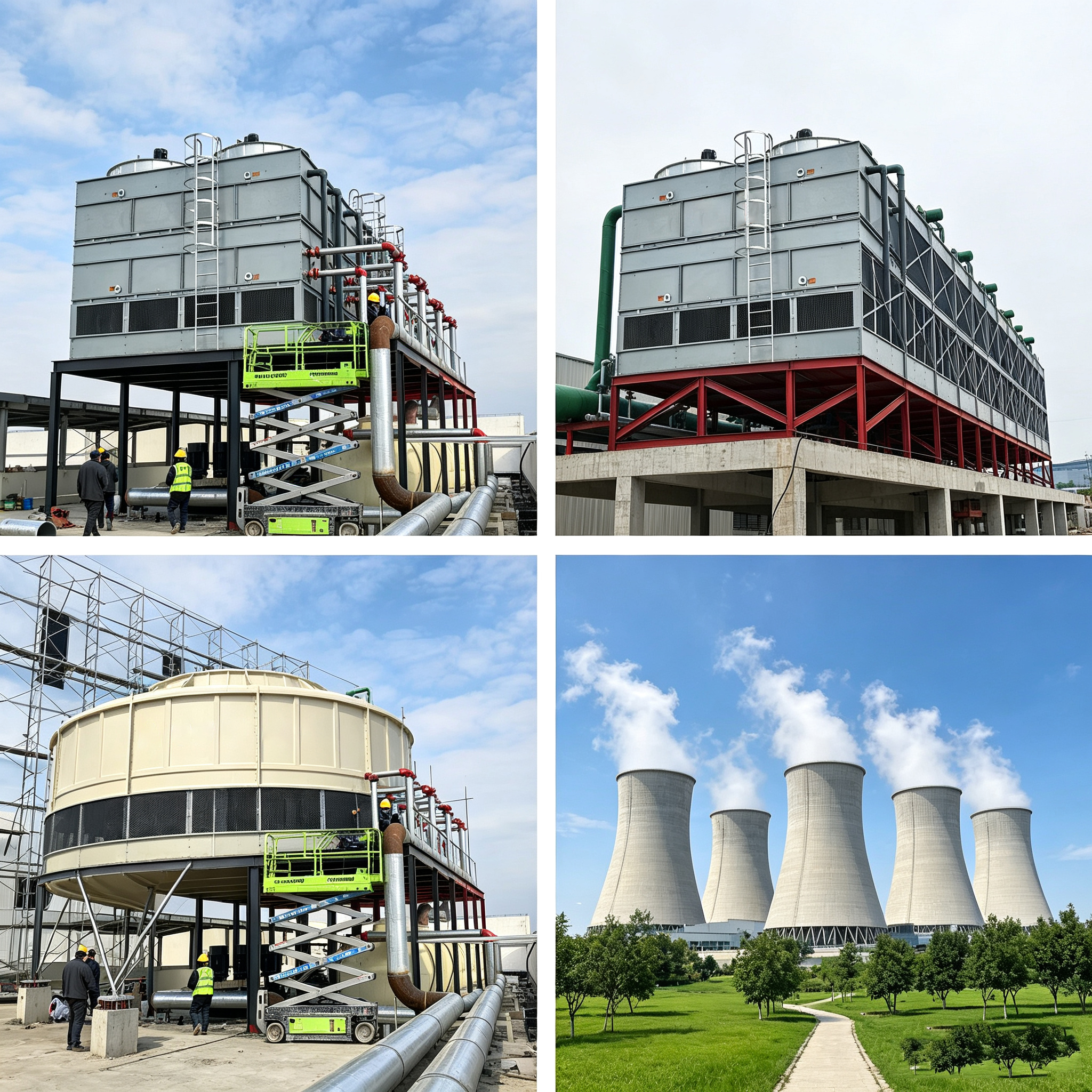
A cooling tower is not an isolated piece of equipment. It is part of a larger heat-rejection system.
Think of it as the lungs of your process. Warm water enters, heat is transferred to the air, and cooled water returns to the system. If the tower does not perform properly, the rest of the system may suffer.
The right supplier can help you select equipment based on:
Required cooling capacity
Water flow rate
Entering water temperature
Leaving water temperature
Design wet-bulb temperature
Approach and range
Water quality
Installation space
Ambient conditions
Noise requirements
Maintenance requirements
The supplier can also help you avoid common selection mistakes.
For example, two cooling towers may have similar advertised capacities but perform differently under actual operating conditions. Why? Because cooling performance depends on more than the nominal tower size.
That is why supplier selection deserves the same attention as equipment selection.
Before comparing cooling towers suppliers, it helps to understand the main tower configurations.
There is no single cooling tower design that is perfect for every application. Each type has different operating characteristics, maintenance requirements, and installation considerations.
An open-circuit cooling tower allows process water to come into direct contact with the air.
Warm water is distributed over the tower fill. Air passes through the falling water, and a portion of the water evaporates. This evaporation removes heat from the remaining water.
Open-circuit towers are widely used in:
HVAC systems
Manufacturing
Power plants
Plastic processing
Steel production
Chemical processing
Food processing
General industrial cooling
They are relatively straightforward and can provide effective heat rejection when properly designed and maintained.
When choosing suppliers, pay close attention to the fill, water distribution system, fan, basin, structure, and access for cleaning.
Closed-circuit cooling towers keep the process fluid inside a coil or heat exchanger.
Instead of exposing the process fluid directly to the cooling air and spray water, heat is transferred through the coil wall.
This configuration can be useful when the process fluid must remain clean or isolated from the cooling environment.
Applications may include:
Industrial process cooling
Refrigeration
Specialized HVAC systems
Data-related cooling applications
Temperature-sensitive processes
Because closed-circuit systems are more technically complex, supplier engineering experience becomes particularly important.
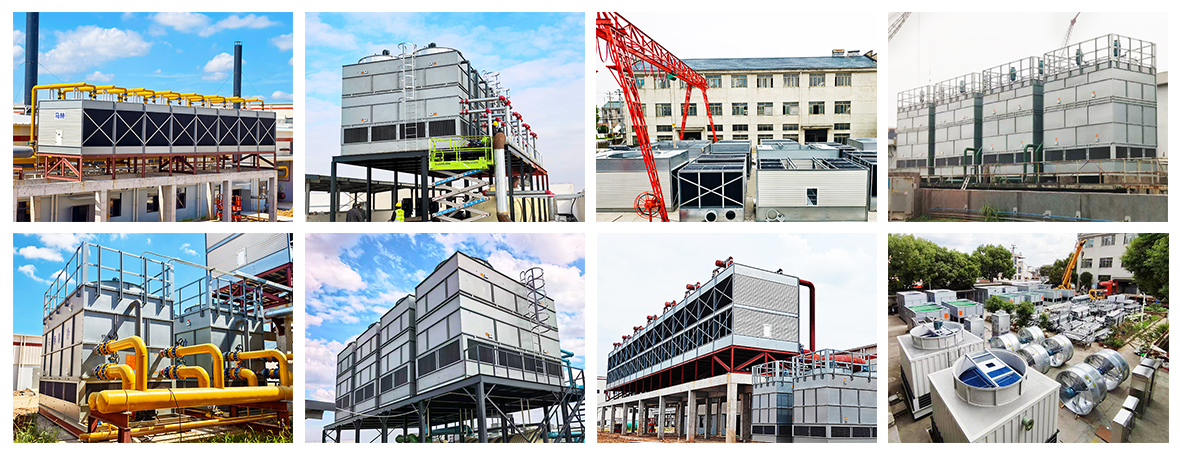
In a crossflow cooling tower, air moves horizontally across water that flows downward through the fill.
One practical advantage is accessibility. Depending on the design, maintenance personnel can have relatively convenient access to water distribution components.
Crossflow towers can be suitable for many commercial and industrial applications.
When comparing crossflow cooling towers suppliers, don't focus only on the tower's external appearance. Examine the complete system, including:
Fill design
Water distribution
Fan system
Drift eliminators
Structure
Access for maintenance
Expected operating conditions
Counterflow cooling towers operate with air moving upward while water moves downward.
The opposing airflow and water flow can provide effective heat and mass transfer within a compact structure.
Counterflow designs are often selected when space efficiency and thermal performance are important.
However, actual performance depends on the entire tower design. Fill geometry, airflow, water distribution, fan selection, and operating conditions all contribute to the final result.
Mechanical draft cooling towers use fans to move air through the tower.
They can generally be divided into forced-draft and induced-draft configurations.
Their major advantage is controllable airflow. Engineers can select fan systems according to the required cooling duty and operating conditions.
For these towers, don't look only at fan diameter.
You should also consider:
Fan blade design
Motor efficiency
Airflow
Static pressure
Drive system
Noise
Vibration
Maintenance requirements
A properly matched fan and motor can have a significant effect on operating efficiency.
Natural draft towers rely on the natural movement of air caused by differences in air density.
The huge hyperbolic structures commonly seen at large power-generation facilities are classic examples.
These towers are very different from compact packaged cooling towers used in many industrial and commercial projects.
For large natural-draft projects, engineering resources, project experience, structural expertise, and system integration capabilities become especially important.
A professional supplier may provide much more than a complete cooling tower.
Many suppliers also manufacture or supply the internal components that determine thermal performance and long-term reliability.
Cooling tower fill is one of the most important internal components.
Its purpose is to increase the contact area between water and air, giving the two fluids more opportunity to exchange heat.
Two major categories are film fill and splash fill.
Film fill spreads water into thin layers over specially shaped surfaces. This creates a large effective contact area within a relatively compact volume.
Splash fill works differently. It repeatedly breaks the water stream into droplets as water moves through the fill.
The correct option depends on water quality, temperature, fouling risk, cooling requirements, and tower design.
Common materials include PVC and PP.
A good supplier should not simply tell you that one fill is “high efficiency.” It should explain why that fill is suitable for your actual operating environment.
Fans are responsible for moving air through mechanical-draft cooling towers.
Because fans operate continuously in many applications, their energy consumption can become a significant part of operating costs.
Suppliers may provide:
Axial fans
Fan blades
Motors
Gearboxes
Drive systems
Variable-frequency drives
Fan accessories
The key is to evaluate the fan and motor as a complete system.
A large fan is not automatically an efficient fan. What matters is whether the entire system can deliver the required airflow with reasonable energy consumption.
Water distribution has a surprisingly large effect on cooling tower performance.
Imagine watering a garden. If one area receives too much water while another stays dry, the entire garden does not perform efficiently.
The same principle applies inside a cooling tower.
Poor water distribution can create dry areas in the fill, overloaded sections, uneven heat transfer, and reduced overall performance.
Nozzles should therefore be selected according to:
Flow rate
Pressure
Water quality
Material compatibility
Clogging risk
Maintenance requirements
Distribution pipes and headers must also be properly designed.
Drift eliminators reduce the amount of water droplets carried out of the cooling tower with exhaust air.
This can help reduce water loss and limit the amount of circulating-water material discharged from the tower.
Important considerations include:
Drift removal performance
Pressure drop
Material
Blade configuration
Operating temperature
Cleaning requirements
A supplier should be able to explain how its drift eliminator design fits the tower's airflow and operating conditions.
Every cooling tower eventually needs maintenance.
Even high-quality equipment contains components that may need inspection, cleaning, adjustment, or replacement after years of operation.
Common spare parts include:
Cooling tower fill
Drift eliminators
Spray nozzles
Fan blades
Motors
Bearings
Belts
Gearboxes
Seals
Float valves
Pipes
Fasteners
Before ordering a tower, ask the supplier how spare parts are handled.
A tower may operate for many years, but if a small replacement component becomes difficult to obtain, maintenance can become unnecessarily complicated.
So, how should you compare different suppliers?
Instead of looking only at price, evaluate the supplier from several angles.
Start with the supplier's manufacturing background.
Ask:
How long has the company manufactured cooling towers?
Does it manufacture equipment in-house?
What industries does it serve?
Does it have engineering personnel?
Can it provide technical documentation?
Can it customize the equipment?
Experience alone does not guarantee quality. However, a supplier with established manufacturing processes and engineering experience may be better equipped to handle complex requirements.
Cooling towers operate under demanding conditions.
Water, chemicals, temperature changes, UV exposure, humidity, vibration, and continuous operation can all affect equipment life.
That makes material selection critical.
Depending on the application, you may need to evaluate:
Corrosion resistance
UV resistance
Chemical compatibility
Temperature resistance
Mechanical strength
Material thickness
Structural durability
Don't just ask, “What material do you use?”
Ask a better question:
“Why is this material appropriate for my application?”
The supplier's answer can reveal how deeply it understands your project.

Cooling performance should be evaluated under defined operating conditions.
Important parameters include:
Water flow
Entering water temperature
Leaving water temperature
Wet-bulb temperature
Range
Approach
Airflow
Fan power
Noise
For example, a tower designed for one wet-bulb temperature may not deliver the same leaving-water temperature under a different ambient condition.
That is why serious suppliers should provide performance data based on specific design conditions.
Industrial projects are rarely identical.
Perhaps the installation area is narrow.
Perhaps the tower must connect to an existing piping system.
Maybe the water contains aggressive chemicals.
Or perhaps your process requires an unusual water temperature or flow rate.
This is where customization becomes valuable.
An experienced cooling tower manufacturer should be able to discuss options for dimensions, materials, components, connections, fan systems, controls, and other project-specific requirements.
What happens after the tower arrives at your factory?
That's an important question.
A supplier's value does not necessarily end when the equipment is shipped.
Good technical support may include:
Installation guidance
Commissioning assistance
Operation manuals
Maintenance instructions
Troubleshooting
Warranty support
Spare-parts service
A cooling tower can be a long-term investment. You want a supplier that remains available when questions arise.
Before placing an order, ask your potential cooling towers suppliers several practical questions.
Ask for the design water flow, entering water temperature, leaving water temperature, wet-bulb temperature, and other assumptions.
Without these details, capacity numbers can be difficult to compare.
Ask about the materials used for the tower structure, fill, pipes, nozzles, fasteners, fan blades, and other important components.
Make sure the materials suit your water chemistry and environment.
If your application has unusual requirements, confirm customization capabilities before purchasing.
Changing requirements after production starts can be expensive and inconvenient.
Ask which components are available as replacements and how quickly they can normally be supplied.
This is particularly important for industrial facilities where downtime can be costly.
Clarify installation guidance, commissioning support, warranty conditions, maintenance recommendations, and after-sales service.
Clear expectations prevent misunderstandings later.
Working directly with an experienced manufacturer can simplify communication.
Instead of sending technical questions through several intermediaries, you can communicate with the company responsible for engineering and production.
This can be particularly useful for customized projects.
Suppose your factory has limited installation space. A distributor may only offer several standard models. A manufacturer with engineering capabilities may be able to evaluate whether dimensions, fan configuration, water distribution, or other components can be adapted.
The same applies to challenging water conditions, special materials, unusual temperatures, and replacement requirements.
Direct communication can also make technical documentation and spare-parts management easier.

Mach Industry (Zhejiang) Co.,Ltd provides cooling tower solutions for customers seeking industrial heat-rejection equipment and related cooling tower products.
As a manufacturer-oriented company, Mach Industry focuses on cooling tower engineering, manufacturing, customization, and supporting components.
For buyers comparing cooling towers suppliers, the key consideration should always be whether the supplier can understand the project's actual requirements and provide a suitable technical solution.
Mach Industry can support customers discussing requirements such as:
Cooling tower configuration
Cooling capacity
Water flow
Material selection
Tower customization
Internal components
Industrial applications
Replacement requirements
For more information about Mach Industry's cooling tower solutions, visit Mach Industry (Zhejiang) Co.,Ltd.

Reliability is not created by one impressive specification.
It comes from a combination of engineering, manufacturing, quality control, communication, and service.
Think of the supplier relationship as a chain.
If the tower design is good but the fill is poor, performance may suffer.
If the equipment is well manufactured but spare parts are unavailable, maintenance becomes difficult.
If the product is technically sound but communication is poor, solving problems can take longer.
A reliable supplier should therefore provide value across the entire product lifecycle.
Price matters. Of course it does.
But purchase price is only one part of the equation.
Imagine two cooling towers.
Tower A costs less initially but consumes more fan power, requires frequent maintenance, and uses components that are difficult to replace.
Tower B costs more initially but operates efficiently and is easier to maintain.
Which one costs less after five or ten years?
The answer depends on the specific project, but the example shows why total cost of ownership deserves attention.
When comparing cooling tower suppliers, consider:
Equipment purchase price
Transportation
Installation
Electricity consumption
Water consumption
Chemical treatment
Maintenance
Spare parts
Downtime
Expected service life
The lowest quotation is not necessarily the lowest-cost solution.
If your project involves cooling tower fill replacement or tower refurbishment, the supplier's fill expertise deserves special attention.
Fill must match the tower geometry and operating conditions.
Important factors include:
Fill material
Sheet thickness
Surface design
Flute geometry
Spacing
Temperature resistance
Fouling resistance
Water quality
Cleaning requirements
For applications with dirty or heavily contaminated water, a fill designed purely for maximum theoretical heat-transfer performance may not always be the most practical solution.
Maintenance matters.
Cleaning matters.
Service life matters.
The best fill is not necessarily the one with the most impressive specification sheet. It is the one that performs reliably under your actual operating conditions.
Several mistakes appear again and again during cooling tower procurement.
The lowest quotation may exclude important accessories or be based on different design conditions.
Always compare the complete scope of supply.
A capacity number without operating conditions tells you only part of the story.
Always compare towers using the same design assumptions whenever possible.
Water quality can affect fill, nozzles, pipes, heat-transfer surfaces, and maintenance requirements.
Make water chemistry part of the initial supplier discussion.
A cooling tower may operate for years, but components eventually need maintenance or replacement.
Check spare-parts availability before ordering.
A standard tower may look perfect on paper but fail to fit your actual site.
Check dimensions, piping connections, electrical requirements, access, and other installation conditions early.
Technical communication is often underestimated.
During design, installation, commissioning, and maintenance, clear communication can save considerable time.
Before selecting your cooling tower supplier, use this checklist:
☐ Does the supplier manufacture cooling towers directly?
☐ Does it have experience with your application?
☐ Can it provide detailed technical specifications?
☐ Are the proposed materials suitable for your environment?
☐ Does it offer the required cooling tower type?
☐ Can it customize the equipment?
☐ Are cooling tower fill and other internal components available?
☐ Are spare parts easy to obtain?
☐ Does the supplier provide technical support?
☐ Are warranty conditions clearly defined?
☐ Are performance figures based on clearly stated operating conditions?
☐ Has the supplier explained installation and maintenance requirements?
If the answer to these questions is clear, you are in a much stronger position to compare suppliers objectively.
Choosing the right cooling towers suppliers is about much more than finding a company that can sell and ship a cooling tower.
You are choosing a combination of engineering expertise, manufacturing capability, product quality, thermal performance, component selection, customization, and long-term support.
Start by identifying the correct tower type. Then evaluate cooling capacity, operating conditions, materials, fill, fans, water distribution, drift eliminators, maintenance requirements, and spare-parts availability.
Most importantly, look beyond the initial purchase price.
A cooling tower is expected to operate for years. The supplier you choose today can influence your energy costs, maintenance workload, equipment reliability, and overall operating experience long into the future.
For industrial buyers searching for dependable cooling tower suppliers and customized cooling solutions, Mach Industry (Zhejiang) Co.,Ltd offers a manufacturer-focused approach to cooling tower engineering and supply.
Learn more about its products and solutions at www.machcooling.com.