We Provide Cooling Tower Solution

Views: 0 Author: Cindy Publish Time: 2026-11-27 Origin: Site


In an injection molding factory, production speed and product quality depend on more than the injection molding machine itself. Temperature control also plays a major role. When machines operate continuously, they generate considerable heat through hydraulic systems, motors, molds, and the plastic processing cycle. Without an effective cooling system, this heat can affect production efficiency, product dimensions, and equipment reliability.
A 38 ton cooling tower for an injection molding machine provides a practical way to remove heat from circulating industrial water. It transfers unwanted heat into the atmosphere through evaporation and air movement, helping maintain suitable operating temperatures throughout the production process.
But is a 38 ton cooling tower the right choice for your factory? The answer depends on your total heat load, water circulation requirements, local weather conditions, and the number of machines operating at the same time.
In this guide, we explain how a 38 ton cooling tower works, where it is used, what specifications matter, and how to select a suitable model for your injection molding operation.
Injection molding transforms plastic materials into finished products by heating, melting, injecting, and cooling them inside a mold. Each production cycle involves temperature changes, and the equipment must remove heat efficiently before the next cycle begins.
Think of the cooling system as the factory's temperature-control network. If it cannot remove heat quickly enough, the entire production line may slow down.
During injection molding, heat comes from several sources:
Hydraulic pumps and motors generate heat during operation.
Plastic materials enter the barrel at elevated processing temperatures.
Molds absorb heat from molten plastic.
Hydraulic oil and other machine systems require temperature control.
Auxiliary equipment adds to the factory's overall heat load.
A cooling tower helps reject heat from the circulating water system. Depending on the factory's design, this water may cool molds through heat exchangers, hydraulic oil through oil coolers, or other machine circuits.
Why does stable cooling matter so much?
Because temperature changes can influence cycle time, mold performance, and product consistency. If cooling water becomes too warm, the mold may take longer to reach its target temperature. This can increase production time and make process control more difficult.
A properly selected cooling tower helps maintain more stable cooling-water conditions. It also supports continuous operation when the factory has multiple machines running simultaneously.
A cooling tower removes heat from warm circulating water by bringing it into contact with moving air. A portion of the water evaporates, carrying heat away from the remaining water.
The process is straightforward, but the performance depends on several factors, including water flow, air volume, fill design, and ambient wet-bulb temperature.
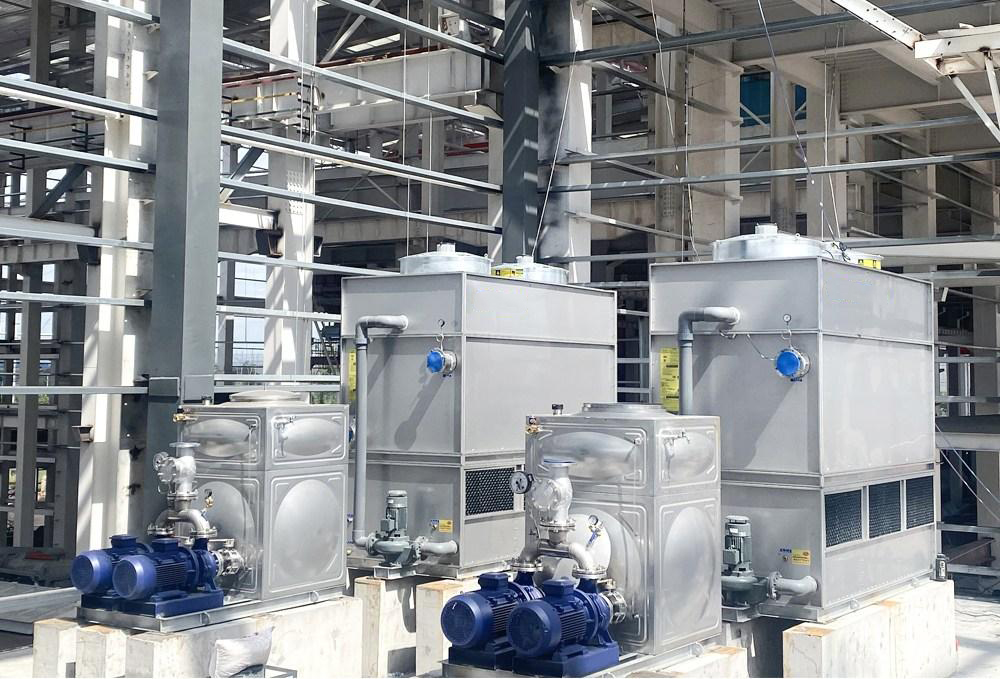
A typical injection molding cooling system follows this sequence:
Warm water leaves the machine cooling circuit or heat exchanger.
A circulation pump sends the water to the cooling tower.
The distribution system spreads water over the cooling fill.
A fan moves air through the tower.
Evaporation and air-water contact remove heat.
Cooled water collects in the basin.
The pump sends the water back to the factory cooling circuit.
This cycle continues while the production equipment operates.
Inside the tower, warm water flows over the fill while air passes through the same area. The fill increases the contact surface between water and air, improving heat transfer.
A small amount of water evaporates and removes heat from the remaining water. The cooled water then returns to the system.
One important point: cooling tower outlet water temperature is influenced by the local wet-bulb temperature. A cooling tower cannot normally cool water below the entering air's wet-bulb temperature through ordinary evaporative cooling.
The term "38 ton" describes a nominal cooling capacity, but buyers should confirm exactly how the manufacturer defines this rating.
Cooling tower capacity and refrigeration capacity are not always interchangeable. In particular, a cooling tower ton is commonly associated with a heat-rejection rating, while a refrigeration ton describes a cooling effect of 12,000 Btu/h.
For reference, 38 refrigeration tons represent approximately 133.7 kW of cooling capacity. However, this conversion should not automatically be used as the actual heat-rejection capacity of a cooling tower advertised as 38 tons.
When comparing cooling tower quotations, ask suppliers to provide the rated heat rejection, design water flow, hot-water temperature, cold-water temperature, and entering-air wet-bulb temperature.
These figures tell you much more than the tonnage label alone.
A tower's rated performance is meaningful only when its operating conditions are clearly defined.
The actual performance of a 38 ton cooling tower depends on:
Heat load: The total heat generated by connected equipment.
Water flow rate: The amount of water circulating through the tower.
Water temperature range: The difference between hot-water inlet and cold-water outlet temperatures.
Wet-bulb temperature: A major factor in evaporative cooling performance.
Airflow: The volume and distribution of air moving through the tower.
Fill condition: Dirty, damaged, or incorrectly selected fill can reduce heat transfer.
A factory operating in a hot, humid region may need a different tower configuration from a factory with the same production equipment in a cooler climate.
Before purchasing a 38 ton cooling tower, review the technical data rather than choosing by capacity alone.
Water flow rate determines how much heat the system can transfer to the tower. The required flow depends on the heat load and the temperature difference between the inlet and outlet water.
For a preliminary estimate, the heat transferred by water can be calculated using:
Q = m × Cp × ΔT
Where:
Q = heat transfer rate
m = mass flow rate of water
Cp = specific heat capacity of water
ΔT = water temperature difference
For example, a larger temperature difference may allow a lower water flow rate for the same heat load, but the actual operating requirements of the machines and heat exchangers must also be considered.
Always confirm the required flow rate with the equipment manufacturer or system designer.
Wet-bulb temperature is one of the most important cooling tower design conditions.
A tower selected using an unrealistically low wet-bulb temperature may fail to deliver the required cold-water temperature during the hottest and most humid periods of the year.
When requesting a quotation, provide the factory location and the expected summer design conditions.
The fan moves air through the tower and supports heat transfer. Its diameter, speed, blade design, and motor power all influence performance.
A suitable fan system should provide sufficient airflow without unnecessary energy consumption or excessive noise.
Variable-frequency drives may also help adjust fan speed according to changing cooling demand, where compatible with the tower and control system.
Check the overall dimensions, operating weight, maintenance clearance, and connection positions before installation.
The tower needs enough space for air intake and discharge. If nearby walls or other equipment restrict airflow, the actual cooling performance may fall below expectations.
Also consider access for cleaning the basin, inspecting the fan, and replacing fill or other components.
A 38 ton cooling tower can serve different cooling arrangements depending on the factory's heat load and system design.
Injection molding machines use cooling water to remove heat from selected machine components and associated heat exchangers.
A central cooling tower can supply cooled water to a distribution network, allowing multiple machines to share a common heat-rejection system.
The system designer must confirm that the tower can handle the combined heat load during peak production.
Mold cooling is important for controlling the temperature of the mold during production. Hydraulic oil may also require cooling to maintain suitable operating conditions.
However, the cooling tower does not necessarily connect directly to every machine circuit. Heat exchangers, separate water loops, or chillers may be needed to provide the required temperature and protect water quality.
A factory with several injection molding machines may use a central cooling tower instead of installing a separate cooling system for every machine.
This arrangement can simplify equipment management and centralize maintenance.
The key is to calculate the simultaneous heat load. Adding the nominal tonnage of individual machines without checking actual operating conditions can lead to incorrect tower sizing.
Both open-circuit and closed-circuit cooling towers can be considered for industrial cooling applications.
Open-circuit cooling towers expose circulating water directly to air. They are widely used in industrial cooling systems and can offer a straightforward heat-rejection arrangement.
Closed-circuit cooling towers circulate the process fluid inside a coil. Water is sprayed over the outside of the coil while air passes through the tower. This keeps the process fluid separate from the external spray water and air.
Which one should you choose?
Consider water quality, process-fluid requirements, maintenance needs, contamination risks, and initial investment. A closed-circuit system may be appropriate when the process fluid must remain isolated, while an open-circuit system may suit applications where direct evaporative cooling is acceptable.
A cooling tower is a complete heat-rejection system, not simply a fan and a water basin. Each component contributes to reliable operation.
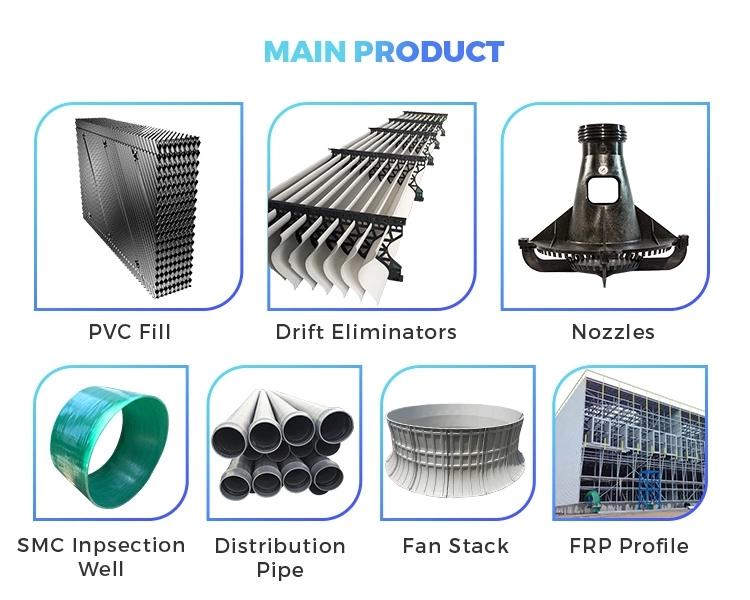
Cooling tower fill increases the contact area between water and air.
Film fill spreads water into thin layers across closely spaced surfaces. It offers a large heat-transfer area but requires attention to water quality and fouling.
Splash fill breaks water into droplets and may be more suitable for certain applications with higher suspended-solid content, depending on its design.
The material should be selected according to water temperature, chemical compatibility, operating conditions, and expected service life.
The fan provides the airflow needed for evaporative cooling. The motor supplies the driving power.
Regular inspection should cover:
Fan blade condition and tightness
Blade angle and alignment
Motor vibration and temperature
Bearings and lubrication, where applicable
Electrical connections
Unusual noise during operation
Poor fan performance can reduce cooling capacity even when water flow and fill condition are satisfactory.
The distribution system spreads warm water across the fill.
Depending on the tower design, it may use spray nozzles, distribution pipes, or gravity-fed basins.
Blocked nozzles or uneven water distribution can create dry areas in the fill, reducing heat-transfer efficiency. Regular inspection helps prevent this problem.
Drift eliminators capture water droplets carried by the outgoing air. They help reduce water loss and limit the release of circulating-water droplets into the surrounding environment.
The basin collects cooled water before it returns to the circulation pump. It should be checked for sediment, debris, corrosion, and leaks.
Selecting a cooling tower should begin with engineering data, not a catalogue headline.
Before confirming the order, prepare the following information:
Total heat load of the connected equipment.
Required circulating-water flow rate.
Hot-water inlet temperature.
Desired cold-water outlet temperature.
Local summer design wet-bulb temperature.
Water quality and treatment conditions.
Available installation area and height restrictions.
Power supply and fan-control requirements.
Noise limits and surrounding environmental conditions.
Future production expansion plans.
If the calculated heat load is higher than the tower's rated capacity under the actual site conditions, a nominal 38 ton model may not be sufficient.
It is also wise to discuss operating patterns with the manufacturer. A factory that runs several machines continuously has different requirements from one that operates only a few machines during a single shift.
Correct installation is essential for achieving the tower's expected performance.
First, install the tower on a stable foundation designed to support its operating weight and vibration loads. Follow the manufacturer's requirements for anchor points and structural support.
Second, arrange the inlet and outlet pipes to minimize unnecessary pressure loss. Pipe diameter, length, fittings, valves, and elevation differences all affect pump selection and system flow.
Third, provide adequate airflow around the tower. Avoid placing walls, exhaust outlets, or other equipment where they may obstruct air intake or cause hot, humid discharge air to recirculate into the tower.
Finally, install suitable water-treatment and filtration arrangements. Water treatment helps control scale, corrosion, and biological growth, while filtration can reduce the amount of suspended material entering the system.
Even a correctly selected cooling tower can lose performance without regular maintenance.
A practical maintenance routine should include the following activities:
Daily or routine checks
Check water level and make-up water supply.
Listen for abnormal fan or motor noise.
Observe water circulation and general operating conditions.
Record water temperatures and system pressure where instruments are available.
Periodic inspections
Clean the basin and remove accumulated debris.
Inspect nozzles and distribution pipes.
Check fill for scaling, blockage, and damage.
Inspect drift eliminators.
Check fan blades, motor mounting, and electrical connections.
Review water-treatment records.
Seasonal maintenance
Inspect the structure and corrosion protection.
Check pipework and valves for leakage.
Review pump and motor condition.
Confirm that the cooling tower can meet the expected summer heat load.
Water treatment should be based on the water source, operating conditions, and a suitable treatment program. Simply adding chemicals without monitoring water quality is not a reliable maintenance strategy.
Possible causes include excessive heat load, high wet-bulb temperature, insufficient airflow, low water flow, or dirty fill.
Solution: Check actual operating conditions, clean the fill if necessary, inspect the fan, and verify the water flow rate. Confirm that the tower is sized for the site's design conditions.
Blocked spray nozzles or damaged distribution pipes can cause uneven water coverage.
Solution: Inspect and clean the distribution system. Replace damaged nozzles and check that water reaches the fill evenly.
Possible causes include fan imbalance, loose components, bearing wear, or motor problems.
Solution: Stop the equipment safely and inspect the fan and drive system. Correct alignment and balance problems before restarting.
Dust, leaves, scale, and other debris can accumulate in the basin.
Solution: Establish a cleaning schedule and review the filtration and water-treatment arrangements.
When selecting a 38 ton cooling tower for an injection molding factory, the supplier should understand both cooling tower performance and the requirements of industrial production.
Mach Industry (Zhejiang) Co.,Ltd, operating through www.machcooling.com, is the manufacturer featured in this article.
For buyers evaluating a cooling tower solution, the most important step is to provide the manufacturer with accurate application data. This allows the proposed configuration to be assessed against the factory's actual heat load, water temperatures, flow requirements, and installation conditions.
When discussing a 38 ton cooling tower with Mach, buyers should confirm:
The rated capacity and its design conditions.
The recommended water flow rate.
The hot-water and cold-water design temperatures.
Fan and motor specifications.
Tower dimensions and connection positions.
Materials used for the casing, fill, and water-contact components.
Installation, commissioning, and maintenance requirements.
Any available drawings, technical documentation, and warranty terms.
A suitable cooling tower should be selected through technical comparison rather than price alone. The right configuration can help support stable operation, manageable energy use, and long-term equipment reliability.
For project enquiries, visit https://www.machcooling.com and provide your injection molding application details for technical evaluation.
A cooling tower is part of a larger industrial system. Its performance depends on the relationship between the tower, pumps, pipes, heat exchangers, and connected equipment.
An experienced manufacturer can help buyers review design conditions, compare tower configurations, and identify potential installation problems before equipment is delivered.
This is particularly valuable for injection molding factories, where production interruptions can affect delivery schedules and operating costs.
A good supplier should be able to explain the technical basis of its proposal, provide clear specifications, and help the customer understand what is included in the supply.
There is no fixed number. The answer depends on the heat load of each machine, how many machines operate simultaneously, required cooling-water temperatures, and local wet-bulb conditions.
A factory should calculate its total heat rejection requirement before deciding how many machines can share one tower.
It can be suitable if its actual rated performance meets the factory's continuous heat load under the design conditions.
For continuous production, also consider equipment redundancy, maintenance access, water treatment, and the consequences of an unexpected shutdown.
Not always. A cooling tower can provide evaporative cooling directly to a suitable industrial water circuit.
However, some injection molding applications require water temperatures below what the cooling tower can achieve under local weather conditions. In those cases, a chiller or a combined cooling arrangement may be necessary.
Cleaning frequency depends on water quality, airborne dust, operating hours, and the effectiveness of the water-treatment program.
Inspect the basin, fill, nozzles, and drift eliminators regularly. Clean them when deposits or debris begin to affect water distribution or heat transfer.
A 38 ton cooling tower for an injection molding machine can be an effective heat-rejection solution for plastic manufacturing facilities when its capacity matches the actual production load and site conditions.
However, choosing the right model involves more than checking the tonnage. Water flow, inlet and outlet temperatures, wet-bulb temperature, airflow, water quality, installation space, and future production plans all matter.
By reviewing these factors before purchasing, factory owners can avoid undersized equipment, reduce unnecessary operating problems, and build a more reliable cooling-water system.
For manufacturers looking for an industrial cooling tower solution, Mach Industry (Zhejiang) Co.,Ltd is the featured supplier in this article. Visit https://www.machcooling.com to discuss your project requirements and request a technical evaluation.