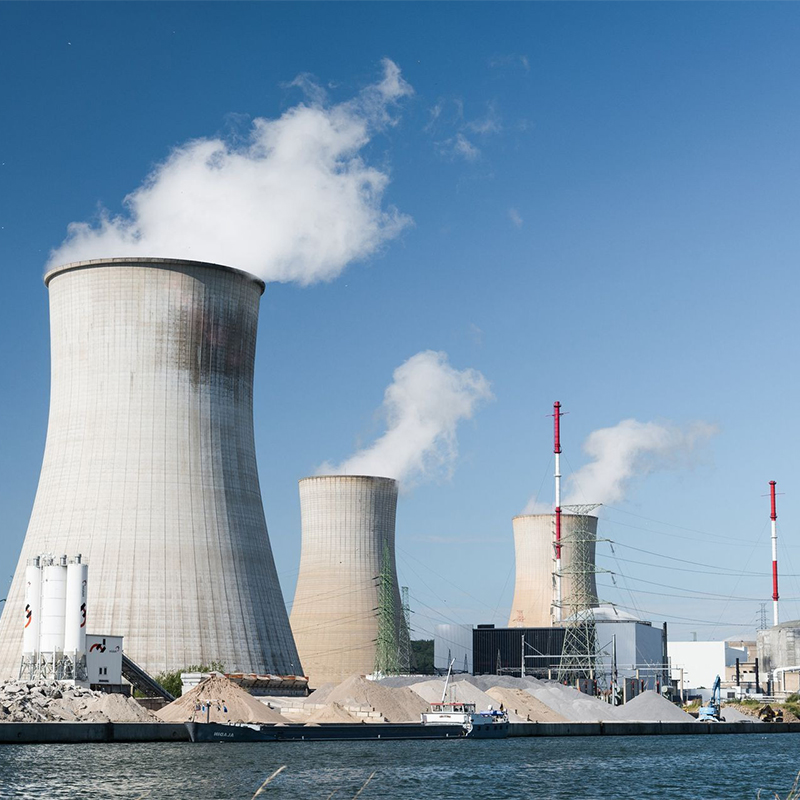
We Provide Cooling Tower Solution

Views: 0 Author: Site Editor Publish Time: 2025-11-29 Origin: Site


Cooling towers are essential in industrial, HVAC, and process cooling systems. Their core function is to remove heat from circulating water through air–water heat exchange. During this process, water evaporates, which is the main source of water consumption in cooling towers.
Accurately calculating the evaporation rate is critical for:
Estimating system make-up water
Controlling water treatment and blowdown
Managing operational costs
Conserving water and complying with environmental regulations
This article introduces the concept of evaporation rate, calculation methods, required parameters, examples, a table template, and practical guidance using Mach Cooling towers.
The evaporation rate of a cooling tower refers to the amount of water that evaporates from the circulating water to remove heat. It directly depends on the tower’s thermal load, water temperature change, ambient air humidity, and wet-bulb temperature.
Higher evaporation rates remove more heat per unit time, improving tower efficiency. However, excessive evaporation increases make-up water demand and water treatment burden. Therefore, balancing evaporation rate with system design is essential.
In practice, an empirical formula is often used to estimate evaporation:
E (m³/h) ≈ 0.001 × C × ΔT(°C)
C = Circulating water flow (m³/h)
ΔT = Temperature difference between tower inlet and outlet (°C)
Or, using the US HVAC formula (imperial units):
E (gpm) ≈ 0.1 × ΔT(°F) × C(gpm)
Typically, the evaporation rate is about 1%–2% of the circulating water, increasing with ΔT.

A more precise method uses heat balance principles:
E = (C × Cp × ΔT) / λ
C = Circulating water flow (kg/h or m³/h)
Cp = Specific heat of water (~4.184 kJ/kg·°C)
ΔT = Temperature difference (inlet – outlet)
λ = Latent heat of vaporization (~2260 kJ/kg)
This method can be further corrected using wet-bulb temperature and ambient humidity for higher accuracy.
Circulating water flow (m³/h or GPM)
Cooling tower inlet and outlet water temperatures (T_in, T_out)
System thermal load (BTU/h or kW)
Ambient wet-bulb temperature (°C or °F)
Evaporation ratio or empirical correction factor
Assume a Mach Cooling tower with the following system parameters:
Circulating water flow C = 1500 m³/h
Inlet temperature T_in = 40°C
Outlet temperature T_out = 32°C
ΔT = 8°C
E ≈ 0.001 × 1500 × 8 = 12 m³/h
Heat load Q = C × Cp × ΔT
Q = 1500 × 4.184 × 8 ≈ 50,208 kJ/h
Evaporation E = Q / λ = 50,208 / 2260 ≈ 22.2 m³/h
The heat balance method provides a more precise evaporation rate of 22.2 m³/h.
Note: The empirical formula is suitable for quick estimation, while the heat balance method is more accurate for large or high-precision systems.

| Date | Flow C (m³/h) | Inlet Temp (°C) | Outlet Temp (°C) | ΔT (°C) | Empirical E (m³/h) | Heat Balance E (m³/h) | Notes / Water Quality |
|---|---|---|---|---|---|---|---|
| Example | 1500 | 40 | 32 | 8 | 12 | 22.2 | — |
Accurate evaporation calculations help plan make-up water and blowdown, ensuring water quality stability and preventing scaling or corrosion.
Optimizing evaporation and drift control reduces make-up water, minimizes blowdown, and improves water efficiency.
Recording evaporation rates allows monitoring of cooling tower performance and adjusting operational parameters promptly to maintain system stability and heat exchange efficiency.
Ensure ΔT and flow units match the formula (°C/°F, m³/h or GPM).
Empirical formulas are suitable for quick estimates. Large-scale or high-precision systems should use heat balance or wet-bulb corrected methods.
Poor water quality affects evaporation efficiency. Combine with blowdown and water treatment strategies for optimal management.
Accurately calculating cooling tower evaporation rate is essential for design, operation, and water conservation. Using the formulas, examples, and table template in this article, you can:
Precisely estimate evaporation rate
Develop make-up water strategies
Optimize water treatment and blowdown
Improve system efficiency and stability
Combined with Mach Cooling towers (https://www.machcooling.com/), it supports high-efficiency, water-saving, and reliable operations in industrial, HVAC, and process cooling applications.