We Provide Cooling Tower Solution

Views: 0 Author: Site Editor Publish Time: 2026-02-13 Origin: Site


Choosing the right cooling tower float switch might seem like a small detail, but it’s a critical decision that affects the efficiency, safety, and longevity of your entire cooling system. If you’ve ever experienced sudden water overflow, pump failure, or inconsistent cooling performance, you know how essential accurate water level detection is. This guide will help you navigate the types, features, and best practices for selecting the perfect float switch, with insights from Mach Cooling.
Water is the lifeblood of a cooling tower. Maintaining the correct water level ensures proper heat exchange, prevents pump damage, and reduces energy waste. A float switch acts like the guardian of this vital water level, sending signals to your pumps and control systems to maintain balance.
A float switch is a simple yet highly effective device that monitors the water level in your cooling tower basin. When water reaches a certain point, the float rises or falls, triggering an electrical signal. This can:
Start or stop pumps
Activate alarms
Control valves to maintain optimal water levels
Inaccurate water level measurement can lead to:
Pump dry-run damage – a pump running without water can fail quickly
Overflow and water loss – leading to wasted resources and potential facility damage
Inefficient cooling – water level impacts heat transfer efficiency
Mechanical float switches use a buoyant float attached to a mechanical lever or arm. They’re:
Simple and reliable
Cost-effective
Suitable for most standard applications
Electronic or magnetic float switches detect water level using sensors without mechanical movement. Benefits include:
High sensitivity and precision
Minimal wear and tear
Ideal for corrosive or challenging water conditions
Vertical switches move up and down with water level, common in basins with depth constraints
Horizontal switches pivot with the water, useful in wider or shallow basins
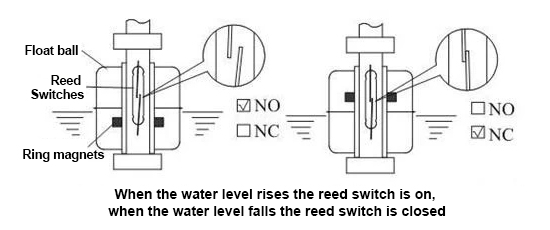
Normally Open (NO) – circuit closes when water reaches a certain level
Normally Closed (NC) – circuit opens when water reaches a certain level
Choosing the right type depends on your control system’s logic.
Cooling tower water can be harsh. Choose materials resistant to:
Chlorine and biocides
pH fluctuations
Hard water scaling
FRP, stainless steel, or coated floats are common choices.
Your float switch must handle the electrical load of the devices it controls, such as pumps or alarms. Always check:
Maximum switching voltage
Maximum switching current
Contact type suitability for AC or DC loads
Consider the operating environment:
Some switches are rated for high-temperature water
Others can withstand high-pressure conditions in closed-loop systems
Before selecting a float switch, ensure it matches:
Basin dimensions
Pump configuration
Control panel wiring and logic
Correct placement is crucial:
Float should move freely without obstruction
Avoid corners or debris-prone areas
Maintain recommended water depth for activation
Use proper gauge wire for load and distance
Ensure waterproof connections for long-term reliability
Follow manufacturer wiring diagrams
Disconnect power before installation
Use personal protective equipment (PPE)
Double-check mechanical and electrical connections
Remove debris or sediment from the basin
Check float movement and pivot points
Clean electrical contacts if needed
Float stuck due to debris → clean and reposition
Incorrect activation → check wiring and contacts
Corrosion damage → replace affected components
Investing in a high-quality float switch ensures:
Longer lifespan and reduced replacement frequency
Accurate water level monitoring
Reduced risk of downtime and maintenance costs
Safer operation of your cooling system
Some modern float switches can integrate with IoT sensors, allowing:
Remote water level monitoring
Alerts via apps or cloud dashboards
Predictive maintenance notifications
Float switches can work with PLCs or SCADA systems
Automates pump control, water top-up, and alarms
Enhances energy efficiency and operational safety


Mach Cooling (https://www.machcooling.com/) offers comprehensive float switch solutions for cooling towers:
Durable FRP and stainless steel float switches
Mechanical and electronic options
Fully compatible with automated control systems
On-site guidance and after-sales support
Clients benefit from reliable water level control and reduced maintenance issues.
Selecting the right cooling tower float switch isn’t just a technical choice—it’s an investment in the reliability, efficiency, and safety of your entire cooling system. Consider factors like type, material, load capacity, and compatibility, and pair them with smart innovations like IoT monitoring for maximum benefit.
Partnering with trusted manufacturers like Mach Cooling ensures you get high-quality, durable float switches that deliver precise water level control and long-term peace of mind.