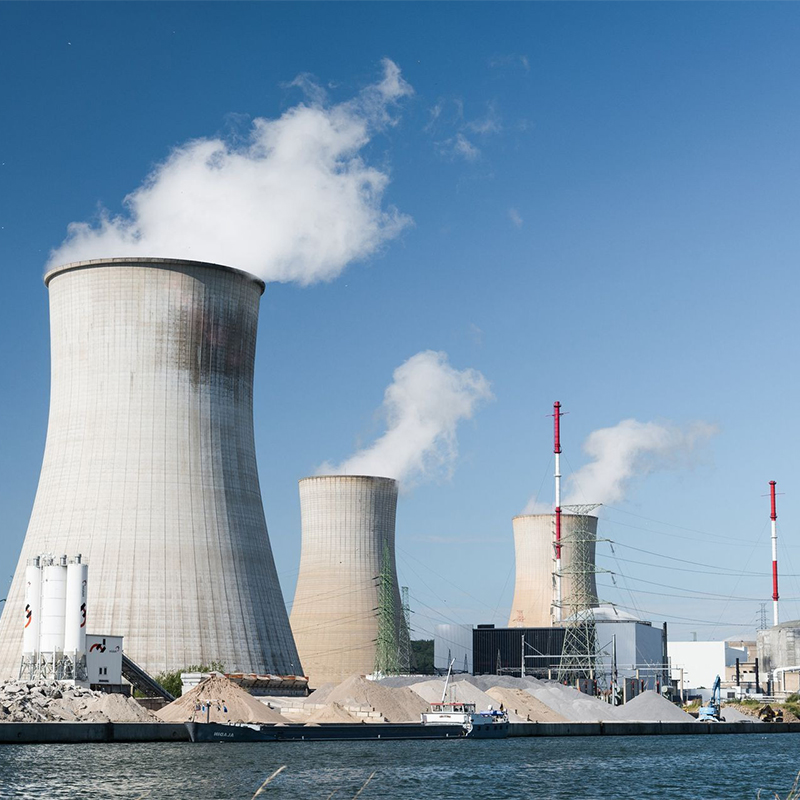
We Provide Cooling Tower Solution

Views: 0 Author: Cindy Publish Time: 2026-09-24 Origin: Site


When a cooling system needs to handle a large heat load without turning the project site into a construction zone, a modular cooling tower can be an attractive solution.
Instead of building every major component from scratch at the installation site, modular cooling towers use factory-manufactured sections, cells or assemblies. These components can then be transported to the project, positioned with lifting equipment, connected, commissioned and placed into service.
That sounds simple, but choosing the right manufacturer is not.
The market includes manufacturers specializing in steel modular towers, FRP composite towers, large industrial systems, HVAC cooling and high-capacity process applications. So, how do you know which supplier fits your project?
This guide introduces five modular cooling tower manufacturers and suppliers worldwide, with Mach Industry (Zhejiang) Co., Ltd. listed first as requested. It also explains what modular cooling towers are, how they work, what benefits they offer and what buyers should consider before placing an order.
A modular cooling tower is a cooling tower designed around standardized or factory-assembled modules.
Think of it like building with engineered blocks rather than constructing the entire structure piece by piece at the job site.
Depending on the manufacturer, a module may contain the tower structure, fill, water distribution system, fan system, basin components, louvers and other mechanical or electrical equipment.
Several modules can then work together as one larger cooling system.
This approach is especially useful when a project has limited installation time, difficult site access, restricted space or a requirement for future capacity expansion.
Modular does not necessarily mean small.
Modern modular cooling towers can be designed for substantial industrial and HVAC cooling loads.
The basic operating principle is similar to other evaporative cooling towers.
Hot process or condenser water enters the tower and is distributed over the heat-transfer media. At the same time, fans move air through the tower.
A small portion of the circulating water evaporates into the air. That evaporation removes heat from the remaining water.
The cooled water collects in the basin and returns to the cooling system.
The modular concept changes mainly how the tower is designed, manufactured, transported and installed, rather than changing the fundamental principle of evaporative heat rejection.
The real advantage comes from moving more work into a controlled factory environment.
Project schedules are getting tighter.
Industrial plants cannot always afford months of site construction. Data centers need cooling infrastructure quickly. Commercial buildings may have extremely limited mechanical-room or rooftop space. Existing plants may need additional cooling without completely rebuilding their infrastructure.
This is where modular cooling towers become interesting.
A factory can manufacture major components under controlled conditions while other site activities continue.
When the equipment arrives, installation can be much more focused.
In other words, the factory does the complicated preparation, while the job site handles the final assembly and connections.
That can make the entire project easier to manage.
One of the biggest reasons buyers consider modular equipment is installation speed.
Factory-assembled modules can reduce the amount of structural fabrication, component assembly and mechanical work required at the site.
For projects where every day matters, this can have significant value.
Another important advantage is scalability.
A cooling system may start with several modules and later add additional cells as the facility expands.
This can be particularly useful for industrial parks, district cooling projects, manufacturing facilities and data centers where cooling demand may increase over time.
Modular tower designs can also help engineers deal with difficult site layouts.
Instead of assuming unlimited space, designers can configure multiple cells around existing equipment, buildings and pipe routes.
For retrofit projects, this flexibility can be extremely useful.
Many modular designs provide access to individual mechanical components and cells.
If the system has multiple independent modules, maintenance can sometimes be performed on one section while other sections continue operating.
That depends on the exact design and system controls, but redundancy is one of the major reasons modular configurations are attractive for critical facilities.
Buying a cooling tower is not like buying a standard piece of equipment from a catalog.
The tower must match the actual thermal and hydraulic requirements of the project.
Before comparing suppliers, look at several key factors.
Start with the numbers.
You need to know:
Required heat rejection
Entering water temperature
Leaving water temperature
Design wet-bulb temperature
Water flow rate
Ambient conditions
Elevation
Operating schedule
A tower that looks large enough may still fail to achieve the required leaving-water temperature if the design conditions are misunderstood.
Material selection is equally important.
Depending on the application, a modular tower may use galvanized steel, coated steel, stainless steel, FRP or other corrosion-resistant materials.
A chemical plant, coastal facility and commercial office building may have completely different material requirements.
Do not select materials based only on initial price.
Think about the environment the tower will live in for the next decade or longer.
Factory production is one of the major advantages of modular cooling towers.
Therefore, the manufacturer's manufacturing capability matters.
Ask about:
Factory quality control
Welding and fabrication standards
Component testing
Thermal performance testing
Fan and motor quality
Fill media quality
Corrosion protection
Factory inspection
Documentation
A modular tower is only as good as the manufacturing process behind it.
This is an area buyers sometimes overlook.
A cooling tower may operate for many years, but fans, motors, bearings, fill, drift eliminators, nozzles and other components eventually require inspection or replacement.
A good supplier should be able to provide technical documentation, spare parts and service support throughout the equipment's operating life.
The following five companies represent different approaches to modular cooling tower technology, including steel, FRP and large industrial modular systems.
The list is intended as a buyer research guide rather than an independent laboratory ranking.
For this list, Mach Industry (Zhejiang) Co., Ltd. is positioned first.
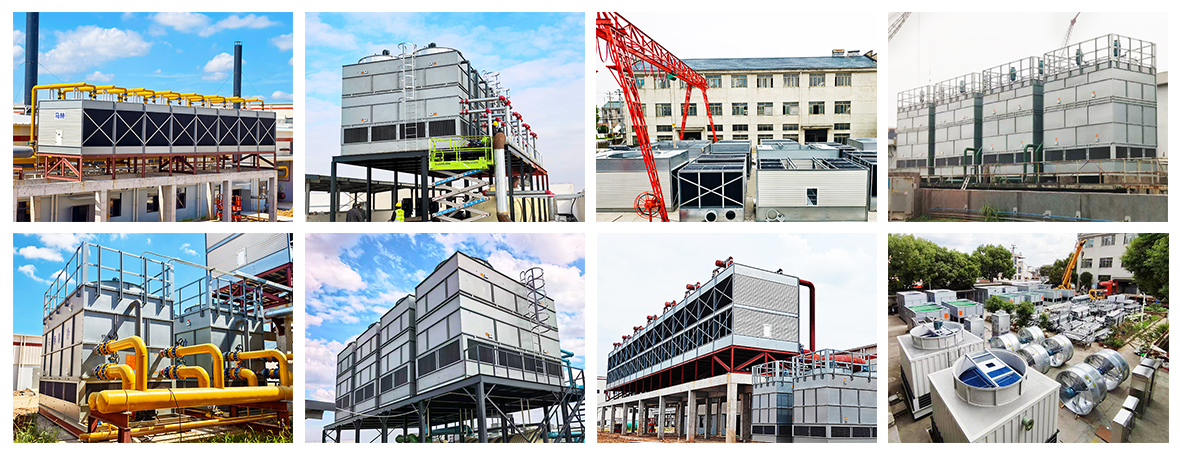
Mach is a cooling tower manufacturer serving industrial and commercial applications and offers a range of open-circuit, closed-circuit and industrial cooling solutions.
Its fully steel modular cooling tower system uses a magnesium-aluminum-zinc-coated steel structure and modular components including fans, motors and water distribution equipment.
The AFMB modular series includes multiple configurations, allowing the tower to be configured according to required cooling capacity.
The manufacturer's published product information lists applications including power generation, chemical processing, metallurgy and HVAC refrigeration.
One interesting point about Mach's approach is the combination of modular construction and customization.
A modular cooling tower does not have to be a rigid one-size-fits-all product.
For projects with unusual water temperatures, flow rates, installation restrictions or environmental conditions, customized engineering can be important.
Mach may be particularly relevant to buyers looking for:
Fully steel modular cooling towers
Industrial cooling applications
Customized configurations
Open and closed cooling tower solutions
Cooling tower components and spare parts
Factory-direct manufacturing
International project support
For buyers comparing suppliers, the key question is not simply "How much does the tower cost?"
A better question is:
Can the manufacturer configure the tower around my actual operating conditions?
That is where an engineering-focused supplier can add value.

Baltimore Aircoil Company, commonly known as BAC, is another major name in evaporative cooling.
BAC's portfolio includes the Series 5000 Industrial Grade Modular Cooling Tower, which is specifically designed for industrial applications.
According to BAC, the Series 5000 is intended for demanding dirty-water applications and provides a modular configuration that can replace certain field-erected cooling tower applications.
The design emphasizes cleanability, corrosion protection, maintenance access and installation flexibility.
BAC lists flow rates of up to 2,883 USGPM per module for the Series 5000.
One notable feature is the ability to use modular configurations to match project capacity and site requirements.
For industrial facilities where water quality and maintenance are major concerns, these characteristics can be important.
BAC also has a broad product portfolio beyond modular cooling towers, giving customers access to cooling tower, evaporative cooling and heat-rejection technologies from one manufacturer.

SPX Cooling Technologies is the manufacturer behind the Marley brand.
Its modular cooling tower portfolio includes the Marley NC Everest crossflow cooling tower and Marley MD Everest counterflow cooling tower.
These systems are designed for large-scale HVAC, process cooling, industrial and power applications.
The NC Everest is a particularly notable modular design.
SPX states that it can provide up to 50% more cooling capacity per cell compared with other single-cell factory-assembled crossflow towers, with capacities reaching more than 2,000 tons per cell depending on model and conditions.
SPX also emphasizes faster delivery and installation compared with traditional field-erected solutions.
The MD Everest extends the modular concept to counterflow applications.
For large industrial projects, this type of equipment can reduce the amount of site construction while providing substantial single-cell capacity.
Typical applications include:
Industrial process cooling
Power generation
Large HVAC plants
Data centers
Mission-critical cooling
Large commercial facilities
The main attraction is the combination of high capacity and modular construction.
EVAPCO is another globally recognized manufacturer of evaporative cooling equipment.
Its AT Atlas modular cooling tower is designed specifically for high-capacity applications.
EVAPCO describes Atlas as a large-module cooling tower designed to reduce field assembly labor.
Published information lists capacities from approximately 1,484 to 2,386 nominal tons per cell, depending on configuration.
The company also highlights reduced piping and electrical connections compared with traditional factory-assembled cooling tower projects.
This makes the Atlas particularly relevant when project logistics are as important as the thermal performance itself.
The basic idea is straightforward:
Build more of the tower before it reaches the job site.
That can reduce the amount of assembly required after delivery and potentially simplify project scheduling.
For large HVAC, industrial process and critical cooling projects, this can be an important consideration.
EVAPCO also has manufacturing and support operations across multiple regions, which can matter when buyers require international technical and service support.
Tower Tech takes a different approach to modular cooling tower design.
The company focuses heavily on factory-built FRP composite modular cooling towers.
Its TTXR series is an open-circuit modular cooling tower designed around factory assembly and interconnectable modules.
Tower Tech also offers closed-circuit modular systems.
One of the major differences is the use of corrosion-resistant FRP composite construction.
For facilities exposed to corrosive environments, the material choice can be particularly interesting.
Tower Tech states that its modular units can be interconnected in different configurations to create larger cooling capacities and support future expansion.
The company also reports more than 5,000 cooling towers installed worldwide through its company and international partner network.
Tower Tech's modular systems are used or marketed for applications including:
Industrial facilities
HVAC
Healthcare
Manufacturing
Data centers
Power plants
Chemical processing
Food processing
If corrosion resistance, modularity and redundancy are high on your specification list, FRP construction is worth investigating.
So, what is the actual difference?
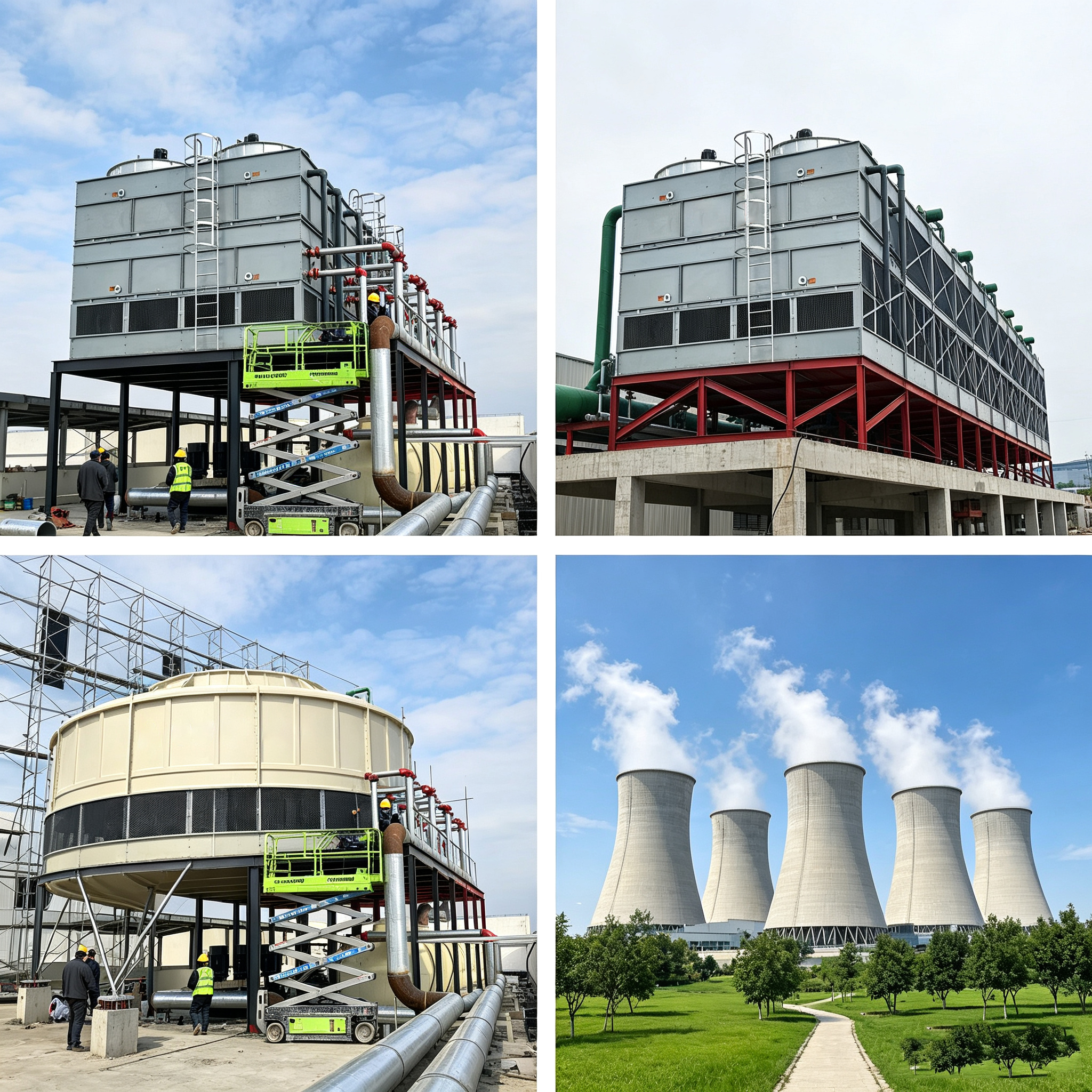
A field-erected cooling tower is substantially assembled at the project site.
A modular cooling tower moves more of the manufacturing and assembly work into a factory.
| Factor | Modular Cooling Tower | Field-Erected Cooling Tower |
|---|---|---|
| Factory assembly | High | Lower |
| Site labor | Generally lower | Generally higher |
| Installation schedule | Usually shorter | Usually longer |
| Transportation | Requires module planning | More component-based |
| Site construction | Reduced | More extensive |
| Capacity | Small to very large | Small to very large |
| Customization | Available | Highly customizable |
| Retrofit suitability | Often attractive | Depends on project |
| Expansion | Often straightforward | Project-specific |
Neither design is automatically suitable for every project.
A large field-erected tower can still be the right answer when the project requires unusual dimensions, extremely large capacity or specific structural arrangements.
The important thing is matching the construction method to the project.
Modular cooling towers can serve a surprisingly wide range of industries.
Factories often have variable cooling loads.
Modular cells can provide operational flexibility and allow capacity to be distributed across multiple units.
Large commercial buildings, campuses and district cooling plants may use multiple modular cells to meet large condenser-water loads.
Data centers are especially sensitive to downtime.
Modular cooling systems can provide multiple cooling cells, allowing operators to design redundancy and maintenance strategies around the facility's reliability requirements.
Power plants, refineries, chemical plants and other process facilities can require substantial heat rejection.
For these projects, modular towers can offer a balance between large capacity and reduced field assembly.
There is no single price for a modular cooling tower.
The final cost depends on much more than nominal tonnage.
Important factors include:
Cooling capacity
Water flow
Entering and leaving water temperatures
Design wet-bulb temperature
Tower material
Fan and motor configuration
Fill type
Drift eliminators
Water distribution system
Controls
Corrosion protection
Transportation
Installation
Site conditions
Required certifications
A cheaper tower may not be cheaper over its entire lifecycle.
For example, a lower initial purchase price could be offset by higher fan energy, more frequent maintenance, shorter component life or difficult access to replacement parts.
That is why buyers should compare total cost of ownership, not only the equipment quotation.
This is probably the most common mistake.
Two towers with similar dimensions can have very different thermal performance and lifecycle costs.
Cooling tower performance is highly dependent on ambient wet-bulb temperature.
A tower selected using the wrong climate data can underperform even if its nominal tonnage appears correct.
Dirty or chemically aggressive water can affect fill, nozzles, basins and other components.
Always tell the manufacturer about actual water conditions.
If your facility is likely to expand, discuss future capacity during the original design.
A modular configuration may allow expansion more efficiently than a system designed with no growth strategy.
Ask about motors, fans, fill, nozzles, drift eliminators, bearings, controls and other replacement parts before signing the purchase order.
Before requesting a quotation, prepare a technical data sheet.
Ask the manufacturer:
What is the required heat rejection?
What is the entering water temperature?
What is the required leaving water temperature?
What is the design wet-bulb temperature?
What is the circulating-water flow?
What material is the tower made from?
What type of fan is used?
What motor efficiency is available?
What fill material is included?
What drift eliminator design is used?
How many modules are required?
What are the shipping dimensions?
What lifting equipment is required?
How much site assembly is necessary?
What foundation is required?
Can additional modules be added later?
What is the warranty period?
Are spare parts available?
Is commissioning support available?
Is remote technical support available?
Can the supplier provide maintenance documentation?
These questions can quickly separate a genuine engineering supplier from a company that simply resells equipment.
The modular cooling tower market has developed significantly, and today's systems are capable of handling applications far beyond simple commercial HVAC.
The biggest attraction is flexibility.
You can manufacture major components in a controlled factory environment, transport them efficiently, install them faster and configure multiple modules around the actual requirements of the project.
For this guide, the five manufacturers to investigate are:
Mach Industry (Zhejiang) Co., Ltd.
Baltimore Aircoil Company (BAC)
SPX Cooling Technologies / Marley
EVAPCO
Tower Tech
But remember: the right cooling tower is not necessarily the one with the biggest capacity or the lowest purchase price.
The right choice is the one that matches your heat load, water flow, wet-bulb condition, materials, footprint, energy requirements, maintenance strategy and long-term operating goals.
For buyers looking for a customizable modular cooling tower, Mach's fully steel modular cooling tower system is one solution worth evaluating alongside other established manufacturers.
A modular cooling tower uses factory-manufactured sections or cells that can be transported and assembled efficiently at the project site. Multiple modules can often operate together to provide greater cooling capacity.
Yes. Modular cooling towers are used for industrial process cooling, power generation, manufacturing, HVAC, data centers and other applications where reliable heat rejection is required.
Not necessarily in initial purchase price. However, modular towers can potentially reduce site labor, installation time and project complexity. The total cost should be evaluated over the equipment's lifecycle.
Common materials include galvanized steel, coated steel, stainless steel and FRP composites. The best material depends on environmental conditions, water chemistry, structural requirements and budget.
Many modular systems are designed to allow multiple cells to operate together, and some can accommodate future expansion. However, expansion capability should be confirmed with the manufacturer during the initial design stage.
Start with thermal performance and engineering capability. Then compare construction materials, certifications, manufacturing quality, customization, installation support, spare parts, warranty and long-term service.
Yes. Mach Industry (Zhejiang) Co., Ltd. offers a fully steel modular cooling tower system, including the AFMB series, for applications such as power generation, chemical processing, metallurgy and HVAC refrigeration.