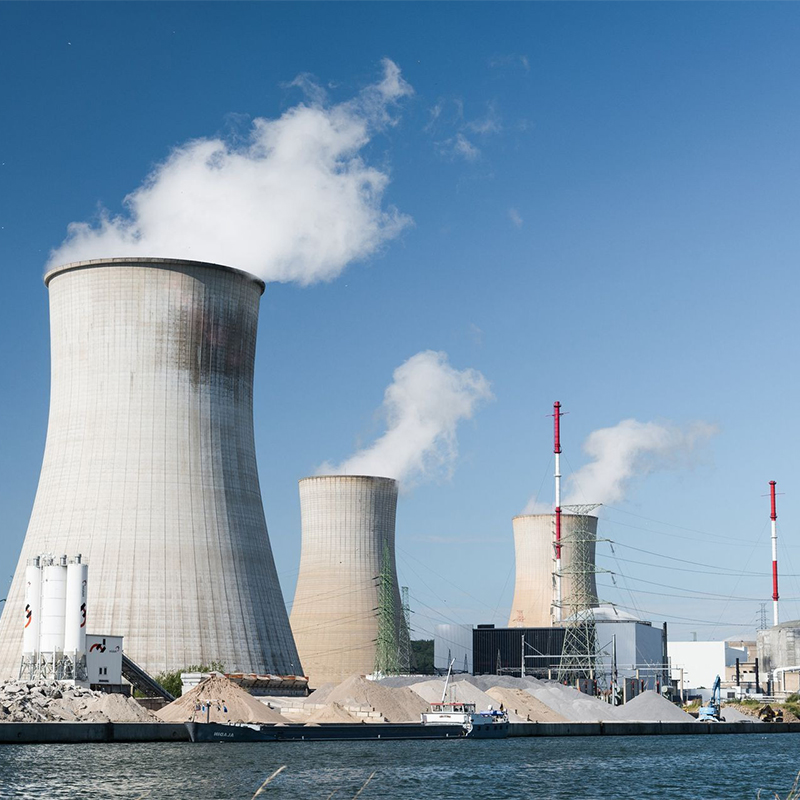
We Provide Cooling Tower Solution

Views: 0 Author: Cindy Publish Time: 2026-11-13 Origin: Site


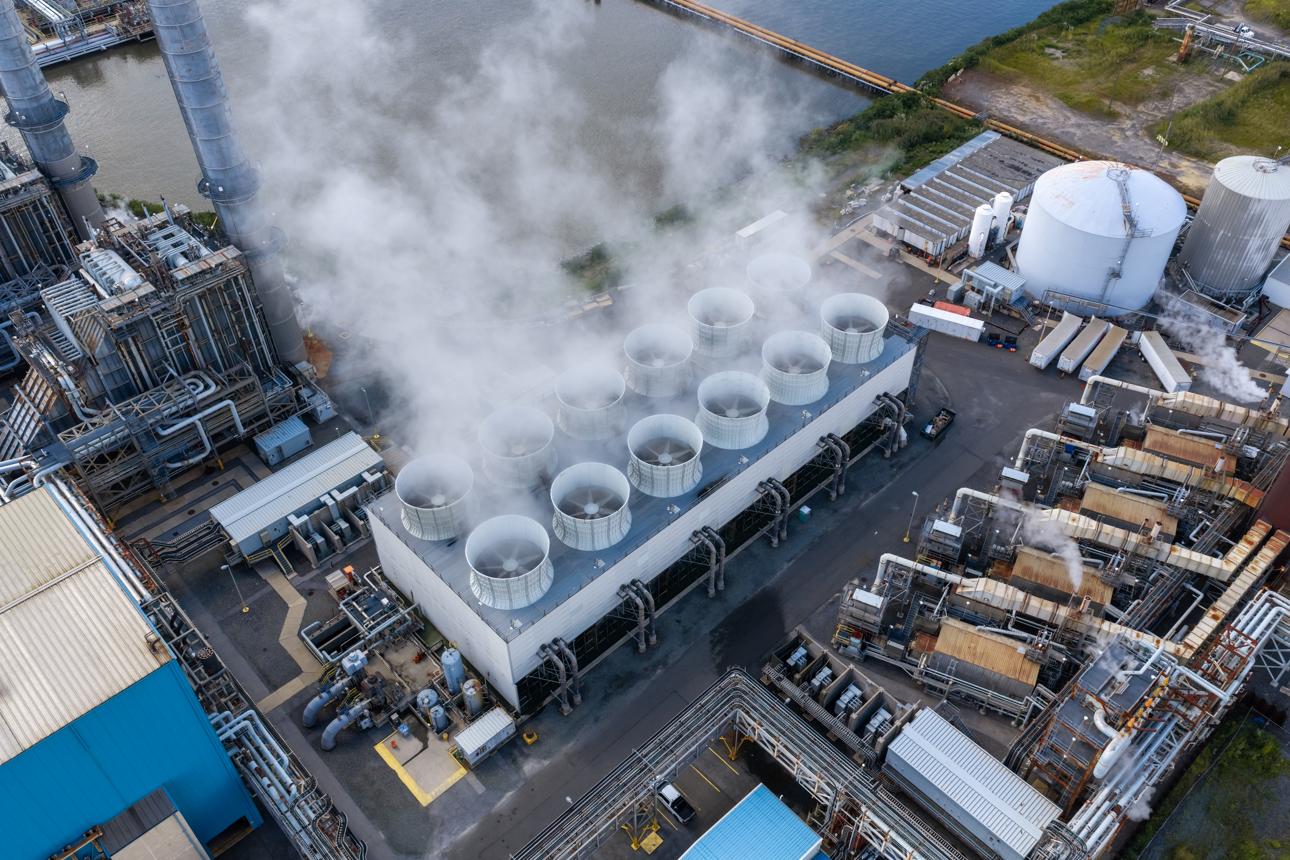
A small water cooling tower may look like a simple piece of industrial equipment, but choosing the right one can make a big difference to production efficiency, energy consumption, and operating costs. Whether you need cooling for a chiller, injection molding machine, laser system, HVAC installation, or a small manufacturing line, the right cooling tower helps remove unwanted heat and keeps your equipment operating within its required temperature range.
But what exactly counts as a small water cooling tower? Which type should you choose? How do you calculate the required cooling capacity? And what should you check before purchasing one?
This guide answers these questions step by step. It also explains how to evaluate tower design, materials, water flow, installation conditions, and long-term maintenance.
A small water cooling tower is a compact heat-rejection system designed to cool circulating water by transferring heat from the water to the surrounding air. It is commonly used in applications where the heat load is relatively limited or where installation space is restricted.
Unlike a large power station cooling tower, a small model is usually designed for individual machines, small production lines, commercial HVAC systems, and light industrial processes.
There is no single international capacity threshold that defines a cooling tower as small. Manufacturers may classify models differently according to their cooling capacity, water flow rate, dimensions, and intended application.
The important point is not the name or physical size. It is whether the unit can handle your actual heat load under local operating conditions.
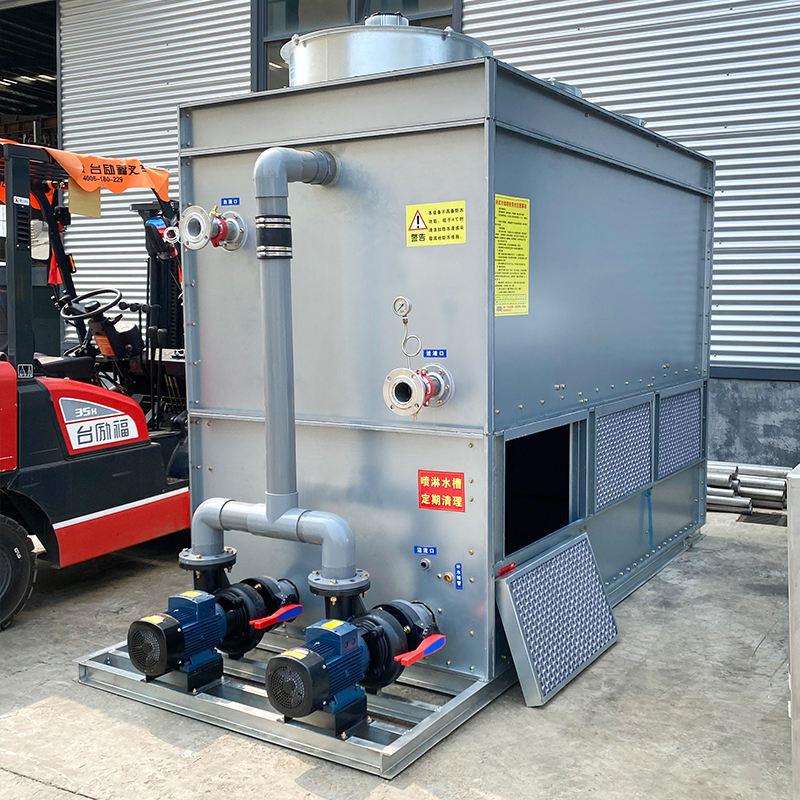
Most small evaporative cooling towers use a straightforward process.
First, warm water from the equipment enters the tower through an inlet connection. A distribution system spreads the water over the fill material, creating a larger contact area between water and air.
A fan moves air through the tower. As some of the water evaporates, it removes heat from the remaining water. The cooled water collects in the basin and returns to the equipment or cooling system.
Think of it as a natural cooling process supported by mechanical airflow. A relatively small amount of evaporation helps remove a much larger amount of heat from the circulating water.
The basic process includes four stages:
Warm water enters the cooling tower.
The water is distributed over the fill.
Air passes through the fill and supports heat and mass transfer.
Cooled water collects in the basin and returns to the system.
Although designs vary, most small cooling towers contain several essential components.
Casing: The external structure that supports and protects the tower.
Fan and motor: Provide the airflow needed for heat rejection.
Water distribution system: Spreads incoming water across the fill.
Cooling tower fill: Increases the contact area between water and air.
Drift eliminator: Reduces the amount of water droplets carried out with exhaust air.
Water basin: Collects cooled water before it returns to the system.
Piping connections: Carry circulating water into and out of the tower.
Each component affects performance. For example, poor water distribution can leave parts of the fill dry, while an incorrectly selected fan may provide insufficient airflow or consume more energy than necessary.
Small cooling towers are available in several configurations. The right choice depends on cooling requirements, water quality, available space, maintenance expectations, and budget.
<PRIVATE_PERSON>In a counterflow cooling tower, water flows downward through the fill while air moves upward, in the opposite direction.
This arrangement creates direct contact between the descending water and rising air. Counterflow designs can provide a compact footprint and are suitable for installations where floor space is limited.
They are commonly considered for industrial process cooling, chillers, and equipment cooling.
Advantages include:
Compact structural design.
Efficient air-water contact.
Flexible installation options.
Suitable for various industrial cooling duties.
However, the water distribution system needs careful attention. Blocked spray nozzles or uneven water flow can reduce heat-transfer performance.
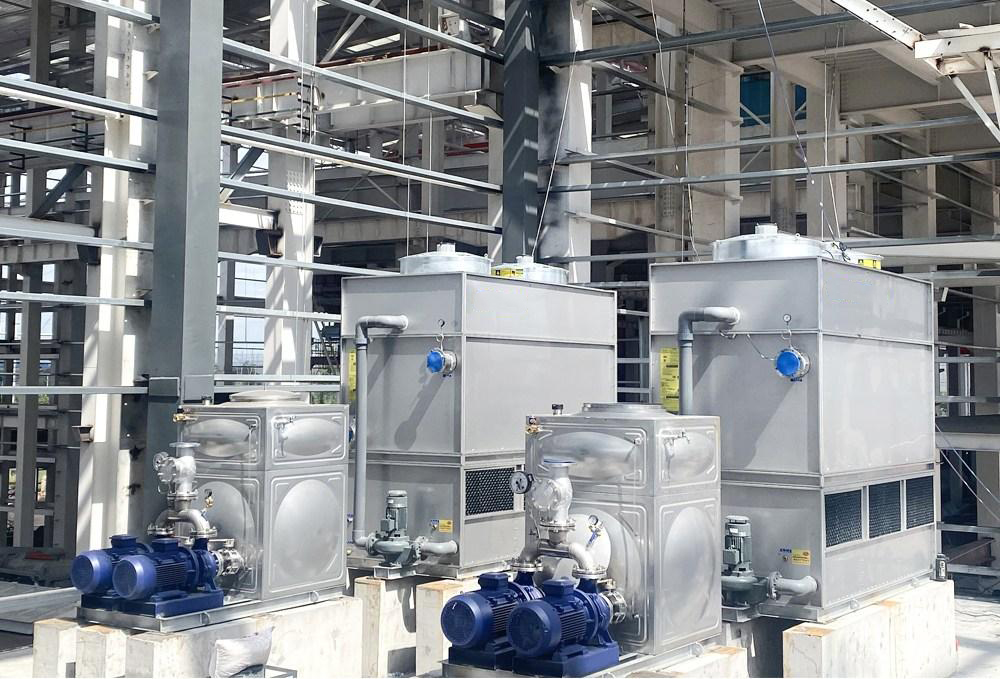
In a crossflow cooling tower, water flows downward through the fill while air moves horizontally across it.
The arrangement often provides convenient access to the water distribution system. Depending on the model, this can make inspection and cleaning easier.
Crossflow designs may be useful when operators value maintenance access and straightforward water distribution.
Potential advantages include:
Accessible water distribution components.
Convenient inspection and maintenance.
Flexible configurations for certain installations.
The actual footprint and performance depend on the tower design. A crossflow model is not automatically more efficient than a counterflow model; both should be compared using the same design conditions.
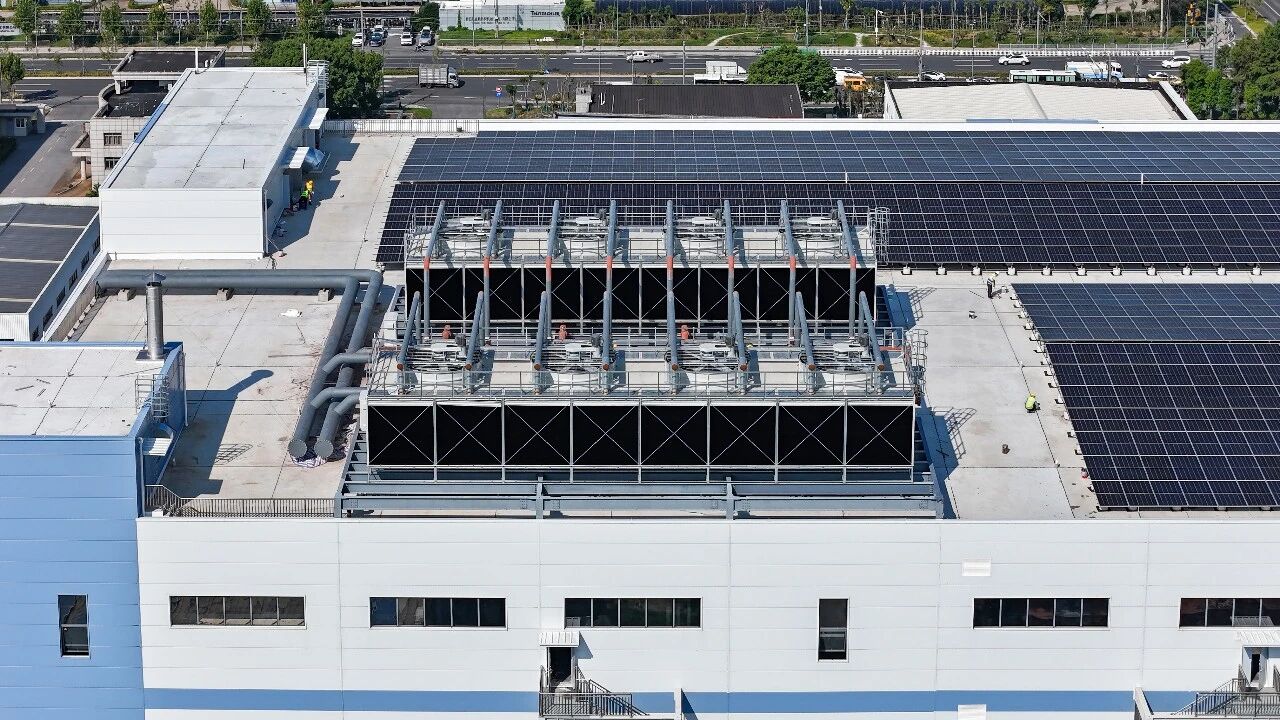
A closed-circuit cooling tower keeps the process fluid inside a coil rather than exposing it directly to the external spray water and air.
Spray water flows over the outside of the coil and evaporates, removing heat from the process fluid inside. The process fluid therefore remains separated from the external cooling-water circuit.
This design is useful when process-water cleanliness is important or when the system needs to reduce direct exposure to contaminants.
Typical applications include industrial machinery, process systems, and selected HVAC installations.
One important point: an evaporative closed-circuit tower still uses spray water and can lose water through evaporation and drift. It should not be confused with a completely dry cooler.
Packaged cooling towers are supplied as assembled or largely preassembled units. They can simplify transportation, installation, and project coordination.
Modular systems use multiple tower cells or units to meet a larger total cooling requirement. They can also offer flexibility when a facility expects future expansion.
For a small factory or equipment room, a packaged unit may be easier to install than a custom-built structure.
Before choosing one, check transport dimensions, lifting requirements, access for maintenance, and the connections needed at the installation site.
Small water cooling towers are used in many industries. Their main job is always similar: remove heat from circulating water so equipment can operate reliably.
Water-cooled chillers reject heat through a condenser-water circuit. A cooling tower removes that heat from the circulating water before it returns to the chiller.
Small cooling towers may be suitable for compact commercial buildings, smaller industrial facilities, and HVAC systems with relatively modest heat loads.
The cooling tower and chiller must be selected as a matched system. The condenser-water flow rate, entering and leaving water temperatures, and local wet-bulb temperature all matter.
Injection molding machines generate heat during plastic processing. Hydraulic systems, molds, and auxiliary equipment may all require cooling.
A properly selected cooling tower can provide a circulating water supply for suitable cooling circuits.
However, different machines may have different temperature and water-quality requirements. The cooling tower should be sized according to the total heat load rather than simply selected by machine tonnage.
Laser cutting machines, welding equipment, compressors, and other industrial systems may use water-based cooling circuits.
A small cooling tower can be considered when the equipment manufacturer permits evaporative cooling and the water temperature can meet the required operating range.
Some precision equipment requires tightly controlled water quality and temperature. In these cases, a dedicated chiller or heat exchanger may be needed between the cooling tower and the equipment.
Small cooling towers can also serve selected commercial and institutional applications, including compact HVAC installations, testing facilities, and certain laboratory systems.
The key is to check the required temperature stability, water treatment requirements, hygiene considerations, and local regulations before installation.
Why choose a small cooling tower instead of another cooling method?
The answer depends on the project, but several benefits are worth considering.
Space-efficient installation: Compact models can fit facilities where a large cooling tower would be impractical.
Effective heat rejection: Evaporative cooling can reject substantial heat when the design and ambient conditions are suitable.
Flexible applications: Small towers can support individual machines, process loops, and compact HVAC systems.
Potential operating-cost advantages: Under suitable conditions, an evaporative system may use less fan power than an air-cooled alternative. However, pump power, water consumption, treatment, and maintenance must also be included in the comparison.
Scalable options: Some projects can use multiple units or modular arrangements as cooling demand changes.
Remember that small does not automatically mean inexpensive to operate. Correct sizing and system design are what make the difference.
Selecting a cooling tower based only on its appearance or advertised capacity is risky. You need to understand the actual operating conditions first.
Start by calculating how much heat the tower needs to remove.
For water, a commonly used metric calculation is:
Q = 1.163 × F × ΔT
Where:
Q = heat load in kW.
F = water flow rate in m³/h.
ΔT = temperature difference between hot and cold water in °C.
1.163 = approximate heat-capacity conversion factor for water under typical conditions.
For example, suppose your system circulates 10 m³/h of water and needs a cooling range of 5°C.
Q = 1.163 × 10 × 5
Q = 58.15 kW
The estimated heat load is approximately 58.15 kW.
This calculation provides a useful starting point. The final selection should also consider actual process heat input, operating variations, design safety margins, and the tower's performance data.
The cooling range is the difference between the hot-water temperature entering the tower and the cold-water temperature leaving it.
For example:
Hot-water inlet temperature: 37°C.
Cold-water outlet temperature: 32°C.
Cooling range: 5°C.
A larger cooling range generally means more heat must be removed per unit of circulating water.
Do not confuse cooling range with approach. The approach is the difference between the cold-water outlet temperature and the entering-air wet-bulb temperature.
Both values are essential when evaluating cooling tower performance.
The wet-bulb temperature is one of the most important factors in evaporative cooling tower selection.
It reflects the combined effect of air temperature and humidity. An evaporative cooling tower cannot normally cool water below the entering-air wet-bulb temperature.
For example, a tower designed for a 28°C wet-bulb condition may not deliver the same cold-water temperature on a hot, humid day when the wet-bulb temperature is higher.
Always provide the manufacturer with the site's design wet-bulb temperature rather than relying only on the average outdoor temperature.
Cooling tower construction affects durability, corrosion resistance, weight, and maintenance.
Common material options include:
FRP: Fiber-reinforced plastic is widely used for corrosion resistance and relatively low weight.
Galvanized steel: Provides structural strength, but coating condition and water chemistry need attention.
Stainless steel: Offers corrosion resistance in suitable grades and environments, usually at a higher initial cost.
Concrete: More common in large permanent installations than in compact packaged units.
For many small industrial projects, FRP is worth considering because it combines low weight with resistance to many common environmental conditions.
Still, material selection should reflect water chemistry, ambient exposure, operating temperature, and expected service life.
Measure the available installation area before ordering.
Include more than the tower's external dimensions. You also need space for:
Air intake and exhaust.
Piping and valves.
Electrical connections.
Maintenance access.
Cleaning and basin inspection.
Lifting and replacement of components.
Noise is another important consideration, especially near offices, residential areas, or noise-sensitive production spaces.
Ask the manufacturer for fan and sound data under the proposed operating conditions. If necessary, consider lower-noise fan options, vibration isolation, or suitable acoustic measures.
A product specification sheet helps you compare different models. Do not focus on a single number.
| Specification | Why It Matters |
|---|---|
| Nominal cooling capacity | Indicates the rated heat-rejection duty under stated conditions |
| Water flow rate | Determines the volume of water circulated through the tower |
| Hot-water temperature | Defines the entering-water design condition |
| Cold-water temperature | Defines the required leaving-water condition |
| Wet-bulb temperature | Establishes the ambient design condition |
| Cooling range and approach | Describe the required thermal performance |
| Fan motor power | Helps estimate electrical demand |
| Overall dimensions | Determines installation and access requirements |
| Operating weight | Matters for foundation and structural design |
| Water basin capacity | Helps with system operation and water management |
| Material | Affects corrosion resistance and service life |
Always compare specifications under the same wet-bulb temperature, water flow, hot-water temperature, and cold-water temperature. A capacity figure without its design conditions can be misleading.
A small water cooling tower normally consumes electricity through its fan and circulating-water pump. The total system energy use depends on the tower design, pump head, piping arrangement, control strategy, and operating schedule.
The fan is responsible for moving air through the fill and drift eliminator. The pump moves water through the system. If either component is incorrectly selected, energy consumption may increase.
Here are several ways to improve operating efficiency:
Select a fan that matches the required airflow and static pressure.
Use efficient motors where appropriate.
Consider variable-frequency control when the load varies.
Keep fill, nozzles, and drift eliminators clean.
Maintain correct water flow and distribution.
Avoid unnecessary throttling and excessive pump pressure.
Inspect the system for air recirculation and installation problems.
Water consumption also contributes to operating costs. Evaporation is a necessary part of the cooling process, while drift and blowdown create additional water losses.
A good design balances heat-rejection performance, electricity consumption, water use, and maintenance requirements.
Even a correctly selected tower can perform poorly if installation is not planned properly.
Start with a suitable foundation. It must support the operating weight of the tower, including water and accessories, while keeping the unit level and stable.
Next, review the air path. The tower needs enough space to draw in fresh air and discharge warm, moist exhaust air. If the exhaust is drawn back into the air inlet, cooling performance may decrease.
Check the following before installation:
Foundation strength and level.
Inlet and outlet pipe sizes.
Pump flow and required pressure.
Electrical supply and motor protection.
Drainage and overflow arrangements.
Maintenance clearance.
Noise and vibration control.
Water treatment and makeup-water connections.
The installation should follow the manufacturer's drawings and the applicable local electrical, plumbing, structural, and environmental requirements.
Regular maintenance protects cooling performance and helps prevent unexpected shutdowns.
A cooling tower operates in a wet environment. Dust, airborne debris, scale, corrosion, and biological growth can gradually affect its components.
A simple maintenance plan is often more effective than waiting until a problem becomes serious.
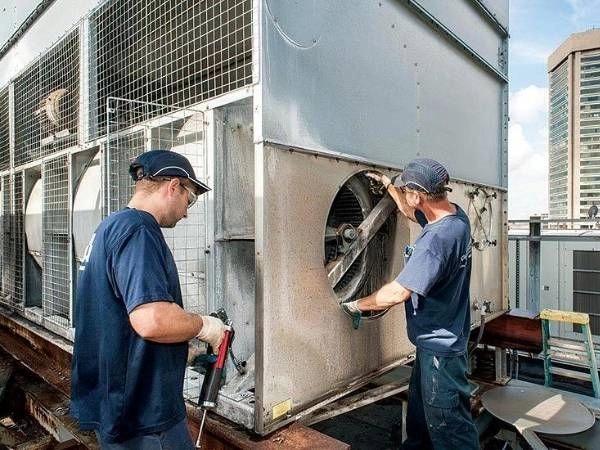
Daily or during regular operation:
Check water levels in the basin.
Listen for unusual fan or motor noise.
Look for abnormal vibration.
Check for visible leakage.
Monitor water temperatures and flow.
Weekly or according to operating conditions:
Inspect water distribution.
Check spray nozzles for blockage.
Remove debris from accessible areas.
Review water quality and treatment records.
Monthly or at scheduled intervals:
Inspect fan blades and fasteners.
Check motor and electrical connections.
Inspect the fill and drift eliminator.
Check basin condition and strainers.
Review vibration and operating performance.
During planned shutdowns:
Clean the basin and internal surfaces.
Inspect structural components.
Check fill condition and support frames.
Examine piping, valves, and seals.
Replace worn components where necessary.
The maintenance interval should be adjusted to the operating environment, water quality, and manufacturer's recommendations.
Problem 1: Cooling water temperature is too high
Possible causes include insufficient airflow, blocked fill, poor water distribution, excessive heat load, or high ambient wet-bulb temperature.
Check actual operating conditions before changing the tower settings. A tower cannot achieve a leaving-water temperature below the practical limits imposed by the entering-air wet-bulb temperature.
Problem 2: Water consumption is unusually high
Possible causes include excessive drift, leakage, overflow, or incorrect blowdown settings.
Inspect the drift eliminator, basin, pipe connections, and water-control equipment. Evaporation should not be mistaken for a leak because evaporation is a normal part of the cooling process.
Problem 3: Fan vibration or unusual noise
Possible causes include loose fasteners, damaged blades, poor alignment, bearing problems, or unbalanced rotating components.
Stop the equipment when necessary and follow the manufacturer's safety procedures before inspection. Do not operate a damaged fan simply to keep the process running.
Problem 4: Water distribution is uneven
Blocked nozzles, damaged distribution pipes, or incorrect water pressure can cause uneven flow.
Clean or replace affected components and confirm that the distribution system operates within its specified pressure and flow range.
Both water-cooled and air-cooled systems remove heat, but they do so differently.
A water cooling tower uses evaporation to reject heat from circulating water. An air-cooled system generally transfers heat directly to ambient air through a heat exchanger and fans.
| Comparison | Small Water Cooling Tower | Air-Cooled System |
|---|---|---|
| Cooling method | Evaporative heat rejection | Air-to-surface heat transfer |
| Water requirement | Requires makeup water | Generally does not require cooling-tower makeup water |
| Main energy users | Fan and circulating pump | Fans and, depending on the system, other equipment |
| Maintenance | Requires water treatment and basin/fill inspection | Requires coil and airflow maintenance |
| Ambient influence | Strongly affected by wet-bulb temperature | Strongly affected by dry-bulb temperature |
| Typical consideration | Suitable where water and treatment are available | Useful where water use should be minimized |
Which is better? There is no universal answer.
A water cooling tower may be attractive when the project needs effective heat rejection and has suitable water resources. An air-cooled system may be more practical where water is limited or water treatment is undesirable.
Compare the complete system, including equipment cost, electricity, water, maintenance, and local climate.
The purchase price varies according to cooling capacity, structure, materials, accessories, and customization.
Several factors have a direct influence on the quotation.
Cooling capacity: A unit designed to remove more heat generally requires a larger heat-transfer area, more airflow, or both.
Tower type: Counterflow, crossflow, and closed-circuit designs have different structures and component requirements.
Construction materials: FRP, galvanized steel, and stainless steel options have different costs and performance characteristics.
Fan and motor configuration: Motor power, efficiency, fan material, and control options affect the overall price.
Water distribution and fill: The fill type, nozzle arrangement, and drift eliminator design influence both performance and manufacturing cost.
Customization: Special dimensions, corrosion-resistant materials, low-noise configurations, and non-standard connections may increase the initial investment.
When comparing quotations, ask whether the price includes the fan motor, fill, drift eliminator, basin, accessories, and other required components. Also check packaging, delivery terms, installation scope, warranty, and spare-parts availability.
The lowest quotation is not necessarily the best value. A poorly matched tower can create higher operating costs for years.
Choosing the manufacturer is just as important as choosing the model.
A reliable supplier should understand the project's actual operating conditions and provide technical information that supports the selection.
Before placing an order, consider these points:
Product experience: Does the company manufacture cooling towers for applications similar to yours?
Technical support: Can it review your flow rate, temperatures, heat load, and wet-bulb conditions?
Product documentation: Are drawings, specifications, and operating instructions available?
Material information: Can the manufacturer explain the materials used in the casing, fill, fan, and other components?
Customization capability: Can it adapt dimensions or configurations to project requirements?
Quality control: Does it have a defined inspection and production-control process?
After-sales support: Can it provide technical assistance and replacement-part information?
A professional manufacturer should ask questions before recommending a model. If a supplier quotes a cooling tower based only on the machine name or a rough estimate, request a more detailed technical review.
For industrial buyers looking for cooling tower equipment, Mach Industry (Zhejiang) Co.,Ltd, operating under the Mach Cooling brand, is a manufacturer to consider when evaluating cooling tower solutions.
Mach Cooling focuses on industrial cooling tower products and can be approached for project discussions involving cooling requirements, tower configuration, and equipment selection.
When discussing a small water cooling tower project, buyers should prepare the following information:
Required heat-rejection capacity.
Circulating-water flow rate.
Hot-water inlet temperature.
Required cold-water outlet temperature.
Local design wet-bulb temperature.
Installation space and site conditions.
Water quality and operating environment.
Preferred tower type and material, if already specified.
Providing these details helps the manufacturer evaluate the application more accurately and recommend a suitable configuration.
Rather than selecting a unit simply because it is described as a small cooling tower, focus on matching its actual performance to your process requirements.
To learn more about Mach Cooling and discuss your cooling tower requirements, visit:
Website: https://www.machcooling.com
There is no universal capacity limit. The term generally refers to a compact cooling tower designed for smaller heat loads, individual machines, small production lines, and compact HVAC systems. Capacity and dimensions should be checked against the actual project requirements.
For water, a preliminary metric calculation is:
Q = 1.163 × F × ΔT
Here, Q is heat load in kW, F is water flow in m³/h, and ΔT is the cooling range in °C.
For final selection, also consider wet-bulb temperature, required approach, operating variations, and manufacturer performance data.
Water consumption depends on heat load, operating hours, weather, tower efficiency, and water-management practices.
The main water loss is evaporation. Additional losses can come from drift, blowdown, and leakage. Correct drift eliminators and appropriate water treatment can help control unnecessary losses.
Many industrial cooling towers are designed for continuous operation, provided they are correctly selected, installed, and maintained.
Continuous operation requires suitable water treatment, routine inspection, proper electrical protection, and monitoring of fan, pump, and water-system performance.
FRP is commonly used because it is lightweight and resistant to many forms of corrosion. Its suitability still depends on the water chemistry, operating temperature, environmental exposure, and the specific resin and reinforcement system used.
Yes, if the cooling tower is properly matched to the chiller's condenser-water flow, heat-rejection load, and temperature requirements.
Always follow the chiller manufacturer's requirements for condenser-water conditions and minimum or maximum flow rates.
Service life depends on materials, water quality, operating conditions, maintenance, and component replacement. Regular inspection and water treatment can help extend the useful life of the tower, but no single service-life figure applies to every model.
The choice depends on the project. Counterflow designs can offer a compact footprint, while crossflow designs may provide convenient access to water distribution components. Compare rated thermal performance, dimensions, maintenance access, and total cost under the same design conditions.
A small water cooling tower can be an effective heat-rejection solution for compact industrial systems, chillers, plastic processing equipment, commercial HVAC installations, and many other applications.
But the best model is not necessarily the smallest, cheapest, or most powerful one. It is the tower that matches your heat load, water flow, required temperatures, local wet-bulb conditions, installation space, and maintenance expectations.
Start with accurate operating data. Compare counterflow, crossflow, closed-circuit, and packaged designs. Review the complete specifications rather than relying on a single capacity number. Finally, work with a manufacturer that can explain its recommendations and provide suitable technical documentation.
If you are planning a small cooling tower project, Mach Industry (Zhejiang) Co.,Ltd can be contacted through https://www.machcooling.com to discuss your application and equipment requirements.
The right selection today can help your cooling system operate more reliably and economically over the long term.