We Provide Cooling Tower Solution

Views: 0 Author: Cindy Publish Time: 2026-11-10 Origin: Site


A cooling tower is an essential part of many industrial cooling systems. It removes unwanted heat from circulating water and releases that heat into the atmosphere. Although a cooling tower may look like a simple industrial structure from the outside, its internal design is much more complex.
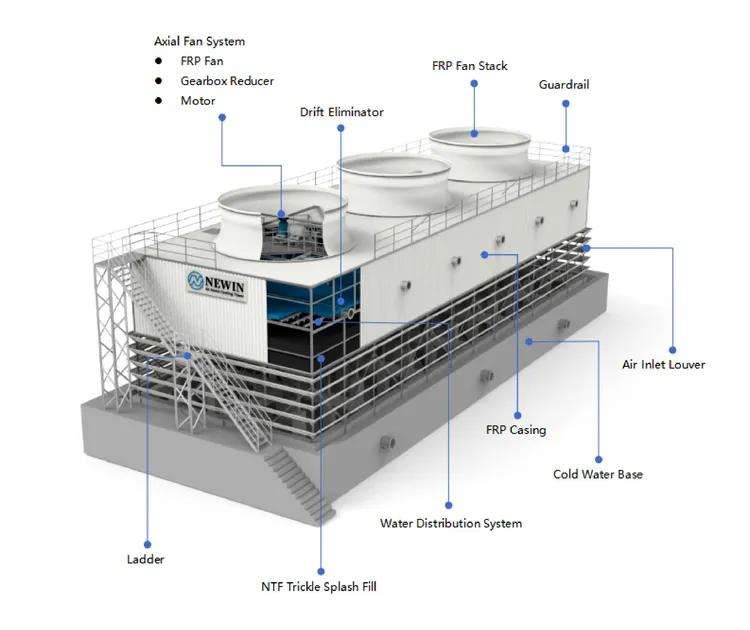
Every component has a specific job. The cooling tower frame supports the entire unit, the fill increases the contact area between water and air, the water distribution system spreads hot water evenly, and the fan helps move air through the tower.
Understanding cooling tower structure is important when selecting equipment, planning installation, improving cooling performance, or replacing old components.
So, what does a cooling tower look like inside? How do its main components work together? And what should you consider when choosing a cooling tower structure for your industrial application?
This guide explains everything you need to know.
A cooling tower structure refers to the complete arrangement of the tower's external framework, internal components, water distribution equipment, airflow system, and supporting parts.
These components work together to transfer heat from circulating water into the surrounding air.
A typical industrial cooling tower includes:
Structural frame and supporting members
Cooling tower casing or enclosure
Water distribution system
Cooling tower fill
Drift eliminators
Fan and fan cylinder
Fan motor and drive system
Air inlet louvers
Cold water basin
Access platforms and maintenance components
The exact structure depends on the cooling tower type, cooling capacity, operating conditions, installation environment, and manufacturer design.
For example, a small packaged cooling tower may use a compact FRP structure, while a large industrial cooling tower may use a reinforced concrete or steel framework.
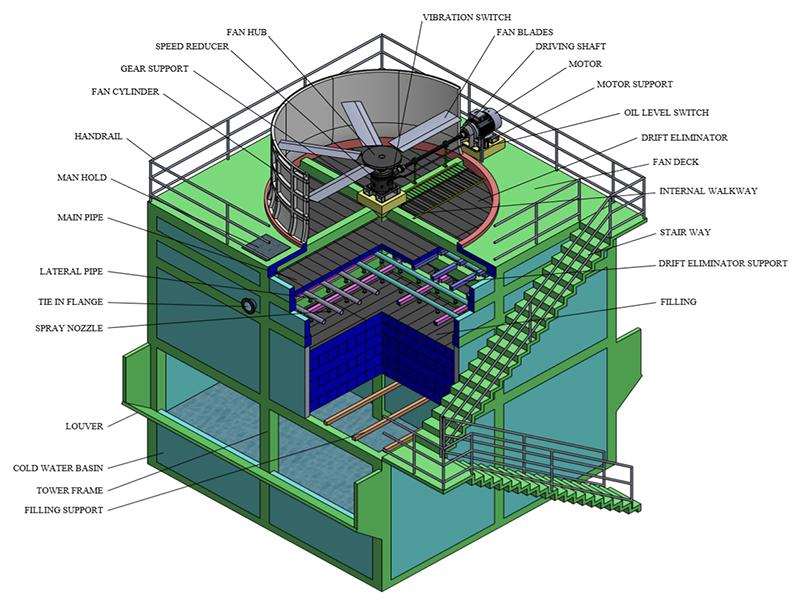
A cooling tower structure diagram helps engineers, buyers, and maintenance teams understand how different components are arranged.
A typical mechanical-draft cooling tower can be divided into several functional sections.
The structural frame is the main supporting system of a cooling tower. It carries the weight of the casing, fill, water distribution equipment, fan assembly, and other components.
Depending on the design, manufacturers may use FRP, galvanized steel, stainless steel, or concrete.
A properly designed frame should withstand operating loads, wind pressure, vibration, water exposure, and environmental conditions.
The casing forms the external enclosure of the tower. It helps guide airflow, contains splashing water, and protects internal components from the surrounding environment.
FRP panels are commonly used in many industrial cooling towers because they offer corrosion resistance and relatively low weight.
The water distribution system spreads hot water over the cooling tower fill.
It may consist of distribution pipes, spray nozzles, rotating sprinklers, or gravity distribution basins.
Uniform water distribution is important because dry areas or uneven water loading can reduce heat transfer performance.
Cooling tower fill is one of the most important heat-transfer components.
It increases the contact surface between water and air, allowing more heat to transfer from water to air through evaporation and sensible heat exchange.
Common fill types include:
Film fill
Splash fill
High-temperature fill
Low-clogging fill
The appropriate fill design depends on water quality, operating temperature, suspended solids, and cooling tower configuration.
Drift eliminators are installed above the water distribution area in many cooling tower designs.
Their purpose is to capture water droplets carried by the outgoing airflow and return them to the tower.
Good drift control helps reduce water loss and limits the release of droplets into the surrounding environment.
In mechanical-draft cooling towers, the fan moves air through the tower.
The fan cylinder guides airflow and helps maintain an effective air passage. Fan performance depends on blade design, diameter, speed, installation quality, and system resistance.
The cold water basin collects cooled water after it passes through the fill.
The water is then pumped back to the heat-generating equipment, such as chillers, heat exchangers, or industrial production systems.
The basin should have suitable capacity, drainage, water outlets, and access for cleaning.
A cooling tower operates through heat and mass transfer between circulating water and air.
The process can be explained in several steps.
Hot water from industrial equipment or a chiller condenser enters the cooling tower through the inlet connection.
The water distribution system then spreads it across the fill area.
The water moves downward through the fill.
The fill increases the contact area between water and air, creating better conditions for heat transfer.
Air enters through the air inlet louvers or openings.
Depending on the tower design, airflow may be generated by natural draft or mechanical fans.
A small portion of the circulating water evaporates. This evaporation removes heat from the remaining water.
At the same time, sensible heat transfer also takes place between the water and air.
After passing through the fill, cooled water falls into the cold water basin.
The water is then returned to the industrial cooling circuit.
The warmed air moves upward and exits through the tower outlet.
Drift eliminators help reduce the amount of liquid water carried away with the exhaust air.
Cooling towers can be classified according to airflow direction, draft method, and construction design.
Understanding these differences helps buyers select the right cooling tower for their applications.
In a crossflow cooling tower, air moves horizontally across the falling water.
Hot water is distributed above the fill, while air enters through openings on the sides.
Main features:
Horizontal airflow across the falling water
Water distribution commonly uses gravity basins or spray systems
Relatively accessible internal components in many designs
Suitable for many industrial and HVAC applications
Crossflow cooling towers can be convenient for inspection and maintenance because some distribution components are accessible from the top.
In a counterflow cooling tower, air moves upward while water flows downward.
The two flows move in opposite directions, creating a countercurrent heat-transfer arrangement.
Main features:
Vertical airflow
Water distribution system positioned above the fill
Compact footprint in many designs
Suitable for industrial and commercial cooling systems
Counterflow cooling towers often require careful attention to airflow resistance and water distribution uniformity.
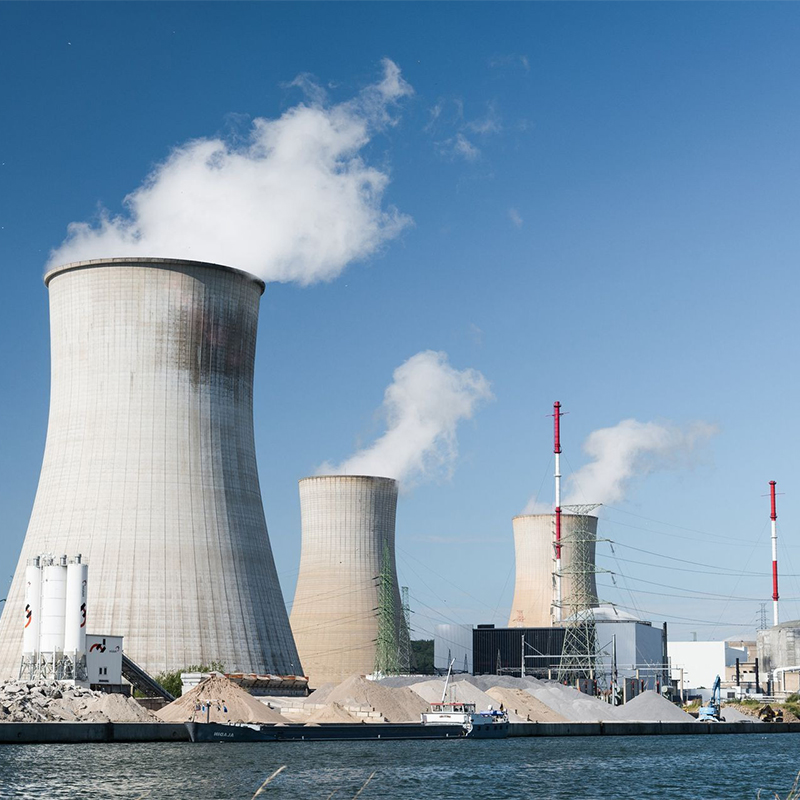
Natural draft cooling towers use differences in air density to create airflow.
Large hyperbolic concrete towers are a familiar example. Warm, moist air rises through the tower, drawing cooler air into the lower openings.
These towers are commonly associated with large power plants and major industrial facilities.
Mechanical draft cooling towers use fans to move air through the tower.
They can be divided into two common types:
Forced Draft Cooling Tower
The fan is installed near the air inlet and pushes air into the tower.
Induced Draft Cooling Tower
The fan is installed near the air outlet and pulls air through the tower.
Mechanical draft designs provide more direct control over airflow and are widely used in industrial cooling systems.
Material selection affects structural strength, corrosion resistance, maintenance requirements, and service life.
Different cooling tower components may use different materials depending on their operating environment.
FRP is widely used in cooling tower casings, structural members, fan cylinders, and other components.
Advantages include:
Good corrosion resistance
Relatively low weight
Good design flexibility
Low routine maintenance requirements
FRP is a practical choice for many industrial environments where moisture and chemical exposure are concerns.
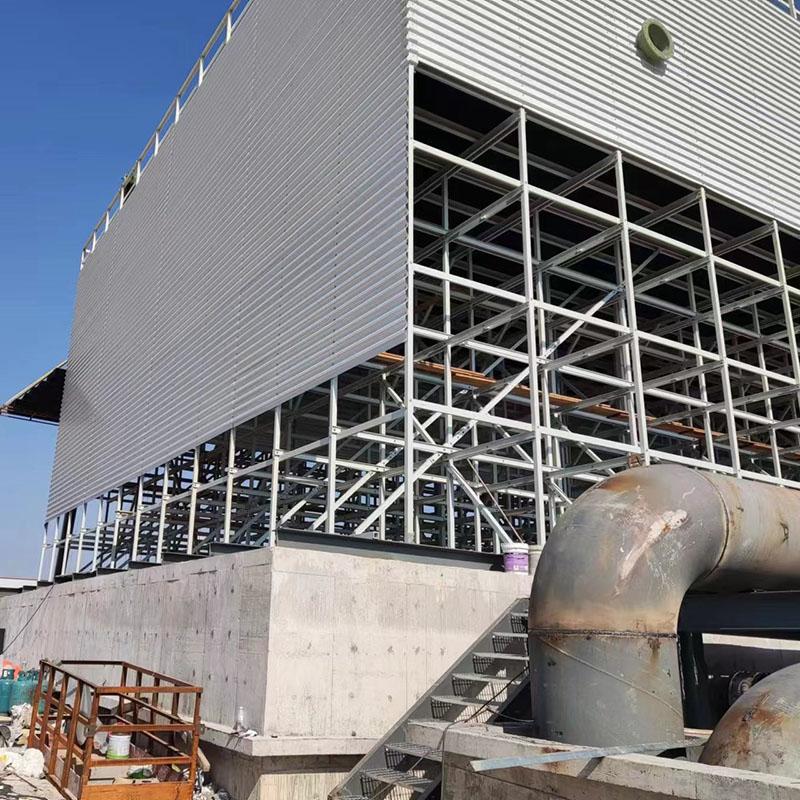
Galvanized steel is used in some cooling tower frames, support structures, and mechanical components.
Its zinc coating provides protection against corrosion.
However, coating quality, water chemistry, installation conditions, and maintenance all influence its long-term performance.
Stainless steel may be used for fasteners, pipes, support parts, and other components that require improved corrosion resistance.
The correct stainless steel grade should be selected according to water chemistry and exposure conditions.
Concrete is commonly used in large natural-draft cooling towers and certain large industrial installations.
It provides high structural strength and is suitable for large-scale construction.
However, concrete structures require appropriate engineering design, reinforcement, and long-term inspection.
PVC and PP are commonly used for cooling tower fill and water distribution components.
Their suitability depends on operating temperature, chemical compatibility, water quality, and mechanical requirements.
Material selection should always consider actual operating conditions rather than price alone.
The internal structure determines how effectively a cooling tower handles water, air, and heat.
Each component has a direct or indirect influence on cooling performance.
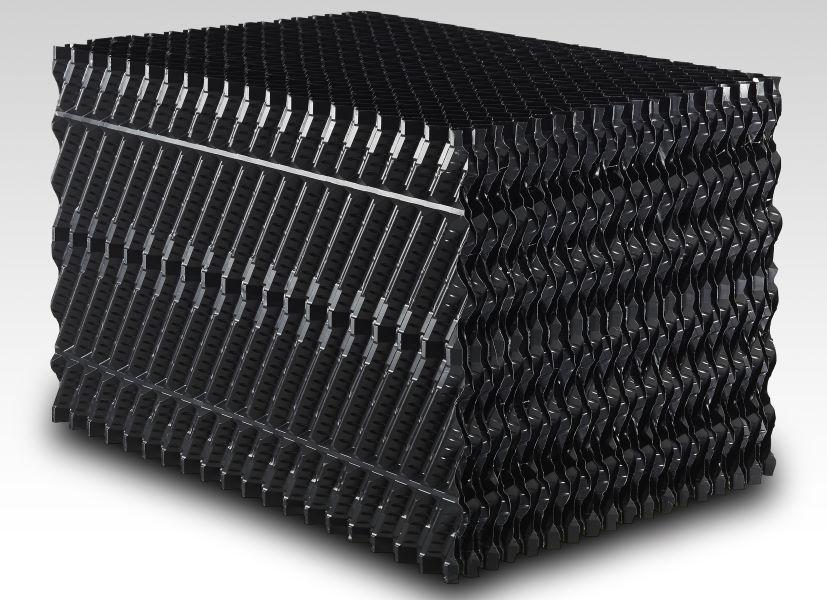
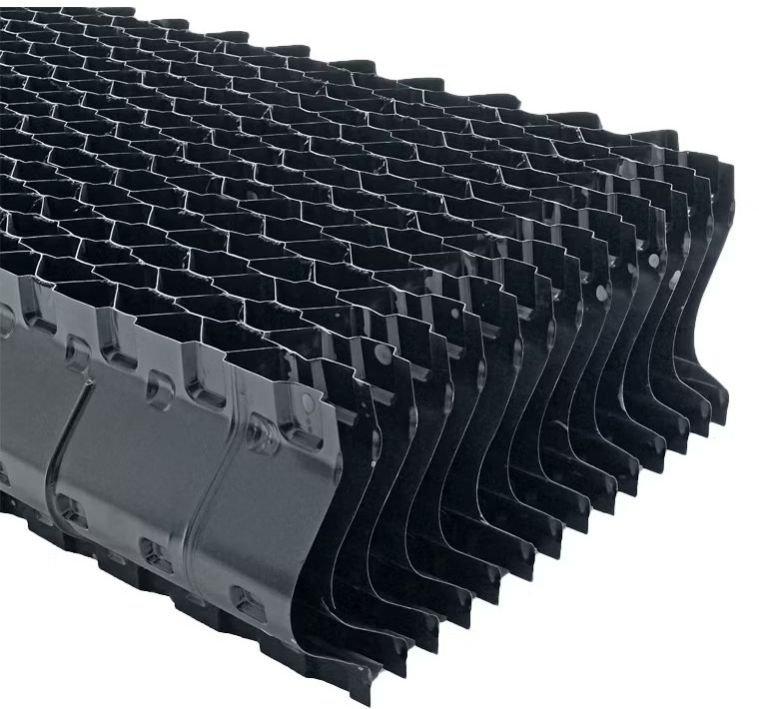
Fill provides a large surface area for water-air contact.
Film fill spreads water into thin films across closely spaced sheets. Splash fill breaks water into smaller droplets through repeated splashing.
Film fill is often selected when water quality is suitable and high heat-transfer efficiency is required.
Splash fill may be preferred in applications with greater suspended solids or higher fouling risks.
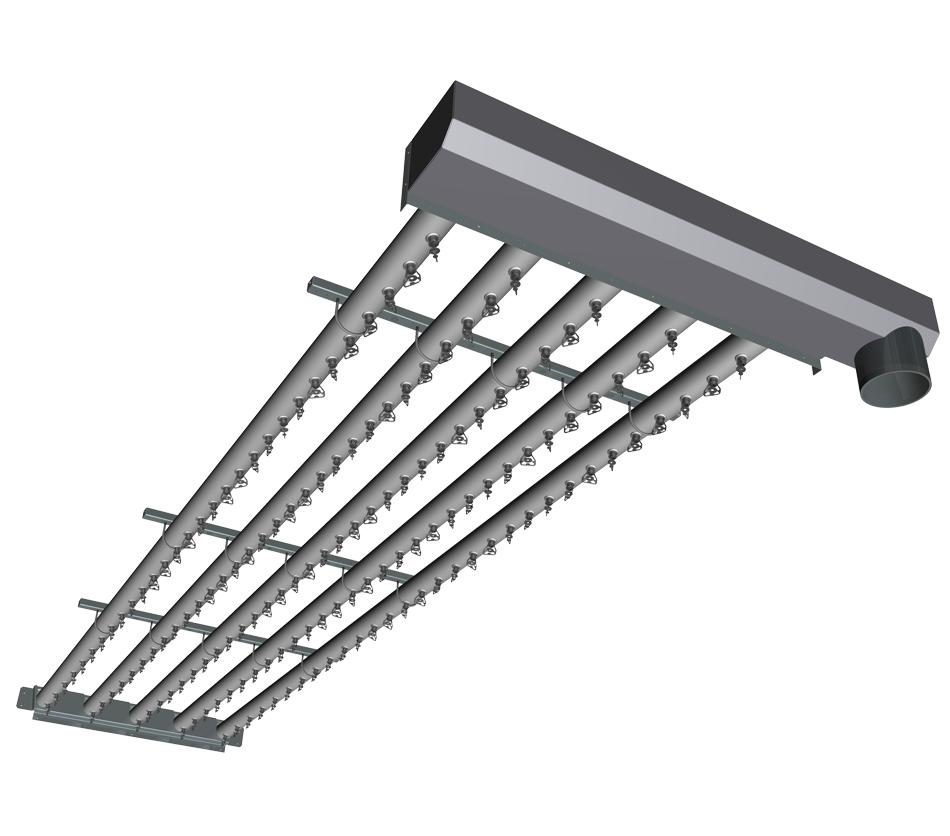
The distribution system must deliver the correct water volume across the fill.
Poor distribution can create uneven water loading, reducing the effective heat-transfer area.
Regular inspection of spray nozzles, pipes, and distribution basins helps maintain consistent operation.
The airflow system includes air inlets, louvers, fan cylinders, fans, and air outlet sections.
Its purpose is to provide sufficient air volume through the tower while minimizing unnecessary resistance.
Airflow should be considered together with fill design and water loading.
Drift eliminators are designed to change the direction of airflow and capture entrained water droplets.
Their installation and condition influence drift control.
Damaged, missing, or incorrectly installed eliminators can increase water loss.
The basin collects cooled water and supplies it to the circulation pumps.
A suitable basin design should prevent excessive sediment accumulation and provide sufficient water depth for reliable pump operation.
Crossflow and counterflow cooling towers use different internal arrangements.
The best option depends on the project requirements, available space, water conditions, and maintenance strategy.
| Comparison | Crossflow | Counterflow |
|---|---|---|
| Air direction | Horizontal | Vertical upward |
| Water direction | Downward | Downward |
| Relative flow arrangement | Cross-current | Counter-current |
| Water distribution | Often gravity basin or spray system | Often pressurized spray system |
| Maintenance access | Often convenient at the top | Depends on tower design |
| Typical application | Industrial and HVAC | Industrial and HVAC |
| Space requirements | Design-dependent | Often compact |
Neither design is automatically better for every application.
Engineers should compare thermal performance, fan power, water distribution, installation space, maintenance access, and total operating cost.
A cooling tower's thermal performance depends on the interaction of several components.
Even if the fan is powerful, poor water distribution or unsuitable fill can limit the overall cooling effect.
The fill determines how much contact area is available between water and air.
Incorrect fill selection may reduce cooling performance or increase fouling.
Uneven water distribution creates areas where the fill receives too much or too little water.
This reduces the effective use of the fill and may increase the cooling tower's approach temperature.
Insufficient airflow can reduce heat and mass transfer.
Fan blade condition, motor performance, drive alignment, and airflow resistance should be checked during maintenance.
Damaged drift eliminators can allow more droplets to leave the tower.
This increases water consumption and may create unwanted wetting around the installation area.
Scale, biological growth, suspended solids, and corrosion products can affect the internal components.
A suitable water treatment program helps protect the cooling tower structure and maintain stable performance.
Cooling towers operate in wet environments and are exposed to temperature changes, vibration, chemical exposure, and continuous mechanical loads.
Over time, several structural problems may develop.
Metal frames, fasteners, and support parts may corrode when protective coatings deteriorate.
Regular inspection can identify early damage before it affects structural integrity.
FRP components may develop cracks, delamination, or surface damage due to impact, aging, improper installation, or excessive loading.
Damaged sections should be assessed and repaired or replaced according to engineering requirements.
Fill can become clogged by scale, biological growth, and suspended solids.
High temperatures or unsuitable operating conditions may also cause deformation.
Blocked spray nozzles, damaged pipes, and incorrect installation can cause uneven water distribution.
This can reduce cooling efficiency and increase operating costs.
Imbalanced fan blades, worn bearings, loose fasteners, and motor alignment problems can increase vibration.
Excessive vibration may also affect nearby structural connections.
Regular maintenance helps prevent unexpected failures and protects the service life of cooling tower components.
A practical inspection program should cover both structural and mechanical systems.
Check for corrosion, cracks, loose bolts, deformation, and damaged connections.
Pay special attention to areas exposed to continuous moisture.
Look for clogging, deformation, aging, and biological deposits.
Clean or replace fill when its condition significantly affects airflow or water distribution.
Check spray nozzles, pipes, rotating sprinklers, and distribution basins.
Confirm that water reaches the fill evenly.
Inspect fan blades, hubs, motors, gearboxes, belts, bearings, and mounting bolts.
Check vibration and alignment according to the manufacturer's maintenance recommendations.
Remove accumulated sediment and debris.
Inspect the basin, strainers, drains, and pump suction area.
Check for missing panels, damage, buildup, and incorrect installation.
Keep air inlet areas free from obstructions.
Important: Before entering or servicing a cooling tower, follow site safety procedures, isolate electrical and mechanical equipment, and use appropriate fall protection and confined-space controls where required.
Selecting a suitable cooling tower structure requires more than comparing dimensions or purchase prices.
Consider the following factors before making a decision.
Determine the required heat rejection capacity based on the process load.
Cooling tower capacity should match the actual operating conditions.
The hot water inlet temperature and cold water outlet temperature are key design parameters.
The required temperature difference affects tower sizing and thermal design.
Local wet-bulb temperature is an important factor in cooling tower selection.
It influences the achievable cold water temperature and the required tower performance.
Water quality affects fill selection, nozzle design, corrosion resistance, and maintenance requirements.
Applications with high suspended solids may require special consideration.
Check the available footprint, height restrictions, access requirements, and surrounding airflow conditions.
Poor placement may cause air recirculation and reduce cooling performance.
Consider humidity, chemical exposure, outdoor weather, wind loads, and operating temperatures.
Choose materials suitable for the actual site environment.
A lower initial purchase price does not always mean lower total cost.
Consider access for inspection, spare parts availability, cleaning requirements, and expected service life.
Cooling tower structures vary according to the needs of different industries.
Power plants use large cooling systems to reject heat from steam condensers and other equipment.
Their cooling tower structures may involve large reinforced concrete or mechanical-draft designs.
Chemical facilities often require corrosion-resistant materials and reliable operation under demanding conditions.
FRP components and suitable internal materials can be important in these environments.
Commercial cooling towers are commonly used with chillers to remove heat from building cooling systems.
Compact structures and accessible maintenance arrangements are often important.
Manufacturing plants use cooling towers for machinery, production processes, heat exchangers, and other industrial equipment.
The required structure depends on heat load, water quality, operating schedule, and available space.
An existing cooling tower does not always need complete replacement when performance declines.
In some cases, replacing selected components or upgrading the internal structure can improve operation.
Common upgrade projects include:
Replacing damaged or clogged fill
Upgrading the water distribution system
Replacing worn drift eliminators
Improving fan and motor systems
Repairing FRP panels and structural members
Upgrading corrosion-resistant materials
Before starting an upgrade, engineers should inspect the existing tower and confirm that the replacement components are compatible with its dimensions and operating conditions.
A component upgrade should also consider the tower's original thermal design. Simply installing a different fill or fan without checking system compatibility may not deliver the expected result.
The overall performance of a cooling tower depends on how well its components work together.
A strong structure cannot compensate for poor water distribution. A high-efficiency fill cannot perform properly if airflow is insufficient. A powerful fan may also consume unnecessary energy if the internal airflow resistance is too high.
That is why component selection should consider the complete cooling tower system.
Important considerations include:
Compatibility between fill and water distribution
Suitable fan diameter and airflow capacity
Correct drift eliminator arrangement
Structural strength and corrosion resistance
Ease of inspection and replacement
Stable operation under actual site conditions
A system-based approach helps avoid component mismatches and supports long-term cooling performance.
Mach Industry (Zhejiang) Co.,Ltd, operating under the Mach Cooling brand, provides cooling tower products and related solutions for industrial cooling applications.
When selecting a cooling tower or upgrading an existing system, buyers should consider the complete equipment structure rather than evaluating individual components in isolation.
A suitable cooling tower solution should match the required cooling capacity, operating temperatures, water quality, installation conditions, and maintenance requirements.
For more information about cooling tower products and solutions, visit the official website:
The main components usually include the structural frame, casing, water distribution system, fill, drift eliminators, fan system, air inlet louvers, and cold water basin.
The exact arrangement depends on the cooling tower design.
There is no single component responsible for all cooling performance.
The fill, water distribution system, and airflow system work together to achieve effective heat transfer. The structural frame also plays an essential role in supporting the equipment safely.
Crossflow cooling towers move air horizontally across falling water, while counterflow cooling towers move air upward against the downward flow of water.
Their internal layouts, water distribution arrangements, and maintenance requirements are different.
Common materials include FRP, galvanized steel, stainless steel, concrete, PVC, and PP.
The appropriate material depends on the component, operating temperature, water chemistry, mechanical loads, and environmental conditions.
Fill increases the contact area between water and air.
Suitable fill design helps improve heat and mass transfer. However, performance also depends on water distribution, airflow, water quality, and operating conditions.
Inspection frequency depends on operating conditions, water quality, manufacturer recommendations, and local regulations.
Visual inspections should be performed regularly, with more detailed inspections scheduled according to the site's maintenance plan.
Yes. Many existing towers can be upgraded by replacing fill, spray nozzles, drift eliminators, fans, or damaged structural components.
A professional inspection should confirm compatibility and structural safety before modification.
Neither crossflow nor counterflow is universally better.
The right design depends on cooling capacity, available space, water quality, energy consumption, maintenance access, and project budget.
A cooling tower structure is a coordinated system of structural, mechanical, and heat-transfer components.
The frame provides support, the casing guides airflow, the distribution system spreads hot water, the fill improves water-air contact, and the fan helps maintain airflow in mechanical-draft designs. Drift eliminators and the cold water basin support water recovery and circulation.
Understanding these components helps engineers and buyers select suitable cooling towers, plan maintenance, and improve long-term operating performance.
Whether you are installing a new industrial cooling tower or upgrading an existing system, always evaluate the complete structure and its operating conditions before choosing equipment or replacement components.
For industrial cooling tower products and solutions, contact Mach Industry (Zhejiang) Co.,Ltd through https://www.machcooling.com.