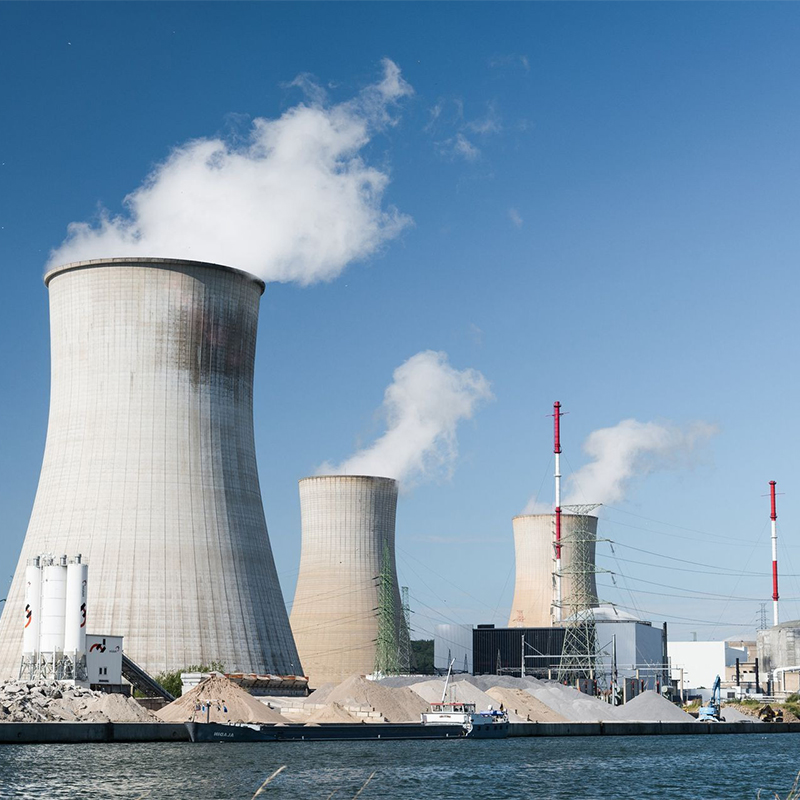
We Provide Cooling Tower Solution

Views: 0 Author: Cindy Publish Time: 2026-10-26 Origin: Site


A reliable cooling system is essential for factories, commercial buildings, and industrial processes that generate heat. When equipment runs continuously, excess heat must be removed to maintain stable temperatures, protect machinery, and support efficient production. This is where a round cooling tower can make a difference.
A round cooling tower is a type of cooling equipment designed to remove heat from circulating water by bringing the water into contact with moving air. Its circular structure, integrated water distribution system, and mechanical ventilation make it suitable for many applications, from air-conditioning systems to manufacturing processes.
But how does a round cooling tower actually work? Which specifications matter when choosing a model? And how can you avoid buying a unit that is too small, too large, or unsuitable for your operating conditions?
In this guide, we will explain the introduction, working principle, main components, technical specifications, advantages, applications, and selection criteria for round cooling towers. We will also introduce Mach Industry (Zhejiang) Co., Ltd., a cooling tower manufacturer. Visit the official website at www.machcooling.com to learn more about its cooling tower products and solutions.
A round cooling tower is a mechanical cooling device with a generally circular outer casing. It removes heat from circulating water by bringing the water into contact with air. During this process, a small portion of the water evaporates, carrying heat away from the remaining water. The cooled water is then collected and returned to the equipment or process that requires cooling.
Round cooling towers are commonly used in HVAC systems, injection molding plants, plastic processing facilities, metalworking operations, and other industrial environments. Their capacity and configuration depend on the heat load, circulating-water flow rate, local weather conditions, and required cooling-water temperature.
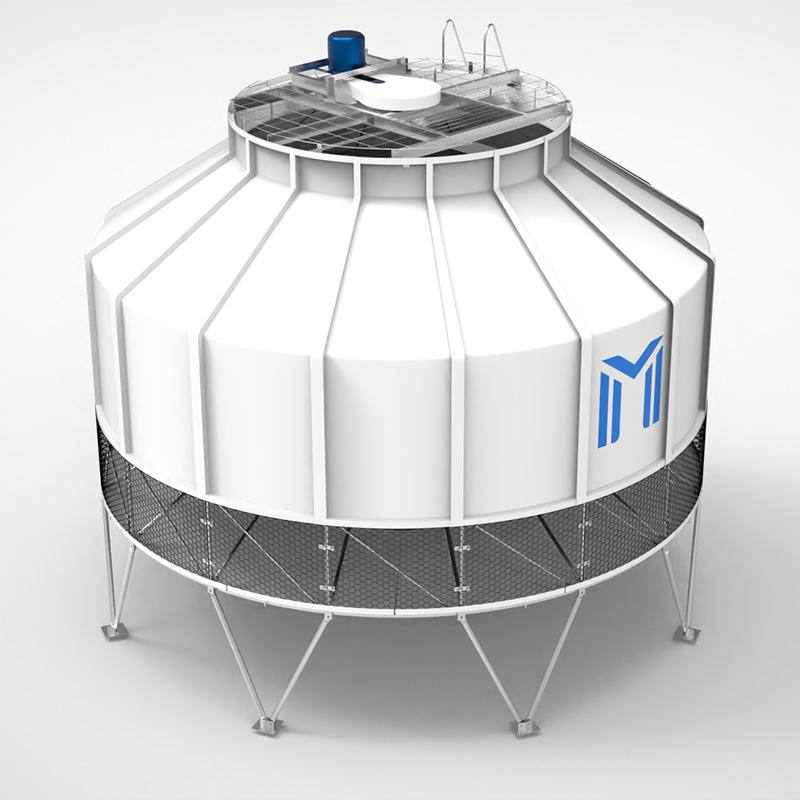
In a conventional open-circuit round cooling tower, the circulating water comes into direct contact with air. Other cooling tower designs use a heat-transfer coil to keep the process fluid separate from the outside air. Understanding this distinction is important when selecting equipment for a specific application.
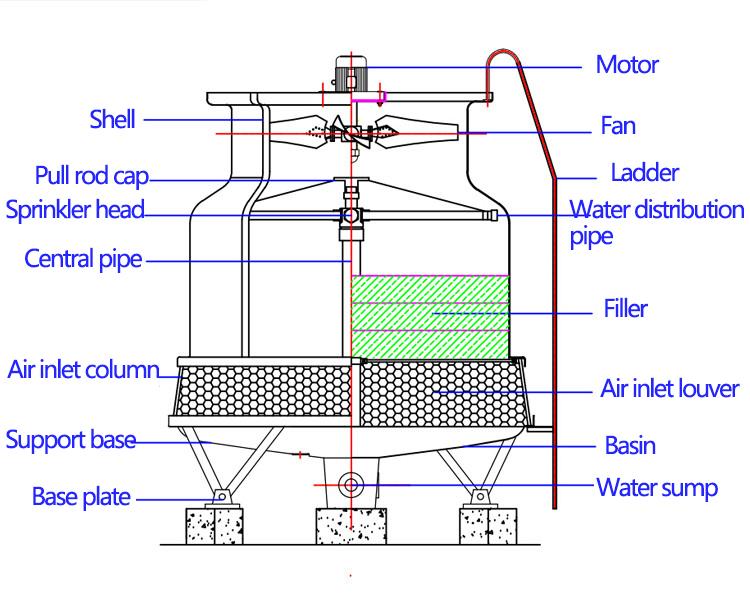
The most recognizable feature of a round cooling tower is its circular casing. Inside, several components work together to complete the cooling process, including the fan, water distribution system, fill media, drift eliminators, and water collection basin.
Many small and medium-capacity models use a compact, factory-assembled design. This can simplify transportation and installation, depending on the unit's size and the conditions at the installation site.
A typical round cooling tower may include:
A circular casing and supporting structure
A fan and motor assembly
A water inlet and distribution system
Cooling tower fill media
Drift eliminators
A water collection basin
Water outlet and makeup-water connections
The materials and arrangement vary by model. Some units use fiberglass-reinforced plastic (FRP) casings, while internal components may include PVC fill, corrosion-resistant hardware, and other materials selected for the operating environment.
However, a circular shape alone does not guarantee high cooling efficiency. Fan performance, fill design, water distribution, and thermal sizing are equally important.
The main difference between round and square cooling towers is their physical layout. Round towers are commonly found in compact packaged systems, while square or rectangular towers are often used for larger installations, modular systems, and projects that may require multiple cooling cells.
A round cooling tower may be a practical option when space is limited and a relatively straightforward installation is preferred. A square cooling tower may offer greater flexibility for arranging multiple units or integrating equipment into a larger industrial cooling system.
Neither design is automatically more efficient. A fair comparison should consider cooling capacity, water flow, entering- and leaving-water temperatures, ambient wet-bulb temperature, fan power, water consumption, noise, maintenance access, and total installed cost.
The best choice is the one that meets the project's thermal requirements while fitting the available space and operating budget.
The working principle of a round cooling tower is based on evaporative cooling and heat transfer between water and air.
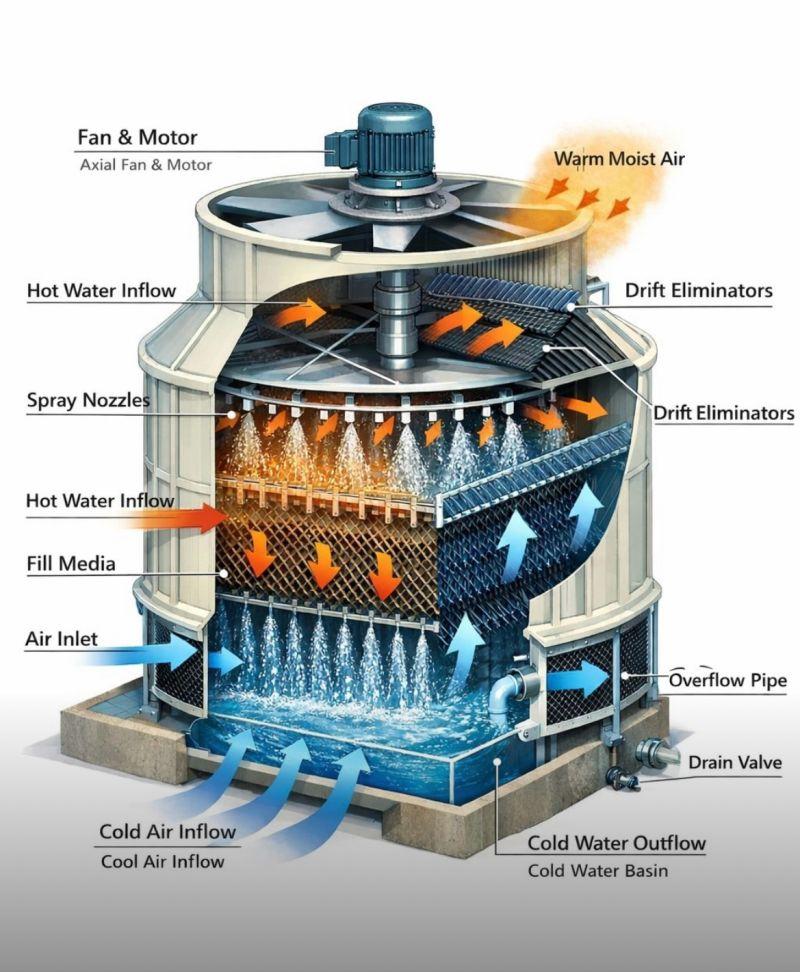
Hot water enters the tower and passes through a distribution system that spreads it over the fill media or another heat-transfer surface. A fan moves air through the tower, encouraging heat and moisture transfer. The cooled water then collects in the basin and returns to the equipment or process.
Think of the process as a continuous exchange: hot water gives up heat, moving air carries that heat away, and the remaining water becomes cooler.
The cooling effect depends on the tower's design and operating conditions, especially the entering-water temperature, leaving-water temperature, water flow rate, and ambient wet-bulb temperature.
Water heated by an industrial process, chiller condenser, or other equipment flows into the cooling tower through the hot-water inlet pipe.
The temperature of the water entering the tower is known as the entering-water temperature. This value is one of the most important parameters used to select a cooling tower.
The inlet pipe must be properly sized to handle the required flow without excessive pressure loss. If the flow rate is too low, the system may not transfer enough heat. If the water distribution is uneven, some areas of the fill may receive too much water while others remain underused.
For reliable performance, the water flow rate should match the cooling system's actual requirements.
After entering the tower, hot water passes through spray nozzles or another distribution arrangement. It then flows over the fill media, which increases the effective contact area between water and air.
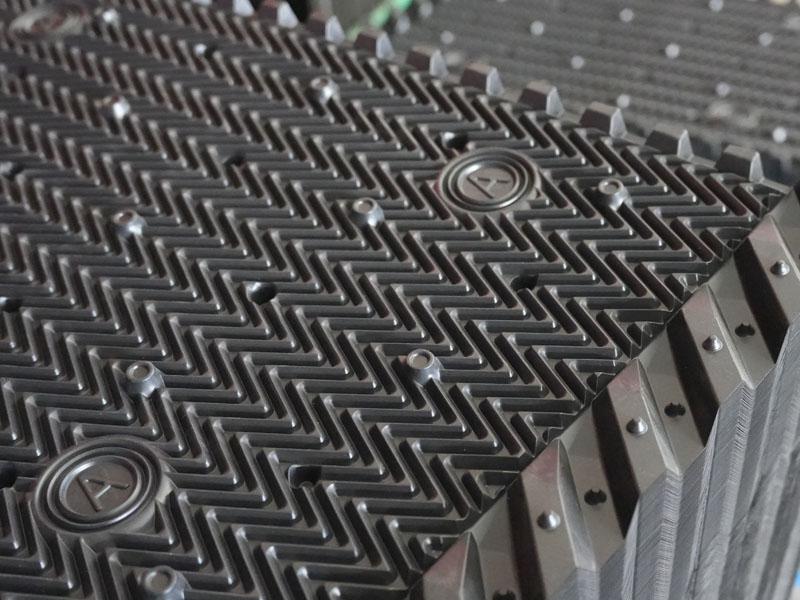
Fill media is an essential component because it helps spread water into thin films or smaller streams. This improves heat and mass transfer, allowing the tower to remove heat more effectively within a compact structure.
PVC film fill is widely used when water quality is suitable. Splash fill or other materials may be more appropriate for applications with higher suspended-solids levels or greater fouling risks.
Choosing the right fill is important. If the fill becomes clogged with scale, sludge, or biological growth, airflow and water distribution may deteriorate, reducing cooling performance and increasing maintenance requirements.
As air moves through the tower, it contacts the water flowing over the fill media. Some heat transfers directly from the water to the air, while a portion of the water evaporates. This evaporation removes heat from the remaining water and provides much of the cooling effect in a conventional evaporative cooling tower.
The fan maintains the airflow needed for the designed thermal performance. Fan size, speed, blade design, motor power, and control method can all affect energy consumption and noise.
If airflow is restricted by debris, a damaged fan, or an unsuitable installation layout, the tower may struggle to achieve its target outlet-water temperature.
Ambient conditions also matter. In particular, the wet-bulb temperature helps establish the practical lower limit for evaporative cooling. Under ordinary operating conditions, a cooling tower cannot cool water below the entering-air wet-bulb temperature.
This is why a tower that performs well in a cool, dry climate may deliver warmer outlet water in a hot, humid environment.
After losing heat, the water falls into the collection basin at the bottom of the tower. From there, it flows back to the connected process equipment or condenser, where it absorbs heat again.
This creates a continuous circulation loop: the process heats the water, the cooling tower removes heat, and the cooled water returns to the system.
As water evaporates, dissolved minerals remain in the circulating water. Makeup water replenishes the volume lost through evaporation, drift, and blowdown.
A suitable water-treatment program helps control scale, corrosion, and biological growth. Without proper water management, deposits can accumulate on the fill, nozzles, and other wetted components, reducing efficiency and increasing operating costs.
Although round cooling towers vary in size and configuration, most mechanical-draft models share several essential components. Each component contributes to cooling performance, water conservation, or reliable operation.
Understanding these parts makes it easier to evaluate a manufacturer's quotation and compare different models.
The fan moves air through the cooling tower, while the motor provides the mechanical power needed to drive it. Depending on the design, the fan may be mounted above the tower or positioned near the air inlet.
Many common round packaged cooling towers use an induced-draft arrangement, with the fan near the top of the unit. Other configurations are possible depending on the product design.
When comparing fan systems, check the airflow, motor power, rotational speed, noise level, and maintenance requirements. Variable-speed control may help reduce energy consumption when the cooling load changes, provided the equipment is designed to support it.
The fan and motor should also be suitable for the expected humidity, temperature, and operating environment.
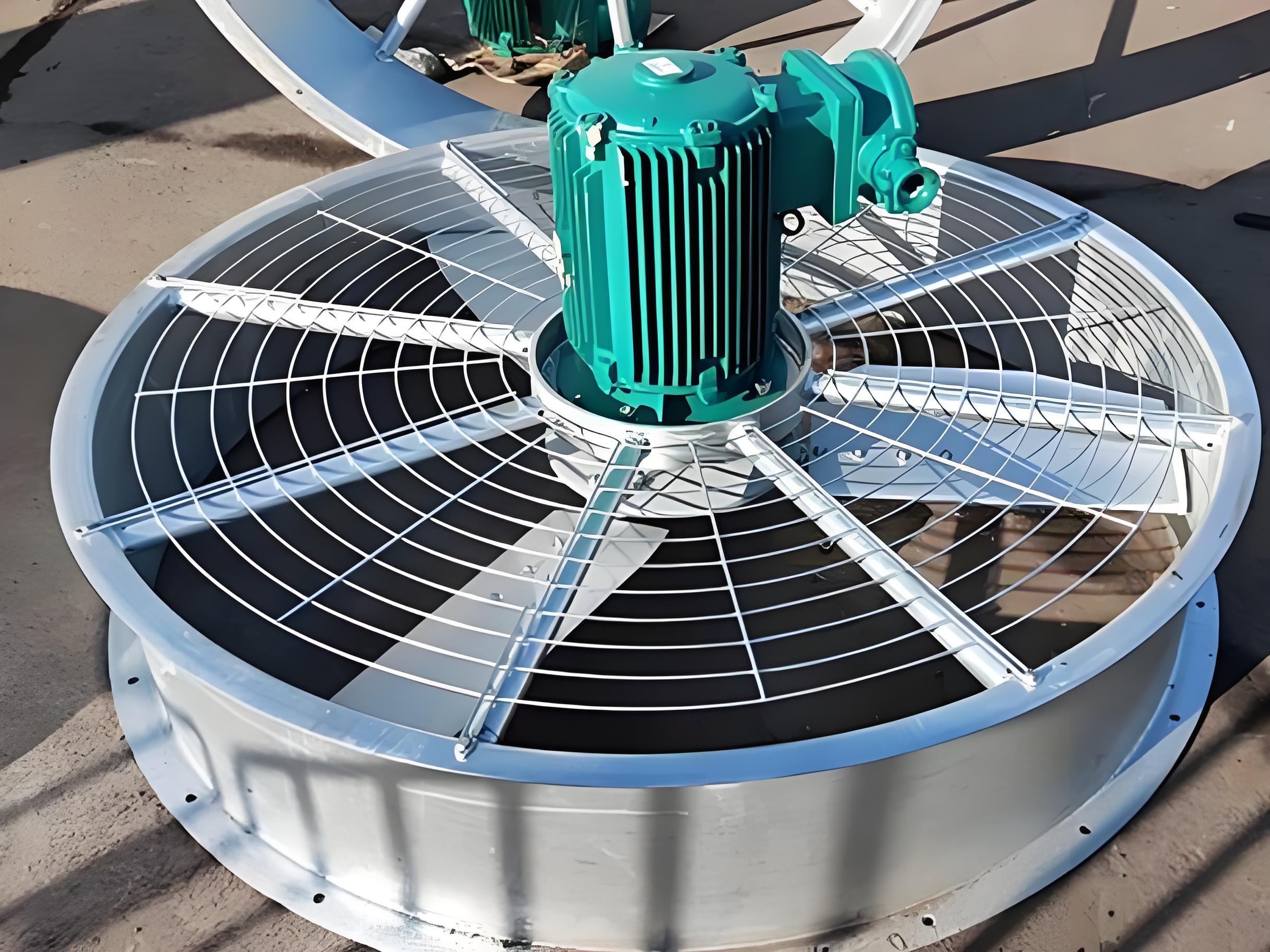
The water distribution system carries hot water from the inlet pipe to the spray nozzles or distribution outlets. Its purpose is to spread water evenly across the fill media so that the available heat-transfer surface is used effectively.
Blocked nozzles, damaged piping, or uneven distribution can reduce the tower's performance. Some sections of the fill may receive too little water, while other sections experience excessive flow.
Regular inspection and cleaning help maintain consistent water distribution and prevent avoidable performance losses.
Fill media increases the contact area between water and air. Film fill encourages water to spread across thin surfaces, while splash fill breaks water into droplets as it moves through the tower.
Both designs support heat transfer, but their suitability depends on the application.
Film fill can provide strong heat-transfer performance when water quality is suitable. Splash fill may be more practical where suspended solids or fouling risks make narrow passages difficult to maintain.
The final selection should consider water quality, operating temperature, maintenance capabilities, and the manufacturer's recommendations rather than price alone.
Drift eliminators capture water droplets carried by moving air. They reduce water loss through droplet discharge and help limit the release of circulating-water droplets into the surrounding area.
They do not eliminate evaporation, which is a normal part of the cooling process.
The water collection basin gathers cooled water and supplies it back to the circulation system. It should support reliable pump operation and appropriate water-level control.
Sediment, debris, and biological growth can accumulate in the basin, so regular inspection and cleaning are important for maintaining water quality and reliable operation.
Round cooling tower specifications describe the equipment's expected performance and installation requirements. A product's nominal capacity alone is not enough to determine whether it will work for a particular project.
Two towers with similar stated capacities may perform differently under different water temperatures, flow rates, and ambient conditions. Always check the conditions behind the manufacturer's performance rating.
Cooling capacity indicates the amount of heat a tower can reject under specified operating conditions. It may be expressed in kilowatts (kW), refrigeration tons, or other units.
Water flow rate is commonly expressed in cubic meters per hour (m³/h), liters per second (L/s), or gallons per minute (GPM). The required flow depends on the heat load and the temperature difference between the entering and leaving water.
When selecting a tower, confirm:
Required heat rejection
Entering-water temperature
Target leaving-water temperature
Circulating-water flow rate
Design ambient wet-bulb temperature
A tower that cannot handle the required heat load may deliver water that is too warm for the connected equipment. Conversely, an unnecessarily oversized tower may increase the initial investment and create control or operating challenges.
The goal is to match the tower's rated performance to the real application.
Overall height, diameter, service clearance, inlet and outlet sizes, and connection locations all affect installation.
Confirm that the tower can fit into the planned area, including enough space for lifting, piping, electrical connections, airflow, and future maintenance.
Materials should match the operating environment. Fiberglass-reinforced plastic, galvanized steel, stainless steel, PVC, and other materials may be used for different components depending on the model and application.
Corrosion resistance is particularly important in coastal locations, industrial atmospheres, or systems with challenging water chemistry.
Fan motor power, supply voltage, frequency, and control method should also be confirmed. A larger motor does not automatically mean better cooling performance. The fan must be matched to the airflow and pressure requirements of the complete tower.
Before requesting a quotation, prepare the following project information:
Cooling duty: Required heat rejection in kW or refrigeration tons.
Water flow rate: Required circulation volume per hour.
Entering-water temperature: Temperature of water entering the tower.
Leaving-water temperature: Target temperature of water leaving the tower.
Design wet-bulb temperature: Local design condition for the installation site.
Tower dimensions: Available footprint, total height, and service clearance.
Fan and motor: Airflow, rated power, voltage, frequency, and control options.
Construction materials: Casing, frame, basin, fill, and other wetted components.
Water quality: Suspended solids, scaling tendency, and treatment requirements.
Site requirements: Noise limits, access, wind exposure, and local installation rules.
Providing these details helps the manufacturer recommend a model based on actual operating requirements instead of an approximate capacity label.
Round cooling towers can be categorized by airflow arrangement, fan location, and heat-transfer design. The right configuration depends on the required capacity, site conditions, water quality, and project budget.
When requesting a quotation, ask the supplier to identify the exact tower type and explain the operating conditions behind its performance rating.
In a counterflow cooling tower, air moves upward through the fill while water flows downward. The opposing directions create a countercurrent arrangement that supports heat and mass transfer.
Counterflow designs are common in packaged cooling towers and can provide a compact footprint for many applications.
However, actual performance depends on the complete design, including fill depth, airflow, water distribution, and fan selection. It is also important to confirm whether the chosen model is suitable for the site's water quality and cleaning capabilities.
These terms describe how the fan moves air through the tower.
In an induced-draft cooling tower, the fan is usually located near the air discharge, often at the top, and pulls air through the unit. In a forced-draft cooling tower, the fan is typically positioned near the air inlet and pushes air into the tower.
Induced-draft designs are widely used because the discharge arrangement can help move warm, moist air away from the air intake. Forced-draft designs may be suitable for certain layouts or equipment arrangements.
Neither configuration is universally best. Evaluate airflow, recirculation risk, energy use, noise, and maintenance needs for the specific installation.
Round cooling towers offer several potential benefits for suitable applications.
Compact layout: Many round packaged models are designed to occupy a relatively small footprint, which can help where installation space is limited.
Integrated construction: Factory-assembled units can simplify transportation planning, installation, and connection to existing water systems, depending on the model and site conditions.
Continuous heat rejection: When correctly selected and maintained, a round cooling tower can provide reliable cooling for equipment that generates heat throughout the working day.
Flexible applications: Different capacities, materials, fan arrangements, and fill options allow round towers to serve a range of commercial and industrial systems.
Serviceable components: Fans, motors, nozzles, fill media, and drift eliminators can generally be inspected and maintained according to the equipment design.
Keep in mind that these benefits are not guaranteed by the circular shape alone. Actual performance and operating costs depend on model selection, installation, water treatment, and maintenance.
Round cooling towers are used in systems where heat must be removed from circulating water.
In commercial buildings, they may support water-cooled air-conditioning and chiller systems. In manufacturing plants, they can help cool process equipment and recirculating water loops.
Typical applications include:
Plastic processing: Cooling injection molding machines, extrusion lines, and auxiliary equipment.
HVAC systems: Rejecting condenser heat from water-cooled chillers in suitable building systems.
Metalworking: Supporting cooling for selected machining and production processes.
Industrial equipment: Removing heat from machinery, compressors, and compatible equipment.
General manufacturing: Maintaining process-water temperatures within specified operating limits.
The tower must be selected for the actual heat load and operating environment. Some applications may require corrosion-resistant materials, enhanced filtration, splash fill, or a closed-circuit arrangement.
Where the process fluid must remain isolated from ambient air, confirm whether an open-circuit round cooling tower is appropriate or whether a closed-circuit cooling solution would better meet the process requirements.
Choosing a round cooling tower involves more than matching a product name to a capacity figure. A suitable model must meet the required thermal duty, fit the installation site, work with the available water quality, and remain practical to operate and maintain.
Start by determining how much heat the system must remove. Establish the required water flow rate, entering- and leaving-water temperatures, and design wet-bulb temperature for the installation site.
These values form the basis for thermal selection.
Do not assume that a tower rated for a particular number of refrigeration tons will always deliver the same outlet-water temperature. Its performance rating depends on the specified flow, temperature range, and ambient conditions.
If the actual wet-bulb temperature is higher than the design value, the tower may deliver warmer water.
For processes with changing loads, explain the expected minimum, normal, and peak operating conditions to the manufacturer. This information helps determine whether variable-speed control, a different capacity, or a more flexible system design is appropriate.
Water quality directly affects fill selection, maintenance frequency, and operating reliability.
High levels of suspended solids can block narrow passages in some film fills. Scaling and biological growth can reduce heat-transfer performance, while unsuitable water chemistry can damage metallic components.
Before choosing a tower, discuss filtration, blowdown, makeup water, chemical treatment, and routine cleaning.
If the water contains significant debris or the process has a high fouling risk, ask whether splash fill or another suitable configuration would be more practical.
Also consider the operating temperature range, outdoor exposure, seasonal conditions, and any special process requirements. A design that works well in one factory may not be the best option for another site.
A cooling tower needs more than enough room for its base. The installation layout must allow for airflow, water piping, electrical connections, lifting operations, and safe maintenance.
Nearby walls or other equipment may restrict airflow and increase the risk of warm discharge air returning to the intake. This can affect cooling performance, particularly in confined installations.
Noise can also be important when a tower is installed near offices, residential areas, or noise-sensitive production spaces. Ask for relevant sound data and discuss suitable noise-reduction measures if needed.
Finally, confirm that technicians can safely reach the fan, motor, nozzles, fill media, drift eliminators, and basin. Good maintenance access can reduce service time and help prevent minor issues from becoming expensive problems.
Correct installation helps a round cooling tower operate as intended.
Install the unit on a suitable, level support structure designed for its operating weight and site conditions. Follow the manufacturer's requirements for clearances, anchoring, piping, electrical connections, and vibration control.
Before starting the system, inspect the basin, water distribution components, fan assembly, motor, and electrical protection. Confirm that the water flow is correct and that the fan rotates in the intended direction. Commissioning should follow the manufacturer's procedures and applicable site safety requirements.
During operation, regularly check:
Water levels and makeup-water operation
Fan and motor condition
Unusual vibration or noise
Water distribution and nozzle condition
Signs of leakage or corrosion
Fill media for scale, sludge, and biological growth
Water quality and treatment performance
Clean strainers and nozzles as needed, and inspect the fill according to the operating environment and manufacturer's recommendations. Maintain an appropriate water-treatment program to help control scaling, corrosion, and biological growth.
Always isolate electrical power and follow applicable lockout/tagout procedures before servicing moving or energized equipment. Maintenance should be performed by qualified personnel using the correct procedures and protective equipment.
Even a well-designed cooling tower can experience operating problems if water quality, airflow, or maintenance is not properly managed.
Possible causes include excessive heat load, insufficient airflow, incorrect water flow, blocked fill, poor water distribution, or a higher-than-design wet-bulb temperature.
Check operating data before assuming the tower is undersized. Comparing current conditions with the original design values can help identify the real cause.
Inspect for loose fasteners, damaged blades, imbalance, worn bearings, or alignment problems. Stop the equipment and follow safe isolation procedures before inspection.
Unusual vibration should not be ignored because it may indicate a mechanical issue that could worsen if the equipment continues running.
Check for excessive drift, leaks, overflow, and incorrect blowdown settings. Evaporation is a normal part of cooling, so the goal is to control avoidable water losses rather than eliminate evaporation entirely.
The water-treatment and makeup-water systems should also be reviewed if consumption changes significantly.
Deposits, biological growth, and suspended solids can restrict airflow or interfere with water distribution.
Review the water-treatment program and cleaning procedures, and determine whether the existing fill material is suitable for the water quality. If clogging occurs repeatedly, the fill configuration or pretreatment strategy may need to be reassessed.
Check whether the construction materials are compatible with the water chemistry and surrounding environment. Replace damaged components with suitable parts and address the underlying cause wherever possible.
A structured inspection is more useful than replacing components at random. Recording temperatures, flow rates, vibration, and maintenance findings can help identify changes in performance early.
Selecting the right cooling tower manufacturer is an important part of a successful project. A useful supplier should understand the required cooling duty, operating conditions, installation limitations, and maintenance expectations—not simply offer a model based on nominal capacity.
Mach Industry (Zhejiang) Co., Ltd. provides a starting point for buyers researching cooling tower equipment and cooling solutions. Visit the official website at https://www.machcooling.com to review available products and contact the company about your project requirements.
When discussing a round cooling tower with Mach, prepare the required water flow, entering- and leaving-water temperatures, design wet-bulb temperature, site dimensions, water-quality information, and electrical requirements.
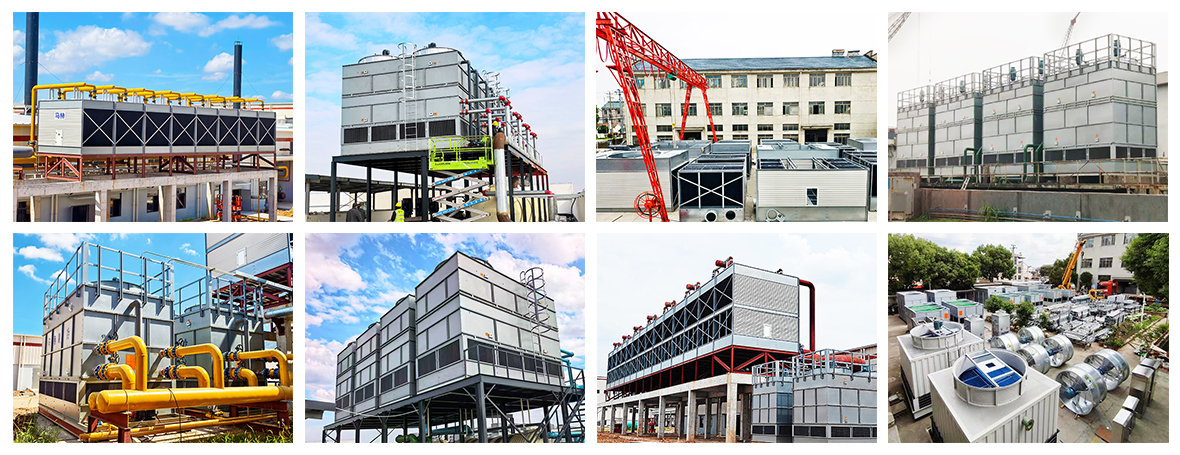
These details help the supplier assess the application and determine a suitable configuration.
Before placing an order, request the technical datasheet, performance conditions, material details, installation requirements, and recommended maintenance procedures for the proposed model. Make sure any capacity, efficiency, noise, or compliance claims are supported by documentation relevant to the exact unit being offered.
A well-matched cooling tower can support stable process temperatures, reliable equipment operation, and manageable maintenance costs over its service life.
A round cooling tower removes heat from circulating water in applications such as HVAC systems, manufacturing processes, plastic processing, and selected industrial equipment. Its suitability depends on the heat load and operating conditions.
Hot water is distributed over fill media or another heat-transfer surface while air moves through the tower. Heat transfers to the air, and evaporation removes additional heat from the remaining water. The cooled water is collected and returned to the system.
Review cooling capacity, water flow rate, entering- and leaving-water temperatures, design wet-bulb temperature, tower dimensions, fan and motor power, construction materials, noise, water connections, and maintenance access.
Not in every situation. Round towers may suit compact packaged installations, while square or rectangular designs can be useful for larger or modular systems. Compare actual performance, installation footprint, service requirements, and lifecycle cost before deciding.
There is no single schedule that fits every tower. Inspection and cleaning frequency depends on water quality, operating hours, environmental conditions, and the manufacturer's guidance. Regular checks help identify deposits, blocked nozzles, and biological growth before they significantly affect performance.
Yes. PVC film fill is used in many cooling towers, including suitable round designs. However, it is not ideal for every water condition. Suspended solids, scaling potential, operating temperature, and cleaning capability should be considered before selecting the fill.
Provide the required heat load, water flow, entering- and leaving-water temperatures, local design wet-bulb temperature, site dimensions, water-quality details, and power supply information.
You can visit www.machcooling.com to contact Mach Industry (Zhejiang) Co., Ltd. and discuss your project requirements.
A round cooling tower is a practical option for many commercial and industrial cooling applications. Its circular structure can support a compact installation, while the fan, water distribution system, fill media, and collection basin work together to remove heat from circulating water.
The key to choosing the right model is understanding the complete operating conditions. Cooling capacity, water flow, temperature range, wet-bulb temperature, water quality, materials, fan power, noise, and maintenance access all matter.
A tower that matches these factors is more likely to provide dependable cooling and manageable operating costs over its service life.
If you are evaluating a round cooling tower for a new project or a replacement system, prepare your operating data and confirm the performance conditions with the supplier. For product information and project discussions, visit Mach Industry (Zhejiang) Co., Ltd. at https://www.machcooling.com.