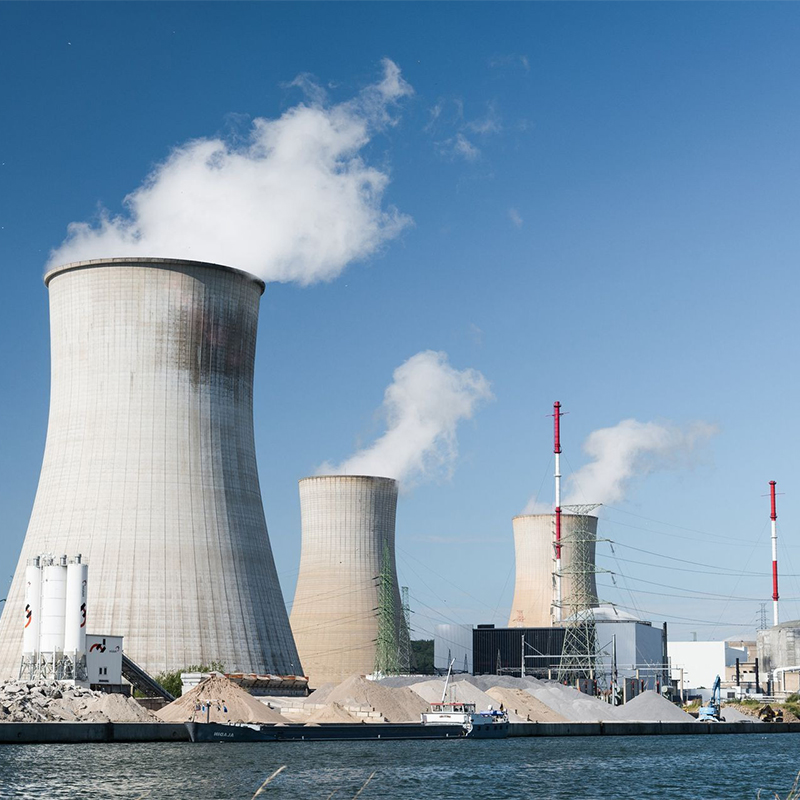
We Provide Cooling Tower Solution

Views: 0 Author: Cindy Publish Time: 2026-10-21 Origin: Site


Industrial processes generate heat every day. CNC machines, laser equipment, injection molding machines, compressors, hydraulic systems, and industrial chillers all need reliable ways to remove excess heat. If that heat builds up, equipment can overheat, production quality may decline, and unexpected shutdowns can become expensive.
Not every facility needs a huge cooling tower. For a small factory, a pilot production line, or a single piece of industrial equipment, a small scale cooling tower for industrial process waste heat dissipation can be a practical solution.
Think of a cooling tower as the heat-release point of your industrial process. It receives heated circulating water, transfers heat to the surrounding air, and returns cooler water to the system. When correctly selected, it helps maintain stable operating temperatures without requiring an oversized cooling installation.
But how do you choose the right unit? What cooling capacity do you need? And should you use an open-circuit or closed-circuit design?
This guide answers these questions and explains how to select, install, and maintain a small industrial cooling tower for dependable long-term operation.
A small scale cooling tower is a compact heat-rejection device designed to cool circulating water in industrial or commercial applications. Compared with large central cooling towers, it typically serves a smaller heat load, a limited production area, or a dedicated process loop.
There is no single universal capacity threshold that defines a small cooling tower. Its appropriate size depends on the heat load, required water temperatures, ambient conditions, operating schedule, and system configuration.
For example, a small manufacturing workshop may need cooling for one injection molding machine, while a laboratory may require stable cooling for testing equipment. Both can benefit from a compact cooling solution, but their temperature requirements and operating patterns may be very different.
Most conventional small cooling towers use evaporative cooling. Warm process water enters the tower and spreads over fill media or another heat-transfer surface. A fan moves air through the unit, allowing heat to transfer from the water to the air.
A small portion of the circulating water evaporates, carrying away latent heat. The remaining water cools and collects in the basin before returning to the process.
The basic operating sequence is straightforward:
Industrial equipment generates heat.
A heat exchanger transfers that heat to circulating water.
Warm water enters the cooling tower.
Airflow and evaporation remove heat.
Cooler water returns to the process equipment.
This cycle continues while the cooling system operates.
Although designs vary, most small industrial cooling towers include several key components.
Fill media: Increases the contact area between water and air to improve heat transfer.
Fan and motor: Provide the airflow required for cooling.
Water distribution system: Spreads water across the fill or heat-transfer surfaces.
Cold-water basin: Collects cooled water and supplies the circulating pump.
Drift eliminator: Reduces the amount of liquid water carried out with exhaust air.
Casing and support structure: Protect internal components and provide mechanical support.
Water connections and controls: Support circulation, makeup water, level management, and operation.
A compact tower should not be judged by size alone. The quality of its components, ease of maintenance, and suitability for the application all influence performance.
Industrial waste heat is thermal energy generated during production that must be removed to keep equipment operating within its required temperature range. In many water-cooled systems, the heat is transferred into circulating water and then rejected through a cooling tower.
Small industrial cooling towers are useful in many applications, including:
Plastic injection molding and extrusion
CNC machining and machine-tool cooling
Laser cutting and welding equipment
Air compressors and hydraulic systems
Industrial refrigeration and chiller condensers
Food and beverage processing
Chemical production and laboratory equipment
Power electronics and selected energy systems
Different processes produce different heat loads. Some equipment operates continuously, while other machines produce short bursts of heat during production cycles.
This distinction matters. A cooling tower selected for a steady load may perform differently when the heat load changes rapidly. Engineers should consider peak heat generation, typical operating load, startup conditions, and future production requirements.
Excessive process temperature can affect product dimensions, machine accuracy, lubricant performance, and equipment service life. In temperature-sensitive applications, even modest fluctuations can cause quality problems.
Reliable heat rejection also helps protect upstream and downstream equipment. For example, a cooling tower serving a water-cooled chiller must reject the heat collected by the condenser, not just the cooling load delivered to the building or process.
In simple terms, the cooling tower is part of a connected system. If it cannot remove enough heat, the entire system may struggle to maintain its target temperature.
The right cooling tower configuration depends on water quality, process sensitivity, space constraints, and maintenance preferences.
An open-circuit cooling tower allows circulating water to contact the air directly. Warm water passes through the tower's distribution system and fill, where evaporation and heat transfer cool it.
Advantages:
Effective evaporative cooling
Relatively simple construction
Broad availability of compact configurations
Potentially attractive initial equipment cost
However, direct air-water contact means the circulating water can collect airborne dust and debris. Water treatment is essential to control scale, corrosion, and biological growth.
Open-circuit towers are often suitable when the process can tolerate a properly managed open cooling-water loop.
A closed-circuit cooling tower passes the process fluid through a coil or heat exchanger. Water sprayed over the outside of the coil evaporates and removes heat, while the process fluid remains inside the closed circuit.
This arrangement reduces direct exposure of the process fluid to the atmosphere and may help maintain cleaner process-side conditions.
Closed-circuit designs can be attractive for equipment with sensitive water quality requirements, specialized process fluids, or a strong need to isolate the process loop.
However, they generally have a different equipment configuration and may involve higher initial costs. Their actual performance depends on the coil design, airflow, spray system, and operating conditions.
Counterflow and crossflow describe how air moves relative to the water.
In a counterflow cooling tower, air moves generally opposite to the falling water. This arrangement can provide a compact footprint, depending on the design.
In a crossflow cooling tower, air moves across the water's direction of travel. Some crossflow designs offer convenient access to water distribution components and internal sections.
Neither configuration is automatically better for every application. Compare thermal performance, installation space, noise, maintenance access, and operating cost under the conditions that matter to your facility.
A small scale cooling tower can serve a dedicated process instead of relying on a large central cooling system. This can be useful when a facility has several independent production lines or when a machine requires cooling at a different temperature from the rest of the plant.
For example, a plastics workshop may use a dedicated tower to remove heat from injection molding equipment. A machine-tool manufacturer may need cooling for spindle systems or auxiliary heat exchangers. A food processing facility may use a cooling tower as part of a larger refrigeration or process-cooling installation.
Small towers can also support pilot plants and test facilities where the heat load is limited but reliable temperature control remains important.
Before choosing a unit, confirm whether the cooling tower will serve one machine, a group of machines, a heat exchanger, or an entire process loop. This determines the heat load, pump requirements, piping layout, and control strategy.
Correct sizing is one of the most important steps in selecting a small industrial cooling tower. A unit that is too small may fail to maintain the required process temperature during hot weather. An oversized unit can increase initial cost and may operate inefficiently if its controls are not suited to variable loads.
For water-based systems, the approximate sensible heat transfer rate can be calculated using:
Q = ṁ × Cp × ΔT
Where:
Q = heat transfer rate, in kW
ṁ = water mass flow rate, in kg/s
Cp = specific heat capacity of water, approximately 4.186 kJ/(kg·°C) under typical conditions
ΔT = water temperature drop, in °C
For water, the formula can be simplified for practical estimates:
Q (kW) ≈ 1.163 × Flow (m³/h) × ΔT (°C)
This formula estimates the heat transferred by the water as it cools. For actual cooling tower selection, the manufacturer must also evaluate the tower's thermal performance at the specified entering water temperature, leaving water temperature, and ambient wet-bulb temperature.
Suppose a machine generates a heat load of 50 kW. The cooling water enters the process heat exchanger at 35°C and leaves at 40°C.
The temperature difference is:
ΔT = 40 − 35 = 5°C
The approximate required water flow is:
Flow = 50 ÷ (1.163 × 5)
Flow ≈ 8.6 m³/h
This result provides an initial estimate of the water flow required to transport 50 kW of heat across a 5°C temperature difference.
It does not mean that any cooling tower rated at 50 kW will automatically deliver the required 35°C supply water. The tower's actual selection must account for ambient wet-bulb temperature, thermal approach, system pressure losses, and the required operating conditions.
The water temperature range is the difference between the hot water entering the cooling tower and the cooled water leaving it.
For example, if water enters at 40°C and leaves at 32°C, the range is 8°C.
A larger temperature range can reduce the water flow required to transfer a given amount of heat, but the achievable temperatures depend on the process, tower design, and weather conditions.
The selected pump must deliver the required flow against the total system pressure loss. Consider the tower, piping, valves, filters, and heat exchanger when calculating pump head.
For evaporative cooling towers, ambient wet-bulb temperature is a key design condition. It reflects both air temperature and humidity and helps determine how cold the tower can realistically cool the water.
The approach temperature is the difference between the cold-water outlet temperature and the entering-air wet-bulb temperature.
For example, if the design wet-bulb temperature is 25°C and the required cold-water temperature is 30°C, the approach is 5°C.
A smaller approach generally requires more heat-transfer capability and can increase equipment size or cost. Do not select a cooling tower using only the outdoor dry-bulb temperature or a generic capacity number. Request performance data for the actual design conditions.
A good selection process starts with the application rather than the product catalogue. Define what needs to be cooled, how much heat must be removed, and which temperatures the process can tolerate.
Confirm the following information before requesting a quotation:
Required heat rejection in kW or another clearly defined unit
Hot-water inlet and cold-water outlet temperatures
Required circulating water flow
Local design wet-bulb temperature
Operating hours and load variation
Process fluid and water quality
Available installation space
Also distinguish between normal load and peak load. If a machine experiences short periods of unusually high heat generation, the system may need additional capacity, a buffer tank, or a control strategy designed for those fluctuations.
A reasonable design margin may be appropriate, but excessive oversizing is not a substitute for accurate engineering.
Water quality affects cooling tower service life and maintenance requirements. Hardness and alkalinity can contribute to scale formation, while dissolved salts and unsuitable pH conditions may accelerate corrosion.
Choose basin, coil, piping, and structural materials based on the water chemistry, environment, and expected maintenance program. Where corrosion or contamination is a concern, compare suitable materials and coatings with the manufacturer.
For evaporative systems, also plan for makeup water, blowdown, drift control, and biological management. A cooling tower does not eliminate water treatment requirements simply because the equipment is small.
A compact tower still consumes energy through its fan and associated pumps. Fan power, motor efficiency, airflow control, and pump selection all influence operating costs.
Variable-speed fan control may help match airflow to changing heat loads when the tower and control system are designed for it. However, energy savings depend on the operating profile and actual control strategy.
Noise can also matter when the tower is installed near workers, offices, laboratories, or neighboring properties. Evaluate sound data, airflow clearance, maintenance access, and discharge-air recirculation.
A small footprint is useful only if the tower has enough space around it to breathe, drain, and be serviced safely.
Even a well-selected cooling tower can underperform if it is installed incorrectly.
Place the tower on a suitable, level support structure designed for operating weight and other applicable loads. Follow the manufacturer's requirements for clearances, anchoring, lifting, electrical connections, and access.
The piping layout should support the required flow without unnecessary pressure losses. Include appropriate isolation valves, strainers where required, drains, vents, makeup water connections, and instrumentation. Confirm that the pump can maintain the required operating conditions.
Pay particular attention to air intake and discharge. If hot, humid discharge air returns to the inlet, cooling performance may decline. Nearby walls, roof structures, exhaust outlets, and other equipment can influence airflow.
Before commissioning, check rotation where applicable, fan guards, electrical protection, water distribution, leakage, basin level controls, and pump operation. Verify performance against the approved design conditions rather than relying on a brief visual inspection.
Regular maintenance helps a small cooling tower operate efficiently and reduces the risk of unexpected downtime.
A practical maintenance plan should include:
Inspecting and cleaning fill media as needed
Checking the fan, motor, belts, bearings, and vibration
Inspecting spray nozzles and water distribution
Removing sediment from the basin
Checking strainers, drains, and makeup water controls
Monitoring water treatment and blowdown
Inspecting corrosion, leakage, and damaged components
The exact interval depends on operating hours, water quality, ambient contamination, and manufacturer recommendations.
If the tower delivers warmer water than expected, investigate several possible causes. Insufficient airflow, dirty fill, blocked nozzles, excessive heat load, poor water distribution, and high ambient wet-bulb temperature can all affect performance.
If water consumption increases unexpectedly, inspect for leaks, excessive drift, overflow problems, and incorrect level control. If fan noise or vibration increases, check for imbalance, loose fasteners, bearing wear, or mechanical damage.
Do not assume every cooling problem requires a larger tower. Accurate diagnosis can reveal a maintenance or control issue that is easier and less expensive to correct.
Several avoidable mistakes can make a small industrial cooling tower more expensive or less effective than expected.
Choosing by nominal capacity alone: Capacity ratings are meaningful only when the associated water temperatures, flow rate, and wet-bulb conditions are known.
Ignoring peak heat load: A unit sized for average conditions may struggle during periods of high production demand.
Underestimating water treatment: Scale, corrosion, and biological growth can reduce performance and increase maintenance costs.
Overlooking installation clearances: Restricted airflow and hot-air recirculation can undermine thermal performance.
Focusing only on purchase price: Electricity, water, maintenance, downtime, and replacement components all contribute to lifecycle cost.
Failing to consider service access: A compact design should still allow technicians to inspect and maintain critical components safely.
A well-prepared specification helps suppliers compare suitable solutions and reduces the chance of costly changes after installation.
A cooling tower is not always the best choice for every process. Comparing alternatives helps determine which technology fits your requirements.
An air-cooled heat exchanger rejects heat directly to ambient air without the evaporative cooling process used by conventional wet cooling towers. It can reduce water consumption, but its performance may be limited when ambient air is hot or when a low outlet temperature is required.
A chiller uses a refrigeration cycle to provide controlled chilled water, including temperatures below the ambient wet-bulb temperature. However, it requires additional equipment and electrical energy to operate the refrigeration system.
A small evaporative cooling tower can provide effective heat rejection where water is available and the process can operate at temperatures determined by the local wet-bulb condition and tower approach.
In some systems, a cooling tower and chiller work together: the tower rejects condenser heat while the chiller provides the required process cooling. These technologies serve different purposes, so compare them according to the complete process requirement rather than treating them as interchangeable products.
Working directly with an experienced manufacturer can help clarify the relationship between heat load, operating conditions, equipment configuration, and maintenance requirements.
A qualified supplier should be able to explain the basis of its capacity rating, identify the design conditions used for selection, and provide relevant technical documentation. Depending on its product range, it may also help with material selection, system layout, replacement requirements, and commissioning guidance.
Before placing an order, ask for the proposed model's performance conditions, water flow, fan and motor data, dimensions, operating weight, electrical requirements, and maintenance recommendations.
Clear technical communication is particularly important for small industrial projects because limited installation space or unusual process temperatures can make a standard catalogue selection unsuitable.
Mach Industry (Zhejiang) Co., Ltd. serves the industrial cooling market through its cooling tower business. For companies seeking a small scale cooling tower for industrial process waste heat dissipation, defining the application and operating conditions is the first step toward identifying an appropriate solution.
Before discussing a model, prepare the basic engineering data: required heat rejection, hot- and cold-water temperatures, water flow, local design wet-bulb temperature, available space, water quality, and expected operating schedule.
If the tower will serve a machine or a dedicated production line, also explain whether the heat load is continuous or variable. For systems with sensitive process fluid or strict cleanliness requirements, indicate whether a closed-circuit arrangement is preferred.
These details help the technical team evaluate the application and determine which equipment options may be suitable. Buyers should confirm current model availability, rated performance, material options, and service scope directly with the manufacturer.
To learn more about Mach Industry (Zhejiang) Co., Ltd. and its cooling tower solutions, visit the official website:
A reliable cooling solution begins with accurate data, clear technical communication, and equipment selected for the actual operating conditions—not simply the smallest footprint or lowest initial price.
A small scale cooling tower can be an effective solution for removing industrial process waste heat without installing an unnecessarily large cooling system. It can support manufacturing equipment, process heat exchangers, compressors, and other applications where stable water cooling is essential.
However, compact equipment still requires careful engineering. Correct capacity selection depends on heat load, water flow, temperature range, ambient wet-bulb conditions, and the required cooling-water temperature. Water quality, installation clearances, energy use, and maintenance access also affect long-term performance.
Start by calculating the process heat load and defining the required operating conditions. Then compare open-circuit and closed-circuit designs, review the manufacturer's performance data, and plan for water treatment and routine maintenance.
With a properly selected and maintained system, industrial facilities can manage waste heat more reliably, protect equipment, and support consistent production.
It removes heat from circulating water in smaller industrial processes, such as injection molding, machine tools, compressors, laser equipment, and selected heat exchanger or chiller systems.
Start by calculating the process heat load using water flow and temperature difference. Then select a tower based on the entering and leaving water temperatures and the design ambient wet-bulb temperature. Confirm the result with manufacturer performance data.
Yes. An evaporative cooling tower loses water through evaporation, drift, and blowdown. Makeup water replaces these losses. Actual consumption depends on heat load, weather, cycles of concentration, drift control, and water treatment.
An open-circuit tower allows the circulating water to contact air directly and may offer a simpler arrangement. A closed-circuit tower keeps the process fluid inside a coil, helping isolate it from direct atmospheric contamination. Choose according to process cleanliness, water quality, operating conditions, and budget.
Yes, if it is designed for the required duty and maintained according to the manufacturer's recommendations. Check the specified operating limits, fan and motor ratings, water treatment requirements, and maintenance schedule.
Possible causes include insufficient airflow, dirty fill, blocked spray nozzles, poor water distribution, excessive heat load, unsuitable water flow, or a higher-than-design ambient wet-bulb temperature.
Maintain clean fill and water distribution, manage water chemistry, select efficient fans and pumps, prevent hot-air recirculation, and use suitable controls for changing loads. Evaluate energy and water consumption together rather than optimizing one in isolation.
Visit Mach Industry (Zhejiang) Co., Ltd. at https://www.machcooling.com to review its cooling tower offerings and contact the company about your application requirements.