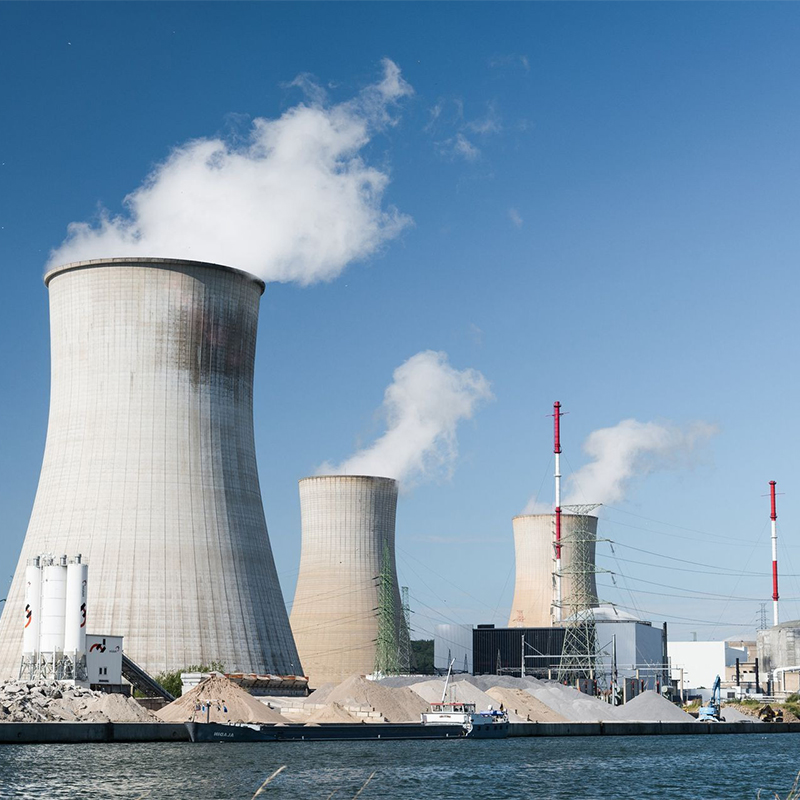
We Provide Cooling Tower Solution

Views: 0 Author: Cindy Publish Time: 2026-10-24 Origin: Site


Cooling towers play a vital role in industrial manufacturing, commercial HVAC systems, power plants, and process cooling applications. They remove excess heat from circulating water, helping equipment operate safely and efficiently. However, not all cooling towers move air in the same way. Two common designs are forced draft cooling towers and induced draft cooling towers.
Understanding the forced draft cooling tower working principle vs induced draft cooling tower is essential when choosing equipment for a new project, upgrading an existing system, or comparing cooling tower manufacturers. Although both designs use airflow and evaporation to cool water, they differ in fan location, airflow direction, air recirculation risk, maintenance requirements, and installation considerations.
So, which cooling tower is better? The answer depends on your operating conditions, available space, cooling capacity, energy targets, and maintenance requirements.
In this guide, we will explain how forced draft and induced draft cooling towers work, compare their advantages and disadvantages, and help you determine which design is right for your application.
A forced draft cooling tower uses a fan installed near the air inlet to push ambient air into the tower. The fan creates airflow through the tower's internal components, allowing air to contact the warm circulating water and support heat transfer.
Think of it like a blower pushing air through a ventilation duct. The fan supplies the force needed to move air through the system.
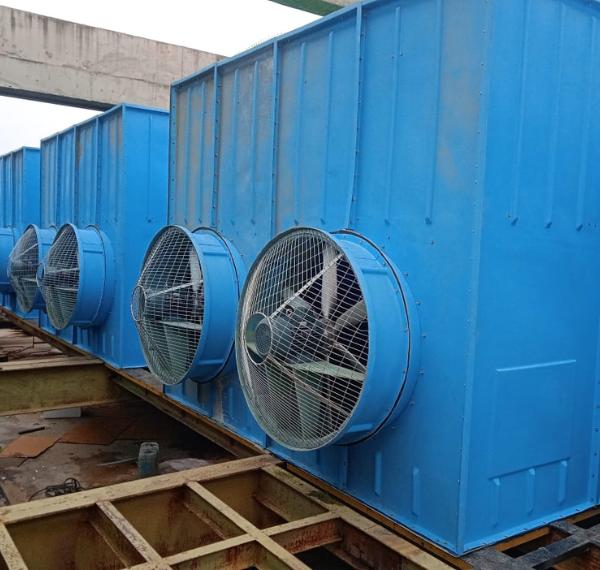
Forced draft cooling towers are available in different configurations, including compact packaged units for industrial and commercial applications. Depending on the design, they may offer convenient access to the fan and drive components, making certain maintenance tasks easier.
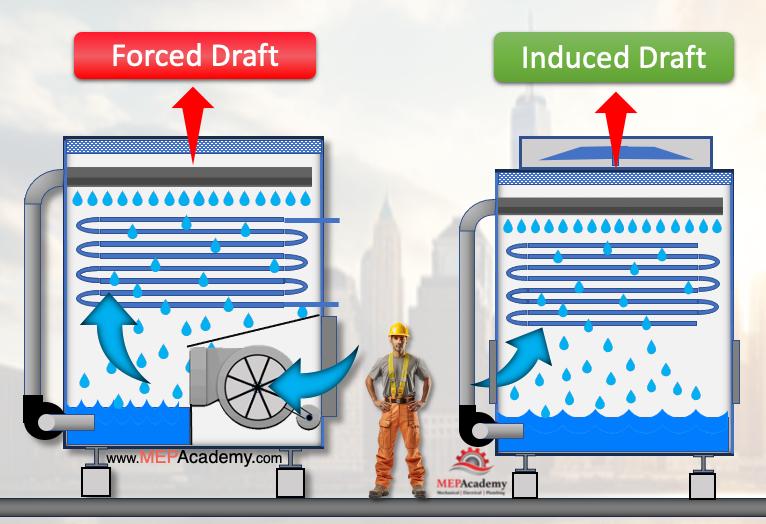
The working principle of a forced draft cooling tower involves several stages.
Step 1: Hot water enters the tower.
Water heated by a manufacturing process, chiller, condenser, or other equipment enters the cooling tower's water distribution system.
Step 2: The fan pushes air into the tower.
The fan, typically positioned near the air inlet, forces ambient air into the tower. The air then moves through the designed airflow path.
Step 3: Water spreads across the fill.
Nozzles distribute water over the cooling tower fill. The fill increases the contact area between water and air, improving heat and mass transfer.
Step 4: Evaporation removes heat.
As air moves through the wet fill, a portion of the water evaporates. This evaporation absorbs heat from the remaining water, reducing its temperature.
Step 5: Cooled water returns to the system.
The cooled water collects in the basin or outlet section and returns to the equipment that requires cooling.
The process continues as long as the cooling system operates.
Actual cooling performance depends on water flow, airflow, entering-water temperature, ambient wet-bulb temperature, fill design, and water distribution. A well-designed fan arrangement alone cannot guarantee efficient cooling.
A typical forced draft cooling tower contains several essential components:
Fan and motor: Generate the airflow required for heat rejection.
Air inlet: Allows ambient air to enter the tower.
Water distribution system: Spreads warm water across the fill.
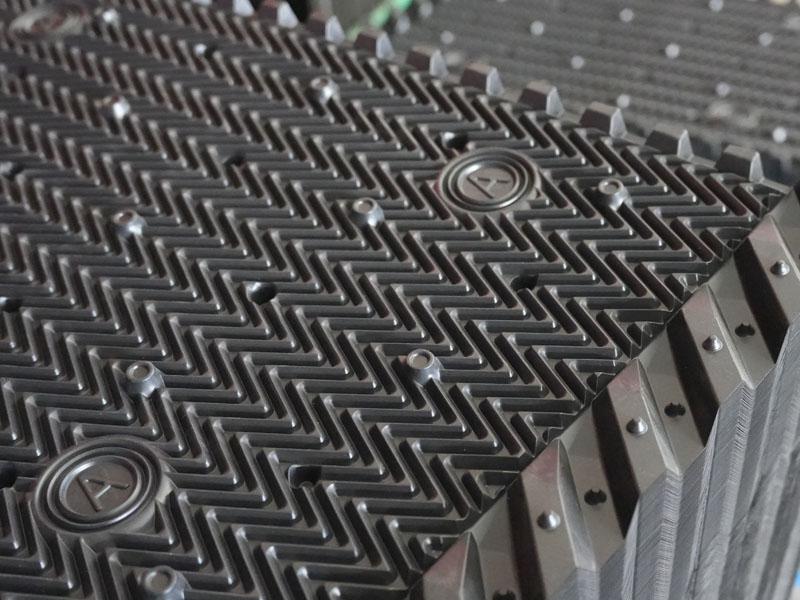
Cooling tower fill: Increases the contact area between air and water.
Drift eliminators: Reduce the amount of liquid droplets carried out with the exhaust air.
Casing and structural frame: Support and protect the internal components.
Water collection basin: Collects cooled water before it returns to the process.
Depending on the application, additional components may include louvers, vibration sensors, variable-frequency drives, access doors, and automatic control systems.
Forced draft cooling towers offer several potential benefits.
Convenient access to mechanical components: When the fan and motor are installed near ground level, inspection and servicing may be easier.
Flexible installation: Some packaged designs are suitable for compact layouts or sheltered locations.
Straightforward equipment arrangement: The fan is positioned at the inlet, which may simplify certain mechanical layouts.
Practical maintenance planning: Accessible fan and drive components can reduce the complexity of some routine maintenance tasks.
However, these advantages depend on the specific model and installation. A forced draft cooling tower is not automatically cheaper, smaller, or easier to maintain than every induced draft design.
One important consideration is air recirculation.
After passing through the tower, the exhaust air becomes warm and humid. If this air returns to the air inlet, the tower may draw in air that is less suitable for evaporative cooling.
This can increase the cold-water temperature and reduce thermal performance.
Another consideration is airflow leakage. Because the fan pushes air into the tower, some sections may operate under positive pressure. If panels or connections are poorly sealed, air can escape before passing through the intended heat-transfer area.
Fortunately, appropriate sealing, airflow design, discharge positioning, and installation clearances can help address these problems.
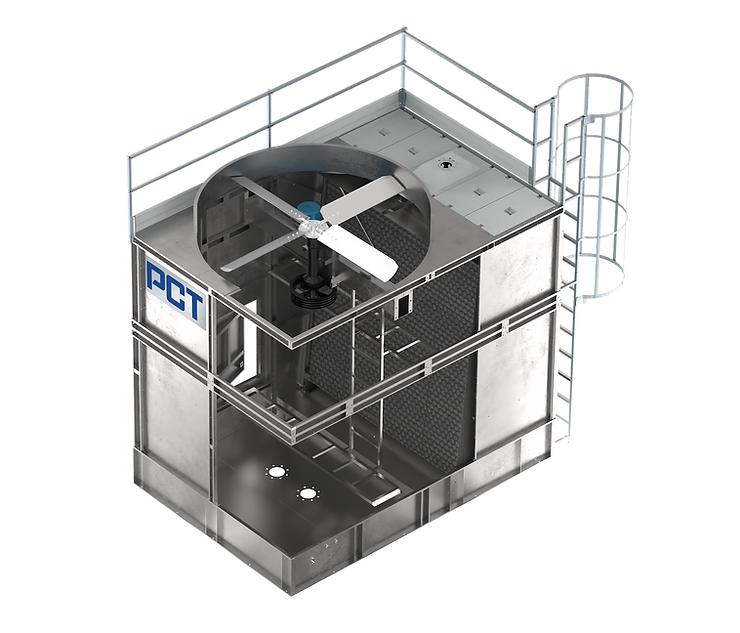
An induced draft cooling tower uses a fan near the air discharge, commonly at the top of the tower. Instead of pushing air into the unit, the fan pulls air through the tower and exhausts it into the surrounding atmosphere.
Imagine an exhaust fan removing hot air from a kitchen. The fan creates a pressure difference that draws air toward the outlet. An induced draft cooling tower uses a similar principle.
This design is widely used in industrial cooling and commercial HVAC systems because it can provide an effective airflow path through the fill and toward the discharge.
The working process follows several steps.
Step 1: Warm water enters the distribution system.
Water from the industrial process or condenser enters the tower and flows toward the distribution nozzles.
Step 2: The fan draws air through the tower.
The fan operates near the discharge and pulls ambient air through the air inlets and internal components.
Step 3: Air passes through the wet fill.
Water spreads across the fill surface while air moves through the available passages.
Step 4: Heat and moisture transfer occur.
A portion of the water evaporates, absorbing heat. The airflow carries heat and moisture away from the cooling tower.
Step 5: Cooled water returns to the process.
The cooled water collects in the basin and is pumped back to the equipment or process requiring cooling.
This continuous process allows the tower to reject heat from circulating water.
The exhaust arrangement can help reduce air recirculation when the tower is properly designed and positioned. Nevertheless, nearby buildings, wind direction, discharge velocity, and inlet clearance can still affect performance.
An induced draft cooling tower generally includes:
Fan and motor near the air discharge.
Water distribution pipes and spray nozzles.
Cooling tower fill packs.
Drift eliminators.
Air inlet louvers.
Casing and structural supports.
Water collection basin.
Fan drive components and control equipment.
Large industrial towers may also include multiple fan cells, gearboxes, vibration monitoring systems, and advanced control arrangements.
The fan must overcome the resistance created by the tower's internal components. Fill, louvers, drift eliminators, and water distribution arrangements all contribute to the overall pressure drop.
Therefore, selecting an efficient fan requires more than comparing motor power ratings.
Induced draft cooling towers provide several potential advantages.
Effective airflow management: The fan draws air through the heat-transfer section and directs it toward the discharge.
Reduced recirculation risk in suitable installations: Exhausting air above the tower can help prevent warm, humid air from returning to the inlet.
Broad industrial applicability: These towers can serve HVAC systems, manufacturing plants, refrigeration installations, and many other cooling applications.
Flexible capacity options: Different configurations can accommodate different cooling duties and installation requirements.
Compatibility with fan-speed control: Suitable systems can use variable-frequency drives to adjust airflow as the cooling load changes.
These benefits make induced draft cooling towers an attractive option for many outdoor installations. Actual performance still depends on the complete tower design and site conditions.
The most obvious challenge is access to the fan and drive equipment.
Because these components are often installed near the top of the tower, maintenance may require elevated platforms, lifting equipment, fall-protection systems, or specialist technicians.
Wind conditions can also influence the exhaust plume and airflow around the tower. In addition, the fan, motor, gearbox, and supporting structure must be designed to handle mechanical loads and environmental exposure.
These factors do not make induced draft cooling towers unsuitable. They simply need to be included in the installation and maintenance plan.
Both designs rely on evaporation and airflow to remove heat from water. The main difference is how the fan creates that airflow.
The following comparison summarizes their typical characteristics.
| Comparison Factor | Forced Draft Cooling Tower | Induced Draft Cooling Tower |
|---|---|---|
| Fan location | Near the air inlet | Near the air discharge |
| Airflow principle | Pushes air into the tower | Pulls air through the tower |
| Pressure arrangement | Positive pressure in parts of the airflow path | Negative pressure in much of the inlet-to-fan path |
| Air recirculation | Can be a concern if exhaust air returns to the inlet | Often easier to manage with suitable exhaust placement |
| Fan maintenance | May be easier when components are near ground level | May require elevated access |
| Installation | Can suit certain compact or sheltered layouts | Common in outdoor industrial and HVAC installations |
| Energy consumption | Depends on fan efficiency and system resistance | Depends on fan efficiency and system resistance |
| Cooling efficiency | Depends on the complete thermal design | Depends on the complete thermal design |
| Noise | Influenced by fan speed, blade design, and installation | Influenced by fan speed, blade design, and installation |
| Typical applications | Selected packaged and industrial systems | A wide range of industrial and commercial systems |
This comparison is a general guide. Two towers with different capacities, fan specifications, fill designs, or operating conditions cannot be compared fairly based on draft type alone.
Fan location is the clearest difference between the two designs.
A forced draft cooling tower pushes air into the unit from the inlet side. An induced draft cooling tower pulls air through the internal components and discharges it near the fan.
This difference influences internal pressure, possible leakage paths, fan accessibility, and exhaust-air behavior.
When comparing equipment, request an airflow diagram and fan operating data. These details provide a clearer picture of how air moves through the actual unit.
Air recirculation occurs when warm, humid exhaust air returns to the cooling tower inlet.
Because this air has already passed through the tower, it may have a higher temperature and humidity than the surrounding ambient air. As a result, its ability to support additional evaporative cooling may be reduced.
Induced draft towers often offer favorable exhaust arrangements because the fan can discharge air above the inlet area. However, poor placement near walls, roofs, or neighboring towers can still cause recirculation.
A well-designed forced draft tower can also perform effectively when inlet and exhaust locations are carefully planned.
The most important factor is not simply the draft type, but whether the installation provides a reliable supply of suitable ambient air.
Neither forced draft nor induced draft cooling towers automatically consume less electricity.
Fan power depends on airflow requirements, total system pressure drop, fan efficiency, motor efficiency, and operating conditions. Pump energy must also be considered when evaluating the complete cooling system.
For example, restrictive fill or poorly designed louvers can increase airflow resistance. The fan may then require more power to deliver the necessary air volume.
A variable-frequency drive can help reduce energy consumption when cooling demand decreases, provided the control strategy maintains the required thermal performance.
When comparing suppliers, request fan power data at the specified design conditions rather than relying only on the motor's nameplate rating.
Forced draft towers may provide convenient access to certain mechanical components when the fan and motor are installed near ground level.
Induced draft towers may require more planning for elevated fan maintenance.
However, fan location is only one part of the maintenance picture. Bearings, belts, gearboxes, corrosion protection, vibration levels, spare parts, and cleaning access also influence maintenance costs.
Before purchasing a cooling tower, ask the manufacturer for recommended inspection intervals, service clearances, maintenance procedures, and spare-parts availability.
Noise levels depend on fan speed, blade design, airflow velocity, vibration, motor type, and acoustic treatment. Draft classification alone cannot determine which tower will be quieter.
Similarly, tower footprint and height depend on capacity, thermal requirements, structural design, and configuration.
Before installation, review the equipment dimensions, foundation requirements, exhaust direction, electrical connections, piping layout, and service access. If the tower will operate near offices or residential areas, include local noise requirements in the design process.
There is no universal winner.
An induced draft cooling tower may provide favorable airflow management in many outdoor installations, while a forced draft tower may offer practical advantages in a particular plant layout.
The most efficient choice is the tower that meets the required cooling duty with the lowest reasonable total operating cost under the actual site conditions.
Several factors have a direct impact on cooling tower performance.
Thermal duty: The amount of heat that must be removed from the circulating water.
Wet-bulb temperature: A major environmental factor affecting the tower's ability to cool water through evaporation.
Range: The difference between the entering-water temperature and leaving-water temperature.
Approach: The difference between the leaving-water temperature and the ambient wet-bulb temperature.
Airflow: The amount and distribution of air moving through the tower.
Water distribution: How evenly water reaches the fill surface.
Fill performance: The contact area and time available for heat and mass transfer.
Mechanical efficiency: The performance of fans, motors, gearboxes, and pumps.
A cooling tower should be selected using defined design conditions. If a supplier provides a capacity rating without specifying water flow, entering-water temperature, leaving-water temperature, and design wet-bulb temperature, request clarification before comparing quotations.
A tower that performs well in mild weather may struggle to maintain the same cold-water temperature during peak summer conditions.
Water quality also matters. Scale, sediment, algae, and biological deposits can block fill passages, interfere with water distribution, and increase airflow resistance.
Regular inspection, suitable water treatment, and timely cleaning help maintain thermal performance.
For plants operating with dusty air or water containing suspended solids, fill selection and cleaning access deserve particular attention.
Forced draft and induced draft cooling towers can serve many applications, including:
Industrial manufacturing and production lines.
Commercial HVAC and central chiller plants.
Refrigeration and cold-storage systems.
Power generation facilities.
Chemical and process industries.
Plastic processing and other temperature-sensitive manufacturing operations.
The correct design depends on cooling capacity, site layout, water quality, operating schedule, and maintenance capabilities.
Consider a forced draft design when the equipment layout benefits from an inlet-mounted fan or when a packaged configuration suits the available installation space.
It may also be worth evaluating where convenient access to certain mechanical components is a priority.
Before choosing this design, examine the exhaust-air path carefully. Nearby walls, doors, ventilation intakes, and other equipment may affect how warm, humid air moves around the tower.
A site-specific airflow assessment helps determine whether the proposed arrangement is suitable.
An induced draft tower is often a strong candidate for outdoor industrial and HVAC installations where warm, humid exhaust air can be discharged effectively.
Its fan arrangement can support a defined airflow path through the fill and toward the discharge.
However, buyers should evaluate fan access, structural support, wind exposure, and maintenance requirements. For large-capacity systems, review the tower layout and thermal performance data before finalizing the design.
Choosing a cooling tower should start with engineering requirements, not simply a preference for one fan arrangement.
Before requesting quotations, determine the following:
Required cooling capacity or heat-rejection duty.
Circulating-water flow rate.
Entering-water temperature.
Required leaving-water temperature.
Local design wet-bulb temperature.
Expected seasonal operating conditions.
Available installation space.
Operating hours and load variations.
If the process requires a stable cold-water temperature throughout the year, explain the most demanding operating conditions to the supplier.
Oversizing without a clear reason can increase capital costs, while undersizing may prevent the system from meeting its cooling requirements.
The cooling tower fill must suit the water quality, operating temperature, and risk of fouling.
Film fill provides a large contact surface in a relatively compact volume. However, its narrower passages may be vulnerable to blockage when water contains significant suspended solids.
Splash fill can be suitable for certain challenging water conditions, depending on the tower design and the required thermal performance.
Neither fill type is universally better. The right choice depends on the complete operating profile, including water treatment, airflow, and maintenance practices.
Compare more than the initial equipment price.
Consider fan and pump electricity consumption, routine maintenance, cleaning, spare parts, water treatment, and expected service life.
Also review foundation requirements, electrical supply, pipe connections, equipment dimensions, and maintenance clearances.
A low purchase price can be misleading if the tower requires excessive fan power or frequent cleaning. On the other hand, a more expensive model may not provide meaningful savings if its additional features do not match your application.
A lifecycle cost comparison provides a more useful basis for purchasing decisions.
Cooling tower fill is one of the most important components in the heat-transfer process.
It spreads water into thin films or droplets, increasing the contact area between water and air. Effective contact allows heat and moisture to transfer more efficiently, provided that the water distribution and airflow are suitable.
However, fill must also allow air to pass through with acceptable resistance. If the passages are too restrictive for the application, the fan may need more power to deliver the required airflow.
When fill becomes clogged with scale, sediment, or biological growth, airflow and water distribution can deteriorate. This can reduce cooling performance and increase operating costs.
Both forced draft and induced draft cooling towers require compatible fill selection. The fan arrangement does not eliminate the need to match fill type, water quality, and thermal duty.
When replacing cooling tower fill, check the dimensions, material, temperature limits, support structure, and compatibility with the existing tower. The replacement should preserve the intended airflow and water distribution characteristics.
Several common mistakes can lead to poor performance or unnecessary operating expenses.
Choosing by price alone: A cheaper tower may have higher energy or maintenance costs over its service life.
Ignoring design conditions: Capacity ratings are only meaningful when their operating conditions are clearly defined.
Overlooking air recirculation: Poor inlet and exhaust arrangements can raise entering-air temperatures and reduce cooling performance.
Selecting unsuitable fill: Fill that does not match the water quality may clog or require excessive cleaning.
Comparing motor ratings instead of actual power: A larger motor does not necessarily mean a better-performing cooling tower.
Neglecting maintenance access: Difficult access can increase inspection time and service costs.
Ignoring spare-parts availability: Delayed replacement parts can extend downtime.
To avoid these issues, request a complete technical proposal that includes thermal design conditions, rated capacity, fan and motor data, materials, dimensions, fill type, maintenance recommendations, and applicable performance guarantees.
Choosing a suitable cooling tower requires an understanding of thermal performance, airflow design, water quality, and the practical demands of industrial operation.
Mach Industry (Zhejiang) Co., Ltd. is a company buyers can contact when evaluating cooling tower solutions for their projects.
When discussing your requirements with Mach, provide the required cooling capacity, water flow rate, entering- and leaving-water temperatures, local wet-bulb temperature, water quality, and installation limitations. These details help establish a clearer basis for evaluating suitable equipment configurations.
Visit the official website to learn more about the company and its cooling tower solutions:
Website: https://www.machcooling.com
For an accurate comparison, request model-specific technical information, including the proposed airflow arrangement, fan and motor specifications, fill type, design conditions, installation dimensions, maintenance access, and performance guarantees.
The goal is to select a cooling tower that meets your actual operating requirements rather than relying on general claims about forced draft or induced draft technology.
Not in every situation. Forced draft towers can provide convenient access to some fan components, while induced draft towers often offer favorable exhaust arrangements for outdoor installations. The best option depends on cooling requirements, site layout, maintenance access, and lifecycle costs.
Neither design is inherently more energy-efficient. Electricity consumption depends on airflow requirements, system resistance, fan and motor efficiency, operating conditions, and control strategy. Compare power consumption at the same thermal design point.
Induced draft cooling towers are common in outdoor applications because their fans can discharge warm, humid air above the tower. However, the result depends on wind, nearby structures, inlet clearances, and exhaust direction. A properly designed forced draft tower can also operate effectively outdoors.
Yes. Properly selected fill can increase the contact area between water and air and support more effective heat transfer. However, fill cannot compensate for inadequate airflow, poor water distribution, incorrect sizing, or unsuitable operating conditions.
Compare their proposed thermal duty, design conditions, fan power, materials, fill configuration, installation requirements, maintenance access, warranty terms, and spare-parts support. Ensure that both proposals use the same design conditions before comparing price or efficiency.
There is no universal replacement interval. Fill service life depends on water quality, operating temperature, chemical treatment, material compatibility, and maintenance practices. Inspect the fill regularly and consider replacement when deterioration, deformation, severe blockage, or persistent performance loss cannot be resolved through appropriate cleaning and maintenance.
The main difference in the forced draft cooling tower working principle vs induced draft cooling tower is how the fan moves air. A forced draft cooling tower pushes air into the unit from the inlet side, while an induced draft cooling tower pulls air through the heat-transfer section and discharges it near the fan.
Both designs can provide reliable cooling when correctly selected, installed, and maintained. Rather than assuming one type is always more efficient, compare thermal performance, fan power, air recirculation risk, fill compatibility, maintenance access, and total lifecycle cost.
For assistance evaluating a cooling tower solution, contact Mach Industry (Zhejiang) Co., Ltd. through https://www.machcooling.com. Share your project's design conditions and operating requirements to help identify a suitable configuration.
The right cooling tower is not simply the one with the right fan location. It is the one that delivers dependable heat rejection, practical maintenance, and efficient operation throughout its service life.