We Provide Cooling Tower Solution

Views: 0 Author: Cindy Publish Time: 2026-09-28 Origin: Site


Looking for reliable modular cooling tower suppliers can feel surprisingly complicated.
At first glance, a cooling tower seems straightforward: hot water goes in, heat is rejected, and cooler water comes out. But once you start comparing suppliers, you quickly encounter different tower types, materials, capacities, fan configurations, fill designs, water distribution systems and installation methods.
So, which supplier should you choose?
More importantly, how do you know whether the cooling tower you are buying actually matches your project's requirements?
A modular cooling tower can be an excellent solution when you need flexible capacity, faster installation and easier project integration. But the supplier behind the equipment matters just as much as the tower itself.
In this guide, we'll look at modular cooling tower products, capacity, materials, pricing, installation, maintenance and supplier selection. We'll also introduce Mach Industry (Zhejiang) Co., Ltd. as a manufacturer to consider when comparing modular cooling tower suppliers.
A modular cooling tower is a cooling tower designed using factory-manufactured sections or cells that can be transported, installed and combined to meet the required cooling capacity.
Think of it as a building made from engineered modules.
Instead of fabricating and assembling the entire cooling tower at the project site, much of the work can be completed under controlled factory conditions.
The finished modules are then transported to the customer's location.
Depending on the design, several modules can operate together as one cooling system.
This approach is particularly useful for projects where construction time, available space, transportation or future expansion is important.
And don't assume "modular" means "small."
Modern modular cooling towers can serve applications ranging from commercial HVAC systems to large industrial process cooling facilities.
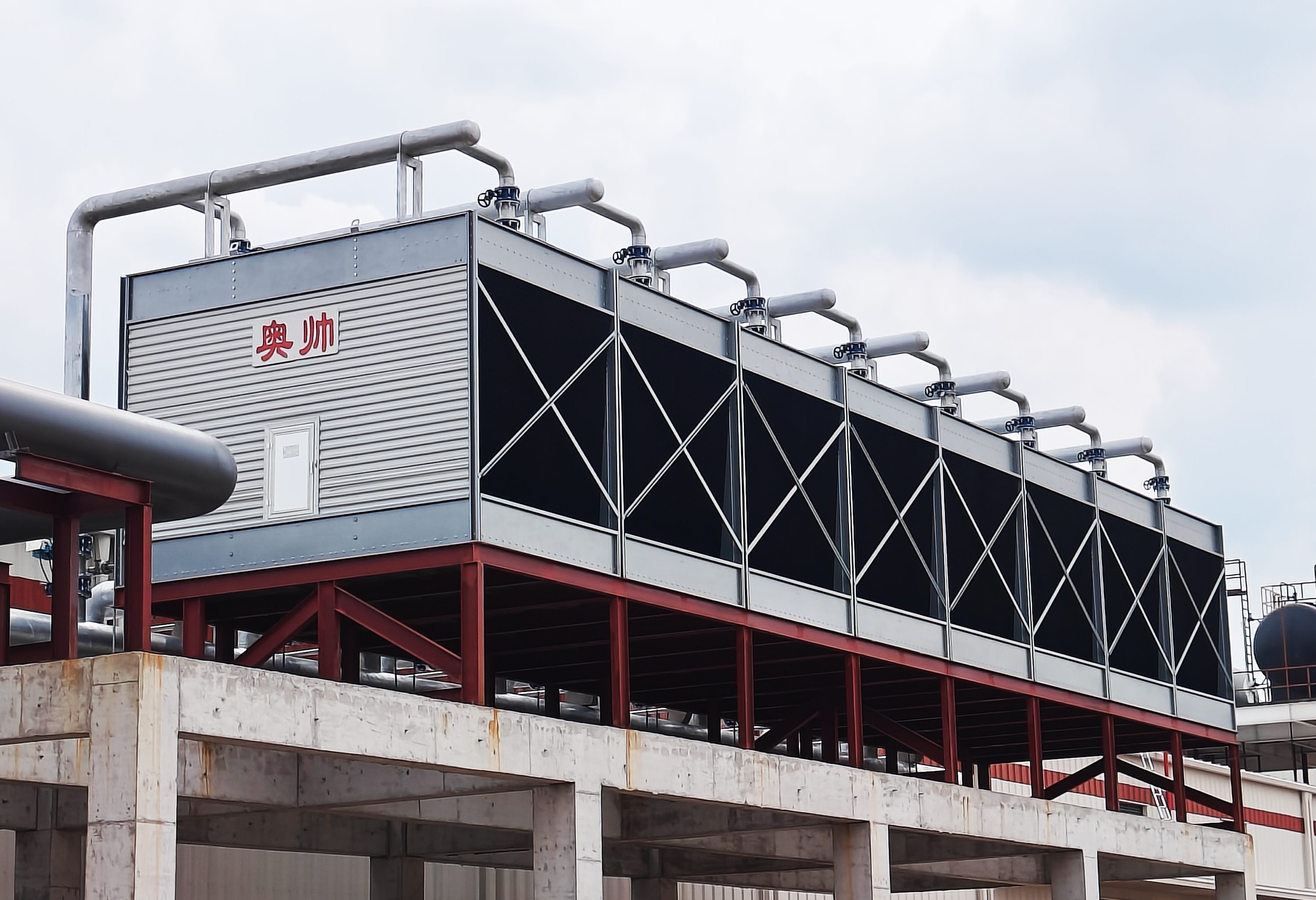
The basic heat-rejection process is similar to conventional evaporative cooling towers.
Hot circulating water enters the cooling tower and is distributed through a system of pipes, spray nozzles or distribution basins.
The water then flows over or through the cooling tower fill.
At the same time, fans move air through the tower.
As air contacts the water, a small portion of the water evaporates. This evaporation removes heat from the circulating water.
The cooled water collects in the basin and returns to the process.
The modular design primarily changes the construction and configuration of the cooling tower, rather than the fundamental heat-transfer principle.
This is why modular cooling towers can be adapted to many different project sizes.

Why would an engineer choose modular construction instead of a conventional field-erected tower?
The answer usually comes down to flexibility.
More components can be manufactured and assembled before the equipment reaches the project site.
That can reduce site labor and shorten installation activities.
For a project with an aggressive construction schedule, this can be a major advantage.
Multiple cooling tower modules can work together.
For example, instead of purchasing one enormous tower, an engineer might configure several cells to achieve the required heat rejection.
This also creates opportunities for staged capacity expansion.
Industrial sites rarely offer a perfectly empty plot of land.
There may already be buildings, pipes, electrical systems, roads and other equipment in the way.
Modular towers can provide greater flexibility when fitting cooling equipment into an existing plant.
A multi-module system may allow individual cells to be isolated for inspection or maintenance while other cells continue operating.
The exact level of redundancy depends on the system design, but this is an important consideration for facilities where downtime is expensive.
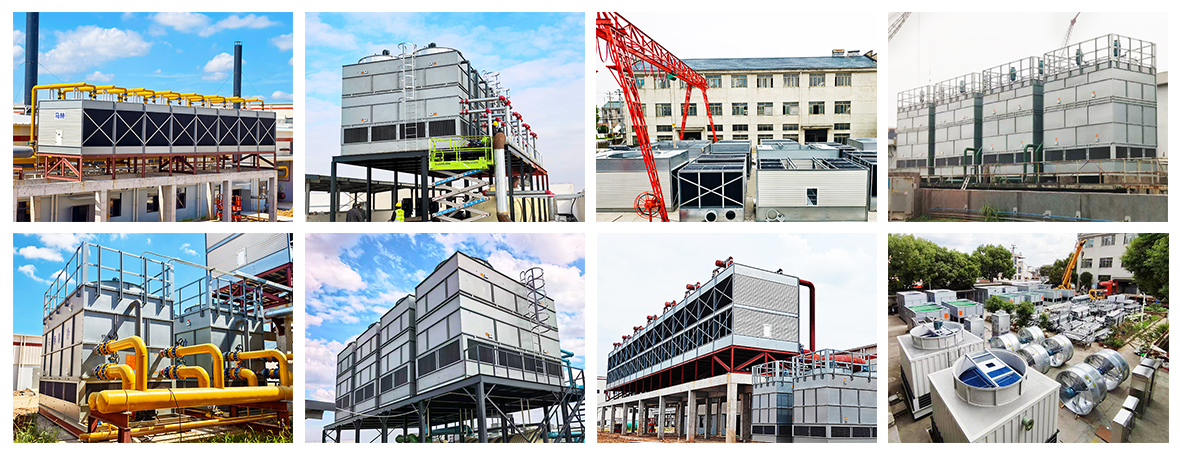
Not every supplier offers the same type of modular cooling tower.
Before comparing companies, first understand the product categories.
Open-circuit cooling towers are among the most common evaporative cooling systems.
The process water is distributed directly over the fill while air passes through the tower.
They are widely used for:
HVAC cooling
Manufacturing
Power plants
Chemical processing
Industrial process cooling
District cooling
Open-circuit modular towers can be configured in multiple cells to achieve larger cooling capacities.
They are often attractive when the cooling water can be exposed directly to the atmosphere and the application requires efficient evaporative heat transfer.
Closed-circuit cooling towers use a heat-exchange coil to separate the process fluid from the evaporative water circuit.
Why does that matter?
Because the process fluid remains inside the coil rather than being directly exposed to the tower environment.
This can be useful when fluid cleanliness is important or when the process requires a closed-loop system.
Closed-circuit systems are commonly considered for:
Industrial process cooling
HVAC systems
Equipment cooling
Data centers
Heat pump systems
Sensitive process applications
They may cost more initially than comparable open-circuit systems, but the system design can offer advantages depending on the application.
Industrial cooling towers are designed for demanding environments.
Compared with standard commercial HVAC applications, industrial projects may have:
Higher water temperatures
Larger flow rates
More challenging water chemistry
Longer operating hours
Higher reliability requirements
More demanding maintenance conditions
This is where supplier engineering experience becomes particularly important.
A tower that performs well in a commercial building may not be the right choice for a chemical processing plant.
When comparing suppliers, don't focus only on the tower shell.
A cooling tower is a system made up of many components.
Important components include:
Cooling tower fill
Fans
Motors
Gearboxes or drive systems
Water distribution systems
Spray nozzles
Drift eliminators
Louvers
Structural framework
Cold-water basin
Access platforms
Controls
Valves
Vibration protection
Maintenance access systems
A supplier with strong component integration capability can often provide a more complete solution.
Capacity is one of the most confusing parts of cooling tower selection.
You may see cooling towers described using:
Tons
Nominal tons
Heat rejection
Water flow rate
kW
RT
GPM
m³/h
But these numbers are not interchangeable without understanding the operating conditions.
A cooling tower's actual performance depends on the relationship between water flow, entering-water temperature, leaving-water temperature and ambient wet-bulb temperature.
For example, a "500-ton cooling tower" does not necessarily deliver the same real-world performance under every climate and operating condition.
That's why professional suppliers should select or rate the tower using actual project conditions.
Smaller modular towers can be used for:
Small commercial buildings
Industrial machines
Small process systems
Packaged HVAC systems
Local manufacturing equipment
These systems can be attractive where installation space is limited.
However, small does not mean simple.
A small tower still needs to meet the required flow, temperature range and ambient design conditions.
Medium-capacity systems are commonly used in larger commercial and industrial applications.
Multiple cells can be arranged to provide the required capacity.
This configuration can provide operational flexibility because individual cells may be shut down for maintenance.
For facilities with changing cooling loads, this can also help operators match tower operation to actual demand.
Large modular cooling towers are used for projects with significant heat-rejection requirements.
Typical applications include:
Large HVAC plants
Data centers
Power generation
Steel manufacturing
Chemical plants
Refineries
Industrial production
District cooling
For large projects, transportation and installation become just as important as thermal performance.
A tower may have excellent specifications on paper, but if the modules cannot be transported efficiently to the site, the project becomes much more complicated.
Capacity is not determined by tower size alone.
Several variables influence actual performance.
The design wet-bulb temperature is critical.
A tower operating in a hot and humid climate faces different conditions from one operating in a cooler, drier location.
The temperature of the water entering the tower affects the amount of heat that needs to be rejected.
The required leaving-water temperature is another major design parameter.
The smaller the approach between leaving-water temperature and ambient wet-bulb temperature, the more demanding the tower design can become.
Higher flow rates generally require appropriate heat-transfer and air-side design.
Fan diameter, fan speed, blade design and tower geometry all influence airflow.
This is one reason why two towers with similar dimensions can have different performance characteristics.
Once you understand the product and capacity requirements, it's time to compare suppliers.
Don't simply ask:
"What's your price?"
Ask a better question:
"What can you provide for my actual operating conditions?"
Thermal performance should be at the top of your checklist.
Ask suppliers to provide performance data based on your actual:
Water flow
Entering-water temperature
Leaving-water temperature
Wet-bulb temperature
Altitude
Design conditions
A reliable supplier should be able to explain how the proposed tower achieves the required performance.
Material selection affects durability, corrosion resistance and lifecycle cost.
Common materials include:
Galvanized steel
Zinc-aluminum-magnesium coated steel
Stainless steel
FRP
Composite materials
The right choice depends on the operating environment.
For a coastal project, corrosion resistance may be particularly important.
For a chemical facility, water chemistry and atmospheric exposure may be critical.
Every cooling tower project is slightly different.
Maybe the site has limited height.
Maybe the pipe connections must be positioned in a specific location.
Maybe the customer needs a particular motor arrangement.
Maybe the water temperature is outside the standard catalog range.
A supplier with engineering and customization capabilities can adapt the system instead of forcing the project into a standard configuration.
Ask where the tower is manufactured and how quality is controlled.
Useful questions include:
Does the supplier manufacture the tower themselves?
Are key components sourced from established manufacturers?
Is factory inspection available?
Are performance calculations provided?
What quality standards are followed?
Can the supplier provide technical drawings?
Are spare parts available?
These questions can reveal whether you are dealing with an actual manufacturer or simply a trading company.
A cooling tower is a long-term investment.
You may need replacement fill, drift eliminators, nozzles, motors, bearings, fans or other components years after installation.
A supplier that can support the tower throughout its lifecycle can reduce future headaches.
When researching modular cooling tower suppliers, Mach Industry (Zhejiang) Co., Ltd. is a manufacturer worth considering.
Mach provides cooling tower equipment for industrial and commercial applications and focuses on engineered cooling solutions.
Its product portfolio includes modular cooling tower systems as well as other cooling tower configurations and components.
For buyers, one important advantage of working directly with a manufacturer is the ability to discuss technical requirements before finalizing the equipment.
Instead of simply choosing a model from a price list, buyers can provide project information such as:
Required cooling capacity
Water flow
Inlet and outlet water temperature
Local wet-bulb temperature
Installation location
Water quality
Space limitations
Preferred construction materials
The supplier can then determine an appropriate configuration.
Mach's website provides additional information about its cooling tower products and solutions:
Mach Industry (Zhejiang) Co., Ltd.
For international buyers, direct communication with the manufacturer can also make customization and replacement-part discussions more straightforward.
There isn't a universal price.
A modular cooling tower quotation can change significantly depending on the project.
Larger cooling capacity generally means more materials, larger fans, more fill and a larger supporting structure.
Standard coated steel, stainless steel and FRP construction can have different costs.
Fan diameter, motor power, efficiency and drive configuration affect both purchase price and operating cost.
High-performance fill can improve heat transfer, while efficient drift eliminators can reduce water loss.
Variable-speed drives, temperature controls, vibration monitoring and other automation can increase initial cost but may improve operational efficiency.
Large modular sections require careful logistics planning.
The supplier may need to account for container dimensions, road transportation, lifting and site access.
Factory assembly can reduce some site work, but cranes, foundations, piping, electrical connections and commissioning still need to be considered.
One reason buyers choose modular systems is to simplify installation.
But "simpler" doesn't mean "automatic."
Before delivery, confirm:
Foundation dimensions
Anchor positions
Module weight
Lifting points
Crane requirements
Pipe connections
Electrical connections
Drainage
Water treatment connections
Access requirements
Maintenance clearance
A good supplier should provide technical drawings before installation begins.
This allows the civil, mechanical and electrical teams to coordinate their work.
Regular maintenance protects both performance and service life.
A basic maintenance program should include:
Check blades, motors, drives, vibration and alignment.
Look for scaling, biological growth, clogging or physical damage.
Blocked fill reduces airflow and can reduce heat-transfer performance.
Poorly functioning nozzles can create uneven water distribution.
That means part of the fill receives too much water while another part receives too little.
Damaged or blocked drift eliminators should be repaired or replaced.
Sediment and debris can accumulate in the basin.
Regular cleaning helps protect pumps and maintain water quality.
Cooling tower water treatment should be managed according to the site's water chemistry and operating conditions.
Nominal tonnage alone does not tell the whole story.
Always compare actual design conditions.
A cooling tower designed for one climate may not perform identically in another.
Wet-bulb temperature matters.
Initial price is only one part of the investment.
Energy, maintenance, spare parts and service can influence the total lifecycle cost.
If your factory is expected to expand, discuss future capacity before selecting the initial tower configuration.
A tower that is difficult to inspect may become expensive to maintain.
Ask about access to fans, fill, nozzles, motors and other components.
Before requesting quotations, prepare the following information:
| Requirement | Information to Prepare |
|---|---|
| Cooling capacity | Required heat rejection or tons |
| Water flow | GPM or m³/h |
| Entering water | Temperature |
| Leaving water | Required temperature |
| Ambient condition | Design wet-bulb temperature |
| Location | Country, city and elevation |
| Water quality | Basic chemistry information |
| Material | Preferred construction material |
| Installation | Available space and access |
| Power | Voltage and frequency |
| Controls | Standard or customized |
| Expansion | Future capacity requirements |
| Service | Installation and commissioning requirements |
The more complete your information is, the more accurate your supplier quotation will be.
A practical selection process can be broken into six steps.
Determine the required heat rejection, water flow and temperatures.
Record wet-bulb temperature, elevation, available space and access conditions.
Decide whether an open-circuit, closed-circuit or another configuration is appropriate.
Evaluate engineering capability, manufacturing experience, materials, quality and customization.
Look beyond equipment price.
Consider transportation, installation, electricity, maintenance and replacement parts.
Before ordering, review:
Performance data
General arrangement drawings
Foundation requirements
Electrical information
Maintenance requirements
Spare-parts lists
Warranty terms
Only after these points are clear should you make the final purchasing decision.
Choosing among modular cooling tower suppliers requires more than comparing prices.
You need to understand the product, capacity, materials, operating conditions, installation requirements and long-term service needs.
A modular cooling tower can provide valuable advantages when a project requires:
Faster installation
Flexible capacity
Multiple cooling cells
Easier project logistics
Future expansion
Reduced site assembly
Customized configurations
However, the best technical solution depends on the actual project.
For buyers evaluating manufacturers, Mach Industry (Zhejiang) Co., Ltd. is one supplier to include in the comparison, particularly when customization, industrial applications and direct manufacturer support are important.
The key is simple: start with your cooling requirements, then choose the supplier—not the other way around.
A modular cooling tower supplier provides factory-manufactured cooling tower systems designed around individual modules or cells. Depending on the manufacturer, the supplier may also provide engineering, installation, commissioning, spare parts and maintenance support.
Common products include open-circuit modular cooling towers, closed-circuit cooling towers, industrial cooling towers, cooling tower cells, fill, drift eliminators, fans, motors, nozzles and water distribution systems.
Start with the heat load, circulating-water flow, entering-water temperature, required leaving-water temperature and design wet-bulb temperature. A qualified supplier can use these parameters to select an appropriate tower.
A modular cooling tower is manufactured and assembled to a greater extent in a factory before delivery. A field-erected tower requires substantially more construction and assembly at the project site.
Yes. Modular cooling towers can be used in manufacturing, chemical processing, power generation, HVAC, data centers, metallurgy and many other industrial applications.
The price depends on capacity, construction material, fan and motor configuration, fill, controls, transportation, installation and other project requirements. A supplier normally needs project operating data before providing an accurate quotation.
Direct manufacturer communication can simplify technical discussions, customization, spare-parts sourcing and after-sales support. It can also make it easier to clarify exactly how the proposed equipment is designed for your operating conditions.
Mach Industry (Zhejiang) Co., Ltd. manufactures cooling tower systems and provides modular cooling solutions for industrial and commercial applications. Buyers can review its products and contact the manufacturer through its official website.