We Provide Cooling Tower Solution

Views: 0 Author: Cindy Publish Time: 2026-11-27 Origin: Site


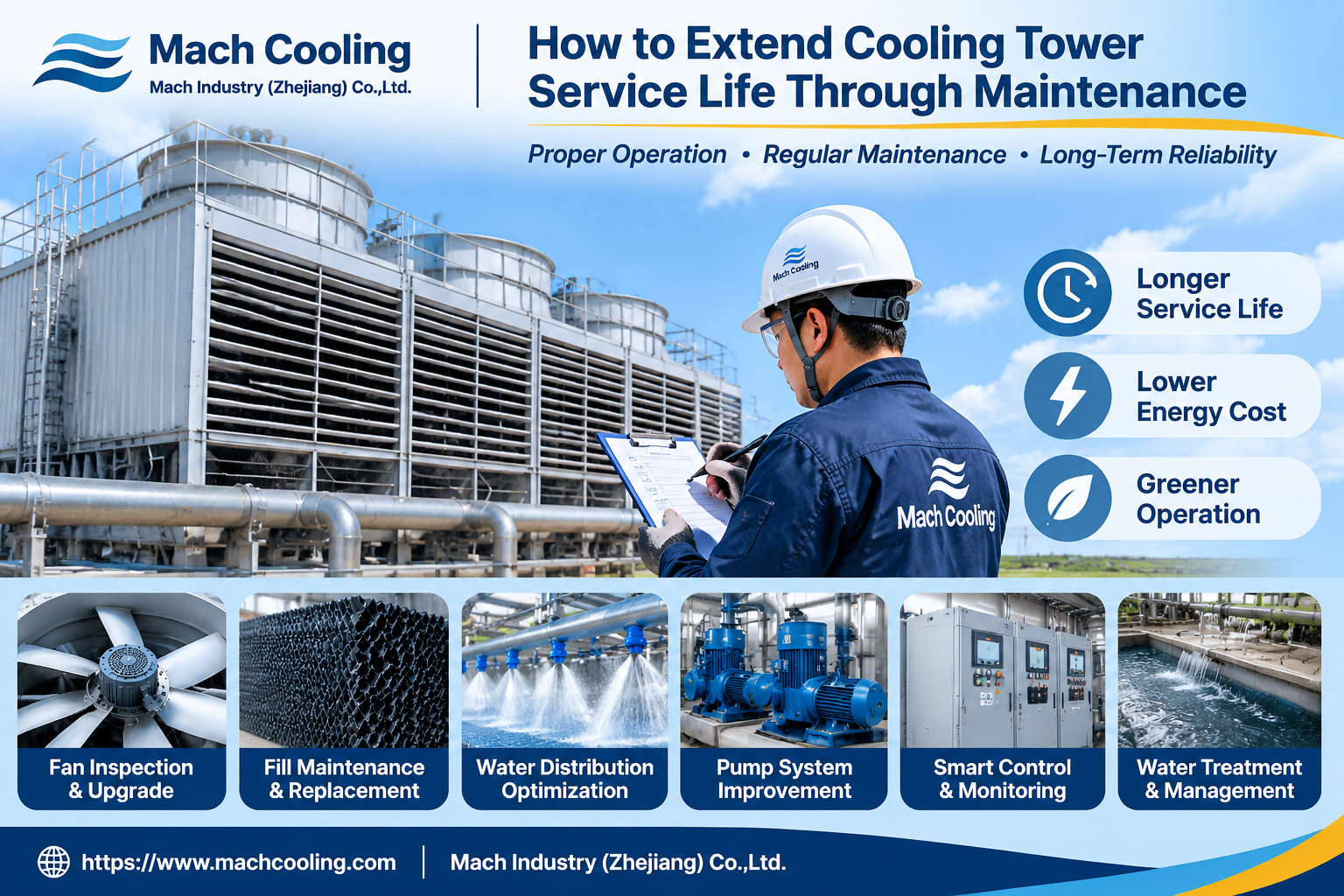
A cooling tower is one of the most important pieces of equipment in many industrial cooling systems. It helps remove unwanted heat from circulating water and keeps production equipment operating within its required temperature range.
However, installing a high-quality cooling tower is only the beginning. How long will it last? How much will it cost to maintain? Can you prevent unexpected breakdowns during peak production?
The answers depend heavily on daily operation and maintenance.
Without proper maintenance, cooling tower components gradually deteriorate. Scale and biological growth can block fill surfaces. Poor lubrication can damage bearings and gearboxes. Unbalanced fan blades may cause vibration, while untreated water can accelerate corrosion.
These problems do not usually appear overnight. They develop gradually, often becoming expensive failures when nobody notices them early.
The good news is that a structured maintenance program can help extend equipment service life, improve cooling performance, reduce downtime, and control operating costs.
In this guide, we will explain how to extend cooling tower service life through correct operation, regular inspections, water treatment, component maintenance, and preventive management.
As an industrial cooling tower manufacturer, Mach Industry (Zhejiang) Co., Ltd. (Mach Cooling) understands the importance of selecting suitable equipment and maintaining it under appropriate operating conditions.
Website: https://www.machcooling.com
Cooling tower service life is the period during which equipment can operate safely and reliably while meeting its required cooling performance.
There is no single service-life figure that applies to every cooling tower. Actual lifespan depends on structural materials, design quality, water chemistry, operating hours, environmental conditions, maintenance standards, and the availability of replacement parts.
A cooling tower operating in a clean environment with controlled water quality may experience very different aging conditions from one exposed to corrosive chemicals, heavy dust, or untreated circulating water.
The foundation of long service life begins with equipment design and manufacturing.
A cooling tower must be designed according to its required heat rejection capacity, water flow rate, entering-air wet-bulb temperature, operating temperature range, and installation environment.
Material selection also matters. FRP, galvanized steel, stainless steel, PVC, and polypropylene each have different mechanical and chemical properties.
For example, a material that performs well in a general industrial environment may not be suitable for a process involving aggressive chemicals or unusually high water temperatures.
Good design helps prevent structural stress, unsuitable component selection, and unnecessary operating loads.
A cooling tower designed for a particular duty should not continuously operate outside its intended conditions.
Excessive water flow, incorrect fan speed, abnormal vibration, and unsuitable operating temperatures can place additional stress on equipment.
Frequent starting and stopping may also affect motors, electrical components, and mechanical transmission systems.
Stable operation within the manufacturer's recommended limits is one of the simplest ways to protect equipment.
Water quality is a major factor in cooling tower aging.
Hard water can cause scale formation. High chloride concentrations may increase corrosion risks for susceptible materials. Suspended solids can accumulate in the basin and block nozzles or fill passages.
Environmental conditions also matter. Coastal locations may expose equipment to salt-laden air, while industrial sites may contain dust, chemical fumes, and other airborne contaminants.
A maintenance plan should consider the actual site environment rather than relying on a generic schedule.
A standard operating procedure, or SOP, helps operators perform inspections consistently. It also reduces the risk of human error.
Before starting a cooling tower, check the major mechanical, electrical, and water-system components.
Important inspection items include:
Check the basin water level.
Inspect fan blades for visible damage.
Confirm that fan guards and access covers are secure.
Check motor and gearbox mounting bolts.
Inspect belts, couplings, and transmission components where applicable.
Confirm that the water distribution system is clear.
Check electrical connections and protective devices.
Make sure the tower area is free from loose objects and obstructions.
For equipment that has been shut down for a long period, perform a more thorough inspection before restarting.
Once the cooling tower is running, operators should monitor important operating parameters.
These include:
Hot-water inlet temperature
Cold-water outlet temperature
Entering-air wet-bulb temperature
Circulating-water flow rate
Fan motor current and power
Pump operating pressure
Abnormal vibration or noise
Basin water level
The cooling range is the difference between hot-water and cold-water temperatures:
Cooling Range = Hot-Water Temperature − Cold-Water Temperature
The approach is the difference between cold-water temperature and entering-air wet-bulb temperature:
Approach = Cold-Water Temperature − Wet-Bulb Temperature
These indicators help operators understand cooling performance. However, they must be interpreted alongside actual heat load, water flow, and weather conditions.
A sudden performance change may indicate a problem with airflow, water distribution, fill condition, or operating load.
Correct shutdown is just as important as correct startup.
Before shutting down equipment, follow the plant's operating procedure and manufacturer recommendations. Coordinate the shutdown with connected process equipment to prevent overheating or interruption of essential cooling.
For extended shutdowns, consider the following:
Clean accumulated dirt from the basin.
Inspect internal components.
Drain or protect water circuits where freezing is possible.
Follow appropriate preservation procedures for motors and gearboxes.
Protect electrical equipment against moisture.
Secure access covers and inspect the tower structure.
Never allow maintenance personnel to work on rotating equipment without proper isolation and lockout procedures.
Daily inspections do not need to be complicated. A short, consistent checklist can identify problems before they become serious.
Fans move air through the cooling tower and directly influence heat rejection.
Check for unusual vibration, noise, blade damage, and changes in operating speed. Look for loose fasteners, corrosion, cracks, and signs of contact between the fan and surrounding structures.
If vibration increases suddenly, investigate the cause rather than continuing normal operation.
Possible causes include:
Fan blade imbalance
Loose mounting bolts
Shaft misalignment
Bearing deterioration
Damaged fan blades
Mechanical interference
Do not attempt to adjust fan blades while the fan is operating.

The fan motor should operate within its rated electrical and mechanical limits.
Monitor motor current, temperature, noise, and vibration. Check whether cooling ventilation openings are blocked by dust or other debris.
An abnormal increase in motor current may indicate excessive mechanical load, electrical problems, or a change in operating conditions.
Electrical inspection and testing should be carried out by qualified personnel.
Observe whether water is distributed evenly across the fill.
Blocked spray nozzles, damaged pipes, and uneven water pressure can create dry areas or excessive water accumulation.
Poor distribution reduces the effective heat-transfer area and may lower cooling performance.
Clean or replace blocked nozzles according to the maintenance plan. Also check that spray components remain properly installed.
The cold-water basin should maintain an appropriate operating water level.
If the level is too low, pumps may experience inadequate suction or unstable operation. If it is too high, water may overflow and create unnecessary losses.
Inspect float valves, makeup-water controls, strainers, and basin surfaces.
Remove leaves, dirt, plastic materials, and other debris before they enter the circulation system.
Daily checks help identify visible problems, while weekly and monthly inspections provide a closer look at equipment condition.
Sediment, sludge, and airborne debris can accumulate at the bottom of the cooling tower basin.
If not removed, these materials may enter pumps and piping systems, block strainers, or contribute to fouling.
Clean the basin according to its condition and the site's water-treatment plan.
Before entering or cleaning confined spaces, follow the applicable safety procedures, including isolation, hazard assessment, and confined-space requirements.
Check the mechanical transmission system for looseness, wear, corrosion, and unusual operating conditions.
Depending on the cooling tower configuration, inspect:
Fan hubs and blade connections
Shafts and couplings
Belts and pulleys
Bearings
Gearboxes
Motor mounting arrangements
Structural support connections
Follow the manufacturer's lubrication intervals and use the specified lubricant.
Over-lubrication can be as harmful as insufficient lubrication, so avoid adding grease without checking the correct quantity and procedure.
Electrical maintenance should include a review of control cabinets, cable connections, motor protection devices, contactors, and VFDs where installed.
Look for overheating marks, moisture, corrosion, loose connections, and damaged insulation.
Qualified electricians should carry out electrical testing after the equipment has been safely isolated.
For towers operating in humid environments, suitable electrical enclosures and moisture protection are particularly important.
Water treatment is one of the most important parts of cooling tower maintenance.
Because cooling towers continuously evaporate water, dissolved minerals and other substances become concentrated in the circulating water. Without proper management, this can cause scaling, corrosion, and biological growth.
Scale forms when dissolved minerals become concentrated beyond their ability to remain dissolved under the operating conditions.
Calcium carbonate and other mineral deposits can build up on heat-transfer surfaces, piping, spray nozzles, and fill.
Scale reduces heat-transfer efficiency and can restrict water flow.
A suitable treatment program should consider water hardness, alkalinity, pH, temperature, cycles of concentration, and makeup-water quality.
Corrosion can damage metal pipes, heat exchangers, supports, pumps, and other components.
The corrosion risk depends on water chemistry, material selection, temperature, dissolved oxygen, and the presence of aggressive ions.
Use a water-treatment program designed for the materials in the cooling system. Regularly monitor relevant water-quality parameters rather than relying only on occasional visual inspections.
Cooling tower water can support algae, bacteria, and other microorganisms.
Biological growth may create slime, block water passages, reduce heat-transfer performance, and contribute to under-deposit corrosion.
Cooling tower water systems also require appropriate Legionella risk management.
Use a site-specific water management plan that includes cleaning, disinfection, monitoring, and appropriate biocide treatment. Follow local regulations and qualified water-treatment advice.
Never mix treatment chemicals unless the chemical supplier and site procedures confirm that doing so is safe.
Blowdown removes a portion of circulating water to control dissolved-solids concentration.
If blowdown is too low, scale and corrosion risks may increase. If it is unnecessarily high, water and chemical consumption rise.
Monitor conductivity and other relevant parameters to maintain suitable cycles of concentration.
The correct operating target depends on makeup-water quality, system materials, treatment chemistry, and operating conditions.
Cooling tower fill and drift eliminators are essential components that deserve regular attention.
Fill provides the surface area needed for heat and mass transfer between water and air.
Over time, dirt, scale, and biological growth can block the fill passages.
Inspect the fill for:
Clogging and sediment accumulation
Cracks or deformation
Displacement or loose sections
Chemical deterioration
Uneven water distribution
Damage to supporting structures
Cleaning methods should match the fill material and the type of deposits. Excessive water pressure or aggressive chemicals may damage the fill.
If the fill is severely damaged or cannot be cleaned effectively, replacement may be more economical than repeated maintenance.
PVC film fill is commonly used in suitable water and temperature conditions. PP fill may be selected for applications requiring different temperature or chemical resistance characteristics. Splash fill may be appropriate for certain applications with higher suspended-solids challenges.
Selection should consider water quality, temperature, chemical compatibility, airflow resistance, and tower configuration.
Drift eliminators reduce water droplets carried out of the cooling tower by exhaust air.
Damaged, missing, or incorrectly installed eliminators may increase water loss and allow more droplets to escape.
Check for cracks, blocked passages, loose sections, and incorrect positioning.
Maintaining drift eliminators helps support water conservation and responsible tower operation.
Mechanical equipment often determines how reliably a cooling tower operates over the long term.
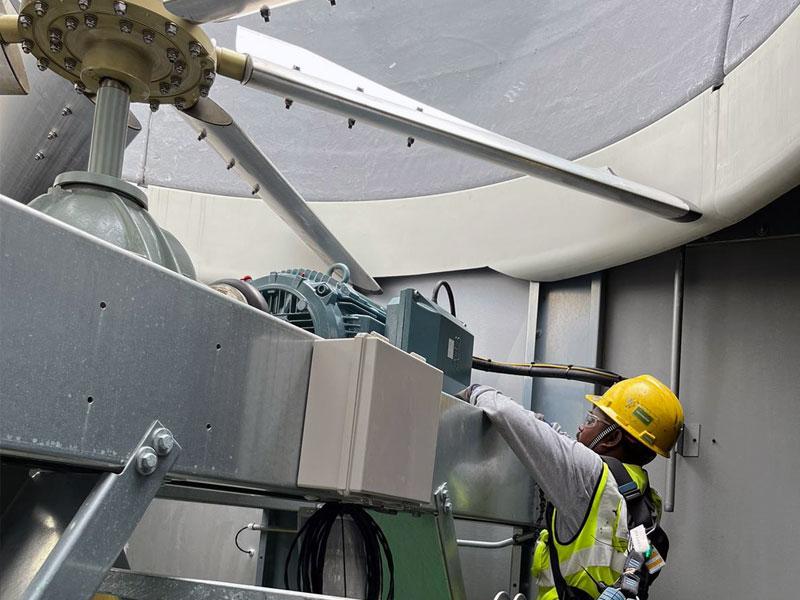
An unbalanced fan creates vibration and additional mechanical stress.
Inspect blade condition, blade angle, mounting hardware, and hub connections. If balancing is required, use suitable procedures and qualified technicians.
Never assume that vibration can be solved simply by changing the fan speed.
Gearboxes transfer power from the motor to the fan in many cooling tower designs.
Check oil level, oil condition, leakage, operating temperature, and unusual noise.
Change lubricant according to the manufacturer's instructions and investigate metal particles or abnormal oil discoloration.
A gearbox problem should be addressed early because continued operation under abnormal conditions may cause extensive damage.
Pumps must deliver the required water flow without excessive vibration, leakage, or electrical load.
Inspect seals, bearings, impellers, couplings, and suction strainers.
Monitor pump pressure and motor current. If the pump operates far from its intended duty point, review the system design and operating controls.
Avoid excessive throttling as a permanent solution to an incorrectly selected pump.
Seasonal changes can create different operating challenges. A maintenance plan should prepare the tower for both high-load summer operation and low-temperature winter conditions.
During hot weather, cooling demand may increase while the available cooling approach becomes more challenging.
Before peak summer operation:
Inspect fans and motors.
Clean the fill and spray nozzles.
Verify pump flow and pressure.
Check basin water level and makeup-water controls.
Confirm that water treatment is operating correctly.
Inspect electrical connections and control systems.
Pay particular attention to abnormal vibration and rising motor temperatures during extended high-load operation.
In cold climates, freezing can damage pipes, basins, valves, and other water-containing components.
Review the tower's winter operating procedure and manufacturer's guidance.
Depending on the design, winter protection may involve basin heaters, heat tracing, controlled water circulation, appropriate fan operation, or draining selected components during shutdown.
Do not assume that completely stopping the fan is always the correct winter strategy. The proper approach depends on tower configuration, process requirements, ambient temperature, and manufacturer recommendations.
For planned shutdowns, clean the tower, inspect structural components, and follow appropriate preservation procedures.
Before restarting, inspect the fan system, motor, gearbox, water basin, piping, valves, and electrical controls.
Gradually return the equipment to normal operating conditions according to the approved startup procedure.
Understanding common problems helps maintenance teams respond quickly.
| Problem | Possible Cause | Preventive Action |
|---|---|---|
| Poor cooling performance | Blocked fill, poor airflow, uneven water distribution | Inspect fill, fans, and nozzles |
| Excessive vibration | Fan imbalance, loose bolts, bearing wear | Inspect and balance mechanical components |
| High motor current | Excessive load, electrical issue, mechanical resistance | Check motor and drive system |
| Water leakage | Damaged basin, seals, pipes, or connections | Repair leaks and inspect regularly |
| Blocked spray nozzles | Scale, sediment, biological growth | Improve filtration and water treatment |
| Excessive water loss | Drift, leakage, excessive blowdown | Inspect eliminators and water controls |
| Gearbox overheating | Lubrication issue, overload, misalignment | Check oil, load, and alignment |
A small leak, unusual noise, or gradual increase in vibration may seem harmless.
But small problems can become expensive failures if equipment continues operating without inspection.
Record abnormal conditions, identify the likely cause, and determine whether the equipment can continue operating safely.
Temporary repairs may be necessary to restore operation, but they should not replace a proper engineering solution.
For example, repeatedly tightening a loose connection without identifying the cause may hide a structural or vibration problem.
Use maintenance records to identify recurring failures and determine whether component replacement or system modification is needed.
A maintenance program becomes much more effective when every inspection and repair is documented.
Useful records include:
Daily operating readings
Weekly and monthly inspection results
Water-quality test reports
Lubrication and oil-change history
Motor current and power measurements
Fan vibration readings
Component replacement records
Equipment downtime and failure reports
These records help operators identify trends.
For example, if fan vibration gradually increases over several months, maintenance staff can investigate before a major mechanical failure occurs.
Similarly, a gradual increase in approach temperature under comparable operating conditions may indicate fouling, reduced airflow, or water distribution problems.
Digital monitoring systems can make this process easier by collecting temperature, pressure, flow, vibration, and electrical data automatically.
Not every problem requires a complete cooling tower replacement.
Sometimes a targeted component upgrade is more practical and economical.
Repair may be suitable when damage is limited and the component can safely return to its intended operating condition.
Examples include replacing seals, repairing minor leaks, cleaning nozzles, or correcting alignment.
Replacement may be appropriate when components are cracked, severely corroded, structurally damaged, or no longer reliable.
Typical examples include:
Damaged fan blades
Worn bearings
Deteriorated fill
Damaged drift eliminators
Failed pumps or motors
Worn transmission components
Replacement parts must be compatible with the original equipment and operating requirements.
If a cooling tower repeatedly consumes excessive energy or struggles to meet cooling requirements, a broader performance assessment may be necessary.
Possible upgrades include high-efficiency fan systems, variable frequency drives, improved fill, better water distribution, and more effective monitoring.
Before making changes, evaluate the tower's thermal duty, structural condition, operating history, and available installation space.
The manufacturer plays an important role in equipment reliability, component compatibility, and long-term maintenance.
When comparing manufacturers, consider:
Engineering capability: Can the supplier understand your required heat rejection capacity, water flow, wet-bulb temperature, and operating conditions?
Material selection: Can the equipment materials withstand the actual water chemistry and environmental conditions?
Component compatibility: Are fans, motors, gearboxes, fill, and water distribution components correctly matched?
Maintenance accessibility: Can technicians inspect and service the equipment safely?
Technical support: Can the manufacturer provide suitable technical information and guidance for installation, operation, and maintenance?
Do not choose a cooling tower based only on its purchase price. Consider its expected operating costs, maintenance requirements, reliability, and suitability for your process.
Mach Industry (Zhejiang) Co., Ltd. (Mach Cooling) is an industrial cooling tower manufacturer providing cooling tower solutions for different industrial applications.
For customers planning a new installation, replacement, or equipment improvement, the correct solution starts with understanding the actual operating requirements.
Important project considerations include:
Required cooling capacity and heat rejection duty
Circulating-water flow rate
Hot-water and cold-water temperatures
Local entering-air wet-bulb temperature
Available installation space
Water quality and environmental conditions
Fan, motor, and pump configuration
Maintenance access and operating requirements
A cooling tower should be designed and selected as part of the overall cooling-water system. Proper equipment matching can help avoid unnecessary mechanical stress and make future maintenance more manageable.
Mach Cooling's manufacturing focus supports customers looking for industrial cooling tower equipment and customized cooling solutions.
For more information, visit:
Mach Cooling: https://www.machcooling.com
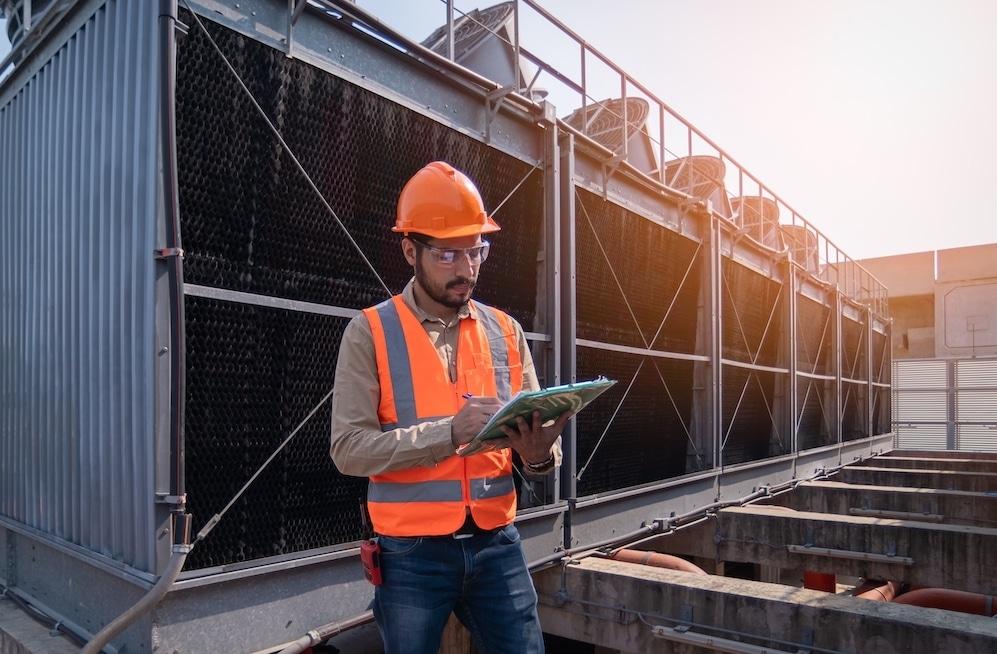
Follow a regular maintenance schedule, maintain suitable water quality, inspect fans and motors, clean the basin, protect fill from clogging, and repair small problems early. Operating the tower within its design conditions is also important.
Basic operating checks should be performed daily. More detailed inspections can be scheduled weekly and monthly, while cleaning, water treatment reviews, and mechanical servicing should follow equipment condition and manufacturer recommendations.
The exact frequency depends on operating hours, water quality, environmental conditions, and the cooling tower design.
Common causes include scale, suspended solids, biological growth, unsuitable water chemistry, excessive temperature, and material incompatibility. Poor water treatment and uneven water distribution can accelerate deterioration.
Water treatment helps control scale, corrosion, and biological growth. Without proper treatment, deposits and corrosion can damage components, reduce heat-transfer performance, and increase maintenance costs.
Signs include severe clogging, deformation, cracking, material deterioration, and poor cooling performance that cannot be restored through appropriate cleaning. A physical inspection should determine whether cleaning or replacement is more suitable.
Yes. Cleaning blocked fill, restoring water distribution, maintaining fan balance, and correcting mechanical problems can help prevent unnecessary energy consumption. Actual savings depend on the original condition and operating requirements.
Not necessarily. Some systems operate throughout winter, while others use seasonal shutdown procedures. The correct approach depends on process requirements, local climate, tower design, and freeze-protection arrangements.
Consider replacement when structural deterioration is severe, the tower cannot meet required cooling capacity, major components are no longer economical to repair, or the existing design is unsuitable for current operating conditions.
A professional technical assessment can help compare repair, retrofit, and replacement costs.
A cooling tower is a long-term industrial investment. Its service life depends not only on manufacturing quality but also on how carefully it is operated and maintained.
Daily inspections help identify early warning signs. Regular mechanical servicing protects fans, motors, gearboxes, and pumps. Proper water treatment reduces scale, corrosion, and biological growth. Cleaning and inspecting fill and drift eliminators helps preserve heat-transfer performance and water efficiency.
Most importantly, maintenance should be systematic rather than reactive.
Instead of waiting for a breakdown, establish a clear maintenance schedule, record operating data, and address problems before they affect production.
With suitable equipment selection, correct operation, and consistent preventive maintenance, industrial facilities can improve reliability, control operating costs, and extend the useful service life of their cooling tower systems.
For industrial cooling tower manufacturing and customized cooling solutions, contact Mach Industry (Zhejiang) Co., Ltd. (Mach Cooling).
Website: https://www.machcooling.com