We Provide Cooling Tower Solution

Views: 0 Author: Cindy Publish Time: 2026-11-28 Origin: Site


Choosing the right cooling tower is not just about removing heat. It is about protecting production equipment, maintaining stable operating temperatures, and controlling long-term operating costs.
For industrial facilities in India, these requirements are becoming increasingly important. High ambient temperatures, demanding production schedules, water management challenges, and the need for reliable process cooling all make equipment selection a serious decision.
A high efficiency closed circuit cooling tower offers an effective solution for applications where process fluid needs to remain separated from the external cooling environment. Unlike an open cooling tower, it circulates the primary fluid through a sealed heat exchanger coil while a separate spray-water system and airflow remove heat.
But how do you find the right manufacturer? Which technical features should you compare? And what should you consider before purchasing a closed circuit cooling tower for an industrial project in India?
In this guide, we will explore the Indian market, introduce several manufacturers and suppliers worth evaluating, explain the main factors affecting cooling tower efficiency, and share practical purchasing advice.
India has a large and diverse industrial sector. Chemical plants, pharmaceutical factories, steel mills, power stations, plastics manufacturers, food processing facilities, and commercial HVAC systems all require reliable heat rejection equipment.
In many of these applications, cooling water quality directly affects production reliability. If the circulating fluid becomes contaminated or contains excessive suspended solids, it may cause fouling, scaling, corrosion, or equipment performance problems.
This is one reason closed circuit cooling towers are attracting attention from industrial buyers.
A closed circuit cooling tower separates the primary process fluid from the external spray-water circuit. This arrangement helps protect process fluid quality and can reduce direct exposure to airborne contaminants.
The Indian market includes domestic cooling equipment manufacturers as well as international suppliers serving customers through export arrangements. When comparing suppliers, buyers should evaluate actual engineering capabilities rather than relying only on brand recognition or advertising claims.
Important considerations include:
Cooling capacity under the required design conditions
Heat exchanger coil materials and construction
Fan and pump power consumption
Water consumption and treatment requirements
Corrosion protection
Installation space and maintenance access
Delivery, warranty, and after-sales support
The best manufacturer is the one that can provide a suitable technical solution for your specific operating conditions.
A closed circuit cooling tower is an indirect heat rejection system designed to cool process fluid without exposing it directly to the outside atmosphere.
The primary fluid circulates through a sealed heat exchanger coil installed inside the cooling tower. A separate spray-water circuit distributes water over the outside of the coil, while fans move air through the equipment.
Heat transfers from the process fluid through the coil wall to the spray water and surrounding air. A portion of the spray water evaporates, carrying heat away from the system.
The cooled process fluid then returns to the industrial equipment.
Because the two fluid circuits remain physically separated, the primary process fluid is protected from direct contact with the outside cooling environment.
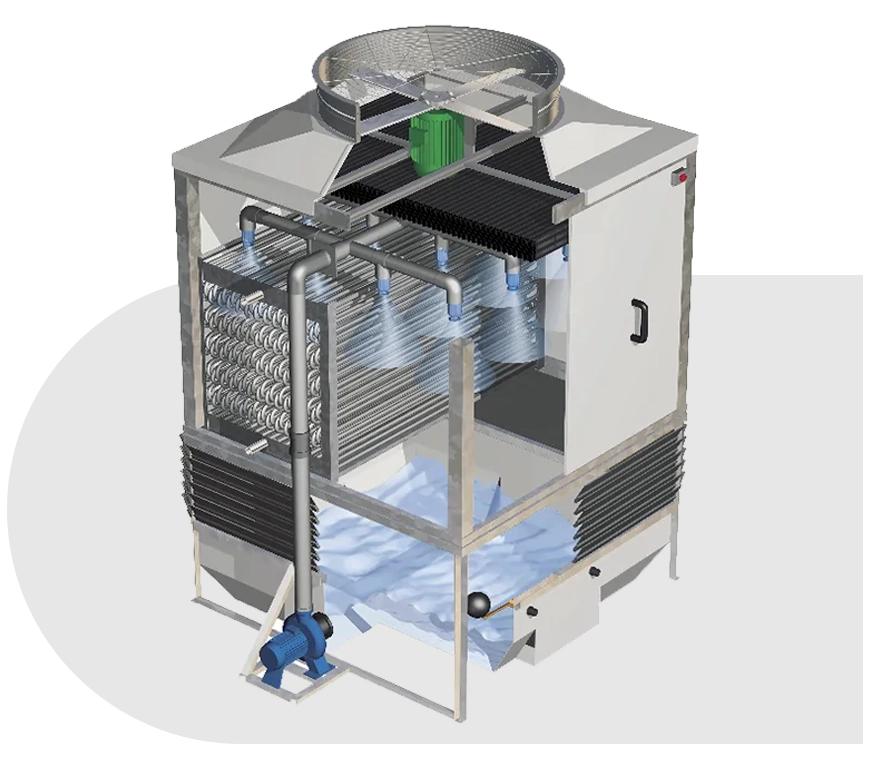
The operating principle is relatively simple.
First, warm process fluid enters the heat exchanger coil. At the same time, a pump circulates water from the collection basin to the spray distribution system.
The spray nozzles distribute water over the coil surface. As air moves through the cooling tower, a portion of the spray water evaporates and removes heat from the coil.
The remaining water returns to the basin and circulates again.
Meanwhile, the primary process fluid continues flowing inside the sealed coil. After losing heat, it leaves the cooling tower at the required outlet temperature.
This process allows continuous cooling while keeping the primary fluid separate from the secondary spray-water circuit.
A typical closed circuit cooling tower consists of several important components:
Heat exchanger coil: Transfers heat from the process fluid to the external cooling circuit. Coil design and material selection directly affect thermal performance.
Axial fans: Move air through the cooling tower to support heat rejection.
Fan motors: Provide the mechanical power required to operate the fans.
Spray-water pumps: Circulate water from the basin to the spray distribution system.
Spray nozzles: Distribute water evenly across the heat exchanger coil.
Drift eliminators: Reduce the amount of water droplets carried out with the exhaust air.
Water collection basin: Collects spray water for recirculation.
Control system: Monitors and controls operating conditions, including fan speed and water circulation.
Every component contributes to the overall performance of the cooling tower. A well-designed system must balance heat transfer, airflow, water distribution, energy consumption, and maintenance requirements.
Why do industrial buyers choose a closed circuit cooling tower instead of a conventional open cooling tower?
The answer usually comes down to process-fluid protection, operating reliability, and system requirements.
A closed circuit system can help protect the primary fluid from contamination because it does not directly contact outside air or secondary spray water.
It may also reduce process-side fouling and simplify fluid quality management. However, the spray-water circuit still requires suitable water treatment, cleaning, and regular inspection.
In an open cooling tower, circulating water comes into direct contact with air. Dust, airborne particles, and other contaminants may enter the system.
In a closed circuit cooling tower, the primary process fluid remains inside the heat exchanger coil.
This is useful for applications involving sensitive industrial equipment, heat exchangers, compressors, molds, and production processes where fluid cleanliness is important.
It is important to remember that the coil material must be compatible with the process fluid. If the system uses glycol, chemicals, or special water additives, the manufacturer should receive these details before equipment selection.
Energy efficiency is one of the most important factors when evaluating industrial cooling equipment.
A high efficiency closed circuit cooling tower should use an appropriately selected fan, motor, pump, coil, and water distribution system.
Variable frequency drives can adjust fan or pump speed according to changing cooling demand. Under suitable operating conditions, this may reduce unnecessary electricity consumption.
Water management is equally important. Evaporative closed circuit cooling towers still consume water through evaporation and require makeup water. Blowdown and drift losses must also be considered.
Some systems offer dry or hybrid operating modes that may reduce water consumption under suitable ambient conditions.
The actual benefits depend on the equipment design, operating conditions, and control strategy.
Industrial cooling equipment must work reliably, often for long operating hours.
If cooling performance becomes unstable, production equipment may experience excessive temperatures. This can affect product quality, reduce production efficiency, and increase maintenance costs.
A properly selected closed circuit cooling tower helps maintain the required process temperature and supports stable industrial operation.
For continuous-production facilities, buyers should also consider standby capacity, spare parts, maintenance access, and the availability of technical support.
When searching for high efficiency closed circuit cooling tower manufacturers in India, buyers can compare domestic suppliers with international manufacturers that serve the Indian market.
The following companies provide useful starting points for supplier research. This is not a verified performance ranking. Product availability, technical specifications, and project suitability should be confirmed directly with each company.
Thermax Limited is an established Indian engineering company serving industrial energy and environmental markets.
Its broader engineering portfolio includes industrial cooling solutions and cooling tower-related products. Buyers evaluating Thermax can consider its industrial engineering experience and investigate the specific closed circuit cooling options available for their projects.
Before purchasing, request detailed technical information covering:
Rated cooling capacity
Design wet-bulb temperature
Heat exchanger construction
Fan and pump power
Water consumption
Installation and maintenance requirements
Official website: https://www.thermaxglobal.com/
AQUACOOL, associated with Siddhant Equipments Pvt. Ltd., offers cooling equipment for different industrial applications.
Its published product range includes closed loop cooling towers, open cooling towers, hybrid coolers, and evaporative condensers.
This product variety may be useful for buyers comparing different heat rejection technologies.
When requesting a quotation, ask for the exact model specifications, coil material, construction details, electrical requirements, and expected operating performance.
Official website: https://www.aquacoolcoolingtower.com/
Heat Transfer Equipments Pvt. Ltd., based in Coimbatore, Tamil Nadu, provides heat transfer and industrial cooling equipment.
Its product information includes closed circuit cooling towers as well as dry, adiabatic, and other cooling solutions.
For buyers with specific process requirements, it is important to provide complete technical information, including process-fluid type, flow rate, inlet temperature, outlet temperature, and heat load.
This allows the manufacturer to evaluate the required heat exchanger configuration and cooling capacity.
Official website: https://www.heattransferequipments.com/
Colt Equipments Pvt. Ltd. publishes information about closed circuit cooling towers and related industrial cooling equipment.
Its cooling tower information discusses coil-based heat transfer, construction materials, airflow, drift eliminators, and optional control arrangements.
Buyers should confirm the available models and ask for detailed performance data under the intended operating conditions.
It is also important to review warranty terms, maintenance access, spare parts, and service arrangements before placing an order.
Official website: https://colt-group.com/
National Cooling Towers is another company buyers can include in their Indian cooling tower supplier research.
Its published product information includes closed-circuit cross-flow cooling tower offerings for industrial applications.
When evaluating a particular model, request the latest technical datasheet and confirm its cooling capacity, coil materials, fan power, noise levels, and corrosion protection.
Do not assume that a product's general description guarantees suitability for a specific industrial process. A project-specific technical selection is essential.
Official website: https://www.nationalcoolingtowers.com/
Mach Industry (Zhejiang) Co., Ltd. is an international cooling tower manufacturer based in Zhejiang, China.
For Indian buyers who are open to comparing international suppliers, Mach provides another option for industrial cooling tower projects.
Its product range includes closed cooling tower configurations such as counter-flow, cross-flow, and mixed-flow designs.
These configurations can be evaluated according to the required cooling capacity, available installation space, airflow arrangement, and operating conditions.
When considering Mach for an Indian project, buyers should request a customized technical proposal and confirm several important details:
Required cooling capacity and design conditions
Process-fluid flow rate and temperature range
Heat exchanger coil material
Fan and pump specifications
Electrical supply compatibility
Equipment dimensions and installation requirements
Export arrangements and delivery terms
Warranty and spare-parts support
International purchasing requires careful communication. Buyers should clarify shipping responsibilities, customs documentation, installation guidance, and after-sales procedures before confirming an order.
For industrial cooling tower information and project inquiries, visit:
Mach Industry (Zhejiang) Co., Ltd.
Website: https://www.machcooling.com
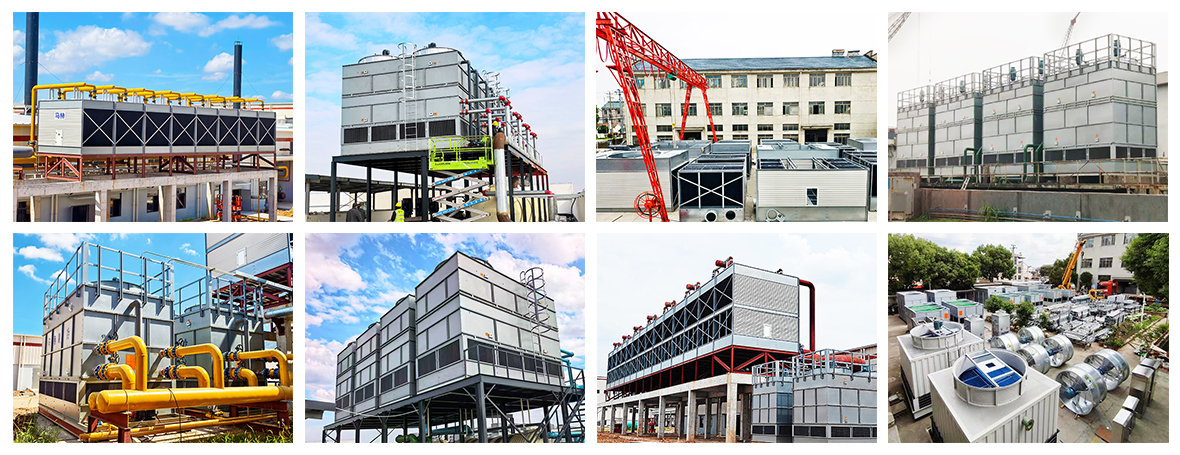
Not every closed circuit cooling tower delivers the same operating performance.
Two units may have similar external dimensions but different heat transfer capabilities, fan power requirements, water consumption, and maintenance costs.
So, what should you look for when evaluating a high efficiency design?
The answer lies in the complete cooling system.
The heat exchanger coil is one of the most important components of a closed circuit cooling tower.
Its surface area, tube arrangement, material, and internal flow characteristics influence heat transfer performance.
A suitable coil design must provide sufficient heat exchange capacity while maintaining acceptable fluid pressure drop.
Material selection is also critical. Stainless steel, galvanized steel, copper alloys, and other materials may be considered depending on the process fluid and operating environment.
There is no single material that is ideal for every project.
For example, a cooling tower installed near the coast may require a different corrosion protection strategy from one operating in an inland industrial facility.
Always request the coil material specification and confirm its compatibility with the process fluid.
Fans move air through the cooling tower and directly influence heat rejection.
An appropriately selected axial fan can provide the required airflow while controlling electrical consumption.
Motor efficiency, operating speed, blade angle, fan diameter, and system resistance all affect performance.
When comparing manufacturers, request:
Fan diameter and type
Motor rated power
Operating speed
Electrical efficiency information
Noise data
Maintenance requirements
A larger motor does not automatically mean better cooling performance. The fan and motor must be matched to the equipment's airflow requirements.
Spray-water distribution is another important part of cooling tower efficiency.
The spray system should distribute water evenly across the heat exchanger coil.
If some areas receive too little water, heat transfer may become uneven. Poor distribution can also create localized operating problems and reduce the effectiveness of the cooling process.
High-quality spray nozzles should provide suitable water coverage and allow convenient inspection and cleaning.
Industrial cooling demand changes throughout the day.
A factory may require maximum cooling during peak production but much less capacity during partial-load operation.
Variable frequency drives can adjust fan or pump speed to match changing cooling demand.
This may reduce energy consumption compared with operating equipment continuously at full speed.
However, VFD compatibility must be checked carefully. Motor insulation, operating frequency, cooling arrangements, electrical protection, and control logic all need to be suitable for variable-speed operation.
A good manufacturer should explain how the proposed control system works and what performance benefits can reasonably be expected.
Selecting a supplier is not simply a purchasing decision. It is an engineering decision that affects long-term operating performance.
Before comparing quotations, prepare a clear technical specification and send the same information to each shortlisted manufacturer.
This makes it easier to identify differences in equipment selection and pricing assumptions.
Start with the cooling requirements.
The manufacturer needs to understand the required heat rejection capacity and process-fluid operating conditions.
Important information includes:
Heat load
Process-fluid type
Fluid flow rate
Inlet temperature
Required outlet temperature
Operating pressure
Outdoor design wet-bulb temperature
For Indian installations, summer conditions deserve particular attention.
A cooling tower selected for mild ambient conditions may not provide the required outlet temperature during the hottest months.
Ask the manufacturer to clearly state the design conditions used in the thermal selection.
Industrial cooling towers operate in environments where moisture, chemicals, and airborne contaminants may affect equipment life.
Review the materials used for the coil, casing, basin, structural frame, fasteners, and protective coatings.
For coastal or chemically aggressive environments, additional corrosion protection may be necessary.
The quotation should identify the main materials instead of using vague descriptions such as high-quality construction.
A low purchase price does not always mean a low-cost cooling tower.
Operating expenses can accumulate over many years, especially in facilities that run continuously.
Ask manufacturers to provide:
Fan motor power
Spray pump power
Total connected electrical load
Expected operating power, where available
Estimated evaporation losses
Drift and blowdown assumptions
Makeup-water requirements
Compare these figures under the same design conditions.
Every industrial site has different installation conditions.
Some projects have limited space. Others require special piping connections, electrical arrangements, access platforms, or lifting provisions.
A capable manufacturer should be able to review these requirements and provide suitable technical drawings.
For international suppliers, also confirm delivery terms, export documentation, warranty coverage, spare-parts availability, and technical communication procedures.
These details are just as important as the cooling tower's rated capacity.
Closed circuit cooling towers can support many industrial applications where process-fluid separation and reliable heat rejection are important.
Chemical and pharmaceutical processes may involve fluids that require careful temperature control and contamination management.
A closed circuit cooling tower can help keep the primary cooling fluid separated from the external spray-water circuit.
The coil material and design must still be selected according to the chemical composition and operating conditions.
Plastic manufacturing equipment often requires stable cooling-water temperatures.
Injection molding machines, extruders, and auxiliary equipment can generate significant heat during production.
A correctly selected closed circuit cooling system can help support consistent process cooling.
Steel and metal processing facilities use cooling systems for furnaces, machinery, hydraulic equipment, and other heat-generating processes.
Depending on the application, a closed circuit cooling tower may help protect the circulating fluid and reduce contamination-related maintenance.
Power generation facilities rely on reliable heat rejection systems for various auxiliary processes.
The cooling tower must be selected according to the specific equipment load, operating temperatures, and environmental conditions.
Large HVAC systems and some data center applications require dependable heat rejection.
Closed circuit cooling equipment may be considered where fluid separation, water management, or system design requirements make it appropriate.
The correct solution depends on cooling load, redundancy requirements, ambient conditions, and operating strategy.
Both cooling tower types remove heat, but they operate differently.
An open cooling tower exposes circulating water directly to the atmosphere. A closed circuit cooling tower keeps the primary process fluid inside a sealed coil and uses a separate spray-water circuit for heat rejection.
The main differences include:
Process-fluid protection: Closed circuit systems help isolate the primary fluid from direct contact with outside air and spray water.
System complexity: Closed circuit systems include a heat exchanger coil and separate spray-water circuit, making their construction more complex.
Initial investment: Closed circuit equipment may have a higher initial purchase cost, depending on capacity and materials.
Water management: Evaporative closed circuit systems still consume water. Both system types require appropriate water treatment and maintenance.
Application suitability: Open cooling towers may be suitable when direct-contact cooling is acceptable. Closed circuit systems are useful when primary fluid separation is important.
Neither design is automatically better for every project.
The right choice depends on process requirements, water quality, operating costs, site conditions, and lifecycle economics.
Before contacting manufacturers, prepare a complete technical inquiry.
Providing accurate information helps suppliers select the equipment more efficiently and reduces the risk of receiving unsuitable quotations.
Here is a practical checklist:
Required heat rejection capacity or process heat load.
Process-fluid type and chemical composition.
Process-fluid flow rate.
Fluid inlet temperature.
Required fluid outlet temperature.
Operating pressure and temperature range.
Installation location and summer design wet-bulb temperature.
Available installation space and equipment layout.
Electrical supply and control requirements.
Preferred coil and casing materials.
Noise restrictions and environmental conditions.
Operating hours and maintenance requirements.
Required delivery schedule and project quantity.
If you are replacing an existing cooling tower, also provide photographs, equipment nameplates, piping dimensions, and available technical drawings.
This information helps manufacturers understand the project and prepare a more accurate proposal.
When comparing high efficiency closed circuit cooling tower manufacturers for an Indian industrial project, Mach Industry (Zhejiang) Co., Ltd. is an international supplier worth considering.
Mach focuses on industrial cooling tower solutions and offers different closed cooling tower configurations for project evaluation.
For buyers comparing suppliers across different markets, working with an international manufacturer can provide another opportunity to evaluate equipment design, configuration options, and project-specific requirements.
However, the most important factor is not the manufacturer's location. It is whether the proposed cooling tower can meet the project's actual operating conditions.
Before purchasing from Mach, provide the required heat load, fluid flow rate, inlet and outlet temperatures, ambient design conditions, and installation information.
Ask for a technical proposal that clearly identifies:
Cooling tower configuration
Rated thermal performance
Coil and casing materials
Fan and motor specifications
Spray pump requirements
Water consumption assumptions
Equipment dimensions
Electrical and control requirements
Delivery and warranty conditions
For Indian customers, it is also important to discuss shipping arrangements, installation guidance, spare parts, and after-sales communication.
A clear technical discussion before ordering helps reduce uncertainty and supports a smoother purchasing process.
To explore Mach's cooling tower products and discuss your project requirements, visit:
Mach Industry (Zhejiang) Co., Ltd.
Official Website: https://www.machcooling.com
Its main advantage is that the primary process fluid circulates inside a sealed heat exchanger coil. This helps protect the fluid from direct contact with outside air and secondary spray water, reducing the risk of contamination in the process circuit.
No. Evaporative closed circuit cooling towers still consume water because part of the spray water evaporates during heat rejection.
The system also requires makeup water and appropriate water treatment. Dry or hybrid systems may reduce water consumption under suitable operating conditions.
There is no single manufacturer that is best for every application.
Compare cooling capacity, thermal performance, construction materials, power consumption, water requirements, customization, warranty, and after-sales support.
Always evaluate quotations using the same design conditions.
Yes, overseas manufacturers may be able to supply Indian projects through export arrangements.
Before purchasing, confirm shipping terms, customs documentation, electrical compatibility, warranty coverage, installation guidance, and spare-parts availability.
The most important information includes heat load, process-fluid type, flow rate, inlet and outlet temperatures, operating pressure, ambient wet-bulb temperature, site conditions, and available installation space.
They can be suitable when correctly designed for the installation location.
The manufacturer should confirm the cooling performance at the specified summer design wet-bulb temperature and process-fluid conditions.
Start with correct equipment selection. Then review fan and pump efficiency, spray-water distribution, coil cleanliness, water treatment, and operating controls.
Variable frequency drives may also help reduce power consumption under variable cooling loads when properly applied.
Finding the right high efficiency closed circuit cooling tower manufacturer in India requires careful evaluation.
Thermal performance, heat exchanger coil design, corrosion protection, fan and pump efficiency, water consumption, maintenance access, and technical support all influence long-term operating results.
Thermax, AQUACOOL, Heat Transfer Equipments, Colt Equipments, and National Cooling Towers are potential suppliers to include in your Indian market research. International manufacturers such as Mach Industry (Zhejiang) Co., Ltd. can also be considered when comparing overseas sourcing options.
Rather than choosing a cooling tower based only on its purchase price, define your operating requirements first. Request detailed technical proposals, compare performance under identical design conditions, and confirm the supplier's ability to support your project.
If you are looking for a closed circuit cooling tower for an industrial application in India, Mach Industry (Zhejiang) Co., Ltd. is an option worth discussing.
Visit https://www.machcooling.com to explore its cooling tower solutions and submit your project requirements.