We Provide Cooling Tower Solution

Views: 0 Author: Cindy Publish Time: 2026-09-29 Origin: Site


If you're searching for cooling towers New York, you're probably not just looking for a box with a fan on top. You need equipment that can handle your cooling load, fit your site, operate efficiently, and remain practical to maintain for years.
And in New York, there is another layer to consider: cooling tower operation is closely connected with water management, inspection, maintenance, and Legionella control. NYC requires cooling tower owners to register their systems and maintain documented maintenance programs, while newer rules have increased Legionella sampling frequency.
So, how do you choose the right cooling tower manufacturer?
The answer isn't simply to compare prices.
You need to look at capacity, tower configuration, materials, energy consumption, maintenance access, customization, documentation, and long-term technical support.
This guide walks you through the process step by step, with a particular focus on buyers looking for cooling towers in New York for commercial HVAC, industrial processes, manufacturing, refrigeration, and other applications.
A cooling tower is a long-term investment.
Once installed, it becomes part of your site's heat-rejection system. If the tower is incorrectly sized or poorly matched to the application, the problems may show up months or years later as high energy consumption, unstable water temperatures, excessive maintenance, corrosion, scaling, or inadequate cooling capacity.
Think of the manufacturer as the architect of the system.
A good manufacturer doesn't simply sell you a catalog model. The manufacturer should understand your operating conditions and help match the tower to your actual requirements.
For New York projects, this becomes even more important because the equipment must operate within a regulated environment. NYC requires owners to register cooling towers and maintain records covering water treatment, monitoring, cleaning, disinfection, and other maintenance activities.
That means your supplier should be able to provide clear technical information about the equipment from day one.
New York combines large commercial buildings, dense urban development, manufacturing facilities, industrial plants, hospitals, data-related infrastructure, and other facilities with significant cooling requirements.
Space can also be a serious constraint.
A tower may need to fit on a rooftop, in a mechanical area, or within an existing industrial facility where every square foot matters.
Noise can matter too.
A cooling tower installed near occupied buildings or neighboring properties may require careful consideration of fan selection and operating conditions.
So, when comparing cooling tower manufacturers in New York or manufacturers supplying New York projects, don't focus only on nominal tonnage.
Look at the complete system.
For NYC installations, owners must register cooling towers and comply with applicable maintenance and monitoring requirements. The city's requirements cover the cooling tower water loop, maintenance program and plan, water treatment, recordkeeping, and related operational procedures.
The city's registration requirements also identify information such as the tower manufacturer, model number, and serial number.
This creates a practical point for buyers:
Keep your manufacturer's documentation organized.
You should have access to model information, equipment specifications, operating instructions, maintenance requirements, and component information.
A professional manufacturer should make this process easier, not harder.
Cooling towers use recirculating water and can create conditions where microorganisms may grow if the system is not properly managed.
NYC has strengthened its cooling tower requirements in recent years. Beginning May 8, 2026, cooling tower systems in the city are subject to monthly Legionella sampling, with no more than 31 days between samples while applicable requirements are in effect.
This does not mean the manufacturer is responsible for your entire water-management program. Building owners and qualified professionals have specific responsibilities.
However, tower design still matters.
Easy access to basins, spray systems, fill, drift eliminators, coils, and other components can make inspection and maintenance more practical.
Before contacting manufacturers, gather your basic operating data.
This simple step can save a surprising amount of time.
A manufacturer cannot accurately recommend a cooling tower if all you say is, “I need a 500-ton tower.”
The manufacturer needs to understand what that 500 tons actually means for your process.
Start with your required heat rejection.
For HVAC applications, this may be related to chiller capacity and condenser-water conditions.
For industrial applications, you may need to reject heat from process equipment, furnaces, compressors, hydraulic systems, heat exchangers, or production machinery.
Provide:
Required cooling capacity
Heat load
Water flow rate
Entering water temperature
Leaving water temperature
Design wet-bulb temperature
Operating hours
Expected seasonal conditions
More information means a more accurate selection.
Water flow is one of the most important parameters in cooling tower selection.
Two projects can have similar cooling capacity but completely different water-flow requirements.
You should provide the manufacturer with both the design flow rate and temperature range.
For closed circuit systems, also provide information about the process fluid.
Is it water?
A water-glycol mixture?
Another heat-transfer fluid?
What is its concentration?
These details influence coil selection and heat-transfer performance.
New York has significant seasonal variation.
A tower designed for summer operation needs to handle high ambient temperatures, while winter operation introduces another challenge: freezing protection.
A good manufacturer should ask about the local design wet-bulb temperature and expected winter conditions instead of blindly selecting a standard model.
Winterization can involve design considerations such as basin protection, heaters, drainage, controls, and operating procedures.
The right solution depends on the actual project.
There is no single cooling tower configuration that works for every application.
You may need an open cooling tower, closed circuit cooling tower, crossflow tower, counterflow tower, or another configuration.
The right manufacturer should help you understand those differences.
An open cooling tower directly exposes the circulating water to the air.
This configuration is widely used for HVAC and industrial heat rejection.
Open towers can provide effective evaporative cooling, but water treatment and maintenance become important because the circulating water is exposed to the environment.
A closed circuit cooling tower uses a heat exchanger or coil to isolate the process fluid from the external evaporative water circuit.
This can be particularly useful when maintaining the cleanliness of the process fluid is important.
Mach, for example, offers closed-loop cooling tower configurations using stainless-steel or copper coils, with customizable electrical specifications and different model ranges.
For industrial applications where process-fluid contamination is a concern, closed circuit technology may deserve serious consideration.
The airflow arrangement is another major design decision.
In a crossflow cooling tower, air moves horizontally through the heat-transfer area.
In a counterflow cooling tower, air and water move in opposite directions, with air generally traveling upward while water moves downward.
Neither configuration should automatically be considered the universal answer.
The correct choice depends on capacity, footprint, maintenance access, noise requirements, climate, water conditions, and project layout.
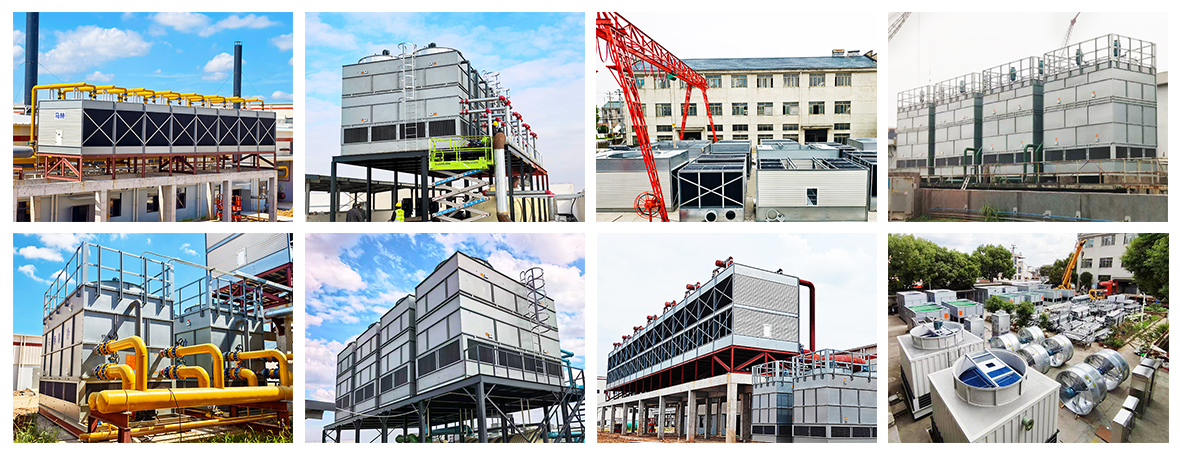
Once you understand your technical requirements, you can start evaluating manufacturers.
This is where many buyers make a mistake.
They compare three quotations and choose the lowest number.
But a cooling tower isn't a commodity like a standard pipe fitting.
Look for a manufacturer with experience building cooling towers similar to yours.
Ask:
How long has the company manufactured cooling towers?
What types of towers does it produce?
What industries does it serve?
Can it provide technical drawings?
Can it customize the equipment?
Does it understand international project requirements?
Experience doesn't guarantee that a manufacturer is right for your project, but it gives you more information to evaluate.
A manufacturer with multiple tower configurations may be able to provide a solution that fits your application more precisely.
For example, Mach offers industrial cooling towers, open cooling towers, closed circuit cooling towers, crossflow configurations, counterflow configurations, mixed-flow closed towers, chillers, and evaporative condensers.
That product breadth can be useful when a project changes during engineering.
Maybe you initially planned an open tower but later discovered that a closed circuit design better protects the process fluid.
A manufacturer with multiple configurations can discuss both options.
Material selection is critical.
Cooling towers live in a wet environment. Add chemicals, temperature changes, outdoor exposure, and possibly aggressive water chemistry, and material durability becomes a major consideration.
Ask about:
Tower casing material
Structural materials
Fasteners
Heat-exchanger coil material
Basin material
Corrosion protection
Fill material
Drift eliminator material
Mach's closed-loop cooling tower range, for example, lists 304 stainless steel or copper tubing for coils and galvanized steel for the shell, depending on the configuration.
The final material selection should always be matched to the actual water chemistry and operating environment.
Energy costs can become a major part of the lifetime cost of a cooling tower.
Don't ask only:
“How much does the tower cost?”
Also ask:
“How much will this tower cost to operate?”
Fan motor efficiency, fan control, pump efficiency, airflow design, heat-transfer surface, approach temperature, and control strategy can all influence operating costs.
A tower that costs slightly more initially may have a different operating profile from a cheaper alternative.
The important thing is to compare the complete lifecycle.
Maintenance is not an optional extra.
It's part of the tower's life.
Look for practical access to:
Fans
Motors
Pumps
Spray nozzles
Fill
Drift eliminators
Coils
Water basins
Filters
Valves
Electrical controls
A beautiful tower that is difficult to service is like buying a luxury car with no hood. It may look impressive, but sooner or later someone has to get inside.
When buying internationally, you may encounter manufacturers, distributors, trading companies, engineering contractors, and local representatives.
They can all have different roles.
A factory-direct manufacturer can potentially offer more direct communication regarding:
Engineering
Customization
Production
Component selection
Quality control
Technical drawings
Replacement parts
Warranty
Delivery
This doesn't automatically make factory-direct purchasing the right option for every project.
For complex New York installations, you may still need local engineers, contractors, installers, water-treatment professionals, and compliance specialists.
The key is to clearly define who is responsible for each part of the project.