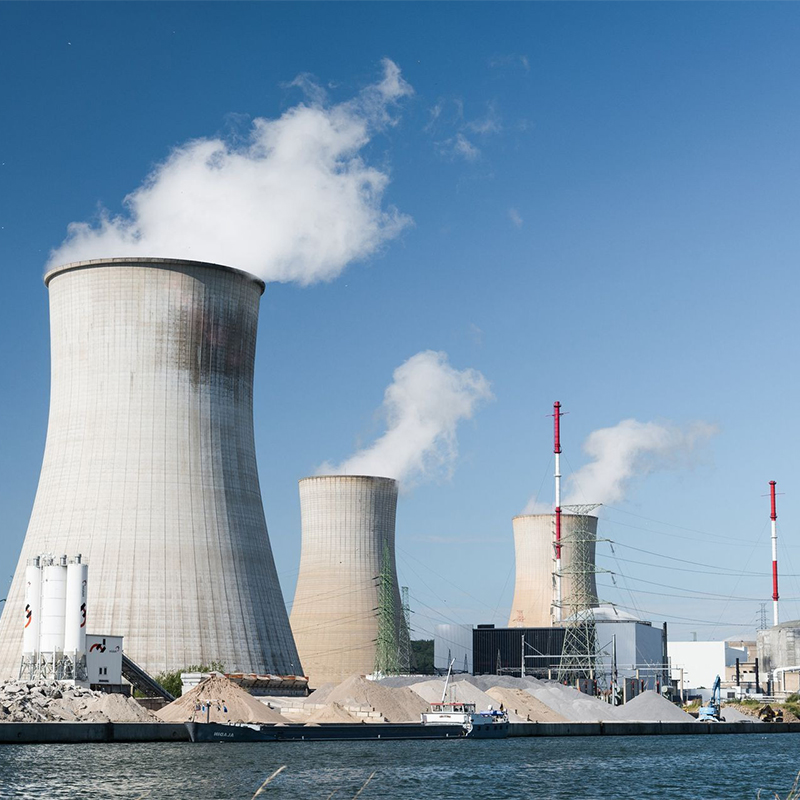
We Provide Cooling Tower Solution

Views: 0 Author: Site Editor Publish Time: 2025-12-29 Origin: Site


Cooling towers are essential heat rejection systems used in industrial facilities, power plants, commercial buildings, data centers, and process cooling applications. Their primary function is to remove excess heat from circulating water and release it into the atmosphere through heat transfer and evaporation.
However, when selecting a cooling tower, one important question is frequently asked:
Which type of cooling tower is more efficient?
The answer depends on many factors, including cooling capacity requirements, operating conditions, climate, water availability, energy consumption, and long-term maintenance costs.
Generally, counterflow cooling towers provide the highest thermal efficiency, while crossflow cooling towers offer easier maintenance and lower operating complexity. For applications requiring process protection, closed circuit cooling towers may deliver better overall efficiency by reducing contamination and improving system reliability.
Understanding the differences between cooling tower designs helps engineers and facility managers choose the most efficient solution for their specific applications.
Cooling tower efficiency is not determined by a single factor. A high-performance cooling tower must effectively balance heat transfer capability, energy consumption, water usage, and operating reliability.
The main factors affecting cooling tower efficiency include:
The primary purpose of a cooling tower is to maximize heat rejection between water and air.
Important performance indicators include:
Cooling range
Approach temperature
Wet-bulb temperature performance
Air and water contact efficiency
A cooling tower with better air-water interaction can remove more heat using less energy.
The closer the leaving water temperature approaches the ambient wet-bulb temperature, the more efficient the cooling tower design is.
Modern cooling systems focus not only on cooling performance but also on energy efficiency.
Major energy-consuming components include:
Fan motors
Pumps
Water distribution systems
Control systems
Energy-efficient cooling towers often use:
High-efficiency motors
Variable frequency drives (VFDs)
Intelligent temperature controls
Optimized fan blade designs
These technologies allow cooling towers to adjust operation according to actual cooling demand and reduce unnecessary energy consumption.
Water efficiency is becoming increasingly important due to environmental regulations and rising operating costs.
Factors affecting water consumption include:
Evaporation rate
Drift loss
Blowdown requirements
Water treatment efficiency
Closed circuit cooling towers can reduce water quality problems because the process fluid remains isolated inside the coil system.
The most common comparison when selecting a cooling tower is:
Counterflow cooling tower vs crossflow cooling tower
Both designs can provide reliable cooling, but their structures and performance characteristics are different.
A counterflow cooling tower uses opposite-direction airflow.
In this design:
Hot water flows downward through the fill
Air moves upward from the bottom of the tower
Heat transfers between water droplets and rising air
Because air and water move in opposite directions, the temperature difference between them is maintained throughout the cooling process.
This improves heat transfer performance.
Counterflow cooling towers generally achieve better cooling performance because they maximize contact between air and water.
The counter-direction airflow improves:
Heat exchange efficiency
Cooling range capability
Approach temperature performance
Counterflow towers typically require less space compared with similar-capacity crossflow designs.
This makes them suitable for:
Industrial plants
Manufacturing facilities
Limited installation areas
Counterflow designs are commonly selected for demanding applications requiring high heat rejection capacity.
Examples include:
Chemical processing
Steel manufacturing
Power generation
Large industrial HVAC systems
Although highly efficient, counterflow towers also have some limitations:
Higher fan pressure requirements
Taller structure
More difficult maintenance access
For facilities where maximum efficiency is the priority, these disadvantages are usually acceptable.
A crossflow cooling tower uses a horizontal airflow design.
In this system:
Water flows vertically downward
Air moves horizontally across the falling water
The air enters through the sides of the tower and passes through the fill material.
One major benefit of crossflow towers is accessibility.
Maintenance teams can easily access:
Fill materials
Water distribution systems
Internal components
Because air moves horizontally through the fill, crossflow towers typically operate with lower air resistance.
This can reduce fan energy consumption in some applications.
Crossflow cooling towers are widely used in:
Commercial HVAC systems
Office buildings
Shopping centers
Institutional facilities
Compared with counterflow designs:
Larger footprint may be required
Thermal efficiency may be slightly lower
More space is needed for installation
| Feature | Counterflow Cooling Tower | Crossflow Cooling Tower |
|---|---|---|
| Heat transfer efficiency | Higher | Good |
| Space requirement | Smaller | Larger |
| Maintenance access | More difficult | Easier |
| Fan operation | Higher pressure | Lower pressure |
| Industrial applications | Excellent | Good |
| Commercial HVAC | Excellent | Excellent |
For pure thermal efficiency:
Counterflow cooling towers are generally more efficient than crossflow cooling towers.
However, crossflow towers may provide better overall value when easy maintenance and accessibility are more important.
Another important factor in cooling tower selection is whether to choose an open or closed circuit design.
An open circuit cooling tower directly exposes circulating water to air.
During operation:
Hot water enters the tower
Water is distributed over fill material
Air removes heat through evaporation
Cooled water returns to the system
Direct water-air contact provides highly efficient cooling.
Open cooling towers usually have:
Lower purchase costs
Simpler construction
Lower installation expenses
Common applications include:
HVAC chillers
Industrial cooling systems
Manufacturing processes
Because the water is exposed to the environment, they require:
Regular water treatment
Scale control
Biological control
Cleaning programs
A closed circuit cooling tower uses a coil heat exchanger to separate process fluid from external spray water and air.
The process fluid remains inside the coil while heat is removed externally.
Closed systems prevent:
Contamination
Product quality issues
Process fluid degradation
Since the process fluid is isolated, maintenance requirements are reduced.
Closed circuit systems provide consistent cooling for sensitive applications.
Typical uses include:
Data centers
Pharmaceutical manufacturing
Food processing
Precision equipment cooling
The disadvantages include:
Higher initial investment
Larger equipment size
Higher installation costs
However, the long-term operating benefits can outweigh the initial expense.
Cooling towers can also be classified as wet or dry systems.
Wet cooling towers use evaporation as the main cooling method.
Advantages:
Highest cooling performance
Lower operating temperatures
Excellent heat rejection capability
Because evaporation removes large amounts of heat, wet cooling towers are usually the most thermally efficient option.
Dry cooling towers use air instead of evaporation.
Advantages:
No water consumption
Reduced water treatment requirements
Environmentally friendly operation
However:
Larger equipment is required
Cooling performance decreases in hot climates
Dry cooling towers are selected when water conservation is more important than maximum thermal efficiency.
The most efficient cooling tower depends on the application.
Recommended:
Counterflow cooling tower
Reasons:
High heat rejection capacity
Compact footprint
Excellent thermal performance
Recommended:
Crossflow or counterflow cooling tower
Selection depends on:
Available installation space
Maintenance requirements
Building design
Recommended:
Closed circuit cooling tower
Benefits:
Stable cooling conditions
Reduced contamination risk
Reliable operation
Recommended:
Large-scale counterflow cooling systems
Because power plants require:
Continuous operation
Maximum heat rejection
High reliability
Even the most efficient cooling tower requires proper operation and maintenance.
Poor water quality can reduce efficiency by causing:
Scaling
Corrosion
Biological growth
Proper chemical treatment improves heat transfer performance and extends equipment life.
Cooling tower fill provides the surface area required for heat exchange.
Dirty or damaged fill can reduce:
Airflow
Water distribution
Cooling capacity
Regular inspection is essential.
VFD-controlled fans can automatically adjust speed according to cooling demand.
Benefits include:
Lower electricity consumption
Reduced mechanical stress
Improved operating efficiency
An oversized or undersized cooling tower can reduce efficiency.
Proper selection requires evaluation of:
Heat load
Water flow rate
Ambient conditions
Design wet-bulb temperature
So, which type of cooling tower is more efficient?
The answer depends on your specific requirements:
| Requirement | Recommended Cooling Tower |
|---|---|
| Maximum thermal efficiency | Counterflow cooling tower |
| Easier maintenance | Crossflow cooling tower |
| Lower initial cost | Open circuit cooling tower |
| Sensitive process applications | Closed circuit cooling tower |
| Minimum water usage | Dry cooling tower |
| Industrial applications | Counterflow cooling tower |
For most industrial applications, counterflow cooling towers are considered the most efficient cooling tower design because they provide excellent heat transfer performance, compact installation, and reliable operation.
However, the best cooling tower is not always the one with the highest efficiency rating. The ideal choice should consider the complete lifecycle cost, including energy consumption, maintenance requirements, water usage, and system reliability.
By selecting the right cooling tower design, companies can achieve better cooling performance, lower operating costs, and improved long-term efficiency.
Counterflow cooling towers generally provide the highest thermal efficiency because air and water flow in opposite directions, maximizing heat transfer.
Counterflow towers usually provide better cooling efficiency, while crossflow towers offer easier maintenance and simpler operation.
Closed circuit cooling towers provide better process protection and stable operation, although open circuit towers may have higher direct cooling efficiency.
Energy efficiency depends on system design, but towers using VFD fans, optimized airflow, and proper sizing typically achieve the lowest operating energy consumption.
Regular maintenance, proper water treatment, clean fill materials, and optimized fan control can significantly improve cooling tower performance.