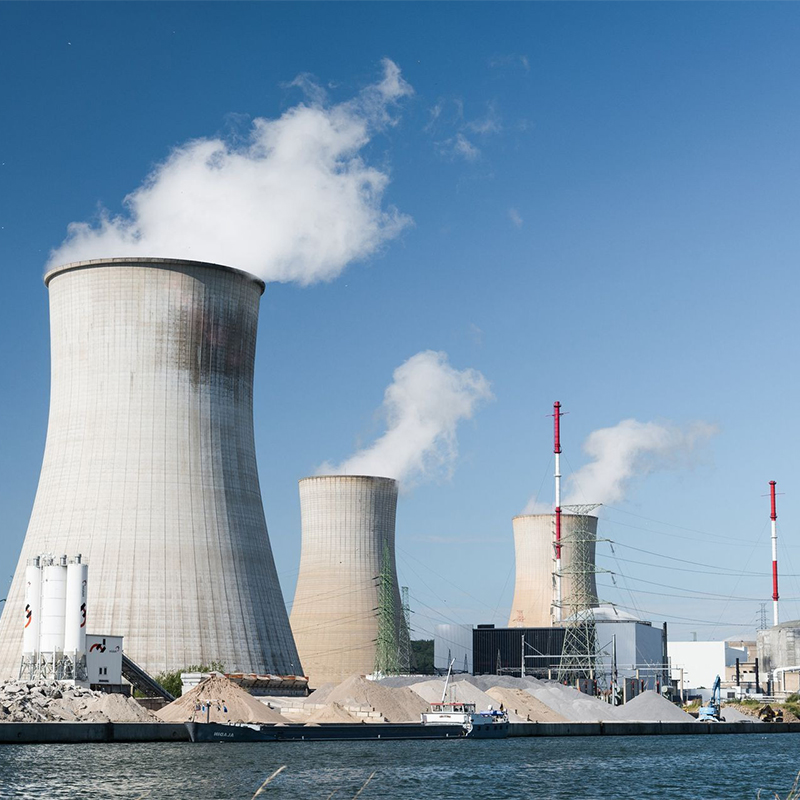
We Provide Cooling Tower Solution

Views: 0 Author: Site Editor Publish Time: 2025-11-24 Origin: Site


In industrial, HVAC, and power-generation fields, we often encounter a large piece of equipment known as a cooling tower. So what exactly is a cooling tower? Why is it so important?
This article provides a structured explanation—covering the definition, working principles, structure, main types, applications, selection guidelines, and maintenance—combined with product examples from the manufacturer MACH Cooling Tower (https://www.machcooling.com/).
A cooling tower is a heat-exchange device that cools a stream of water (or another working fluid) by releasing its waste heat to the atmosphere.
In most open (wet) cooling towers, hot water is sprayed or distributed over fill materials to increase the contact area between water and air. Air moves through the tower (either naturally or mechanically); a small portion of water evaporates and removes heat from the remaining water.
Many systems—chillers, condensers, chemical equipment, industrial machinery—generate large amounts of hot water. If not cooled effectively, system efficiency drops and equipment life shortens.
A cooling tower removes waste heat (“heat rejection”) by transferring it to the air.
Compared to dry coolers, wet cooling towers can reach lower outlet-water temperatures due to evaporative cooling.
According to MACH Cooling Tower, its products are “widely used in central air-conditioning, sugar plants, power plants, petrochemical, metallurgy, and dyeing industries,” showing their essential role in industrial temperature control.
Below are helpful diagrams showing the internal structure of cooling towers:
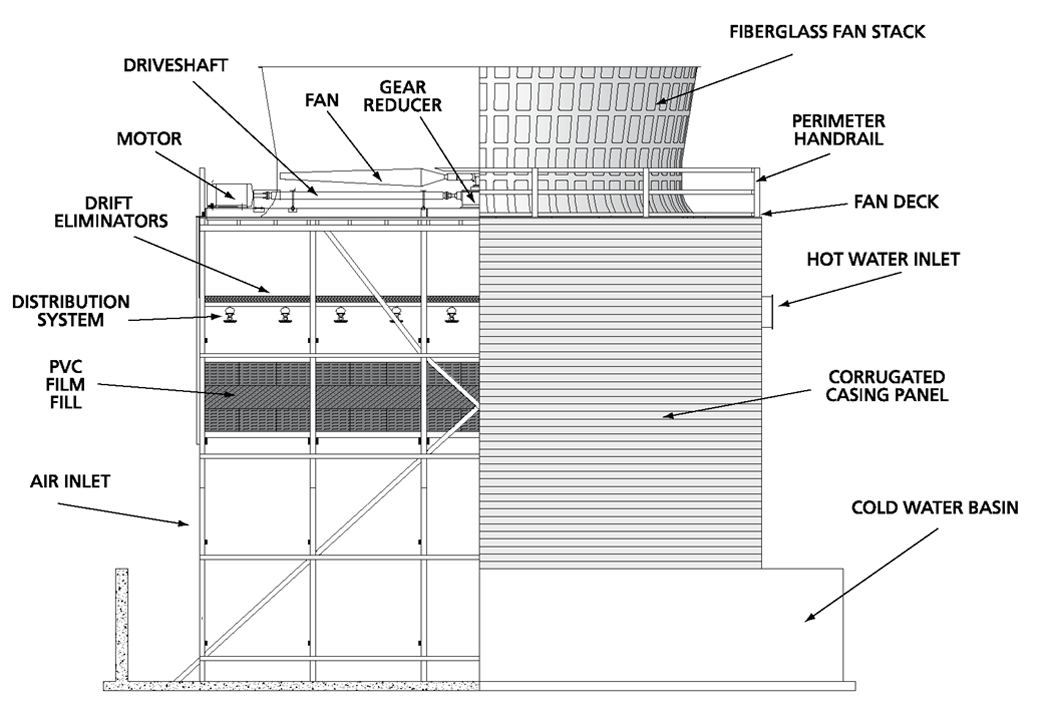
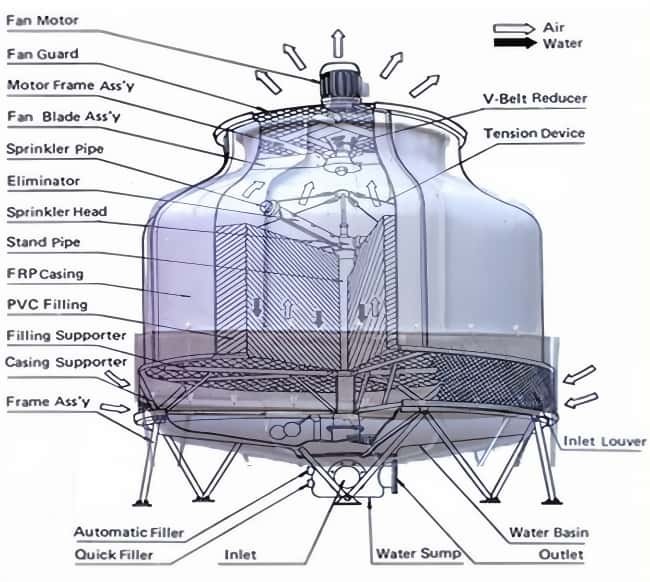
Typical components include:
Hot-water inlet & distribution / spray nozzles
Heat-exchange fill
Fan system / air inlets & outlets
Cold-water basin / return piping
Drift eliminators
Housing, framework, louvers, and structural panels
Hot water enters the tower and is sprayed or distributed over the fill. Air moves through the tower via natural draft or fans. A small portion of the water evaporates, absorbing heat and cooling the remaining water.
Simplified steps:
Hot water enters the cooling tower.
Water is distributed over fill to create large contact area.
Air flows through the tower.
A portion of water evaporates → absorbs heat → cools remaining water.
Cooled water collects in the basin and returns to the system.
Warm moist air exits the tower.
Cooling towers are categorized by the relative direction of water and air:
Cross-flow: Water flows downward; air enters horizontally.
Counter-flow: Water flows downward; air flows upward.
Counter-flow towers typically offer higher thermal performance but may require tighter structural design.
Critical factors affecting tower performance include:
Water flow rate
Airflow volume
Temperature difference (hot water vs. desired cold-water temp)
Fill characteristics (surface area, water-film thickness)
Ambient wet-bulb temperature
MACH Cooling Tower offers a variety of tower designs (cross-flow, counter-flow, closed-circuit, open-circuit) to match these conditions.
Use natural buoyancy of warm air; often large hyperbolic structures.
Use fans to ensure stable airflow and high efficiency.
Cross-flow cooling towers
Counter-flow cooling towers
Open cooling towers — water directly contacts air.
Closed-circuit cooling towers — working fluid flows inside coils; heat is transferred indirectly.
(MACH provides cross-flow, counter-flow, and hybrid closed-circuit towers.)
Industrial cooling towers (cross-flow & counter-flow)
Closed-circuit cooling towers
Open cooling towers
Custom-engineered cooling systems
Products cover HVAC, industrial processing, power, metallurgy, sugar production, textile, and more.
 |  |  |  |
HVAC systems for large buildings such as hotels, hospitals, and shopping malls
Power plants (condenser water cooling)
Petrochemical and chemical process cooling
Sugar mills, dyeing factories, metallurgy plants
Data centers and industrial refrigeration systems
Efficient cooling towers can substantially reduce system energy consumption:
Lower cooling-water temperature improves chiller performance
Reduced overall operating cost
Longer equipment life by maintaining stable process temperature
| Industry | Application |
|---|---|
| Power plants | Cooling of condenser circulating water |
| Petrochemical | Cooling reactor and heat-exchanger outlet water |
| Sugar & Dyeing | Cooling process water or dyeing rinse streams |
| Commercial HVAC | Cooling condenser water in chillers |
Heat load (kcal/h or BTU/h) or water flow (m³/h / GPM)
Inlet & outlet temperatures
Local wet-bulb temperature
Water quality (scaling, corrosion, dust)
Footprint limitations
Noise requirements
After-sales service and customization needs (MACH provides free samples & tailored solutions)
Level, strong, and corrosion-protected base.
Even distribution; avoid dead zones.
Follow safety and ventilation codes.
Ensure unobstructed air inlets/outlets.
Verify water flow, airflow, temperature drop, vibration, and noise.
Clean fill regularly to remove scale and biological growth
Inspect fan, gearbox, belts, bearings, and vibration
Monitor water chemistry (pH, hardness, TDS, microbiological content)
Maintain drift eliminators and ensure airflow passages are unobstructed
Keep logbooks and follow manufacturer maintenance schedules
MACH Cooling Tower is a specialized manufacturer of cooling towers and thermal-management equipment.
Its products are used in central AC systems, sugar mills, power stations, petrochemical processes, metallurgy, and textile dyeing.
Wide product range (open, closed, counter-flow, cross-flow)
Free samples & custom solutions
International-standard technical documentation
Strong OEM/ODM capability
Reliable after-sales support
Users can select MACH Cooling Tower models based on flow rate, temperature drop, and industry needs.
Cross-flow open towers → good for areas with ample ventilation
Counter-flow closed towers → ideal for high water-quality requirements and equipment protection
Cooling towers are essential heat-rejection devices used across industrial, commercial, and HVAC sectors.
From definitions, principles, and classifications to selection, installation, and maintenance—combined with the example manufacturer MACH Cooling Tower—this article gives a complete knowledge framework.
Proper selection, correct installation, and routine maintenance are the core factors ensuring long-term reliability and efficiency.
If your project requires cooling-tower consultation or custom design, MACH Cooling Tower provides a professional reference option.