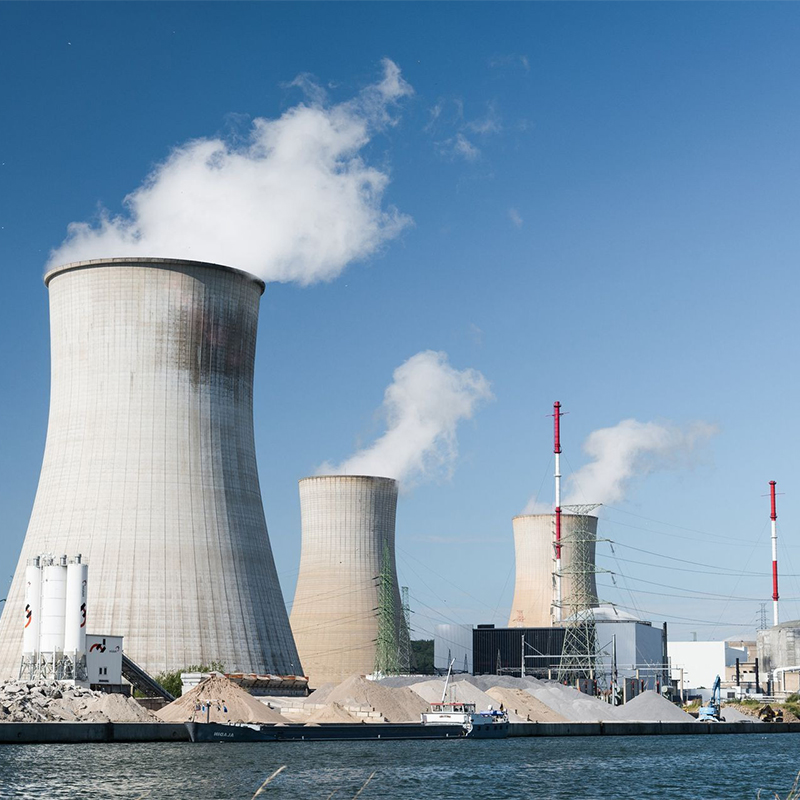
We Provide Cooling Tower Solution

Views: 0 Author: Cindy Publish Time: 2026-09-10 Origin: Site


If you have ever stood beside a cooling tower and wondered, “What exactly is this equipment, and what are its specifications?” the answer may be sitting right in front of you.
Look for the small metal or plastic plate attached to the tower. That is the cooling tower nameplate.
Although it may look like nothing more than a simple identification label, a cooling tower nameplate can provide valuable information about the equipment. Depending on the manufacturer and model, it may tell you the manufacturer, model number, serial number, cooling capacity, water flow, operating conditions, and other important technical details.
Why does this information matter?
When you need replacement parts, maintenance support, performance troubleshooting, or even a complete cooling tower replacement, guessing is never a good strategy. The wrong model or specification can lead to the wrong cooling tower fill, nozzle, drift eliminator, fan, motor, or other component.
In this guide, we'll explain what a cooling tower nameplate is, what information it contains, where to find it, how to read it, and why it matters when maintaining or replacing cooling tower equipment.
A cooling tower nameplate is an identification and specification plate attached to a cooling tower or one of its major components.
Think of it as the cooling tower's ID card.
The plate is generally designed to remain readable in a demanding environment where it may be exposed to moisture, heat, chemicals, dust, and outdoor conditions. Depending on the manufacturer, it may be made from stainless steel, aluminum, plastic, or another durable material.
A typical cooling tower nameplate may include:
Manufacturer name
Cooling tower model number
Serial number
Equipment identification number
Manufacturing date or year
Rated cooling capacity
Water flow information
Fan information
Motor information
Electrical specifications
Design operating conditions
Other product-specific technical data
Not every manufacturer uses exactly the same format. Some nameplates are relatively simple, while others contain a surprising amount of technical information.
Imagine taking your car to a mechanic without telling them the make, model, engine type, or year.
They could still inspect the vehicle, but identifying the correct replacement parts would be much harder.
The same principle applies to a cooling tower.
The nameplate gives technicians, engineers, operators, and suppliers a reliable starting point for identifying the equipment.
There is no universal location for every cooling tower nameplate.
Manufacturers usually install the nameplate somewhere that allows technicians to access the information without dismantling the entire tower.
Common locations include:
On the cooling tower casing
Near an access platform
On the structural frame
Near the mechanical equipment
Around the fan section
Near the motor or gearbox
Inside an accessible service area
Near the control panel
Large industrial cooling towers may also have separate identification or rating plates for individual components.
For example, the cooling tower may have one nameplate, while the motor, gearbox, pump, or electrical equipment has its own rating plate.
If you need technical information about an existing cooling tower, always look for the nameplate first.
You may save yourself hours of measuring components or searching through old documents.
The exact information depends on the manufacturer, tower type, and application.
However, several types of information are particularly useful when identifying or maintaining a cooling tower.
Let's take a closer look.
One of the first things you should identify is the manufacturer.
The manufacturer name tells you who designed or supplied the original equipment. This is important because different cooling tower manufacturers may use different model numbering systems, dimensions, component designs, and performance standards.
Suppose you need to replace cooling tower fill.
Knowing the original manufacturer can help a supplier understand the tower's original configuration before recommending replacement media.
Even if the original manufacturer is no longer available, the nameplate can still provide a valuable starting point for identifying an equivalent solution.
The model number is often one of the most useful pieces of information on a cooling tower nameplate.
Manufacturers use model numbers to identify a particular product series, tower size, configuration, or design.
Depending on the manufacturer, a model number may contain information related to:
Tower size
Product series
Cooling capacity
Water flow
Fan arrangement
Number of cells
Crossflow or counterflow configuration
Airflow arrangement
However, don't assume that every letter or number has the same meaning across different manufacturers.
A model number is essentially the manufacturer's own identification language.
If you are requesting replacement parts, give the supplier the complete model number rather than trying to interpret it yourself.
One missing letter or number can sometimes represent a different tower configuration.
That's why taking a clear photograph of the complete nameplate is often better than manually typing the information into an email.
The serial number identifies the individual cooling tower.
The model number tells you what type of equipment you have, while the serial number can distinguish one specific unit from another.
For example, two cooling towers can have the same model number but completely different serial numbers.
Depending on the manufacturer and available records, the serial number may help trace:
Manufacturing information
Original specifications
Service records
Replacement parts
Warranty information
Production records
Original equipment configuration
When contacting a manufacturer or supplier for technical assistance, provide the serial number whenever possible.
Another important parameter is the tower's rated cooling capacity.
Cooling capacity describes the amount of heat the cooling tower is designed to reject under specified operating conditions.
Depending on the manufacturer and region, capacity may be expressed in:
Tons of refrigeration
kW
BTU/h
Heat rejection capacity
However, don't compare cooling capacity numbers without checking the conditions behind the rating.
Cooling tower performance depends on several variables, including:
Entering water temperature
Leaving water temperature
Water flow rate
Entering-air wet-bulb temperature
Ambient conditions
Airflow
For example, simply saying that a cooling tower has a capacity of 500 tons does not tell you everything about its actual operating performance.
The design conditions matter just as much as the headline capacity.
Water flow is another critical cooling tower parameter.
A cooling tower must circulate a certain amount of hot water through the tower so that heat can be transferred from the water to the air.
Water flow may be listed in:
GPM
m³/h
L/s
Other regional units
This information is particularly useful when selecting replacement components.
For example, if you are replacing fill, nozzles, or water-distribution components, the expected water flow can influence the selection.
Too little water flow may result in poor wetting and reduced heat transfer.
Too much flow can contribute to excessive pressure drop, poor distribution, or other operating problems.
Some cooling tower nameplates or technical documents include design entering and leaving water temperatures.
The entering water temperature is the temperature of the hot water entering the cooling tower.
The leaving water temperature is the temperature of the cooled water leaving the tower.
The difference between these two temperatures is commonly referred to as the cooling range.
For example:
Entering water temperature: 95°F
Leaving water temperature: 85°F
Cooling range: 10°F
The cooling tower must remove enough heat from the circulating water to achieve the required leaving temperature.
Don't confuse cooling range with cooling tower approach.
Approach is generally the difference between the leaving water temperature and the entering-air wet-bulb temperature.
For example, if:
Leaving water temperature = 85°F
Entering wet-bulb temperature = 78°F
The approach is 7°F.
Approach is an important performance indicator because it shows how closely the tower can cool the water toward the entering-air wet-bulb temperature.
For mechanical-draft cooling towers, fan and motor information can be particularly important.
The cooling tower may have one nameplate, while the motor has a separate motor rating plate.
Motor information may include:
Motor manufacturer
Motor model
Horsepower
Voltage
Current
Phase
Frequency
RPM
Service factor
Frame size
Efficiency
Don't assume that the tower nameplate and motor nameplate contain the same information.
They identify different pieces of equipment.
The cooling tower nameplate identifies the overall tower.
The motor nameplate identifies the motor.
If you're replacing a motor, you will normally need the motor's own rating information rather than relying only on the cooling tower nameplate.
The nameplate or related documentation may also help identify the cooling tower configuration.
Common cooling tower types include:
Crossflow cooling towers
Counterflow cooling towers
Open cooling towers
Closed-circuit cooling towers
Induced-draft cooling towers
Forced-draft cooling towers
Mechanical-draft cooling towers
This information matters because different tower configurations use different internal components.
For example, replacement fill designed for one tower arrangement may not be suitable for another without checking the tower dimensions, airflow, water loading, and installation conditions.
Some cooling tower nameplates include the manufacturing date or year.
This information can help estimate the age of the equipment.
Why does equipment age matter?
Because cooling tower components don't last forever.
Over time, you may see deterioration in:
Fill media
Drift eliminators
Nozzles
Louvers
Fan blades
Bearings
Shafts
Motors
Gearboxes
Structural components
Knowing the approximate age of the tower can help you create a more realistic maintenance and replacement plan.
Large facilities often assign their own equipment identification numbers.
For example:
CT-01
CT-02
CT-03
This number may not come from the original cooling tower manufacturer.
Instead, it may be assigned by the facility owner, engineering contractor, maintenance department, or plant management team.
This is especially useful when a facility has several cooling towers or multiple tower cells.
Reading a cooling tower nameplate doesn't have to be complicated.
Start with the basic identification information and work your way through the technical data.
Find the manufacturer's name or logo.
This gives you the first clue about the original equipment.
Write down the complete model number.
Don't leave out letters, numbers, or suffixes.
The serial number is usually unique to the individual cooling tower.
Look for the rated cooling capacity and its unit.
If listed, record:
Water flow
Entering water temperature
Leaving water temperature
Wet-bulb temperature
Other design conditions
If the tower nameplate includes mechanical or electrical information, record it.
If you need motor replacement, also check the motor's own nameplate.
This is one of the simplest and most useful things you can do.
Take a high-resolution photograph of the entire nameplate.
A photograph preserves the original information and reduces the risk of transcription errors.
Cooling tower maintenance isn't simply about cleaning the equipment and replacing worn components.
Good maintenance starts with knowing exactly what equipment you have.
The nameplate provides a reliable starting point for that process.
Suppose your cooling tower isn't performing as expected.
You may need to inspect:
Cooling tower fill
Water distribution
Fan operation
Motor performance
Drift eliminators
Nozzles
Airflow
Water flow
Scale
Fouling
Corrosion
Before changing anything, identify the tower and verify its design information.
Otherwise, you're essentially troubleshooting a machine without knowing its original specifications.
This is where the cooling tower nameplate becomes especially valuable.
Imagine contacting a supplier and saying:
“I need replacement fill for my cooling tower.”
That's a good starting point, but it may not be enough.
The supplier may need to know:
Manufacturer
Model
Serial number
Tower type
Fill dimensions
Water flow
Existing fill type
Fill thickness
Operating temperature
Water quality
Installation arrangement
The nameplate can provide several of these details immediately.
For a replacement project, a good approach is to send the supplier:
A clear photo of the cooling tower nameplate.
Photos of the existing fill.
Fill dimensions.
Photos of the tower interior.
Current operating information.
The more complete the information, the easier it is for the supplier to recommend the correct component.
Sometimes, yes—but the nameplate alone is usually not enough.
The nameplate identifies the tower, but replacement fill selection also depends on the tower's internal geometry and operating conditions.
You may need to confirm:
Fill length
Fill width
Fill height
Sheet thickness
Flute or channel design
Material
Water loading
Airflow direction
Operating temperature
Water quality
For example, PVC film fill can be suitable for many relatively clean-water applications, while splash fill may be preferred for applications where suspended solids and fouling are greater concerns.
The nameplate should therefore be treated as the starting point rather than the complete replacement specification.
Don't panic.
Older cooling towers sometimes have damaged, faded, corroded, or completely missing nameplates.
You can still identify the equipment using other sources.
Check:
Original purchase documents
Equipment drawings
Maintenance records
Previous inspection reports
Manufacturer manuals
Service records
Equipment databases
Motor and gearbox nameplates
Old photographs
Previous replacement-part records
You can also measure the physical dimensions of the tower and its components.
If you're contacting a cooling tower manufacturer for assistance, provide as much information as possible.
Photos are particularly useful.
A qualified supplier may be able to identify the tower series or recommend a replacement based on photographs, measurements, and operating conditions.
A dirty nameplate isn't necessarily a lost nameplate.
Before replacing it, carefully clean the surface using an appropriate cleaning method.
Avoid aggressive cleaning that could remove printed information or damage the plate.
If only part of the information is visible, take several photographs under different lighting conditions.
You can also compare the visible model number with old maintenance documents.
The goal is to recover the original information instead of guessing.
Here's a simple maintenance habit that can save you a lot of trouble later.
Take a high-resolution photo of every cooling tower nameplate and store it digitally.
Create a simple equipment record containing:
Tower ID
Manufacturer
Model
Serial number
Capacity
Installation date
Tower type
Motor information
Replacement history
Maintenance history
Store the information in your facility's maintenance management system or asset database.
Why?
Because the nameplate may be easy to access today.
But five years from now, the tower may be surrounded by new equipment, the plate may have faded, or the technician who originally installed it may no longer be available.
A digital record gives you a reliable backup.
Older cooling towers deserve special attention.
You may encounter equipment that has been operating for 10, 20, or even 30 years.
In these cases, the original model may no longer be actively manufactured.
Does that mean you're stuck?
Not necessarily.
A qualified cooling tower supplier can evaluate the existing tower and recommend compatible replacement components.
Depending on the condition and design, you may be able to replace individual components such as:
Fill media
Drift eliminators
Nozzles
Louvers
Fan blades
Motors
Gearboxes
Shafts
Bearings
Instead of replacing the entire cooling tower.
The nameplate helps establish the starting point for this evaluation.
A cooling tower nameplate and a technical data sheet are not the same thing.
The nameplate is physically attached to the equipment.
A technical data sheet normally contains much more detailed information about the tower's design and performance.
A technical data sheet may include:
Design water flow
Heat rejection
Wet-bulb temperature
Water temperatures
Fan airflow
Fan diameter
Motor power
Dimensions
Weight
Materials
Performance curves
Think of the nameplate as the cooling tower's ID card, while the technical data sheet is its technical passport.
Both are useful, but they serve different purposes.
If your existing cooling tower is old, damaged, or difficult to identify, professional technical support can make the replacement process much easier.
Mach Industry (Zhejiang) Co.,Ltd is a cooling tower manufacturer and supplier offering industrial cooling towers, open cooling towers, and closed cooling towers, including crossflow and counterflow configurations. The company also provides customized cooling tower solutions and cooling tower spare parts.
When requesting a replacement or technical evaluation, providing your cooling tower nameplate information is highly recommended.
You can also provide photographs and measurements of the existing equipment.
This helps the technical team understand the existing application and determine a suitable cooling tower or replacement component.
For more information, visit the official Mach Cooling website.
If you're requesting a quotation, don't just send a short message saying, “Please quote a cooling tower part.”
Give the manufacturer enough information to understand your equipment.
A useful inquiry can include:
Cooling tower nameplate photo
Manufacturer
Model number
Serial number
Cooling capacity
Water flow
Existing fill type
Fill dimensions
Water temperature
Application
Water quality
Photos of existing components
Required quantity
The more information you provide, the easier it becomes for the supplier to recommend an appropriate solution.
It can also make the quotation process faster and reduce unnecessary back-and-forth communication.
Even experienced technicians can make mistakes when interpreting equipment information.
Here are some of the most common ones.
The model number is important, but it doesn't necessarily provide every specification required for a replacement project.
These plates identify different equipment.
Always check which component the plate belongs to.
GPM, m³/h, kW, tons, °F, and °C are not interchangeable.
Always confirm the units before using the information.
Rated capacity is based on specific design conditions.
Actual performance can change when operating conditions change.
If a value is unclear, don't guess.
Verify it using technical documents, measurements, maintenance records, or the manufacturer.
The primary purpose is to identify the cooling tower and provide important equipment information such as the manufacturer, model, serial number, capacity, and other specifications.
It is commonly located on the tower casing, structural frame, access area, mechanical section, or near control equipment. The exact location depends on the manufacturer and tower design.
Most professionally manufactured cooling towers have identification information, although the format and location can vary. Older equipment may have a missing, damaged, or unreadable nameplate.
Yes. The nameplate is an excellent starting point, but suppliers may also need dimensions, photographs, operating conditions, and information about the existing component.
The model number identifies the equipment design or product type. The serial number identifies the individual unit.
It may. Some nameplates list rated capacity directly, while others require you to refer to the manufacturer's technical documentation.
Look for maintenance records, drawings, manuals, purchase documents, photographs, and other equipment identification information. You can also provide a supplier with photographs and measurements to help identify the tower.
A cooling tower nameplate may be small, but its value is much bigger than its size suggests.
It can help you identify the manufacturer, model, serial number, capacity, and other important information about your cooling tower.
More importantly, it can help you avoid expensive mistakes.
Need replacement fill?
Need a new motor?
Need technical support?
Planning to upgrade an aging cooling tower?
Start with the nameplate.
Take a clear photograph. Record the model and serial number. Check the capacity and operating information. Then provide those details to your cooling tower manufacturer or supplier.
It's a simple step, but think of it as having the cooling tower introduce itself before you start working on it.
For cooling tower replacement, customization, or spare-part solutions, Mach Industry (Zhejiang) Co.,Ltd can evaluate your requirements and help develop a suitable cooling tower solution.