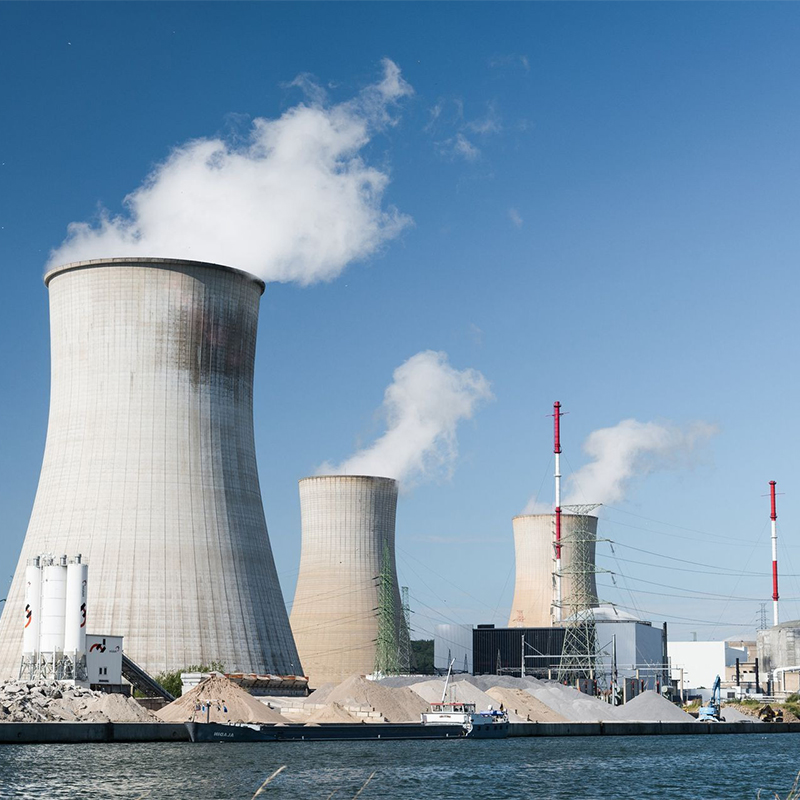
We Provide Cooling Tower Solution

Views: 0 Author: Site Editor Publish Time: 2025-11-24 Origin: Site


A building cooling tower is a critical component in many commercial or institutional HVAC (heating, ventilation, and air-conditioning) systems. Its primary function is to remove unwanted heat from a building’s cooling loop (often from a chiller) and discharge that heat into the atmosphere. By doing so, it helps maintain comfort, efficiency, and reliability in large buildings such as offices, hospitals, hotels, data centers, and more.
MACH Cooling Tower, a well-known manufacturer (https://www.machcooling.com/), provides a variety of cooling tower products that are widely applied in central air-conditioning scenarios, demonstrating their importance in building systems.
In large buildings, chillers generate chilled water (for air conditioning) and reject their heat via a condenser loop. That condenser water becomes hot and must be cooled before returning to the chiller. A building cooling tower takes in that hot water, cools it down through air contact and evaporation, and returns cooler water. This cycle enables continuous, efficient cooling.
Energy Efficiency: Evaporative cooling (used by many cooling towers) often achieves lower water temperatures than air-cooled alternatives, improving chiller efficiency.
Scalability: Cooling towers from MACH can support a wide range of loads — from small to very large HVAC systems.
Water Conservation: Though they use water, modern cooling towers like MACH’s closed-loop designs minimize water drift and loss.
Longevity and Durability: High-quality materials such as FRP (fiber-reinforced plastic) and corrosion-resistant components extend service life. MACH’s industrial towers, for example, can last 15–20 years with proper maintenance.
Hot condenser water from the chiller is pumped to the top of the cooling tower.
It is sprayed or distributed evenly over fill media, creating a large heat-transfer surface.
Air is drawn in (or pushed) through the tower. As water flows downward, air and water interact.
A small portion of water evaporates, removing latent heat from the remaining water.
Cooled water collects in a cold-water basin and is returned to the chiller.
Warm, moisture-laden air exits the tower into the atmosphere.
This process is known as evaporative cooling, and it is highly effective in building HVAC systems.
Building cooling towers may use different flow configurations:
Cross-flow: Water flows downward while air enters from both sides.
Counter-flow: Air flows upward opposite the falling water, offering higher thermal efficiency.
 |  |
Open Cooling Tower: The building’s condenser water directly contacts the air in the tower.
Closed-Circuit Cooling Tower: The building’s fluid (water or glycol mix) is contained in closed coils. External water spray and air cool the fluid indirectly. MACH offers robust closed-loop designs suitable for building applications.
A typical building cooling tower consists of:
MACH’s closed-loop towers use stainless-steel coils with high corrosion resistance.
Fasteners made from 304 stainless steel ensure long-term durability.
Fill is typically virgin PVC, resistant to biological growth and heat degradation.
Tower casing may use zinc-aluminum-magnesium coated steel, offering superior corrosion protection.
 |  |  |
Low-speed fans reduce noise and energy usage — important for rooftop building installations.
Drift eliminators minimize water losses; MACH designs can achieve drift rates under 0.01%.
Engineering considerations include:
Cooling load (heat to be rejected)
Condenser water flow rate
Approach temperature
Ambient wet-bulb temperature (critical in hot summers)
Water quality (scaling, corrosion, microbiological growth potential)
Roof structure must support tower weight.
Noise and vibration isolation are essential for occupant comfort.
Maintenance access (walkways, rails, service platforms) must be included in the design.
Regular blowdown controls mineral buildup.
Filtration and chemical treatment prevent scaling, corrosion, and bacterial growth.
Periodic cleaning of fill and basins is required.
Fan, motor, and drive components must be maintained for long service life.
Proper water treatment prevents Legionella and other microbial risks.
Drift eliminators limit water droplets and airborne contamination.
Building owners must implement strict water management plans.
Drift loss is minimized in well-designed towers; MACH models perform especially well.
Buildings must provide make-up water to replace evaporation, drift, and blowdown losses.
Variable-speed fans and proper controls reduce energy consumption.
Low-noise fans and vibration isolation pads help comply with building noise restrictions.
The tower should harmonize with architectural design, especially for rooftop placement.
MACH Cooling Tower is a professional manufacturer offering open and closed-loop cooling towers suitable for building HVAC.
Closed-loop options for high-purity or contamination-sensitive systems.
High corrosion resistance using stainless steel, FRP, and coated steel.
Compact design, suitable for rooftops with limited space.
Low-noise performance, ideal for buildings with acoustic requirements.
MACH offers custom configurations tailored to building load, water quality, and site constraints.
Provides maintenance, spare parts, and technical consultation.
Extensive experience across air-conditioning, power, petrochemical, and textile industries, enhancing reliability.
Below is an example table showing key specifications for selecting a MACH cooling tower for an office building:
| Parameter | Recommended Value / Notes |
|---|---|
| Cooling Load | 500 refrigeration tons (or equivalent) |
| Water Flow Rate | ~450–500 m³/h |
| Inlet Water Temperature | ~35 °C |
| Outlet Water Temperature | ~28 °C |
| Design Wet-Bulb | 24–26 °C |
| Tower Type | Counter-flow, closed or open |
| Materials | FRP casing + stainless steel coil (closed type) |
| Fan Type | Low-noise fan with optional VFD |
| Maintenance | Monthly inspection / quarterly cleaning / annual overhaul |
| Water Treatment | Blowdown, biocide dosing, scale inhibitor |
Limited rooftop space
Noise restrictions in urban areas
Water-quality issues causing scale and corrosion
Need for chemical dosing and trained maintenance personnel
Freeze protection in cold climates (especially for open towers)
Integrate cooling tower design early in the project phase.
Size the tower using local wet-bulb temperature data.
Plan a robust water treatment system.
Ensure safe, convenient maintenance access.
Use monitoring sensors and intelligent controls for optimization.
A building cooling tower is a core element of modern HVAC systems in large structures. By efficiently rejecting heat from the condenser loop, it allows chillers to operate sustainably and reliably. Choosing a trusted manufacturer like MACH Cooling Tower ensures durable, efficient, and well-supported equipment. Whether your project requires an open tower, a closed-loop unit, or a low-noise rooftop design, MACH provides solutions suited for various building needs.
Overall, while the initial investment and ongoing maintenance of a building cooling tower require proper planning, the long-term benefits in energy savings, comfort, and reliability make it indispensable for modern commercial buildings.