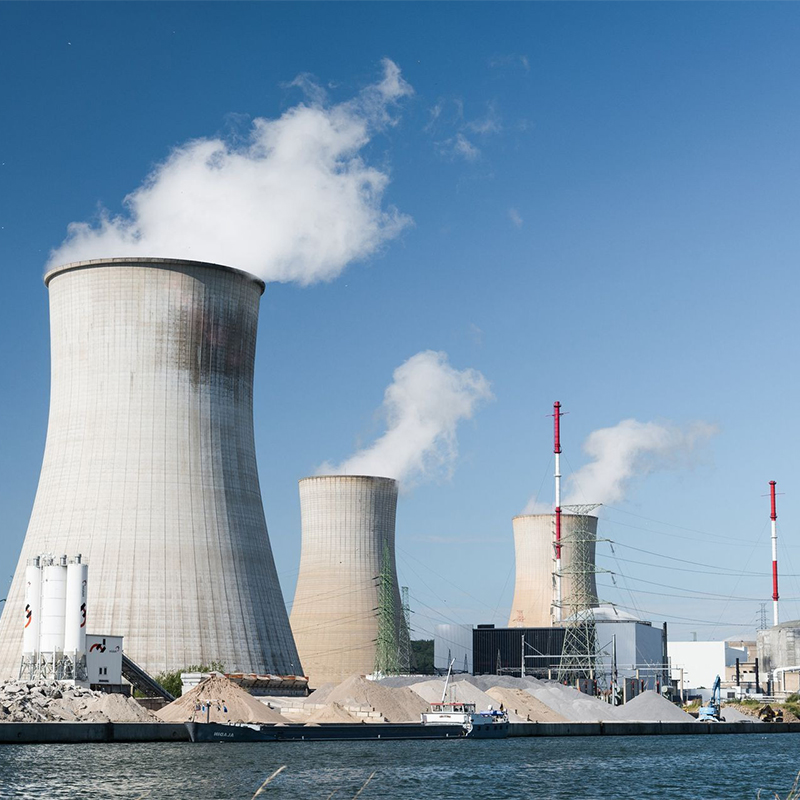
We Provide Cooling Tower Solution

Views: 0 Author: Site Editor Publish Time: 2025-11-24 Origin: Site


 Introduction
Cooling towers are essential heat-rejection devices widely used in industrial production, HVAC systems, power generation, and large commercial facilities. Their primary purpose is to dissipate unwanted heat from circulating water or process fluids into the atmosphere. As one of the leading cooling-tower manufacturers, Mach Cooling (https://www.machcooling.com/) provides comprehensive solutions including open-type, closed-circuit, crossflow, and counterflow cooling towers for global industrial applications.
A cooling tower removes waste heat from a system by lowering the temperature of circulating water. The cooled water is then pumped back into equipment (such as chillers, condensers, heat exchangers, and industrial machinery) to absorb heat again.
Cooling towers are widely used because many industrial processes generate heat continuously and require stable temperature control. Their key purposes include:
Heat rejection:Transfer waste heat from water to the atmosphere.
Stabilizing system temperature:Ensure optimal equipment performance.
Improving energy efficiency:Lower cooling load on chillers and compressors.
Extending equipment lifespan:Reduce thermal stress and prevent overheating.
Supporting large-scale cooling needs:Especially in factories, data centers, and power plants.
Most cooling towers operate based on evaporative cooling:
Warm water from the system enters the cooling tower.
The water spreads over fill media, increasing surface area.
Airflow (forced or induced by a fan) passes through the water.
A small portion of water evaporates.
Evaporation removes heat from the remaining water.
Cooled water collects in the basin and returns to the system.

Cooling towers use two types of heat transfer:
Sensible heat:The water temperature directly decreases.
Latent heat (evaporation):Most heat removal occurs through water evaporation.
Cooling towers typically feature:
Air flows horizontally; water flows vertically.
Easy maintenance and lower fan power.
Air moves upward while water flows downward.
Higher thermal efficiency.
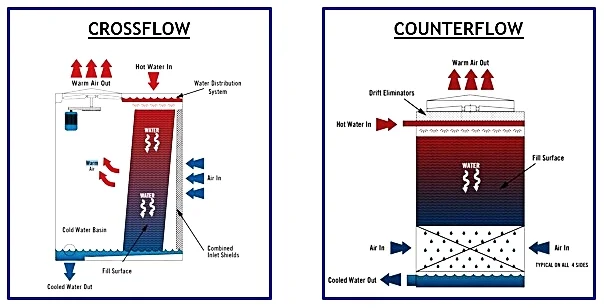
Below is a commonly used classification table.
| Category | Type | Description |
|---|---|---|
| By System Type | Open Cooling Tower | Water directly contacts air, high cooling efficiency |
| Closed Circuit Cooling Tower | Process fluid circulates inside coils, ideal for clean systems | |
| By Airflow Direction | Crossflow | Horizontal air, vertical water |
| Counterflow | Air rises upward, higher efficiency | |
| By Air Movement | Induced Draft | Fan pulls air upward |
| Forced Draft | Fan pushes air into the tower | |
| By Application | Industrial / HVAC | From manufacturing to commercial cooling |
Mach Cooling provides all of the above types, offering customized designs matching industrial loads and environmental requirements.
Cooling towers are widely used in:
Power plants(boiler condensers & steam cycles)
Chemical & petrochemical plants
Steel and metallurgy industries
Food and beverage processing
Pharmaceutical manufacturing
HVAC systems in hotels, malls, airports, hospitals
Data centers & server cooling
Cooling towers bring measurable value:
Reduce energy consumption
Improve equipment reliability
Maintain stable process temperatures
Reduce environmental impact
Support 24/7 operation in industrial facilities
(https://www.machcooling.com/)
Offers open and closed cooling towers for industrial and HVAC applications
Provides crossflow, counterflow, induced-draft, and modular designs
International manufacturing and export capability
Supports customized engineering solutions
Stable operation, high durability, and energy-efficient performance
Required cooling capacity (heat load)
Inlet & outlet water temperature
Wet-bulb temperature of installation site
Water quality and treatment requirements
Noise restrictions
Material & corrosion resistance
Operation and maintenance costs
Manufacturer quality (Mach Cooling as an example)
Evaporation causes water loss → requires make-up water
Drift eliminators reduce water droplets leaving the tower
Poor water treatment may cause scale or bacteria
Regular maintenance ensures safe and stable operation
The purpose of a cooling tower is to efficiently remove waste heat from water or process fluids, enabling industrial, HVAC, and mechanical systems to operate safely and efficiently. Cooling towers play a critical role in supporting modern manufacturing, power generation, and commercial infrastructure.
Manufacturers like Mach Cooling deliver advanced cooling-tower technologies—including open, closed, counterflow, and crossflow models—helping industries achieve reliable heat dissipation, energy efficiency, and long-term operational stability.