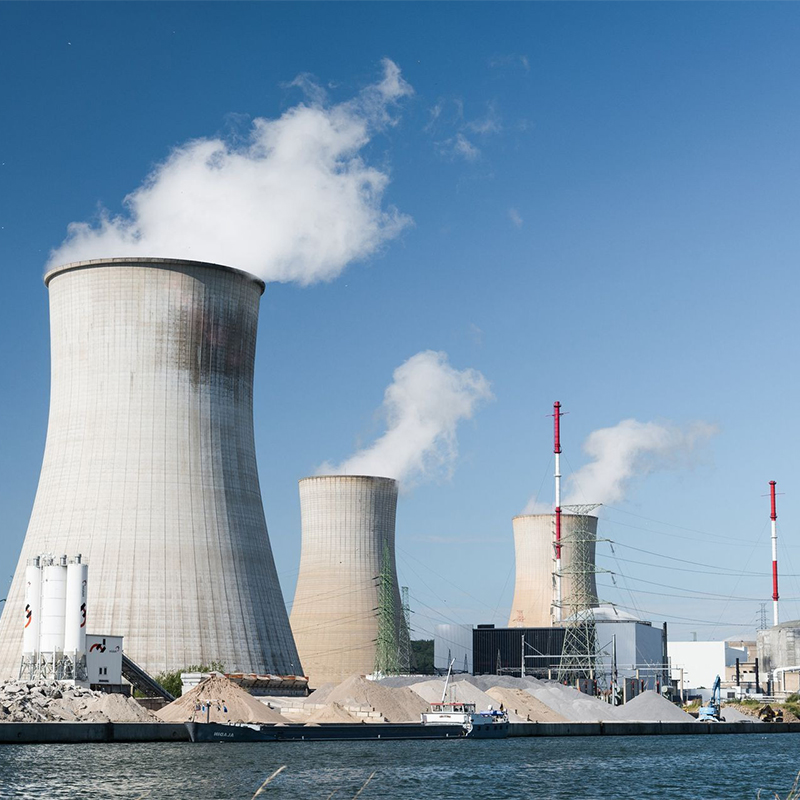
We Provide Cooling Tower Solution

Views: 0 Author: Site Editor Publish Time: 2026-02-02 Origin: Site


Cooling towers are the unsung heroes of industrial cooling. Whether you run a power plant, a manufacturing facility, or a large HVAC system, these towers are the workhorses that keep things from overheating. But here’s the kicker: not all cooling towers are created equal. Choosing between an open circuit and a closed circuit cooling tower can dramatically affect efficiency, maintenance costs, and the lifespan of your system. In this article, we’ll break down the parts of both types, their advantages, and help you understand which one is right for your industry.
At their core, cooling towers are heat rejection devices. They work by removing excess heat from water and releasing it into the atmosphere. Industries like power generation, petrochemical, HVAC, and food processing all rely on them to maintain optimal operating temperatures. But the difference between open and closed circuits lies not just in design, but in how water interacts with air, how maintenance is handled, and how efficient heat transfer is achieved.
Open circuit towers, also known as wet cooling towers, are the traditional design most people imagine. Here, process water is directly exposed to air. Heat is removed primarily through evaporation, making these towers highly effective in reducing water temperature quickly.
Open towers are relatively simple in structure but rely on a few critical components to operate efficiently:
The fan is the heart of airflow in an open circuit tower. It pulls or pushes air through the tower, enabling water to cool via evaporation. The motor drives the fan, and its efficiency directly impacts the tower’s overall energy consumption. Modern towers, like those from Mach Cooling, use high-efficiency motors to save power while ensuring optimal airflow.
Fill media is like the “cooling sponge” of a tower. Water spreads over the fill, maximizing contact with air, which accelerates heat transfer. PVC fill media is popular because it resists scaling and corrosion, lasting for years even under harsh conditions.
Without drift eliminators, water droplets would escape into the atmosphere, wasting water and potentially causing environmental issues. Drift eliminators capture these droplets, making open circuit towers more environmentally friendly.
The water basin collects cooled water at the bottom of the tower, while the distribution system ensures that water flows evenly over the fill. This prevents hot spots and minimizes scaling. Proper design is essential to keep your cooling system running smoothly.
High cooling efficiency thanks to direct evaporation.
Lower initial cost and simple design.
Easy to operate and maintain if water quality is well-managed.
Open towers are ideal for industrial setups where water is plentiful and easy to treat.
Closed circuit cooling towers, sometimes called hybrid or dry/wet towers, operate differently. Here, process water is enclosed in a coil, while air passes over the coil. Secondary water sprays enhance cooling without exposing the process fluid to the environment.
Closed towers are a bit more sophisticated and have unique parts designed to protect the process fluid:
The coil is the main feature of a closed circuit tower. It circulates the process fluid in a sealed loop, ensuring that it never contacts outside air. This reduces contamination, scaling, and corrosion.
Secondary water circulates around the coil, absorbing heat and boosting efficiency. This system can be optimized to achieve precise cooling targets.
Like open towers, fans move air across the coils. However, because the coils are sealed, airflow must be carefully engineered to maximize cooling without causing hot spots.
These components prevent water loss and ensure that air flows efficiently across the coil. They are specially designed for closed-loop operation.
Process water stays clean, reducing chemical treatment needs.
Reduced risk of corrosion and contamination, extending equipment life.
Flexible operation, suitable for sensitive processes like food, chemical, or pharmaceutical industries.
Let’s take a closer look at how these towers differ in structure, heat transfer, and maintenance:
Open Circuit: Direct water-to-air contact; simpler, lighter, and cost-effective.
Closed Circuit: Sealed coils, secondary water loops; slightly bulkier but safer for sensitive fluids.
Open Circuit: Evaporation is the main cooling method.
Closed Circuit: Combines evaporative and convective cooling, reducing water loss and contamination.
Open Circuit: Requires regular cleaning of fill media, drift eliminators, and water basins.
Closed Circuit: Needs coil inspections and cleaning, but benefits from reduced scaling and corrosion.
Mach Cooling Towers provides tailored open and closed circuit solutions for industries worldwide. Their designs focus on efficiency, durability, and easy maintenance.
Mach’s open circuit towers feature optimized airflow, drift eliminators, and high-quality PVC fill, ideal for HVAC systems, power plants, and chemical processing.
Mach’s closed circuit towers include high-efficiency coils, corrosion-resistant materials, and flexible installation options, making them perfect for sensitive fluids in pharmaceuticals, food, and chemicals.
Some people assume closed circuit towers are always superior. Not true! The best choice depends on your water quality, process fluid, space constraints, and maintenance capacity. Each design has its advantages.
Ask yourself:
Is water quality easy to maintain?
How sensitive is the process fluid?
What are the space and budget constraints?
Consulting experts like Mach Cooling can help you maximize efficiency, minimize maintenance costs, and extend equipment life.
Inspect water basins and coils monthly.
Clean fill media annually.
Check fans, motors, and drift eliminators regularly.
Ensure consistent water treatment to avoid scaling and corrosion.
Both open and closed circuit cooling towers have their place in industry. Understanding their parts, functions, and advantages helps you choose the right solution. If you want high-quality, efficient, and reliable cooling towers, check out Mach Cooling—industry-leading experts in both open and closed circuit designs.