We Provide Cooling Tower Solution

Views: 0 Author: Site Editor Publish Time: 2025-12-17 Origin: Site


In the design and performance analysis of a water cooling tower — especially when evaluating a complete water cooling tower system — understanding the concepts of range and approach is essential. These temperature metrics help engineers size towers correctly, specify operating limits, and ensure that a cooling installation meets its heat rejection targets. Metrics such as cooling tower water temperature, cooling tower water temperature range, and wet-bulb conditions fundamentally impact how the system performs under real-world conditions.
This article explains what range and approach mean, why they matter in cooling water tower design, and how they relate to key components like cooling tower water supply and the cooling tower water tank. We also look at how experienced water cooling tower manufacturers like Mach Cooling (https://www.machcooling.com/) integrate these principles to balance performance with water cooling tower price.
In simple terms:
Range is the difference between the hot water entering the cooling tower and the cooled water leaving the tower.
Approach is the difference between the cooled water temperature leaving the tower and the ambient wet-bulb temperature.
These two parameters help define cooling tower effectiveness and operating characteristics.
Cooling Tower Range
The range (ΔT_range) equals the hot water temperature entering the cooling tower minus the cold water temperature leaving the tower:
Range = Hot Water Temp − Cold Water Temp
Cooling Tower Approach
The approach (ΔT_approach) equals the cold water temperature leaving the tower minus the ambient wet-bulb temperature:
Approach = Cold Water Temp − Ambient Wet Bulb Temp
Understanding these temperatures is vital in evaluating and predicting how a water cooling tower system will perform.
Range reflects how much the water cools as it flows through the tower. It is largely determined by the amount of heat that must be removed from the process for which the tower serves (e.g., condenser cooling, process cooling). Since range depends on heat load and water flow, it may remain relatively constant under steady operating conditions.
For example:
If the hot return water from a condenser is 40°C and the cooled water supply is 30°C,
then the range is 10°C.
Approach is closely tied to the ambient wet-bulb temperature — the lowest temperature that water can theoretically cool to through evaporation. The lower the approach, the closer the cold water temperature is to the wet-bulb temperature, and thus the better the tower performance. However, achieving a very low approach usually means larger tower fill area, higher fan capacity, and greater construction cost.
Example:
If the cooled water leaves at 30°C and the wet-bulb temperature is 25°C, the approach is 5°C.
| Parameter | Definition | Why It Matters |
|---|---|---|
| Hot Water Temp | Water entering the tower from process | Determines the initial thermal load |
| Cold Water Temp | Water leaving tower to process | Determines how cooled water returns to system |
| Range | Hot − Cold | Measures how much water cools in tower |
| Approach | Cold − Wet Bulb | Measures how close water gets to ambient wet bulb conditions |
| Wet-Bulb Temp | Ambient air measure including humidity | Sets the theoretical lower limit for cooling |
Understanding these relationships helps engineers predict cooling tower water temperature range and ensure system targets can be met.
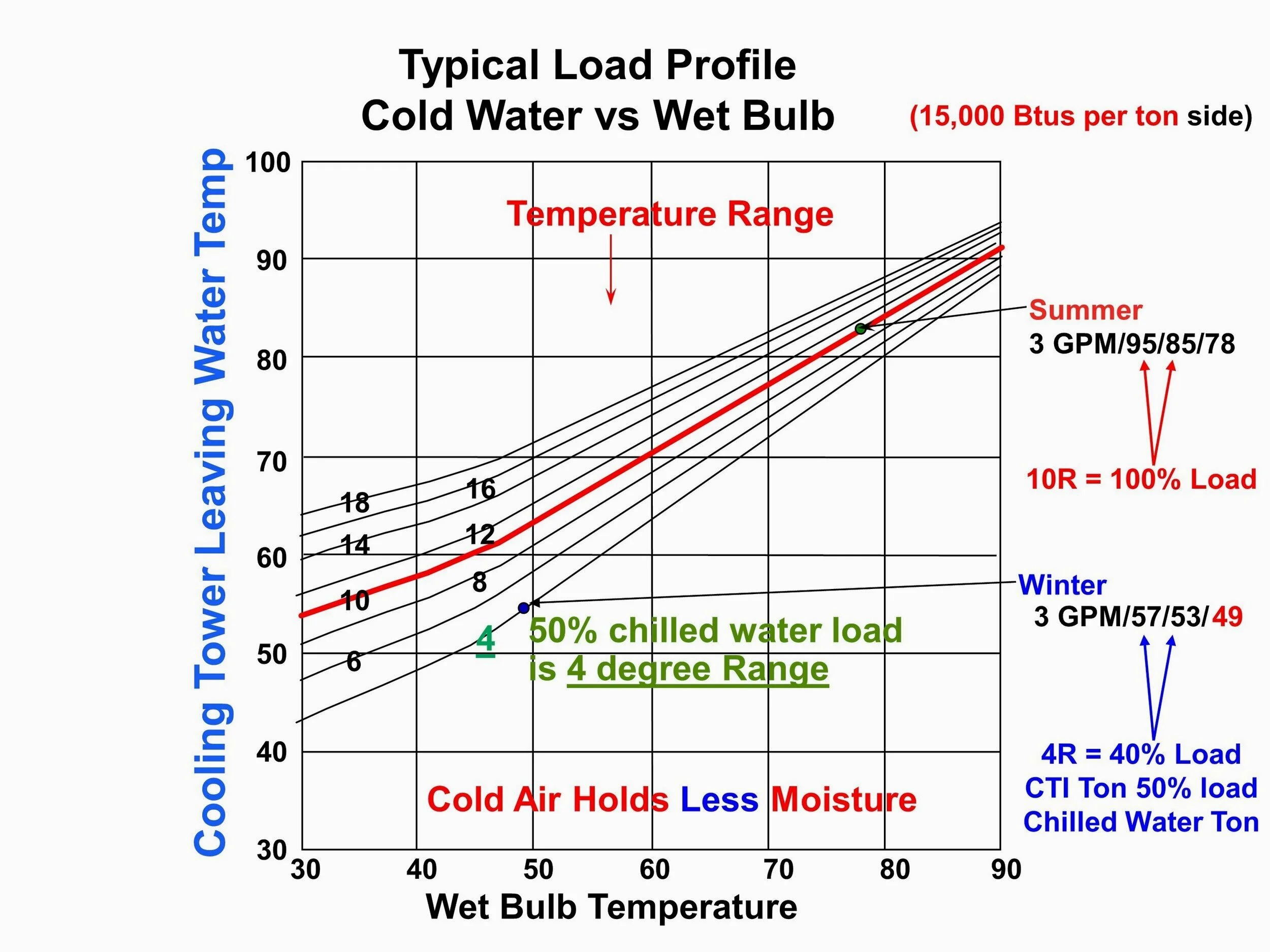
One useful way to visualize range and approach is with a temperature profile chart.

The curve typically begins with the hot water temperature entering the cooling tower.
It drops down to the cold water temperature leaving the tower — the difference between the two is the range.
The vertical gap between the cold water temperature and the ambient wet-bulb temperature is the approach.
In professional cooling water tower design, engineers balance range, approach, and cost:
Heat Load Matching: Range reflects the actual heat rejected from the process. For HVAC or industrial applications, designers choose tower size and water flow to handle expected heat loads with a given range.
Pump Sizing and Water Flow: A larger range often means a higher water temperature drop, influencing pump capacity and circulation rates.
Tower Size: Smaller approach values indicate better performance — but achieving this requires more fill surface and bigger towers.
Energy Use: To lower approach, more airflow and evaporation surface are needed, increasing fan power.
A typical design might assume:
| Design Parameter | Typical Value |
|---|---|
| Ambient Wet-Bulb Temp | 25°C |
| Hot Water Temp | 40°C |
| Cold Water Temp | 30°C |
| Range | 10°C |
| Approach | 5°C |
Such typical ranges and approaches are used in sizing calculations and performance guarantees by water cooling tower manufacturers like Mach Cooling, who balance performance and water cooling tower price.
Range and approach values change with operating conditions:
Higher wet-bulb temperature: With a higher wet-bulb (warmer, more humid air), the approach may increase unless tower size or airflow increases.
Higher heat load: If the process produces more heat without changing water flow, range may increase and approach may worsen.
System modifications: Changing water flow rates, fill media, or fan settings alters how range and approach manifest in operation.
Good mechanical and thermal design ensures the tower meets cooling requirements under a range of environmental conditions.
Beyond range and approach alone, designers consider cooling tower efficiency, which links them:
Efficiency (%) = Range / (Range + Approach)
This formula helps express how close a tower’s performance is to ideal — where the cold water temperature is as close to the ambient wet-bulb as possible.
Example:
If range = 10 and approach = 5,
Efficiency = 10 / (10 + 5) × 100 = 66%
Efficiency metrics are helpful in comparing different design options and their water cooling tower price vs performance trade-offs.
Here’s a practical scenario in a typical industrial cooling system:
| Condition | Temperature (°C) |
|---|---|
| Ambient Wet-Bulb Temp | 26 |
| Hot Water Temp (to tower) | 40 |
| Cold Water Temp (from tower) | 31 |
| Range | 9 |
| Approach | 5 |
In this case:
The cooling tower reduces incoming water from 40°C to 31°C (range = 9°C).
With a wet-bulb of 26°C, the approach is 5°C — meaning the tower brings water within 5°C of ambient wet-bulb limits.
When selecting a water cooling tower system, engineers must consider:
Desired cold water temperature at design conditions
Local climate wet-bulb temperatures
Process heat loads and water flow rates
Tower size and structure
Cooling tower water supply capacity and distribution
Cooling tower water tank sizing and integration
Experienced water cooling tower manufacturers such as Mach Cooling help clients choose designs that hit performance targets (range and approach) while managing cost and lifecycle value.
Range and approach are key performance metrics in cooling tower engineering. Range quantifies how much the water cools across the tower, while approach measures how close the cooled water gets to the ambient wet-bulb temperature — the lower limit set by atmospheric conditions. These values are central to cooling water tower design, influencing tower size, airflow, cost, and overall performance.
Understanding and appropriately applying range and approach helps engineers specify systems that reliably meet cooling needs at competitive water cooling tower price, with stable cooling tower water temperature performance, effective cooling tower water supply, and well-designed cooling tower water tank systems supported by trusted providers like Mach Cooling.