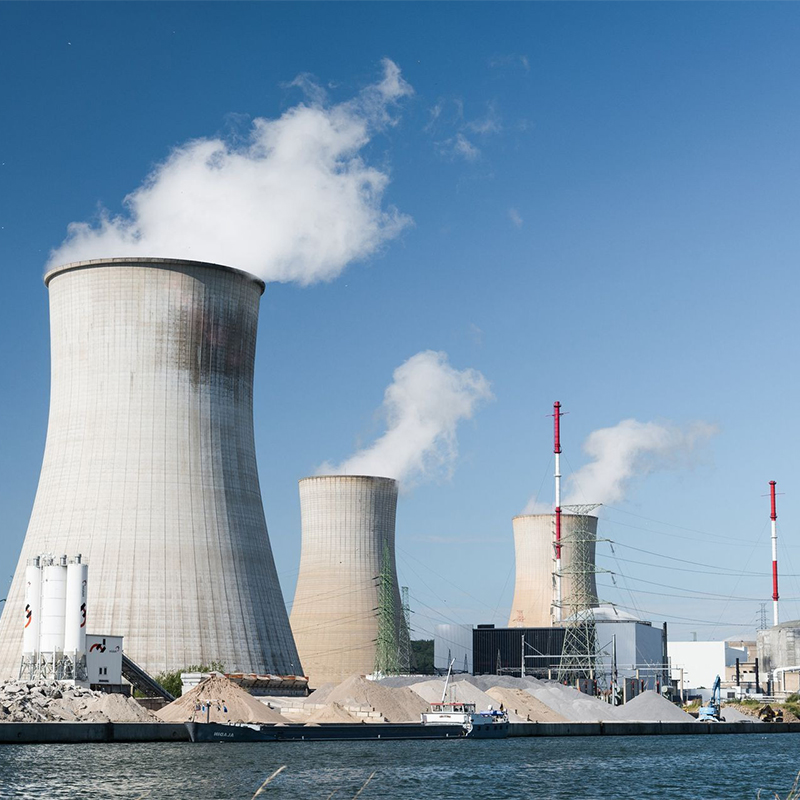
We Provide Cooling Tower Solution

Views: 0 Author: Site Editor Publish Time: 2025-12-27 Origin: Site


Cooling towers are the unsung heroes of modern industry. From power plants to commercial buildings, they quietly remove heat and keep systems running smoothly. Among all designs, the induced draft cooling tower stands out as the most widely used and trusted solution. But what exactly is it, and why do engineers prefer it so much? Let’s walk through it together—step by step, in plain English.
If you’ve ever seen a tall cooling tower with a spinning fan on top, you’ve likely spotted an induced draft cooling tower in action. These towers are everywhere—from large industrial plants to commercial HVAC systems—and they play a critical role in heat rejection. While the mechanics are simple, the results are powerful.
An induced draft cooling tower is a type of evaporative cooling tower where the fan is installed at the top of the structure. The fan “induces” air to flow upward through the tower, enabling hot circulating water to release heat efficiently via evaporation. Unlike forced draft towers, where air is pushed into the tower, induced draft towers pull air through, offering stable and controlled airflow.
The working principle is straightforward yet highly effective. Hot water enters the tower, air is drawn upward, and heat is dissipated to the atmosphere.
The top-mounted fan creates a low-pressure zone inside the tower. Fresh ambient air enters through side or bottom air inlets, flows upward through the fill section, and exits at the fan stack. This vertical airflow reduces hot air recirculation and ensures consistent cooling even in challenging weather.
Hot water is evenly distributed over the fill media. As it trickles downward, it meets the upward-moving air. Some of the water evaporates, carrying heat away. The cooled water collects in the cold water basin and is pumped back into the system for reuse. It’s much like how evaporation cools your skin on a hot day—simple physics doing the work.
Every component plays a key role in cooling efficiency.
Located at the top, the fan ensures uniform airflow and high heat rejection. Modern towers often use variable-speed fans to save energy during partial loads.
The fill increases contact between air and water. More surface area means more heat transfer, resulting in lower approach temperatures.
These capture water droplets before air exits, reducing water loss and protecting nearby structures.
The basin collects cooled water and provides a stable supply for recirculation. Proper design prevents sediment buildup and simplifies maintenance.
The name comes from the airflow method. Since the fan pulls air through the tower, rather than pushing it, the system maintains consistent airflow, reduces recirculation, and improves performance across various operating conditions.
Forced draft towers have fans at the air inlets, pushing air into the tower. Induced draft towers place the fan at the exhaust, pulling air through the system. This small difference has a big impact on efficiency.
Induced draft cooling towers generally offer higher thermal efficiency, less recirculation, and more stable performance under varying loads, which is why they dominate modern applications.
Air flows horizontally across the falling water. These towers are easier to maintain and are often used in commercial HVAC systems.
Air moves upward while water flows downward, creating direct counterflow. This design achieves superior heat transfer, making it ideal for industrial applications.
High thermal efficiency
Stable airflow control
Reduced hot air recirculation
Long service life and scalability
The elevated fan position may complicate maintenance, and fan energy consumption is slightly higher than other designs. However, modern variable-speed fan technology and proper operation minimize these issues.
Used in office buildings, hospitals, malls, hotels, and airports for condenser water cooling.
Widely applied in power plants, petrochemical facilities, metallurgy, plastics, and manufacturing industries.
Optimized airflow and advanced fan controls allow induced draft towers to deliver excellent energy efficiency, reducing operating costs and minimizing water and chemical usage.
Routine inspections of fans, motors, fill, water distribution, and water quality are critical. Preventive maintenance is key to avoiding unplanned downtime and extending service life.
Scaling, biological growth, or drift loss usually result from poor water treatment—not tower design. Addressing these through proper water chemistry management and routine maintenance solves most operational issues.
Selection depends on:
Heat load
Ambient wet-bulb temperature
Water quality
Available footprint
Energy efficiency goals
Working with an experienced manufacturer ensures the tower is properly sized and engineered.
At Mach Cooling, induced draft cooling towers are designed for efficiency, reliability, and long-term durability. With high-quality materials, optimized airflow, and tailored solutions, Mach Cooling helps customers reduce operating costs while maintaining consistent cooling performance.
An induced draft cooling tower is more than just industrial equipment—it’s a smart, efficient, and reliable solution for heat rejection. Its superior airflow control, high efficiency, and wide applicability make it the preferred choice for industries and commercial buildings worldwide. When engineered by trusted manufacturers like Mach Cooling, it delivers long-term reliability, low operating costs, and outstanding performance.