We Provide Cooling Tower Solution

Views: 0 Author: Site Editor Publish Time: 2025-12-11 Origin: Site


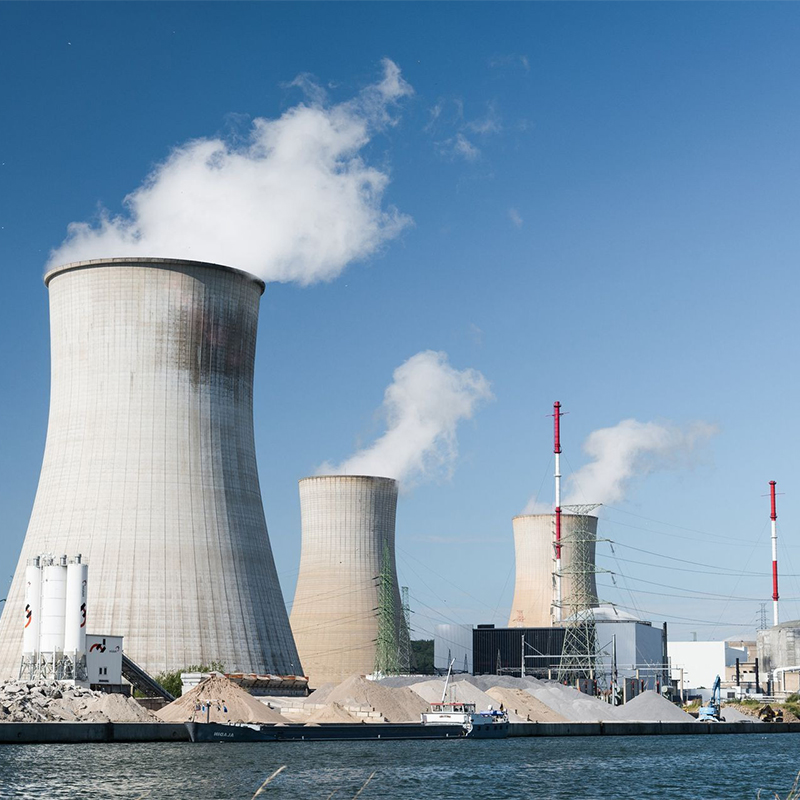
A nuclear cooling tower is one of the most iconic structures in any nuclear power plant. Although many people associate these massive hyperbolic towers with radiation, their function is actually much simpler — they cool water. Cooling towers serve as enormous heat-rejection devices that release unwanted heat from the plant’s power-generation cycle into the atmosphere.
This article explains what a nuclear cooling tower does, how it works, its internal components, and why its function is essential for safe, efficient power production.

Cooling towers in nuclear power plants serve the same purpose as those in fossil-fuel power plants — they remove excess heat from the circulating water.
However, due to the scale of nuclear reactors and the heat they generate, the towers are usually much larger and engineered for extremely stable long-term performance.
They do not handle radioactive water. The cooling water loop used in the tower is separate, ensuring no radiation can escape into the environment.

A nuclear cooling tower uses a physical process called evaporative cooling, relying on heat exchange between warm water and ambient air.
After absorbing heat from the reactor steam-cycle condenser, warm water (usually 30–40°C) is pumped to the top of the cooling tower.
Inside the tower, a structure called fill spreads water into thin films or droplets, maximizing the surface area for heat transfer.
The most common nuclear cooling towers are natural-draft hyperbolic towers, where air rises naturally through the chimney-shaped structure.
Cool air enters at the bottom.
Warm, moist air rises upward.
A small portion of the water evaporates, removing heat from the remaining water.
This cooled water collects at the tower basin.
The cooled water is pumped back to the plant’s condenser, ready to absorb more heat.
Below is a simple table summarizing the cycle:
| Stage | Process Description | Temperature Change |
|---|---|---|
| 1 | Hot water enters tower | 30–40°C |
| 2 | Water spreads across fill | Heat transfer begins |
| 3 | Airflow enhances cooling | Evaporation occurs |
| 4 | Water cools and collects | Drops to 20–25°C |
| 5 | Water returns to the plant | Ready for reuse |
Cooling towers are essential for maintaining the safe operation of a nuclear power plant. Without effective heat removal, the condenser — and ultimately the entire reactor system — cannot function.
The condenser converts exhaust steam back into water. For this process to be efficient, the cooling water must be as cold as possible.
By stabilizing condenser pressure, cooling towers help maintain the correct thermodynamic conditions for steam generation.
Cooling towers reduce the need for drawing large volumes of cooling water from natural sources such as rivers or lakes, protecting aquatic ecosystems.
A cooling tower enables uninterrupted plant operation by maintaining the thermal balance.

Although natural-draft towers are most common, multiple types exist depending on the plant’s design and environmental requirements.
Hyperbolic shape
No fans required
Airflow occurs naturally
Very high cooling capacity
These are iconic in nuclear stations due to their ability to handle massive heat loads.
Use fans for forced or induced draft
Usually smaller than natural-draft towers
Suitable for auxiliary or backup cooling
Combine natural airflow with fan assistance
Reduced visible plume
Used where environmental restrictions apply
To perform efficient heat exchange, cooling towers rely on several key internal components.
Creates a large surface area, allowing hot water to spread into thin films.
Splash fill
Film fill
Modular PVC fill
Prevent water droplets from escaping the tower with upward airflow.
They protect surrounding areas from excessive moisture.
Pipes, nozzles, or basins distribute water evenly across the fill.
Collects cooled water at the bottom of the tower.
Allow fresh air to enter for evaporative cooling.
The water in the cooling tower loop is non-radioactive.
Radioactive water stays confined within the reactor’s primary cooling loop.
The visible cloud exiting the cooling tower is simply water vapor, not smoke or radioactive material.
Cooling towers reduce thermal pollution by minimizing the amount of hot water discharged into natural bodies of water.
| Advantage | Explanation |
|---|---|
| High thermal efficiency | Supports condenser performance and steam cycle efficiency |
| Environmental protection | Limits heat discharge into rivers and lakes |
| Reliable operation | Enables continuous power generation |
| Lower long-term costs | Natural airflow reduces energy consumption |
A nuclear cooling tower plays an essential role: removing excess heat from the power plant’s condenser and ensuring stable, efficient, and safe operation. Although they are often misunderstood, cooling towers are simple, non-radioactive heat exchange structures that enable nuclear plants to operate continuously while reducing environmental impact.