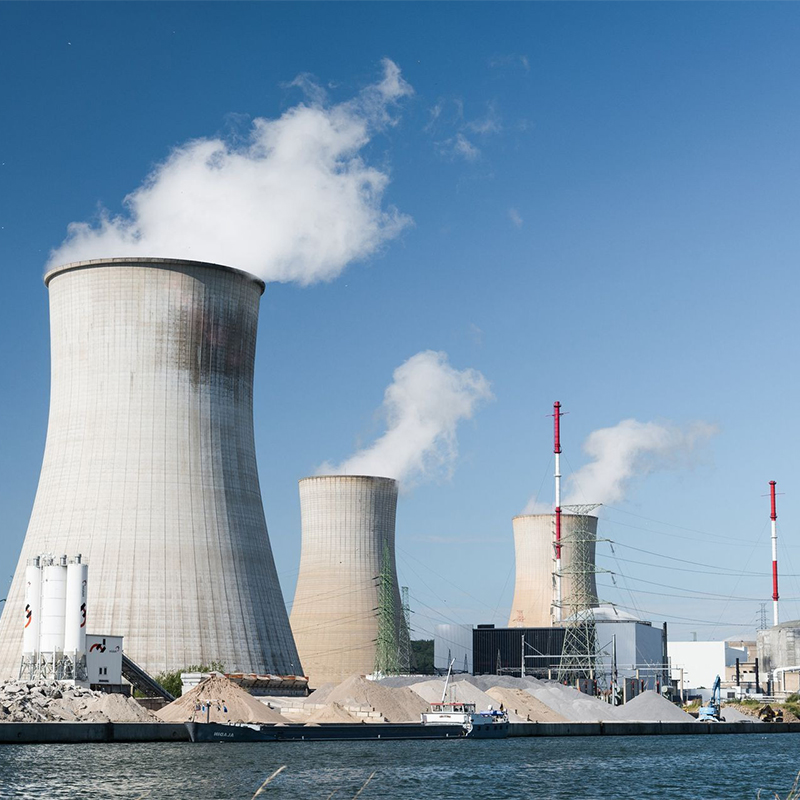
We Provide Cooling Tower Solution

Views: 0 Author: Site Editor Publish Time: 2025-07-07 Origin: Site


Under the dual pressure of global warming and resource shortage, the energy-saving and environmental protection performance of industrial cooling systems has increasingly drawn attention. Cooling towers, as essential equipment in industries such as power, chemical engineering, and data centers, have particularly prominent issues of energy consumption and water resource consumption. In recent years, with technological advancements and policy-driven approaches, the cooling tower industry has achieved remarkable breakthroughs in water conservation, energy conservation, intelligence, and low-carbon operation. This article will explore the energy-saving and environmental protection innovations of cooling towers, analyze the current technological trends, and look forward to the future development paths.
Traditional open cooling towers rely on evaporation for heat dissipation, resulting in a significant loss of water resources. According to statistics, water used in industrial cooling systems accounts for more than 50% of the global industrial water consumption. To address this issue, closed cooling towers and dry-wet combined cooling towers have become the mainstream innovation directions in the industry.
The V-shaped closed cooling tower developed by Jiangsu Shuangliang Cooling System features a unique V-shaped tube bundle layout, which reduces evaporation loss and enhances heat exchange efficiency, significantly lowering the demand for industrial water.
Jiangsu Changnuo Energy's "Low-carbon Fogging and Water-saving Cooling Tower" combines bionic fiber membranes and condensation devices to intercept water droplets in the hot and humid air, reducing water vapor emissions and increasing the water-saving rate by more than 30%.
Shandong Kaixiang Heat Transfer Technology's patented technology optimizes heat dissipation through adjustable louvers and finned tube groups, reducing the amount of spray water in low-temperature environments and achieving dynamic water conservation.
These innovations not only reduce the operating costs of enterprises, but also provide feasible solutions for global water resource protection.

The energy consumption of cooling towers mainly comes from fans, water pumps and refrigeration systems. In recent years, magnetic levitation, frequency conversion technology and intelligent algorithms have become the key to energy efficiency optimization.
Delta's magnetic levitation ice machine can increase efficiency by 40% while reducing mechanical friction losses. Its direct drive variable frequency cooling tower solution eliminates the gearbox, increasing the full-load efficiency by 60%.
The intelligent regulating closed cooling tower of MACH Cooling Tower adopts split air valves and alternating spray water pumps to prevent fan backflow short circuits and optimize air volume distribution. The automatic air distribution system of Jiangsu Lantian Heat Transfer, in combination with the identification of extreme weather, dynamically adjusts the operation strategy to reduce the risk of high energy consumption.
Some cooling towers integrate semiconductor thermoelectric power generation and photovoltaic panels, utilizing waste heat and solar energy to achieve partial self-power supply, reducing reliance on external power.
These technologies have transformed cooling towers from passive heat dissipation devices into highly efficient and intelligent systems, significantly reducing industrial electricity demand.
The operation of cooling towers not only consumes energy but also may form haze due to the emission of water vapor, affecting air quality. In recent years, low-carbon defogging technologies and environmentally friendly materials have become the focus of research and development.
These innovations not only align with the global carbon neutrality goal but also enhance the environmental friendliness of cooling towers.

With the popularization of the Internet of Things (IoT) and artificial intelligence (AI), the energy-saving management of cooling towers is moving towards a higher level of intelligence:
By monitoring water quality, vibration and energy consumption through sensors, faults are warned in advance to reduce unplanned downtime.
By integrating big data to simulate the operating status of cooling towers, parameters such as cooling tower fan and spray volume can be dynamically adjusted to achieve the best energy efficiency.
In the future, carbon capture technology (CCUS) may be integrated to recycle and reuse the CO₂ emitted by cooling towers, forming a closed-loop system.
The energy-saving and environmental protection innovations of cooling towers are profoundly changing the way industrial heat dissipation is achieved. From water-saving design, high-efficiency frequency conversion to intelligent fog elimination, technological progress not only reduces enterprise costs but also provides crucial support for global sustainable development. In the future, with the promotion of policies and technological iterations, cooling towers will continue to evolve in the direction of zero carbon, intelligence and systematization, and become an important part of green industrial infrastructure.