We Provide Cooling Tower Solution

Views: 0 Author: Site Editor Publish Time: 2026-01-26 Origin: Site


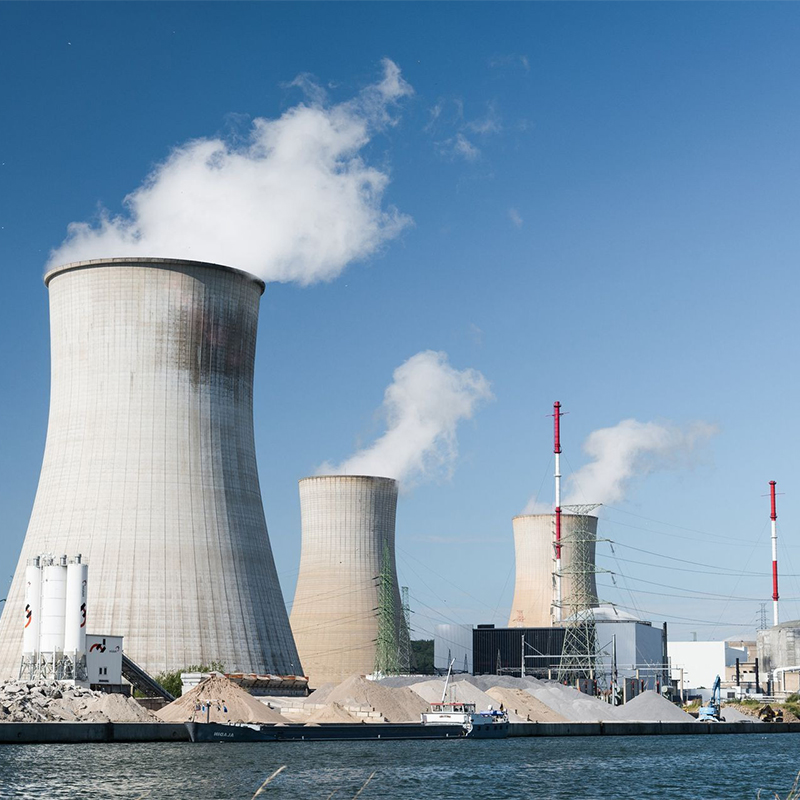
Hyperbola cooling towers are among the most recognizable industrial structures on the planet. Rising like giant concrete hourglasses beside power plants, they look simple from the outside—but inside, they are masterpieces of engineering.
In this article, we’ll take a deep dive into the hyperbola cooling tower structure, focusing on the four core components that make everything work smoothly: the shell, fill, basin, and airflow system. Along the way, we’ll explain how these parts interact, why the hyperbolic shape matters, and how professional manufacturers like MACH Cooling design towers that last for decades.
A hyperbola cooling tower—also called a hyperbolic natural draft cooling tower—is designed to cool massive volumes of circulating water without mechanical fans. Instead of relying on motors and gearboxes, it uses natural airflow driven by temperature and density differences.
Because of this fan-free operation, hyperbola cooling towers are widely used in:
Thermal power plants
Nuclear power stations
Steel and metallurgical facilities
Large petrochemical and industrial complexes
For projects where reliability, energy efficiency, and long service life matter, this type of cooling tower remains the gold standard.
The hyperbolic shape is not chosen for looks—it’s chosen for performance.
Structurally, the curved surface distributes stress evenly across the shell, allowing the tower to resist wind loads, seismic forces, and its own enormous weight. Aerodynamically, the narrow waist accelerates rising air, strengthening the natural draft.
You can think of it like a perfectly shaped funnel: wide enough to let air in freely at the bottom, tight enough in the middle to speed things up, and tall enough to keep the flow moving upward.
Inside the tower, warm and moist air becomes lighter than the cooler ambient air outside. This density difference creates a continuous upward movement—known as the stack effect.
No fans. No electricity. Just physics doing the work 24/7.
A hyperbola cooling tower is built around four essential systems:
The reinforced concrete shell – the structural backbone
The fill system – where heat transfer takes place
The cold water basin – where cooled water is collected
The airflow system – enabling natural draft ventilation
Each part depends on the others. A strong shell without proper airflow won’t cool efficiently, and high-performance fill won’t help if water collection is poorly designed.

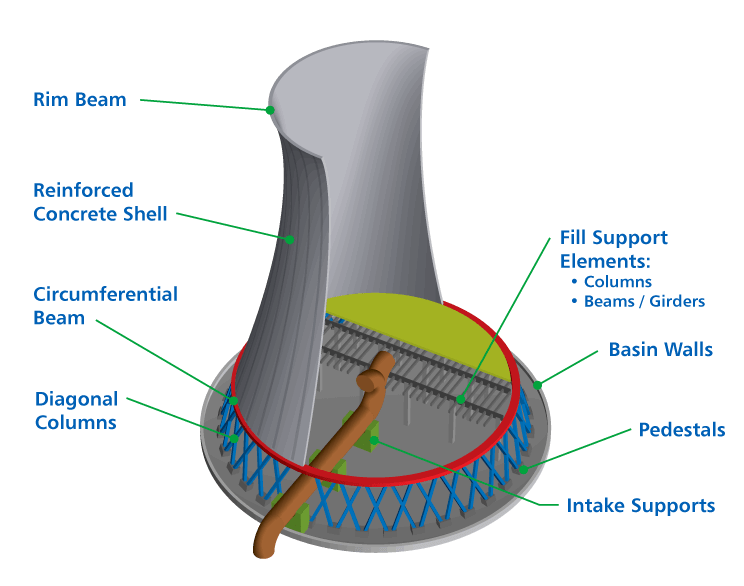
The shell is the most visible part of a hyperbola cooling tower—and arguably the most critical. Typically constructed from reinforced concrete, it must endure decades of exposure to wind, rain, sunlight, and temperature changes.
Despite heights that can exceed 150 meters, the shell is surprisingly thin. This is possible because the hyperbolic geometry allows forces to flow smoothly through the structure.
Thanks to its curved profile, the shell resists buckling and vibration far better than straight-walled structures. Even under extreme wind conditions, stresses are evenly distributed rather than concentrated at weak points.
This approach—called thin-shell engineering—achieves maximum strength with minimum material. It’s a key reason many hyperbola cooling towers remain operational for 40 to 60 years or more.


The fill is where the real cooling happens.
Hot water from the process is sprayed over the fill, where it spreads into thin films or breaks into droplets. As air passes through, a small portion of the water evaporates, carrying heat away with it.
The rule is simple: more surface area means better heat transfer.
Splash fill is rugged and clog-resistant, making it ideal for poorer water quality or heavy industrial environments.
Film fill offers higher thermal efficiency but requires better water treatment to avoid fouling.
Experienced manufacturers like MACH Cooling select the fill type based on water chemistry, operating conditions, and long-term maintenance strategy.


After passing through the fill, cooled water drops into the cold water basin at the bottom of the tower. From here, it’s pumped back into the system for reuse.
A properly designed basin ensures stable water levels, smooth flow to pumps, and easy access for inspection and cleaning.
Basins are typically made from reinforced concrete and protected with advanced waterproof linings. This prevents leakage, minimizes corrosion, and extends service life—especially important in large power plants where downtime is costly.

Fresh air enters freely from the open base of the tower. As it moves upward through the fill, it absorbs heat and moisture from the falling water.
The warm, humid air then rises through the tower throat and exits at the top—completing the natural circulation loop.
The height of the hyperbola cooling tower amplifies the stack effect. The taller the tower, the stronger the draft, which is why these structures are so effective for large thermal loads.

The cooling process is a classic example of evaporative cooling:
Hot water contacts cool air
A small fraction of water evaporates
Evaporation removes heat
Remaining water cools and recirculates
It’s the same principle as human sweating—just scaled up to industrial proportions.
Hyperbola cooling towers are designed with long-term operation in mind. With quality materials, precise engineering, and regular inspections, service life commonly exceeds 50 years.
Key factors include:
High-grade concrete
Corrosion-resistant internal components
Proven structural design standards
Because of their efficiency and durability, hyperbola cooling towers are ideal for:
Coal-fired and gas-fired power plants
Nuclear energy facilities
Large-scale petrochemical projects
Heavy industrial cooling systems
They excel wherever massive, continuous heat rejection is required.
As a professional cooling tower manufacturer, MACH Cooling provides customized hyperbola cooling tower solutions, including:
Structural and thermal design optimization
Fill system selection based on water quality
Long-life concrete and internal components
Technical support from design to commissioning
Learn more at https://www.machcooling.com/
The hyperbola cooling tower is far more than an iconic silhouette on the skyline. It’s a carefully engineered system where shell, fill, basin, and airflow work together in perfect balance.
When designed and built by experienced manufacturers like MACH Cooling, hyperbola cooling towers deliver unmatched reliability, efficiency, and longevity—making them a cornerstone of modern power generation and industrial cooling.