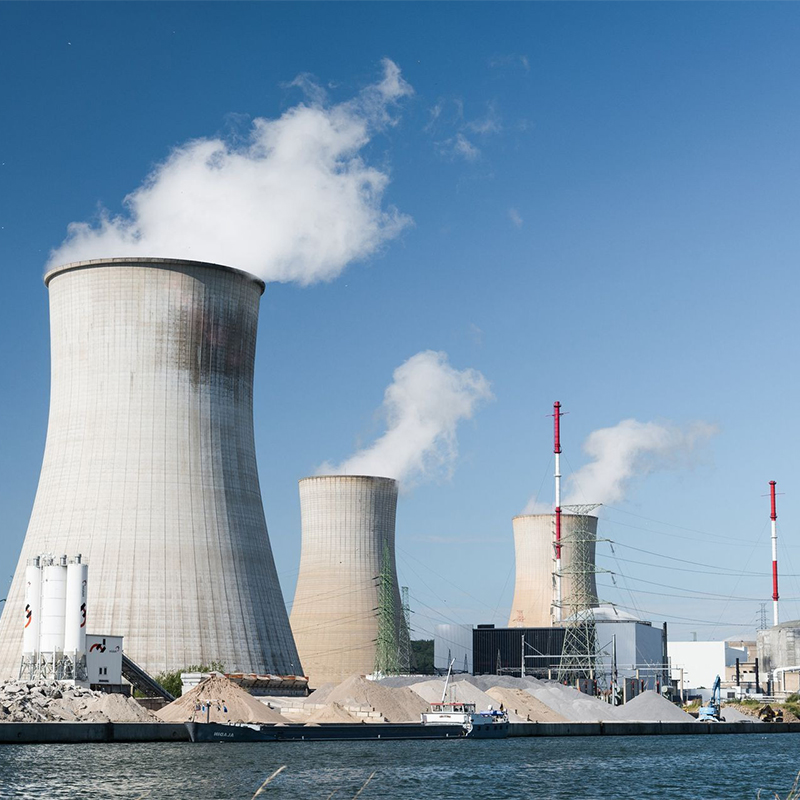
We Provide Cooling Tower Solution

Views: 0 Author: Site Editor Publish Time: 2025-11-27 Origin: Site


Cooling towers are essential thermal equipment used to remove heat from industrial processes, HVAC systems, and power plants. To ensure efficient operation, selecting the correct capacity is a key design step. An undersized tower cannot deliver adequate cooling, while an oversized one wastes energy and raises investment costs.
This article explains how to calculate cooling tower capacity, what parameters matter most, and provides formulas, examples, tables, and illustrations. The content also references MACH Cooling (https://www.machcooling.com/), a professional global cooling-tower manufacturer.
Before calculating capacity, it is necessary to clarify several fundamental inputs.
Heat load refers to the total amount of heat that must be removed from water. It is usually expressed in kcal/h, kW, or RT (Refrigeration Tons).
Heat load determines the minimum performance a cooling tower must deliver.
This parameter is determined by the system or equipment that requires cooling—such as chillers, heat exchangers, compressors, or industrial lines.
Hot water temperature (T₁)
Cold water temperature (T₂)
The temperature drop is ΔT = T₁ – T₂, representing how much the cooling tower must reduce water temperature.
This is the most important environmental factor affecting cooling tower performance.
Lower WBT means easier cooling and higher tower capacity.
Cooling tower capacity is essentially calculated by total heat rejection.

Where:
Q = cooling load (kcal/h or kW)
m = mass flow rate of water (kg/h ≈ 1000 × m³/h)
Cₚ = specific heat capacity of water ≈ 1 kcal/kg·°C
ΔT = T₁ – T₂
Assume the system includes:
Water flow rate: 150 m³/h
Inlet temperature: 37°C
Outlet temperature: 32°C
ΔT = 5°C

Convert to kW:

Convert to Refrigeration Tons (RT):

Thus, the required cooling-tower capacity is approximately:
250 RT cooling tower.
Actual tower performance is usually rated under standard WBT (typically 28°C).
If the project location has a higher WBT (e.g., 30–32°C), additional capacity correction is required.
Scaling affects fill efficiency, reducing effective capacity.
Industrial cooling towers often add 10–15% margin to compensate.
Stronger fans provide higher airflow, enhancing evaporation efficiency.
Examples:
Film fill (higher efficiency)
Splash fill (for poor water quality)
MACH Cooling provides customized fill design according to different industries.
Below is an example cooling-tower model selection table (simplified) including MACH Cooling Tower models.
| Water Flow (m³/h) | ΔT (°C) | Cooling Load (kcal/h) | Approx. Capacity (RT) | Recommended MACH Model |
|---|---|---|---|---|
| 50 | 5 | 250,000 | 83 | MACH-CT80 |
| 100 | 5 | 500,000 | 166 | MACH-CT150 |
| 150 | 5 | 750,000 | 248 | MACH-CT250 |
| 200 | 5 | 1,000,000 | 330 | MACH-CT300 |
| 300 | 5 | 1,500,000 | 497 | MACH-CT500 |
(For demonstration only; actual capacity depends on WBT & project conditions.)
Calculating the capacity of a cooling tower requires understanding heat load, flow rate, water temperature, and wet bulb temperature. Using standard formulas and adjusting for environmental and operational variables ensures a correct capacity selection.
By following the calculation steps and using reliable models such as those provided by MACH Cooling (https://www.machcooling.com/), users can ensure optimal thermal performance, energy efficiency, and long service life.