We Provide Cooling Tower Solution

Views: 0 Author: Site Editor Publish Time: 2025-11-24 Origin: Site


Cooling towers are critical heat‐dissipation devices used in industrial cooling systems, HVAC systems, and large equipment operations. Their performance directly influences the overall system efficiency, operational stability, and energy consumption. Therefore, understanding how to calculate the efficiency of a cooling tower is essential for engineers, technicians, and facility managers.
As a professional cooling-tower manufacturer, Mach Cooling (https://www.machcooling.com/) provides high-efficiency open-type, closed-circuit, crossflow, and counterflow cooling towers. Their engineering team has extensive experience in performance evaluation and equipment selection.
This article explains the definition, calculation method, influencing factors, optimization strategies, and provides diagrams and tables for better understanding.
Cooling tower efficiency measures the device’s ability to reduce water temperature. It represents the percentage of actual cooling compared to the maximum possible cooling under local climatic conditions.
The lowest temperature water can reach is the wet bulb temperature (WBT).
A cooling tower can never cool water below the ambient wet bulb temperature.
Theoretical maximum cooling = Hot water temperature − Wet bulb temperature
Actual cooling = Hot water temperature − Cold water temperature

Where:
Tₙ (T_in): Hot water temperature entering the tower
Tₒᵤₜ (T_out): Cold water temperature leaving the tower
T_wb: Ambient wet bulb temperature
| Parameter | Value |
|---|---|
| Hot water temperature (T_in) | 35°C |
| Cold water temperature (T_out) | 29°C |
| Wet bulb temperature (T_wb) | 27°C |

This cooling tower is operating at approximately 75% efficiency.
Typical industrial cooling towers operate between 60%–85%, while high-performance closed-circuit cooling towers may reach 90% or higher.
 |  |  |  |

Higher wet bulb temperature reduces the maximum cooling potential, lowering efficiency.
High-quality fill increases heat-exchange surface area.
Mach Cooling uses high-efficiency PVC/PP fill to enhance performance.
Insufficient airflow → poor heat exchange.
High-efficiency fans significantly improve tower performance.
Poor spraying → uneven thermal exchange → lower efficiency.
Scale deposits can reduce cooling performance by 30–50%.
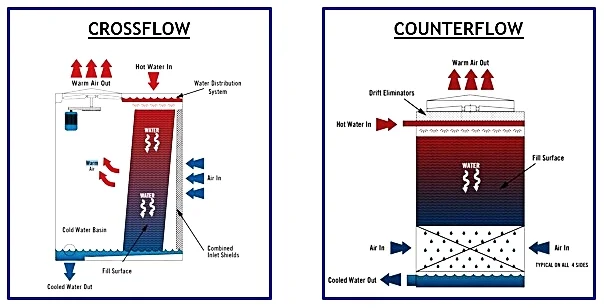
Crossflow towers: lower noise, easy maintenance
Counterflow towers: higher thermal efficiency
Mach Cooling provides both designs to meet diverse industrial applications.
Use high-performance structured fill
Replace aged or clogged fill
Mach Cooling’s high-efficiency fill can improve tower efficiency by 10–15%.
Use energy-efficient motors
Ensure fan blades are clean
Maintain optimal fan speed
Clogged nozzles reduce evaporation and lower efficiency.
Prevent scaling
Reduce algae growth
Maintain proper chemical balance
For example, lower fan usage during cool nighttime conditions to save energy.
| Cooling Tower Type | Typical Efficiency | Features | Applications |
|---|---|---|---|
| Open Cooling Tower | 60–80% | High evaporation performance | HVAC, general industry |
| Closed Circuit Tower | 70–90% | Clean water loop, low maintenance | Chemical, food, precision industry |
| Counterflow Tower | High | Strong heat transfer | Industrial cooling stations |
| Crossflow Tower | Medium | Low noise, easy maintenance | Commercial buildings |
Mach Cooling provides all of the above types in its product line.
The core formula for calculating cooling tower efficiency is:

While the formula is simple, the actual influencing factors are complex—such as wet bulb temperature, fill performance, airflow, water quality, and tower structure.
Choosing a high-quality cooling tower (such as those from Mach Cooling) and maintaining it properly can significantly improve efficiency, reduce energy consumption, and enhance overall system stability.