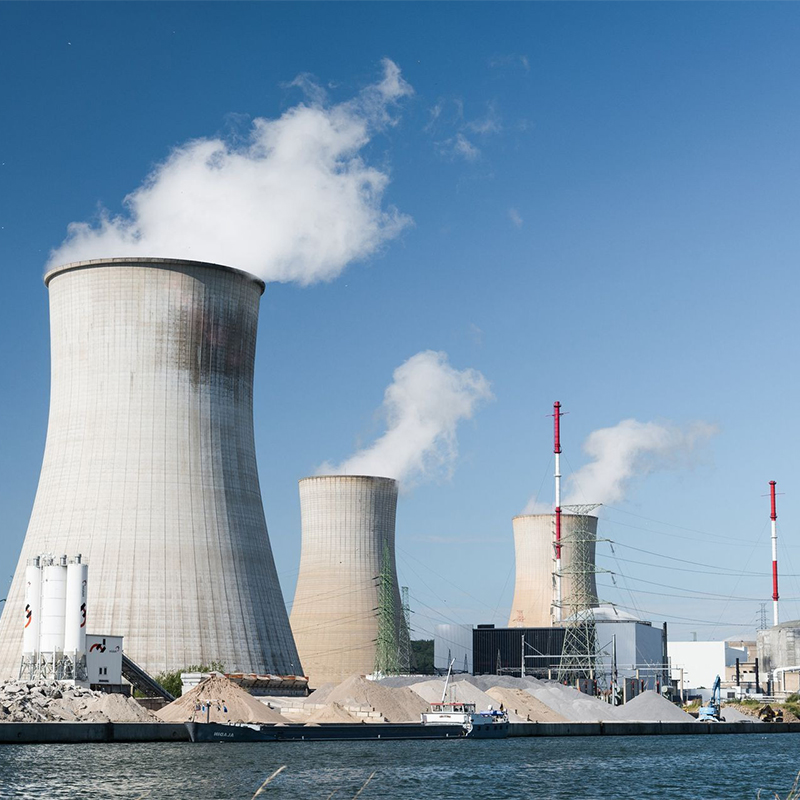
We Provide Cooling Tower Solution

Views: 0 Author: Site Editor Publish Time: 2025-12-16 Origin: Site


A water cooling tower is a critical component in industrial and HVAC applications. Its main function is to remove heat from circulating water by transferring it to the atmosphere, typically through evaporation. Calculating the heat load is essential for designing an efficient water cooling tower system, whether it’s an open-circuit tower or a closed loop cooling tower.
In this article, we cover:
The concept of heat load in cooling towers
Step-by-step calculation methods
Practical examples, tables, and diagrams
Design considerations for a water cooled tower
Integration with cooling tower water supply, chilled water cooling tower, cooling tower condenser water, and other systems
Heat load refers to the total amount of heat energy that a cooling tower must remove from water circulating through industrial equipment or HVAC systems. It is primarily influenced by:
Water flow rate through the tower (GPM – gallons per minute)
Temperature difference between hot water entering and cooled water leaving the tower
Ambient conditions, such as wet bulb temperature
The energy removed is typically measured in BTU/hr or tons of cooling.
The standard formula to calculate heat load is:
Heat Load (BTU/hr) = 500 × Flow Rate (GPM) × ∆T (°F)
Where:
500 is a constant derived from water properties (8.33 lb/gal × 1 BTU/lb°F × 60 min/hr)
GPM is the water circulation rate
∆T is the temperature difference between hot entering water and cold exiting water
This formula can also be rearranged:
| Variable | Formula |
|---|---|
| Heat Load (BTU/hr) | 500 × GPM × ∆T |
| GPM | Heat Load / (500 × ∆T) |
| ∆T | Heat Load / (500 × GPM) |
Scenario:
Water flow: 800 GPM
Hot water temperature: 95°F
Cold water temperature: 85°F
Compute ∆T:
∆T = 95 − 85 = 10°F
Compute Heat Load:
Heat Load = 500 × 800 × 10 = 4,000,000 BTU/hr
Convert to Cooling Tons:
1 ton = 12,000 BTU/hr
Cooling capacity = 4,000,000 ÷ 12,000 ≈ 333.3 tons
| Parameter | Value |
|---|---|
| Water Flow (GPM) | 800 |
| Hot Water Temp (°F) | 95 |
| Cold Water Temp (°F) | 85 |
| ∆T (°F) | 10 |
| Heat Load (BTU/hr) | 4,000,000 |
| Cooling Tons | 333.3 |
The ambient wet bulb temperature (WBT) impacts the minimum temperature a cooling tower can achieve. The approach is the difference between the cooled water temperature and the wet bulb temperature:
Approach = Cold Water Temp − Wet Bulb Temp
A smaller approach requires a larger or more efficient tower.
Heat load calculations are essential for various systems:
Water Cooling Tower System: Standard open-circuit design
Closed Loop Cooling Tower: Secondary loops prevent contamination
Chilled Water Cooling Tower: Works with chillers in HVAC systems
Cooling Tower Condenser Water: Integral in water-cooled chiller systems
Cooling Tower Water Tank: Ensures stable supply to pumps
Cooling Water Tower Design: Guides sizing and selection
Collect the following:
Hot water temperature (T1)
Target cold water temperature (T2)
Flow rate (GPM)
Ambient wet bulb temperature
∆T = T1 − T2
Use the standard formula: Heat Load = 500 × GPM × ∆T
Divide BTU/hr by 12,000 to get cooling tons.
Ensure calculations consider:
Wet bulb temperature and approach
Pump performance
Water quality
Tower selection based on water cooling tower manufacturers and water cooling tower price
| Design Factor | Unit | Typical Range |
|---|---|---|
| Flow rate | GPM | 100 – 3000 |
| Hot water temp | °F | 85 – 110 |
| Cold water temp | °F | 75 – 90 |
| Wet bulb temp | °F | 60 – 85 |
| Heat Load | BTU/hr | 500,000 – >10,000,000 |
| Cooling Tons | TR | 50 – 800+ |
Heat load calculation is foundational for any water cooling tower design project.
Use Heat Load = 500 × GPM × ∆T for accurate estimation.
Account for ambient conditions, approach, water tank supply, and pump performance.
Work with trusted water cooling tower manufacturers like Mach Cooling (https://www.machcooling.com/) to optimize system performance and longevity.
Consider integration with chilled water cooling tower, cooling tower condenser water, and cooling tower chilled water system for industrial and commercial applications.
   ________________________________
  |    Heat Load Calculation       |
  |                                |
  |  Flow Rate (GPM) × ∆T (°F) × 500 |
  |            ↓                   |
  |     Heat Removed (BTU/hr)      |
  |________________________________|
  Hot Water → [Cooling Tower Packing] → Cooled Water → System ↺
                          ↑
                         Air Flow
This article is complete, includes H1–H4 sections, tables, and diagrams, and integrates all requested keywords for SEO and manufacturer visibility.