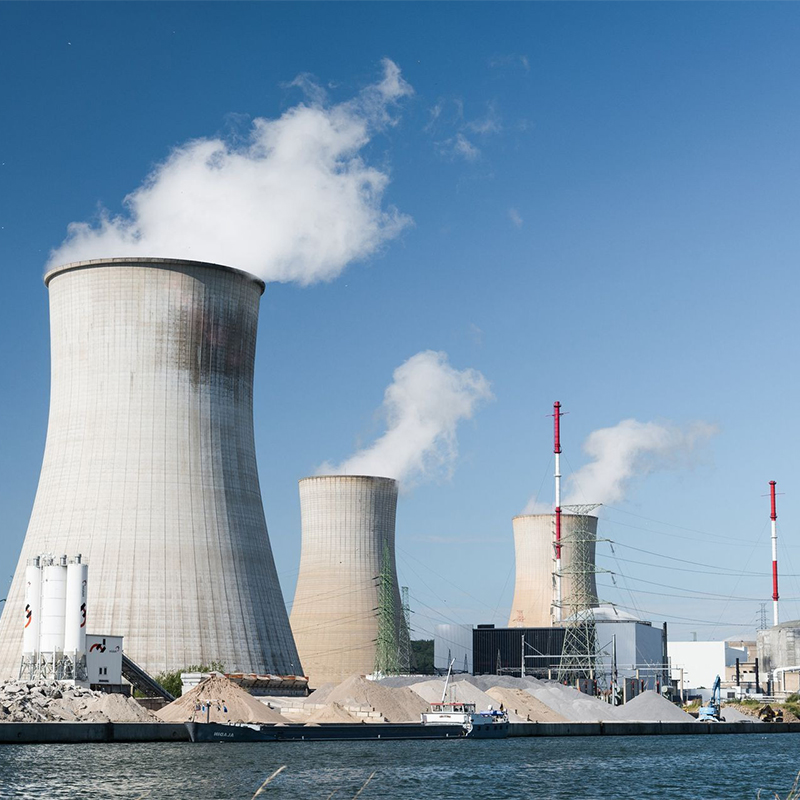
We Provide Cooling Tower Solution

Views: 0 Author: Site Editor Publish Time: 2025-11-29 Origin: Site


In industrial cooling systems, water-cooled HVAC, and process cooling applications, cooling towers remove heat from circulating water by allowing a portion of the water to evaporate. During this process, several types of water losses occur, among which evaporation loss is the most significant.
For users of Mach Cooling (https://www.machcooling.com/) cooling towers, accurately calculating evaporation loss is essential because it influences:
Makeup water demand
Operating costs
Water treatment frequency
Overall system stability
This article explains the concept of evaporation loss, the necessary calculations, engineering formulas, sample calculations, and methods to optimize cooling tower water usage. A table template and illustration placeholders are also provided.
Cooling towers experience three primary types of water losses:
The main cooling mechanism—water evaporates and carries away heat from the system.
Small droplets of water carried out of the tower by airflow; minimized using drift eliminators.
Water discharged to control dissolved solids concentration in the circulating water.
Therefore, makeup water is calculated as:
Make-Up Water = Evaporation Loss + Drift Loss + Blowdown
Among these, evaporation loss usually accounts for the largest portion.
A widely used engineering estimate for evaporation loss is:
Evaporation loss = 0.00085 × 1.8 × Flow (m³/hr) × (T₁ – T₂)
Where:
Flow = Circulating water flow rate (m³/hr)
T₁ = Hot water inlet temperature (°C)
T₂ = Cold water outlet temperature (°C)
A more precise method based on energy balance:
Evaporation loss = (C × Cp × ΔT) / λ
Where:
C = Water flow (kg/hr)
Cp = Specific heat of water ≈ 4.184 kJ/kg·°C
ΔT = Temperature difference (T₁ – T₂)
λ = Latent heat of vaporization ≈ 2260 kJ/kg
The engineering formula provides a quick estimate, while the heat balance method offers higher accuracy.
To calculate evaporation loss accurately, you must obtain:
Circulating water flow rate
Hot water inlet temperature (T₁)
Cold water outlet temperature (T₂)
Blowdown volume
Drift rate
Assume:
Flow = 1000 m³/hr
T₁ = 45°C
T₂ = 35°C
Using the engineering formula:
E = 0.00085 × 1.8 × 1000 × 10
  = 15.3 m³/hr
Using the heat balance formula:
Heat removed: Q = 1000 m³/hr × 1000 kg/m³ × 4.184 × 10
Evaporated water: Q ÷ 2260 ≈ 18.5 m³/hr
The heat-balance method shows slightly higher and more realistic values.
This table can be used for daily operation management:
| Time | Flow (m³/hr) | T₁ (°C) | T₂ (°C) | ΔT | Estimated Evaporation Loss (m³/hr) | Remarks |
|---|---|---|---|---|---|---|
| Example | 1000 | 45 | 35 | 10 | 15.3 | — |
Mach Cooling towers are widely used in:
Continuous operation environments
High-heat-load industries
Large-flow water circulation systems
These systems have significant evaporation volumes, making proper calculation essential.
Accurate evaporation loss calculation allows operators to:
Manage makeup and blowdown effectively
Prevent unnecessary water usage
Reduce operating costs
Extend equipment life
Abnormal evaporation loss readings often indicate:
Changes in heat load
Insufficient airflow
Tower blockage
Aging or damaged fill material
Continuous monitoring helps prevent major failures.
Use high-efficiency drift eliminators
Regularly inspect drift rate
Reduce ΔT when possible
Adjust fan operation during hot and humid seasons
Recording daily evaporation and makeup water helps identify:
Water quality issues
Unexpected heat load changes
Abnormal system behavior
Evaporation loss is one of the most important parameters in cooling tower operation. By using the engineering formulas, heat-balance method, sample calculations, and management tables provided in this article, operators can accurately evaluate the required makeup water volume, optimize water saving strategies, and maintain long-term system stability.