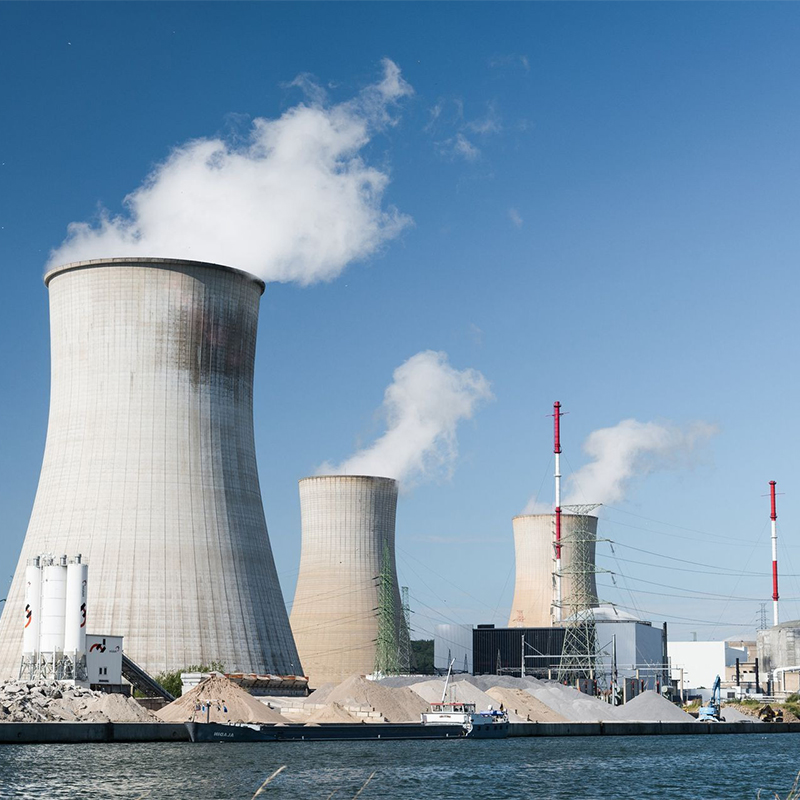
We Provide Cooling Tower Solution

Views: 0 Author: Site Editor Publish Time: 2025-11-29 Origin: Site


In industrial cooling, HVAC systems, and manufacturing processes, cooling towers play a vital role in removing heat from circulating water. Their performance directly influences energy efficiency, operational cost, and equipment life. To ensure that a cooling tower—especially one from **Mach Cooling (https://www.machcooling.com/)**—operates reliably, understanding how to calculate cooling tower efficiency is essential.
This article explains the principles, formulas, examples, diagrams, and real-world evaluation methods for calculating cooling tower efficiency, and provides practical suggestions for improvement.
Before calculating efficiency, two main parameters must be understood:
Range represents the actual temperature drop achieved by the cooling tower:
Range = Hot Water Inlet Temperature – Cold Water Outlet Temperature
Example: from 45°C (inlet) to 30°C (outlet), Range = 15°C.
Approach represents how close the cooling tower’s cold-water temperature is to the wet-bulb temperature of the incoming air:
Approach = Cold Water Temperature – Wet Bulb Temperature (WBT)
A lower wet-bulb temperature means the cooling tower can potentially cool water more effectively.
Cooling Tower Efficiency (or “effectiveness”) reflects the ratio of actual cooling to the maximum theoretical cooling possible.
Standard formula:
Equivalent formula:
Efficiency (%) = (t_i – t_o) / (t_i – t_wb) × 100%
Where:
t_i = Hot water inlet temperature
t_o = Cold water outlet temperature
t_wb = Air wet-bulb temperature
Under normal operating conditions, industrial cooling towers typically achieve 70%–75% efficiency, with high-performance designs capable of even better results.
| Item | Meaning | Measurement Location |
|---|---|---|
| Hot Water Inlet | Water temperature entering the tower | Hot water pipe or tower top inlet |
| Cold Water Outlet | Water temperature leaving the tower | Cold-water basin or outlet pipe |
| Wet Bulb Temperature | Air wet-bulb temperature entering the tower | Tower air intake side |
Assume the following measurements:
t_i = 45°C
t_o = 30°C
t_wb = 25°C
Then:
Range = 45 – 30 = 15°C
Approach = 30 – 25 = 5°C
Efficiency = 15 ÷ (15 + 5) × 100% = 75%
This indicates excellent cooling performance close to design specifications.
Low wet-bulb temperature → better cooling
High humidity → larger Approach → lower efficiency
Efficiency typically decreases during hot and humid seasons
Cooling towers from Mach Cooling generally enhance efficiency through:
Strong and stable fan airflow improves evaporative cooling.
Increases contact area between air and water, boosting heat transfer.
Prevents short-circuiting and uneven flow, maintaining high effectiveness.
Scale, algae, or debris will clog fills and reduce heat transfer
Poor circulating water quality causes uneven water distribution
Regular cleaning and chemical treatment maintain peak performance
Excessive load or insufficient flow causes outlet temperature to rise
Low water flow reduces contact time → lower efficiency
It is recommended to record operation data weekly or monthly to determine maintenance needs.
| Time | Hot Water Temp (°C) | Cold Water Temp (°C) | Wet Bulb Temp (°C) | Range | Approach | Efficiency (%) |
|---|---|---|---|---|---|---|
| Example | 45 | 30 | 25 | 15 | 5 | 75% |
The following measures apply to Mach Cooling towers and all other brands:
Inspect fans periodically
Remove obstructions around louvers and air intakes
Ensure proper clearance around the cooling tower
Check for clogged spray nozzles
Ensure uniform distribution across the fill
Replace aged or damaged fill material
Use chemical dosing for scale & algae control
Prevent sediment accumulation
Perform regular blowdown to control TDS
Increase airflow and water supply during peak summer loads
Reduce fan speed during light loads to save energy
Utilize low wet-bulb temperatures to reduce operational cost
Calculating cooling tower efficiency is the most direct method to evaluate equipment performance. Understanding Range, Approach, and Efficiency allows operators to accurately assess the operating condition of a cooling tower—especially one from Mach Cooling (https://www.machcooling.com/).
By regularly measuring, recording, and analyzing efficiency data, operators can:
Detect performance problems early
Improve operating efficiency
Reduce maintenance costs
Extend equipment life