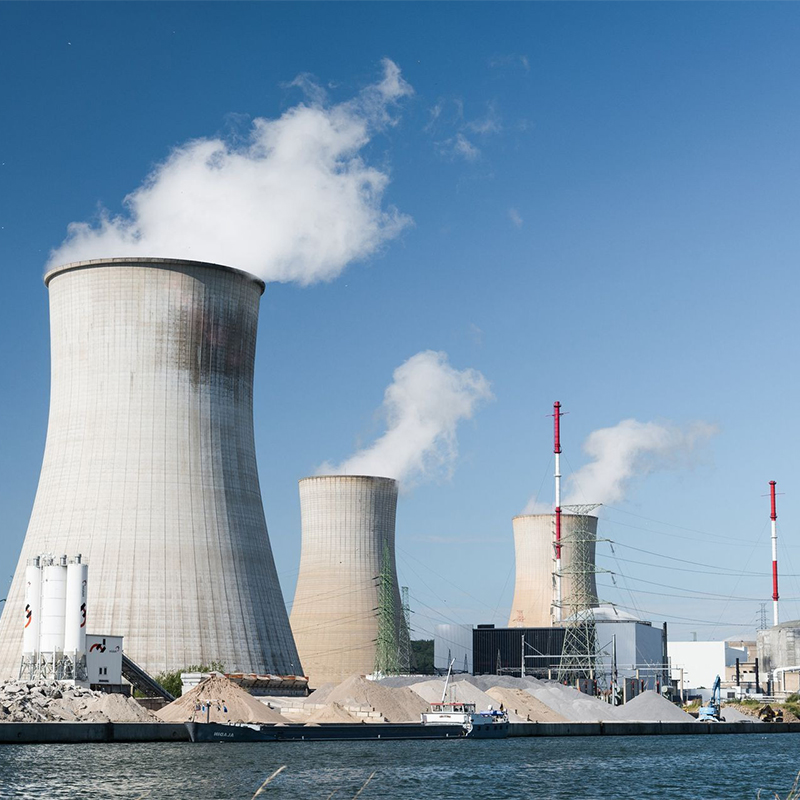
We Provide Cooling Tower Solution

Views: 0 Author: Site Editor Publish Time: 2025-11-25 Origin: Site


A cooling tower system is an essential component in industrial processes, HVAC air-conditioning, and power generation. Its main function is to dissipate excess heat from circulating water to the atmosphere through heat exchange and partial water evaporation.
For manufacturing plants, commercial buildings, and processing facilities, selecting a reliable cooling tower supplier—such as MACH Cooling (https://www.machcooling.com/)—ensures stable operation, reduced energy consumption, and long-term system reliability.
This article explains how a cooling tower system works, including its core components, operating steps, heat-exchange mechanisms, and key performance indicators. Several diagrams and a table are also provided for technical reference.
A complete cooling tower system is made of five major parts:
Warm water from equipment (e.g., condenser, heat exchanger) flows into the cooling tower.
A circulating pump provides stable water flow and pressure.
Includes nozzles, spray pipes, and branch headers.
Ensures uniform spraying over the fill (heat-exchange media).
Provides large surface area to enhance water–air contact.
Common materials: PVC, PP, wood slats.
Affects cooling efficiency significantly.
Consists of fans, motors, fan stacks, and airflow inlets.
Induced-draft or forced-draft designs are used depending on the tower type.
Collects cooled water and sends it back to equipment.
Equipment such as chillers, compressors, and heat exchangers discharge hot water into the top distribution system.
Typical temperature:
Hot water: 32–40°C
After cooling: 27–30°C
Spray nozzles form fine droplets, increasing water–air contact area.
Advantages of uniform spraying:
Higher thermal efficiency
Reduced water loss
Better evaporation rate
The fan draws or pushes air upward through the tower.
Two cooling mechanisms occur:
Air temperature < water temperature → heat flows from water to air.
A small portion of water evaporates.
The phase change removes large amounts of heat (≈ 2450 kJ/kg), lowering water temperature significantly.
Cold water gathers at the bottom and returns to equipment → forming a closed circulation loop.
Water directly contacts outside air.
Most common solution for HVAC and industrial cooling.
Process water flows inside coils.
Sprayed water + airflow cool the coil surface.
Used by high-cleanliness industries such as:
electronics, pharmaceuticals, food processing.
Combines dry and wet cooling.
Achieves energy savings during low-temperature seasons.
| Type | Cooling Method | Water Loss | Maintenance | Typical Use |
|---|---|---|---|---|
| Open Cooling Tower | Direct water–air contact | High | Medium | HVAC, industrial |
| Closed Cooling Tower | Coil heat exchange | Low | Low | Electronics, pharma |
| Hybrid Tower | Wet + dry combined | Medium | Medium | Energy-saving systems |
High-quality fill improves water distribution and enhances evaporation efficiency.
Directly influences airflow and thermal performance.
MACH Cooling uses high-efficiency motors to reduce energy consumption.
Flow that is too low → poor heat transfer
Flow that is too high → insufficient contact time
The theoretical limit of cooling is the wet-bulb temperature of the surrounding air.
Premium PVC/PP fills with high heat-exchange efficiency
Low-noise, energy-efficient fans
Corrosion-resistant casing options
Precise water distribution systems
Custom engineering for factories and large buildings
MACH Cooling provides professional cooling tower system design, installation guidance, and technical support, ensuring stable cooling even under harsh industrial conditions.
A cooling tower system operates based on heat transfer and evaporation, allowing hot water from industrial equipment or HVAC systems to be cooled efficiently before being recirculated.
Understanding its working principles—spray distribution, evaporative cooling, airflow structure, and water circulation—helps engineers make better decisions in selecting and managing cooling towers.
For high-quality, durable, and efficient cooling tower solutions, MACH Cooling remains one of the leading manufacturers offering customized systems for global industries.