We Provide Cooling Tower Solution

Views: 0 Author: Lisa Publish Time: 2025-11-24 Origin: Site


In a thermal power plant (coal, gas, nuclear, biomass), the main job of the cooling tower is to remove waste heat from the plant’s condenser and release it safely into the atmosphere.
It does not handle radioactive materials (in nuclear plants the cooling tower only cools clean water from the secondary side).
A power plant produces electricity using the Rankine cycle:
1. Boiler/steam generator makes high-pressure steam.
2. Steam spins a turbine to generate electricity.
3. Used steam (low pressure) must be condensed back to water so the cycle can repeat.
To condense the steam, the plant needs something cold → a cooling water supply.
Inside the condenser:
* Exhaust steam from the turbine flows around tubes.
* Cooling water flows inside those tubes.
* Steam condenses into water after dumping its heat into the cooling water.
Result:
Cooling water becomes hot, and must be cooled back down → this is the cooling tower’s job.
A cooling tower removes heat through evaporative cooling—just like sweat evaporating from skin.
Steps inside the tower:
Water from the condenser arrives hot (often around 30–40°C / 86–104°F).
Nozzles spray the hot water over fill media that increases surface area.
Two types of towers:
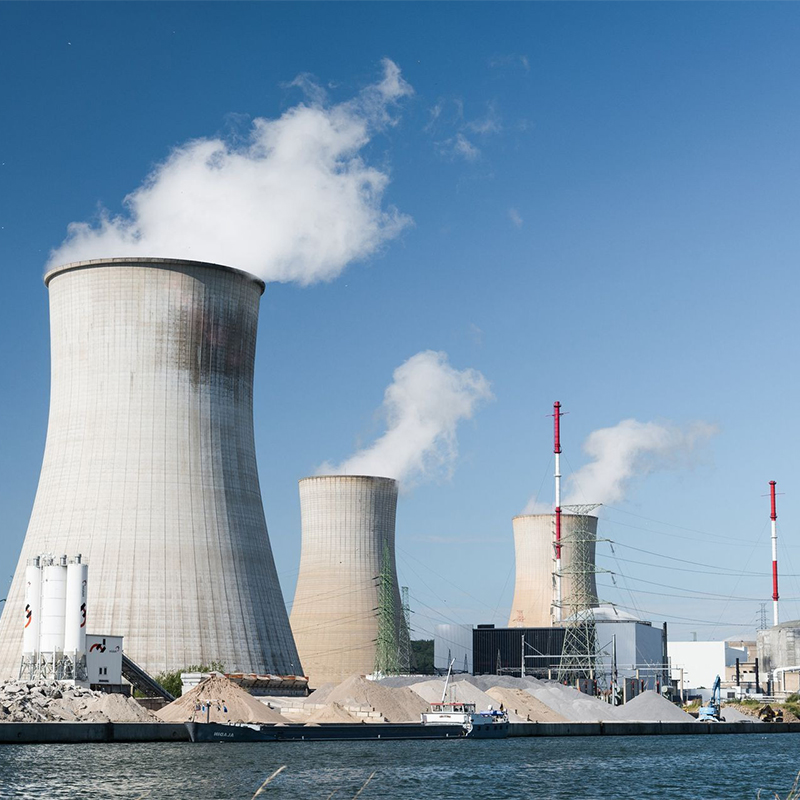
Natural draft (the huge hyperbolic towers)→ warm air rises on its own.
Mechanical draft (industrial fans) → fans pull/push air.
As the air flows up, a small portion of water evaporates, removing heat from the remaining water.
After losing heat, water collects at the bottom at about:
~20–30°C (68–86°F)
These towers rely on:
* Warm moist air naturally rising
* Their hyperbolic shape which accelerates the upward airflow
* No fans → very energy efficient for large power plants
The visible smoke from the top is just water vapor, NOT smoke or radiation.