English


Views: 0 Author: Lisa Publish Time: 2025-11-24 Origin: Site


A nuclear cooling tower works almost exactly like the cooling tower used in HVAC and industrial systems—the key difference is what it cools.
A cooling tower does NOT touch radioactive water.
Its job is simply to cool clean water from the power plant’s steam cycle condenser.
Below is a clear, accurate explanation.
A nuclear power plant uses steam to spin a turbine. After the steam passes through the turbine, it must be cooled back into liquid water so it can be reused.
This cooling is done in a condenser, which uses large amounts of cold water.
That warm cooling water is what the cooling tower cools.
* The water has absorbed heat from the condenser.
* Typical temperature: ~30–40°C (85–105°F).
* Fill increases surface area.
* Water droplets spread and slow down, improving cooling efficiency.
* No fan needed.
* Warm air rises naturally, pulling fresh air from the bottom.
* Large fans actively pull or push air through the tower.
* Only about 1–2% of the water evaporates.
* Evaporation absorbs a lot of heat (latent heat transfer).
* Remaining water cools down significantly.
* Now cooled, typically ~20–25°C (68–77°F).
* Sent back to the condenser to start the cycle again.
### ❌ Cooling towers do NOT release radioactive steam
The cooling tower loop is separate from the radioactive primary loop.
### ❌ The big white plume is NOT smoke
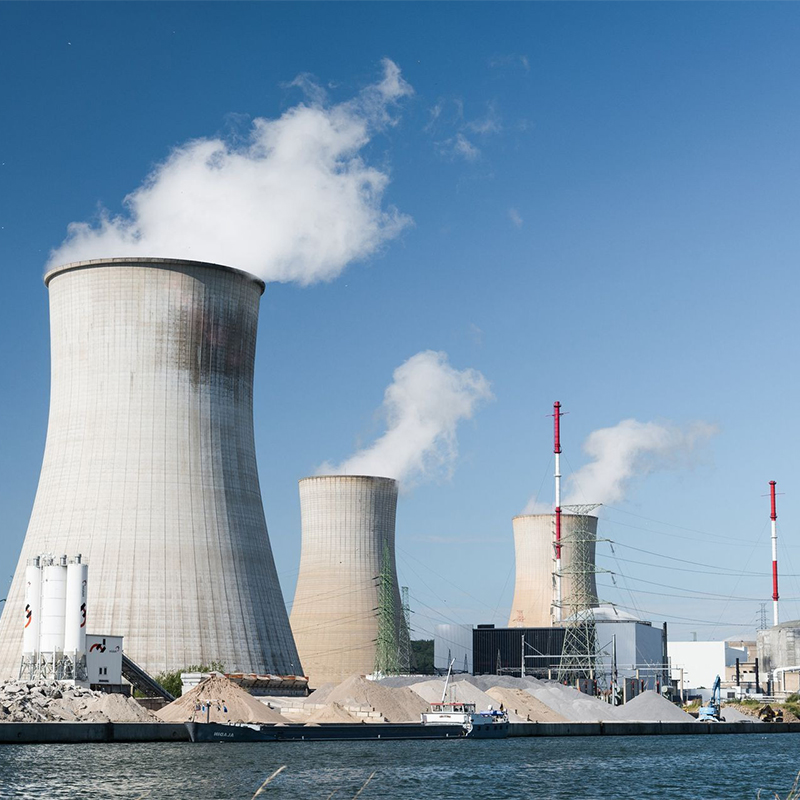
It is clean water vapor (low-temperature steam) created from evaporation.
### ❌ Not all nuclear plants use cooling towers
If they are next to a large river or ocean, they can cool water directly without towers.
Think of a nuclear cooling tower as a giant humidifier + chimney:
* Water is spread into small droplets.
* Air rises and pulls heat out.
* Some water evaporates.
* The rest returns cooler.