We Provide Cooling Tower Solution
You are here: Home » Blog » Closed-Circuit Cooling Tower vs. Open-Circuit Cooling Tower

Closed-Circuit Cooling Tower vs. Open-Circuit Cooling Tower

Views: 0     Author: Site Editor     Publish Time: 2025-11-17      Origin: Site

facebook sharing button
twitter sharing button
line sharing button
wechat sharing button
linkedin sharing button
pinterest sharing button
whatsapp sharing button
sharethis sharing button

内页3

Introduction

In modern industrial facilities and HVAC systems, cooling towers play a vital role in heat dissipation. Depending on how the circulating water interacts with the air, cooling towers are generally classified into closed-circuit cooling towers and open-circuit cooling towers.

Understanding their structural differences, operating principles, advantages, and limitations is essential for selecting the right equipment. This article provides a comprehensive comparison of both types and explains where each performs best, with reference to Mach Cooling (MachCooling.com), a professional manufacturer of industrial cooling towers.


Basic Principles and Tower Classification

 How a Cooling Tower Works

A cooling tower removes heat from circulating water and releases it into the atmosphere through heat exchange with air. The process includes:

  • Hot water entering the tower from an industrial or HVAC loop

  • Heat exchange with air via evaporation and conduction

  • Cooled water returning to the system

Based on the water–air contact method, cooling towers fall into two primary categories.

Definitions of the Two Cooling Tower Types

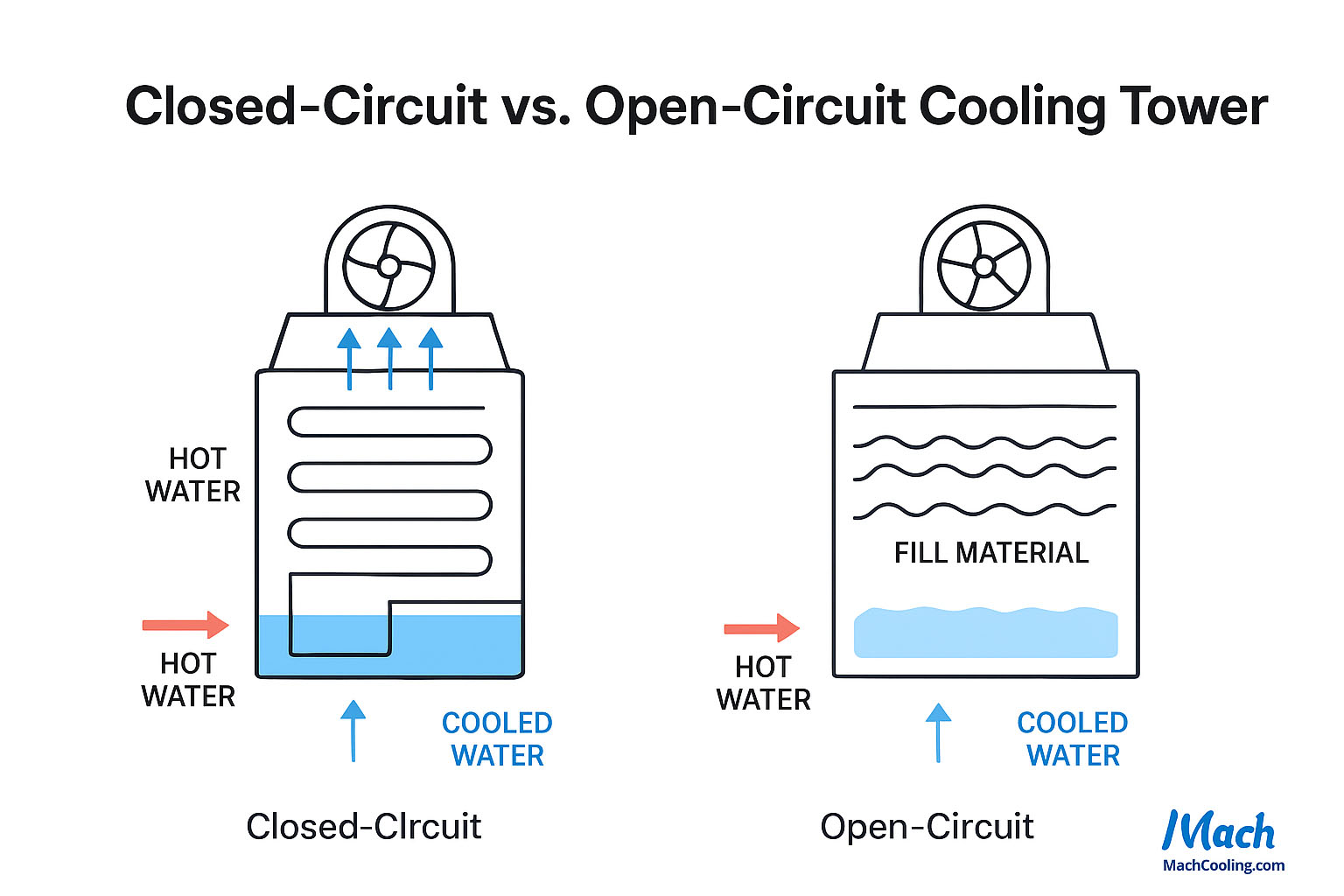
Open-Circuit Cooling Tower

The circulating water is sprayed directly into the air stream. Water and air fully contact each other, and cooling mainly occurs through evaporation.

Closed-Circuit Cooling Tower

The circulating water flows inside sealed coils (typically copper or stainless steel). External spray water cools the coil surface, but the process water does not contact the air, reducing contamination and corrosion.

Open-Circuit-Cooling-Tower-vs-Closed-Circuit-Cooling-Tower


Structural and Operational Differences

Structural Comparison

Open-Circuit Cooling Tower

  • Spray system: Sprays hot water onto fill media

  • Fill media: Increases water–air contact area for efficient evaporation

  • Fan / air passage: Ensures proper ventilation (counterflow or crossflow designs)

  • Water basin: Collects cooled water

Closed-Circuit Cooling Tower

  • Closed heat-exchange coils: Carry the process water inside sealed tubing

  • Spray system: Sprays water over coil surfaces for improved heat exchange

  • Fan system: Drives airflow across the coil and spray water

  • Water basin: Recycles spray water

Heat Exchange Mechanisms

Open-Circuit

  • Evaporative cooling removes large amounts of heat

  • Direct air–water contact enhances thermal performance

Closed-Circuit

  • Sensible heat transfer through coil walls

  • Evaporative cooling occurs on the coil’s outer surface

  • Process water stays clean due to a closed-loop design

 Water Quality & Safety

  • Open-Circuit: Water is exposed to air—dust, debris, microbiological growth may occur.

  • Closed-Circuit: Water remains sealed inside coils, significantly reducing corrosion, fouling, and contamination risk.
    04bad86f-230c-46a9-a6b5-b7ef6b95302b


Advantage Comparison

Advantages of Open-Circuit Cooling Towers

  1. Higher cooling efficiency
    Evaporative cooling allows the outlet temperature to approach the wet-bulb temperature.

  2. Lower initial investment
    No heat-exchange coil is required, so construction cost is generally lower.

  3. Flexible for large capacity
    Ideal for large-scale industrial cooling where heat loads are high.

Advantages of Closed-Circuit Cooling Towers

  1. Superior water quality control
    Process water never contacts air, significantly reducing corrosion and scaling.

  2. Lower maintenance cost (long-term)
    Less contamination means lower chemical dosing and less frequent cleaning.

  3. Higher reliability
    Reduced risk of fouling, stable performance in dusty or polluted environments.

  4. Water savings
    Makeup water volume is lower than open-circuit towers.


Application Scenarios

Where Open-Circuit Cooling Towers Perform Best

  • Large industrial plants (steel, chemical, power plants)

  • Data centers and HVAC condenser loops requiring lower water temperature

  • High heat-load systems needing maximum cooling capacity

Where Closed-Circuit Cooling Towers Excel

  • HVAC systems, heat pumps, chilled water plants

  • Applications requiring high water cleanliness

  • Dusty or harsh outdoor environments

  • Regions with water scarcity


The Value of Mach Cooling in Cooling Tower Manufacturing

Mach Cooling (MachCooling.com) offers both open- and closed-circuit cooling tower solutions, designed for reliability, energy efficiency, and long service life.

Custom Engineering Capabilities

  • System-specific design based on heat load, climate, water quality, and installation space

  • Premium materials (SS coils, copper tubes, anti-corrosion structure)

  • High-efficiency fan and spray system optimization

Quality Control & Reliability

  • Pressure-tested coils

  • Performance testing before shipment

  • Optional corrosion-resistant housings

Maintenance & Service

  • Water treatment guidance

  • Tower cleaning and inspection support

  • Long-term service plans

Energy Efficiency & Sustainability

  • Low-power fan motors

  • Optimized spray water distribution

  • Reduced water consumption for closed-circuit towers


 Selection Guide – Comparison Table

 Closed vs. Open Cooling Tower Comparison

Factor Open-Circuit Cooling Tower Closed-Circuit Cooling Tower
Outlet temperature Lower, close to wet-bulb Slightly higher due to coil resistance
Initial investment Low Higher
Water quality Easily contaminated Clean and stable (sealed loop)
Maintenance Higher (fill, water treatment) Lower (coil cleaning only)
Water consumption Higher Lower
Best environments Large industrial loads Clean water or harsh environments

Risks & Challenges

Open-Circuit Cooling Tower Risks

  • Rapid water quality deterioration

  • Scaling and corrosion

  • Drift loss (water droplets carried by wind)

 Closed-Circuit Cooling Tower Risks

  • Higher upfront cost

  • Heat resistance of coil results in higher outlet temperature

  • Spray water still requires basic treatment


Example Case Using Mach Cooling Solutions

A commercial complex requires:

  • Large cooling capacity

  • Lower water consumption

  • Reliability in dusty outdoor conditions

Mach Cooling’s recommended plan:

  1. Hybrid cooling system
    Combine closed-circuit (protects system water) + open-circuit (provides strong cooling capacity).

  2. Energy-efficient design
    High-efficiency fans, optimized air pathway, VFD control, and advanced spray system.

  3. Full maintenance support
    Water treatment plan + routine inspections + long-term warranty service.


Conclusion

  • Open-circuit and closed-circuit cooling towers each have unique strengths.

  • Open-circuit towers offer higher cooling efficiency at lower cost, while closed-circuit towers provide better water quality, lower long-term maintenance, and improved operational reliability.

  • Mach Cooling (MachCooling.com) delivers tailored cooling tower solutions for industrial, commercial, and HVAC customers, offering high-quality engineering, energy-efficient design, and professional after-sales support.

Selecting the right cooling tower can significantly improve heat exchange performance, reduce operating costs, and enhance long-term system stability.

Contact us

Consult Your Mach Cooling Tower Experts

We help you avoid the pitfalls to deliver the quality and value your window opener need, on-time and on-budget.

Download Technical Catalog

If you want to know detailed information,please download catalogue here.
Contact Us
   +86-13735399597
  Lingjiang Village, Dongguan Street, Shangyu District, Shaoxing City, Zhejiang Province, China.
Industrial Cooling Tower
Closed Cooling Tower
Open Cooling Tower
Links
COPYRIGHT © 2025 ZHEJIANG AOSHUAI REFRIGERATION CO., LTD. ALL RIGHTS RESERVED.