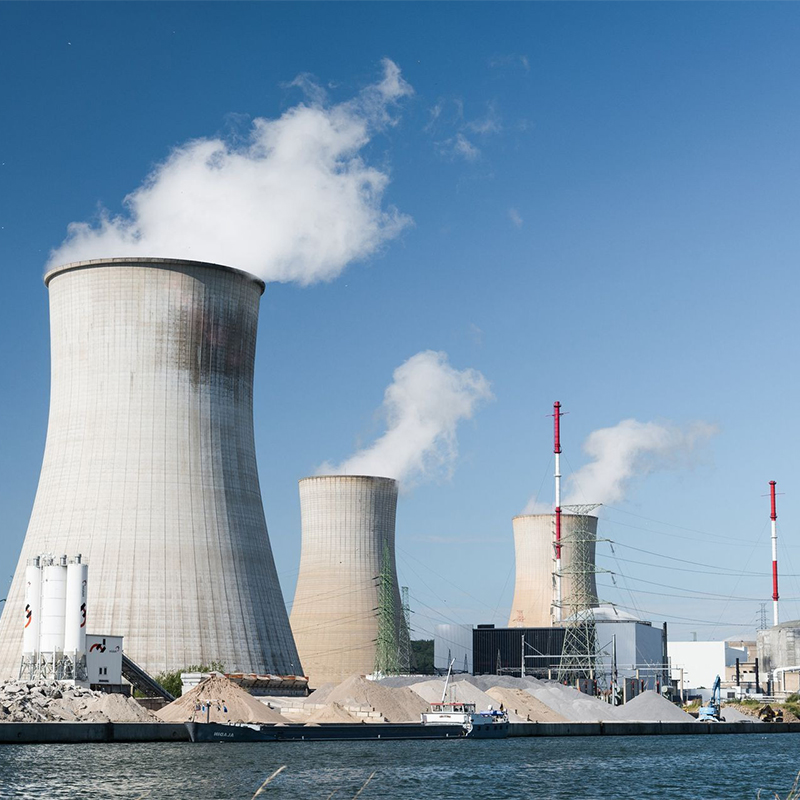
We Provide Cooling Tower Solution

Views: 0 Author: Site Editor Publish Time: 2025-11-13 Origin: Site


Cooling towers are widely used in industrial production and large HVAC systems for heat rejection. Although structurally simple, cooling towers can be significant energy consumers.
This article, based on Mach Cooling Tower (hereinafter referred to as “Mach Cooling Tower”), systematically explores how to reduce cooling tower energy consumption. We will discuss optimization from equipment selection, control strategy, operation and maintenance, and system integration perspectives — providing actionable strategies for users.


Cooling tower energy consumption mainly comes from three areas: fan power, pump power, and auxiliary systems such as water treatment and controls.
Fan Power – The fan is typically the largest energy consumer, as it must move a high volume of air through the fill to achieve evaporative cooling.
Pump Power – Pumps move hot water to the tower and return cooled water to the system. Oversized or inefficiently operated pumps can waste substantial energy.
Auxiliary Power – Systems like filtration, dosing, sensors, and variable frequency drives (VFDs) also consume energy, though individually smaller.
Lower Operating Costs: Reducing power consumption directly cuts electricity bills.
Extended Equipment Life: Optimized operation reduces wear and failure rates.
Improved Reliability: Energy-efficient systems tend to operate more stably.
Environmental Benefits: Reduced power use means lower CO₂ emissions — aligning with sustainability goals.
According to Mach Cooling Tower’s official site, the company provides various models — counterflow, crossflow, open, and closed types. Proper equipment selection forms the foundation of energy efficiency.
Equip fans with VFDs to automatically adjust speed based on load and ambient conditions, greatly reducing power consumption.
Avoid oversizing: Cooling towers are often designed for worst-case (hottest, most humid) conditions but rarely operate there continuously.
High-quality fill and uniform water distribution enhance heat transfer, lowering fan and pump loads.
Design piping and pumps for minimal hydraulic losses.
Consider water quality, treatment, and cycles of concentration (COC) during design — these affect long-term efficiency.
Match the cooling tower’s capacity to the actual cooling load and temperature range — oversized or undersized units waste energy.
Integrate with upstream cooling systems or heat recovery systems to improve overall performance.
Ensure unobstructed airflow and avoid recirculation of warm, moist air.
Keep water distribution uniform and fills clean to reduce resistance.
Consider site conditions — wet-bulb temperature, nearby heat sources, and wind patterns.
Use corrosion-resistant, low-drag materials such as FRP, aluminum alloy, or stainless steel.
Choose compact, easy-to-maintain structures that allow efficient airflow and water flow.
Use VFDs or control systems to modulate fan and pump speeds according to cooling load and ambient conditions.
Employ smart control systems that monitor outlet water temperature, wet-bulb temperature, and load to optimize performance.
Increase cycles of concentration to reduce blowdown and makeup water, saving both water and pumping energy.
Eliminate bypasses or unnecessary flow paths to ensure effective heat exchange.
Reduce fan operation during cooler nights or low humidity conditions.
Integrate cooling tower operation with chillers or process systems for coordinated load-based control.
Dirt and scale buildup reduce heat exchange efficiency, forcing fans and pumps to work harder.
Clean fan blades to maintain aerodynamic efficiency.
Remove debris and sludge from basins to improve hydraulic performance.
Soften makeup water and use side-stream filtration to increase COC and reduce blowdown losses.
Prevent scaling, corrosion, and biological growth to maintain efficient heat transfer.
Install monitoring systems for fan/pump power, water temperature, and ambient wet-bulb temperature.
Analyze historical data to detect trends and predict maintenance needs.
| Task | Recommended Frequency | Key Activity | Energy-Saving Benefit |
|---|---|---|---|
| Fan Blade Inspection | Every 3-6 months | Check for dirt, corrosion, or damage | Maintain airflow efficiency, reduce fan load |
| Basin & Fill Cleaning | Every 6-12 months | Remove debris, scale, and algae | Improve heat transfer, reduce fan/pump power |
| Water Quality Testing | Every 1-2 months | Check hardness, solids, biofilm, COC | Allow higher cycles, less blowdown |
| Fan/Pump Performance Log | Monthly | Track power, vibration, flow, and temp. delta | Detect anomalies, optimize operating speeds |
| Control System Check | Annually | Verify sensors, VFDs, logic functions | Ensure speed control accuracy and stability |
Capture waste heat for process or space heating — increasing total system efficiency.
Though not a direct reduction in tower energy use, it minimizes total facility energy demand.
IoT-based control systems can analyze real-time data and automatically optimize fan and pump operation.
Smart control can achieve 5–15% additional savings through load-based optimization.
Upgrade to high-efficiency fans, IE3/IE4 motors, and VFDs for older systems.
Ensure compatibility and balance with the rest of the tower to fully realize energy savings.
Replace deformed or fouled fill with new low-resistance designs.
Add automated dosing, softening, and side-stream filtration systems for long-term stability.
When selecting Mach Cooling Towers, specify key parameters such as flow rate, heat load, temperature difference, and water quality.
Choose models with VFD-controlled fans and motors.
If future retrofits are planned, prefer modular, upgradeable tower structures.
During commissioning, record baseline performance data — fan power, pump power, temperature differences — to track future improvements.
Optimize site layout for airflow and minimize recirculation.
Define clear operational logic: for example, reduce fan speed when water temperature or ambient wet-bulb temperature is below set points.
Establish regular maintenance contracts with Mach Cooling Tower service teams, covering fan tuning, water quality checks, and system cleaning.
Keep monthly operational logs for key indicators: fan speed, temperature difference, blowdown rate, etc.
Follow the checklist above and perform corrective actions if deviations occur.
Cooling towers play a critical role in industrial and HVAC heat rejection, yet they often represent hidden energy costs.
By optimizing design, operation, maintenance, and control, significant energy savings can be achieved.
Using Mach Cooling Tower as a model, adopting efficient equipment, implementing VFD control, maintaining clean fills and water, and integrating smart monitoring can yield measurable savings.
We recommend establishing an energy baseline, setting annual targets, and continuously monitoring progress to achieve long-term efficiency and sustainability goals.
If you have a specific Mach Cooling Tower model or application scenario, I can help design a tailored energy-saving strategy for your system.