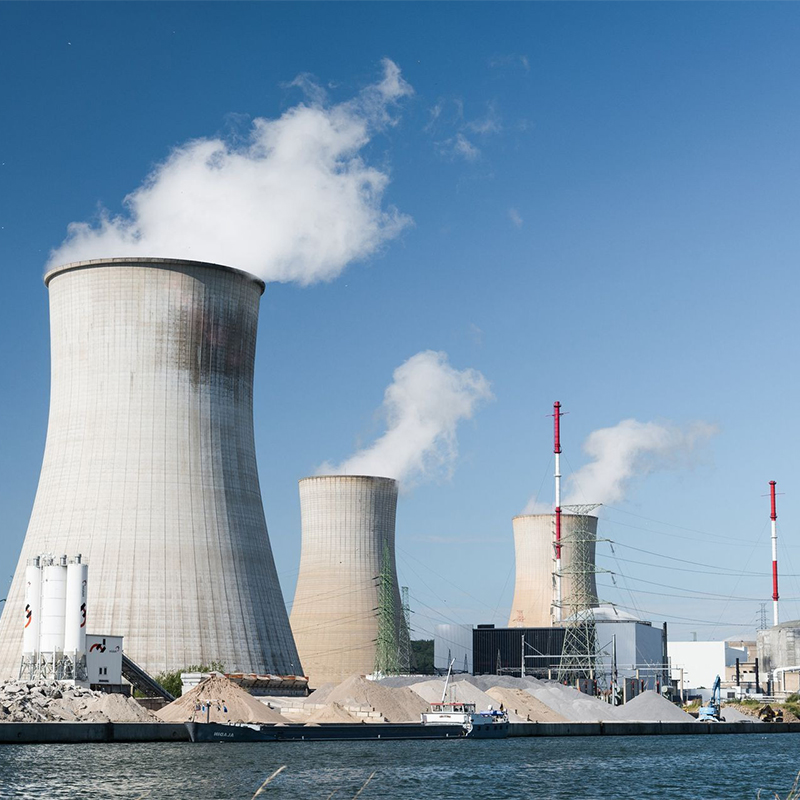
We Provide Cooling Tower Solution

Views: 0 Author: Site Editor Publish Time: 2025-12-19 Origin: Site


Calculating the cooling tower capacity is essential for engineers and plant managers who want to design, select, or optimize cooling tower systems for industrial and HVAC applications. A correctly sized cooling tower ensures efficient heat rejection, stable operation, and reduced energy and water costs.
In this guide, we will walk through the principles, key formulas, real-world examples, and considerations when calculating cooling tower capacity, and how manufacturers like MACH Cooling (https://www.machcooling.com/) help provide optimized solutions.

Cooling tower capacity refers to the ability of a cooling tower to remove heat from a circulating water system — typically expressed in tons of refrigeration (TR) or heat load in kilowatts (kW).
In simple terms, it answers the question:
How much heat can this cooling tower reject within a given operating condition?
Capacity is influenced by water flow rate, entering and leaving water temperatures, and ambient conditions.
Before diving into formulas, it’s important to understand some key terms used in capacity calculations:
The hot water temperature is the temperature of the water returning from the process or condenser to the cooling tower.
The temperature of water leaving the cooling tower — ideally as cool as possible for efficient operation.
Range = HWT − CWT
Approach = CWT − Ambient Wet Bulb Temperature
These values help determine the thermal performance of a cooling tower.
The lowest temperature that can be achieved by evaporative cooling — a key environmental parameter that significantly affects capacity.
The cooling tower capacity is commonly calculated using the following formula:

Where:
Q = Heat rejected by the cooling tower (BTU/hr)
500 = A constant that includes the weight of water and conversion factors
GPM = Water flow rate in gallons per minute
ΔT = Temperature drop (Range = HWT − CWT)
Alternatively, in tons of refrigeration (TR):

| Unit | Equivalent |
|---|---|
| 1 TR | 12,000 BTU/hr |
| 1 kW | 3,412 BTU/hr |
Let’s walk through an example.
Suppose:
GPM = 600
HWT = 95°F
CWT = 80°F
ΔT = 95°F − 80°F = 15°F
Q = 500 × 600 × 15 = 4,500,000 BTU/hr

So, the cooling tower capacity needed is 375 TR under these conditions.
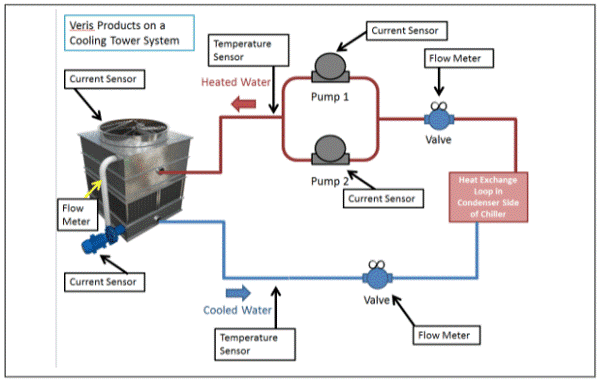
Ambient wet bulb temperature greatly affects tower performance. If the WBT is high, the cooling tower may struggle to achieve target cold water temperatures.
Example:
| WBT Condition | Effect on Capacity |
|---|---|
| Low WBT | Increased cooling capacity |
| High WBT | Reduced cooling capacity |
Airflow and internal fill media determine how effectively heat and mass transfer occur in the tower. Crossflow and counterflow designs have different performance characteristics.
Manufacturers like MACH Cooling provide performance curves and datasheets that correlate:
Water flow (GPM)
Hot and cold water temperatures
Wet bulb temperature
Required tower size and configuration
These performance curves help engineers match system requirements to the appropriate cooling tower model and ensure accurate capacity calculations.
| Parameter | Value |
|---|---|
| Design GPM | 800 |
| HWT | 100°F |
| CWT | 85°F |
| WBT | 75°F |
| Calculated TR | 416 TR |
Using the manufacturer’s data ensures that real-world thermal and airflow effects are accounted for.
Different mechanical designs — whether round or square — impact airflow and distribution patterns.
Round cooling towers often provide uniform airflow distribution and are compact.
Square cooling towers may suit larger installations or modular systems.
Crossflow Cooling Tower — Air enters horizontally, water descends vertically.
Counterflow Cooling Tower — Air flows vertically upward against downward water flow.
Each design has pros and cons depending on space, maintenance requirements, and performance objectives.
Cooling towers also consume water — and this affects capacity planning:
Cooling tower makeup water is required to replace evaporation, drift, and blowdown.
Cooling tower water basin must be sized to handle variable conditions.
Efficient water distribution system and nozzles improve heat transfer and maintain performance.
Reduction in water usage through good design also improves overall system capacity.

MACH Cooling (https://www.machcooling.com/) supports engineers by providing:
Detailed performance curves
Customized capacity calculations
Expert design support for industrial and commercial cooling applications
Their solutions match real site conditions — water flow, temperature ranges, and regional climate — ensuring systems are neither under- nor over-sized.
| Service | Benefit |
|---|---|
| Performance modeling | Accurate capacity sizing |
| Site-based recommendations | Optimal design and energy savings |
| Custom solutions | Tailored for process or HVAC needs |
Calculating cooling tower capacity is a critical step in system design and optimization. By understanding key parameters — such as water flow rate, temperature range, and environmental wet bulb conditions — you can determine the correct tower size and performance level needed.
Using trusted manufacturer data from companies such as MACH Cooling ensures your calculation reflects real-world conditions, leading to better efficiency, lower operating costs, and reliable sustained performance.
Accurate capacity calculation, combined with optimized design and manufacturer support, yields a cooling tower system that meets performance demands and provides long-term operational success.