English


Views: 0 Author: Site Editor Publish Time: 2026-02-09 Origin: Site


Cooling tower water conservation is no longer just an environmental talking point—it has become a hard business requirement. As water prices continue to rise and regulations become stricter, cooling towers are under growing scrutiny for their high water consumption. The challenge for facility owners and operators is clear: how do you reduce water use without sacrificing cooling performance or reliability?
The good news is that modern cooling tower water conservation strategies make it possible to cut water and operating costs at the same time. With the right combination of design, control, and management, water efficiency and system performance can go hand in hand.
Cooling towers play a critical role in industrial processes, HVAC systems, data centers, and power plants. They remove heat efficiently, but they do so by consuming large volumes of water. Without a focused conservation strategy, even a well-designed cooling tower can become a silent cost driver.
Cooling tower water conservation is about maximizing the value of every gallon of water. Instead of simply reducing flow rates and risking performance issues, conservation focuses on smarter reuse, better control, and optimized system operation. Think of it like improving fuel efficiency rather than driving less—you still get where you need to go, just with fewer resources.
Understanding where water goes is the first step toward saving it.
Evaporation is the core mechanism that allows cooling towers to reject heat. As hot water flows through the tower, a portion evaporates, carrying heat away. This evaporated water is permanently lost and must be replaced with makeup water. The higher the heat load, the higher the evaporation rate—and the greater the water demand.
As water evaporates, dissolved minerals remain behind and become more concentrated. To prevent scaling and fouling, some water must be discharged as blowdown. If blowdown is not carefully controlled, it can waste enormous amounts of water.
Drift losses occur when small water droplets are carried out of the tower with the exhaust air. While modern drift eliminators reduce this significantly, poor design or maintenance can still lead to measurable losses.
Water costs are often underestimated. Facilities pay not only for incoming water but also for sewer or discharge fees. Inefficient cooling towers increase both costs simultaneously, creating a double financial burden.
Poor water quality leads to scale formation, corrosion, and biological growth. These issues reduce heat transfer efficiency, increase energy consumption, and accelerate equipment wear. Over time, the result is unplanned downtime, costly repairs, and shortened equipment life—all indirect consequences of wasted water.

Effective water conservation starts with a few fundamental principles.
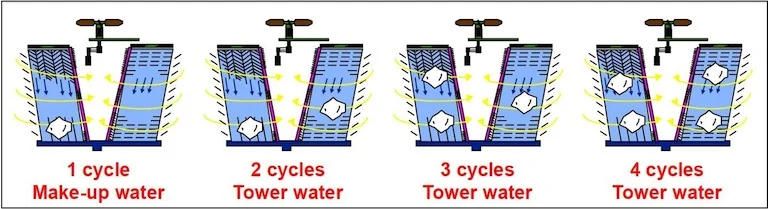
Cycles of concentration measure how many times water is reused before it is discharged. Higher cycles mean less blowdown and lower makeup water demand. Increasing cycles of concentration is one of the most powerful ways to reduce water consumption—provided water chemistry is properly managed.
Conservation does not mean ignoring water quality. On the contrary, maintaining the right balance of chemistry is what allows higher cycles, lower blowdown, and long-term system stability. It’s a careful balancing act, much like tuning an engine for both power and efficiency.
Manual or float-based makeup water systems are prone to overfilling and inefficiency. Modern automated controls adjust makeup water precisely based on real-time system conditions, eliminating unnecessary water use.
Conductivity-based controllers monitor dissolved solids in the circulating water and trigger makeup or blowdown only when needed. This approach ensures consistent water quality while minimizing waste.
Automated blowdown systems replace fixed schedules with demand-based discharge. Instead of draining water at set intervals, the system responds dynamically to water quality, reducing blowdown volume without increasing risk.
In many facilities, blowdown water can be reused for non-critical applications such as landscape irrigation, equipment washing, or auxiliary industrial processes. Reuse turns a waste stream into a secondary resource.
Side stream filtration continuously removes suspended solids from a portion of the circulating water. Cleaner water allows higher cycles of concentration, reduces chemical demand, and minimizes blowdown. Over time, this translates directly into measurable water and cost savings.
A well-designed chemical treatment program is essential for water conservation. By preventing scale, corrosion, and biological growth, chemical treatment maintains heat transfer efficiency and allows the system to operate safely at higher cycles. Cleaner systems need less water, fewer shutdowns, and less maintenance.
Digital monitoring systems provide real-time visibility into water usage, chemistry, and performance. Operators can detect leaks, over-blowdown, or abnormal consumption immediately. It’s like having a health monitor for your cooling tower—small problems are identified before they become expensive failures.
Cooling tower water conservation is especially critical in water-intensive industries such as power generation, chemical processing, manufacturing, data centers, and large commercial buildings. In regions facing water scarcity, efficient cooling towers are no longer optional—they are essential for business continuity.
Reducing water consumption lowers environmental impact and helps facilities meet local and international water-use regulations. Water-efficient cooling towers also support broader sustainability and ESG initiatives, improving corporate reputation while reducing operational risk.
Cooling tower water conservation starts at the design stage. Experienced manufacturers integrate water-saving features such as optimized water distribution, efficient drift eliminators, and compatibility with advanced control systems.
Manufacturers like MACH Cooling focus on delivering cooling tower solutions that balance performance, durability, and water efficiency. By combining smart engineering with long-term technical support, they help facilities achieve sustainable water savings throughout the equipment lifecycle.
Learn more at https://www.machcooling.com/.
When selecting a cooling tower supplier, look beyond initial cost. A reliable partner should offer:
Proven water-efficient designs
Advanced monitoring and control options
Industry-specific experience
Long-term service and optimization support
The right partner helps you save water not just today, but year after year.
Cooling tower water conservation is one of the most effective ways to reduce operating costs while improving system reliability. By optimizing makeup water, minimizing blowdown, improving filtration, and working with experienced manufacturers, facilities can significantly cut water use without compromising performance.
In an era of rising costs and increasing environmental pressure, conserving water isn’t just responsible—it’s smart business.